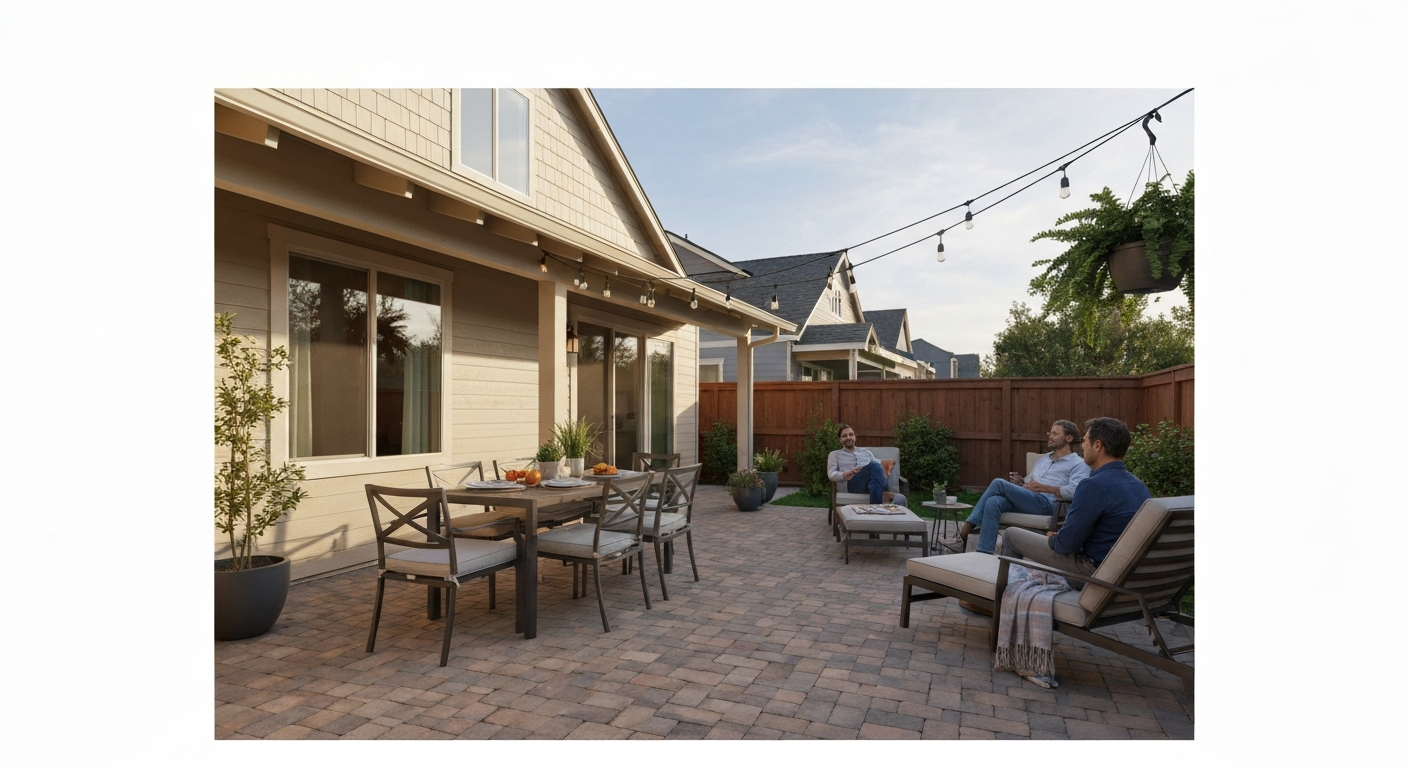
A patio is a ground-level paved outdoor area adjoining your home, open to the sky, with no roof attached. Merriam-Webster defines a patio as “a recreation area that adjoins a dwelling, is often paved, and is adapted especially to outdoor dining.”. A verandah (also spelled veranda) is a roofed, open-sided gallery attached to the exterior of the building, almost always with a railing. The roof is the single clearest difference: if the space has one built into or extending from the house's structure, you're looking at a verandah, not a patio.
Patio vs Verandah: Key Differences and How to Tell

Ada Hollis
3 May 2026
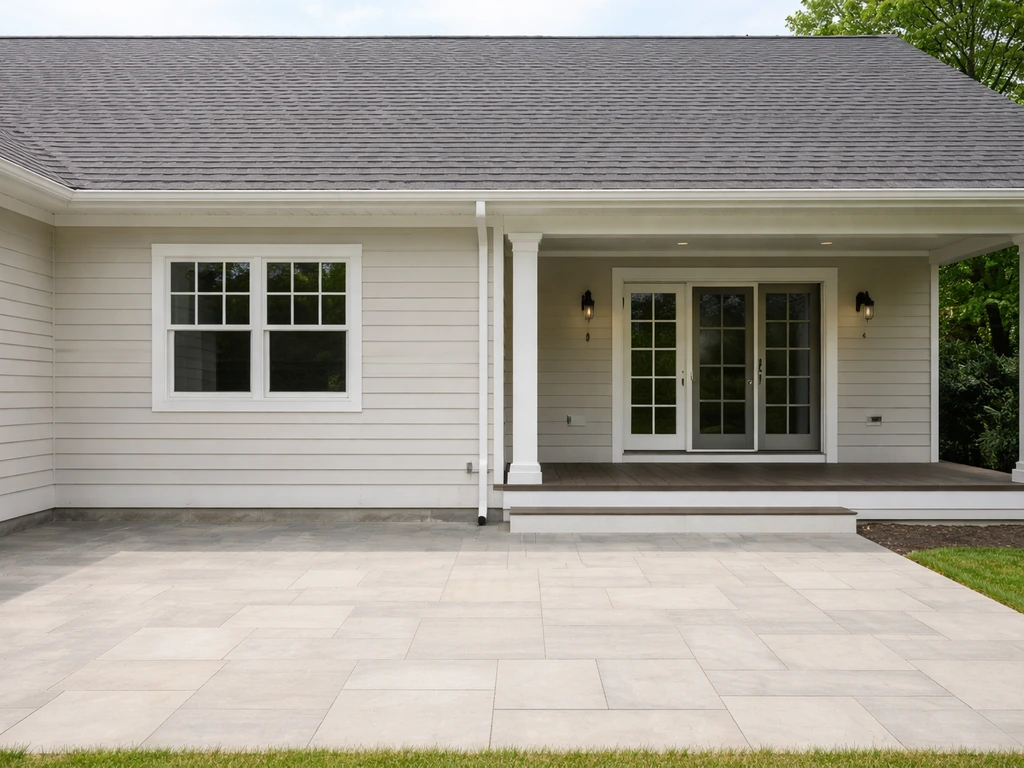
Quick definitions: patio, verandah, and veranda
Merriam-Webster defines a patio as "a recreation area that adjoins a dwelling, is often paved, and is adapted especially to outdoor dining." That captures the essence well. It sits at grade (meaning flush with the ground), it's typically concrete, pavers, stone, or brick, and it has no overhead structure of its own. You put furniture on it, eat outside, and the sky is above you.
A verandah, by contrast, is defined by Merriam-Webster as "a usually roofed open gallery or portico attached to the exterior of a building." Britannica adds that it's "open-walled" and "usually surrounded by a railing," and often extends along more than one outside wall of the building. Think of the long, shaded wrap-around porches you see on older colonial or Victorian homes, or on farmhouses in Australia and the American South. That's a verandah.
Veranda and verandah mean exactly the same thing. They're the same structure with two different spellings (more on that below). So if a listing says "veranda" or "verandah," you can treat them identically when picturing the space.
How to tell which one you're actually looking at
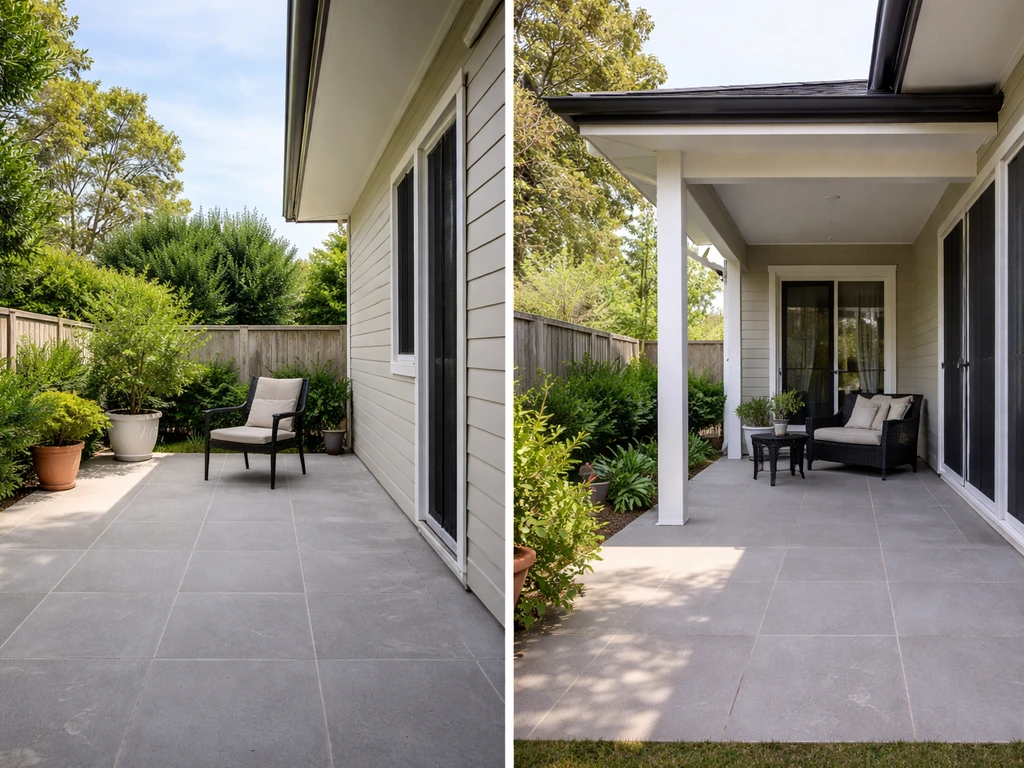
When you're walking through a property or reading a listing description, here are the concrete cues that separate a patio from a verandah.
| Feature | Patio | Verandah / Veranda |
|---|---|---|
| Roof / cover | None (open to sky) | Yes, roofed (part of or attached to the building) |
| Level | At grade (ground level) | Often slightly raised or at entry level, with steps |
| Attachment | Adjoins the house but structurally independent | Directly attached to the building exterior |
| Railing | Rarely | Usually present |
| Flooring | Pavers, concrete, stone, brick | Timber decking, tile, or concrete under a roof |
| Location on property | Commonly back or side yard | Commonly front, side, or wrapping around multiple walls |
| Enclosure | Fully open on all sides | Open-sided but sheltered by the overhead roof |
| Typical use | Outdoor dining, lounging | Shaded sitting area, outdoor living with weather protection |
The simplest practical test: stand in the space and look up. If there's a roof over your head that's part of the house, you're in a verandah. If you're looking at open sky, you're on a patio. Then look down: if you're on paved ground at yard level with no railing, that confirms patio. If there's a railing around you and you had to step up to get there, that's more consistent with a verandah.
Where a porch fits into all this
The porch question comes up constantly when people try to label these spaces, and it makes sense because porches and verandahs look similar. Merriam-Webster defines a porch as "a covered area adjoining an entrance to a building and usually having a separate roof." The key phrase there is "adjoining an entrance." A porch is functionally tied to a doorway, usually the front door. If you're also comparing a patio to a porch, the key is that a porch is entrance-focused and tied to a doorway patio vs. It's an entry shelter, not an outdoor living gallery.
A verandah is broader. It extends along one or more exterior walls and serves as an outdoor living space in its own right, not just a covered landing before a door. Per Britannica, a veranda can run along multiple outside walls of the building. Per MLS glossary standards used by realtors, a porch is specifically defined as "a covered area attached to the front, back, or side of a house, usually at the main entrance." That entrance association is what separates it from a verandah in listing language.
Put simply: if it's covered and at the front door, it's a porch. If it's covered and extends along the side of the house or wraps around corners as an outdoor living gallery, it's a verandah. If it's uncovered, paved, and sitting at ground level in the back or side yard, it's a patio.
Structure and layout: covered vs open, attached vs standalone
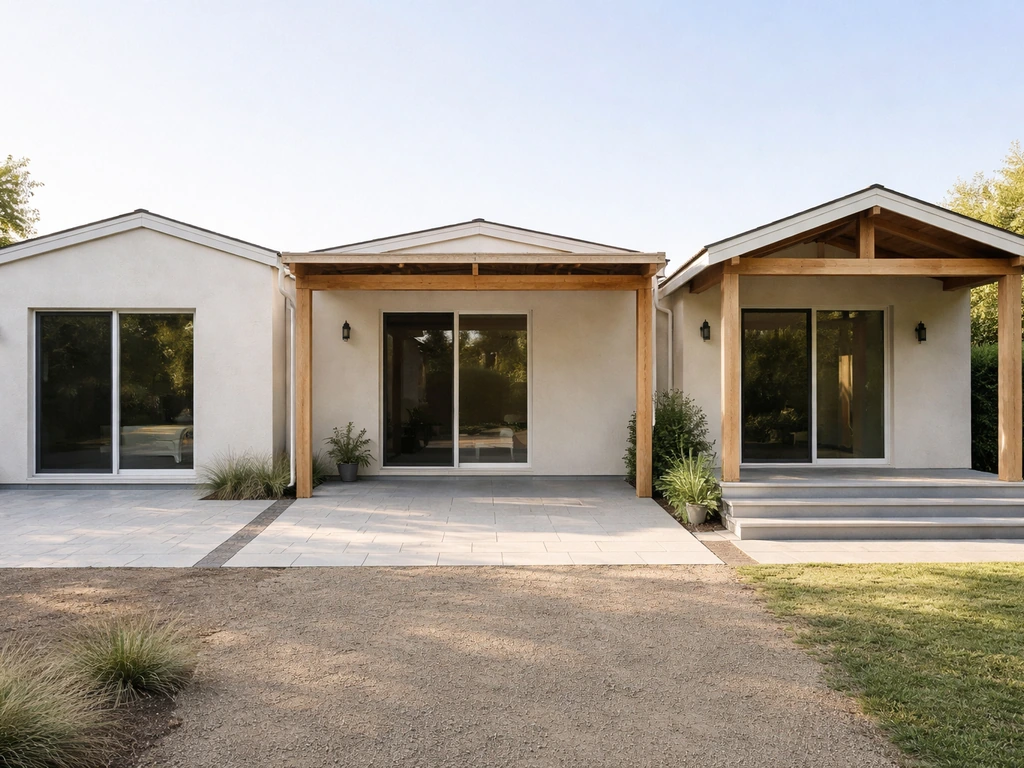
These three spaces (patio, verandah, porch) sit along a spectrum from completely open and ground-level to fully roofed and architecturally integrated. Understanding where each sits helps when you're planning a space or trying to describe one accurately.
A patio is standalone in the sense that it doesn't require the house's roof structure to exist. You can pour a concrete slab or lay pavers anywhere adjacent to the house and call it a patio. Many homeowners later add a pergola or a patio cover above it, which is sometimes called a "covered patio" in contractor and listing language. Importantly, that covered patio is still not a verandah unless the roof is genuinely integrated into the building's architecture. A freestanding pergola above a paver patio is a covered patio, not a verandah.
A verandah, by contrast, is architecturally attached. Its roof is either an extension of the main roof or a lower secondary roof built as part of the structure. Edmonton's residential methodology describes an open veranda as "an unheated, open-air" space with a railing, protected by a roof, extending along an exterior wall. That's the key: it extends along the wall rather than sitting away from it. You don't add a verandah after the fact the way you lay a patio. It's built into the building's design.
A porch sits somewhere in between. It's attached and roofed like a verandah, but it's more compact and entrance-focused. It typically has its own separate smaller roof rather than a sweeping gallery roof. If a covered outdoor structure at the front door is small enough to just shelter the entryway, it's a porch. If it's wide enough to put chairs and a table and runs along a whole wall, it edges into verandah territory.
Veranda vs verandah: does the spelling actually matter?
No, it doesn't, in terms of what the space actually is. Both spellings refer to exactly the same structure. The difference is purely regional. "Veranda" (no h) is the standard spelling in American English and most of the world. "Verandah" (with an h) is the conventional spelling in Australian and New Zealand English, per Wiktionary, Wikipedia, and Britannica's dictionary entries. If you're reading a property listing in Sydney or Melbourne, you'll often see "verandah." If you're in the US or UK, you'll likely see "veranda."
The word itself came into English from Hindi (varandā), which in turn has roots in Portuguese and Spanish. That's why British colonial architecture, Australian homesteads, and American Southern plantation homes all share the verandah as a design feature. The concept traveled with colonialism and adapted into local building traditions, which is also why the spelling diverged across regions.
For practical purposes: if you're searching for properties in Australia or New Zealand and the listing says "verandah," picture a roofed outdoor gallery attached to the house. If an American listing says "veranda," picture the same thing. Don't let the spelling variation trip you up.
Getting the terms right in real estate listings and home descriptions

If you're listing a home or describing a space to a buyer or tenant, using the right term matters because it shapes expectations before anyone walks in the door. MLS systems formalize these definitions precisely so that listing categories stay consistent.
- Call it a patio if: it's a paved, ground-level outdoor area with no permanent roof structure, adjacent to the house. It can be in the back, side, or front yard. Concrete slabs, pavers, stone, and tile all read as patio.
- Call it a verandah (or veranda) if: it's a roofed, open-sided gallery running along one or more exterior walls of the building, with a railing. It's architecturally attached, not a freestanding structure.
- Call it a porch if: it's covered and sits at or near the main entrance to the home, usually smaller and more entrance-focused than a verandah. Per MLS convention, the porch is tied to the main entry.
- Say "covered patio" if: you've added a pergola, awning, or patio cover to a ground-level paved space, but it's not integrated into the house's roofline. This is a common and accepted listing term.
- Avoid mixing these up in listings: describing a ground-level paver slab as a verandah will confuse buyers who expect a roofed gallery. Calling a wrap-around covered gallery a porch undersells the space.
When you're reading a listing, apply the same logic in reverse. A property described as having a "rear patio" likely has an uncovered paved area out back. A listing saying "wrap-around veranda" signals a substantial roofed outdoor living space running along multiple walls. "Front porch" means a covered entry landing. If a listing description seems to mix these terms inconsistently, look at the photos first and apply the recognition cues: roof or no roof, at grade or raised, attached or standalone.
Naming your space and deciding what to build or change
If you're trying to name an existing space, go back to the three-question test: Is there a roof? Is it attached to the building's structure? Is it at grade or raised with a railing? Most outdoor spaces answer those questions pretty clearly. The edge cases are usually "covered patios" where someone has added a pergola or a corrugated metal cover to a ground-level slab. That's still a covered patio in most practical and listing contexts, not a verandah, because it's not architecturally integrated.
If you're deciding what to build from scratch, here's how to think about it. A patio is the most accessible and affordable starting point: lay pavers or pour a slab adjacent to the house, add furniture, done. You can always add a cover later. A verandah requires planning from the architectural stage because it needs to tie into the building's roofline. It's more expensive but offers genuine weather protection and adds significant character to a home, especially in regions with hot sun or heavy rainfall. A porch is the right choice if you mainly want a covered front entry that creates a welcoming arrival experience without committing to a full gallery structure.
One thing worth knowing if you're comparing outdoor spaces more broadly: the line between a patio and a backyard, or between a patio and a courtyard, also comes up frequently for homeowners and renters trying to label what they have. A patio vs courtyard comparison comes up often because both are outdoor living spaces, but courtyards are typically enclosed or semi-enclosed. A patio is specifically the paved, adjoin-the-house portion, while a backyard is the whole outdoor area behind the home. If you're also wondering where a patio fits into a larger outdoor layout, compare patio vs backyard to clarify how much of the yard you're really talking about. A courtyard is typically an enclosed or semi-enclosed outdoor space, often surrounded on multiple sides by walls or the structure itself. Keeping those distinctions in mind will help you use all these terms accurately, whether you're searching property listings or writing your own.
The bottom line: patio, verandah, and porch are not interchangeable. If you're also trying to understand the difference between a patio and a yard, focus on what defines the paved area versus the surrounding open space patio vs yard. Each has a distinct physical profile. Once you know the three cues (roof, attachment, level), you'll be able to identify and name any of these spaces correctly within about thirty seconds of walking into one.
FAQ
Can a patio have an awning or retractable canopy and still be a patio?
Yes. If the ground-level paved area is still your own slab or paving, and the cover is temporary or freestanding (like a retractable awning or detachable shade), most listing language will still call it a covered patio. It becomes more “verandah-like” only when the roof is a permanent, building-integrated extension tied into the structure’s roofline.
What if the space is roofed but the roof is not part of the house structure?
If the roof is supported by posts or an independent frame, and the house roofline does not extend to create it, it is generally classified as a covered patio rather than a verandah. The key decision point is whether the cover is architecturally integrated with the building’s exterior, not just whether there is overhead shade.
How do I tell if a “raised” patio is actually a verandah?
A raised, paved terrace can still be a patio if it is standalone or only lightly attached, without a gallery roof integrated into the house. Railings alone do not define a verandah. Use the roof and attachment test together: an integrated roof along an exterior wall points to a verandah, while a raised paved platform with its own perimeter railing usually points to a patio or terrace.
In real estate listings, what should I do when the text conflicts with the photos?
Prioritize photos for the three cues: roof, attachment, and level/entry. If the listing says “veranda” but the photos show an uncovered paved yard edge or a post-supported cover, update your interpretation to match the visible structure. When in doubt, search for the exact features in the photo captions (roofed/unroofed, railing, stairs) rather than relying on the label.
Does a “wrap-around porch” always mean verandah, or can it be a porch?
Wrap-around porches can still be porches, but the deciding factor is size and how far it runs along exterior walls. If it is a broader roofed open gallery that extends along multiple outside walls, that usually crosses into verandah territory in listing expectations. If it is compact and mainly shelters an entrance doorway area, it is more likely a porch.
What’s the quickest way to distinguish a porch from a verandah when both are roofed and attached?
Check how the roof behaves. Porches typically have a smaller, entry-focused roof and align closely with a door (often one primary entry). Verandahs more commonly form a longer, exterior-wall gallery that can accommodate seating along the side or multiple sides. The “how many walls and how large” clue helps fast.
If my backyard patio is paved and partially covered by a pergola, is it still a patio?
In most practical and listing contexts, yes. A pergola that shades a ground-level paved area is still usually treated as a covered patio, especially if it sits over your patio slab and does not replace or extend the building’s roof structure. A verandah is built as part of the building’s architectural envelope, not just added shade over paving.
Can a patio be at the front of the house and still be called a patio?
Yes. “Front patio” is a common label, and it does not automatically mean porch. Use the roof test: an uncovered paved area at grade is a patio, while a roofed entry shelter attached to a doorway is a porch. Attachment matters too, because a roofed gallery integrated with the building can indicate a verandah.
Do patio and courtyard mean the same thing?
Not usually. A courtyard is typically enclosed or semi-enclosed, with walls or building surfaces shaping the sides, so it feels like an internal outdoor room. A patio is specifically the paved, house-adjacent portion, even though it can be within a larger yard area. If it is mostly open with one-sided adjacency to the home, it is more likely a patio than a courtyard.
When naming a new outdoor project, what decision should I make first: patio, porch, or verandah?
Start with the roof decision. If you want the simplest, lowest-commitment outdoor extension, choose a patio and consider adding a cover later. If you want consistent weather protection tied to the home’s design, plan for a verandah. If your priority is welcoming cover at an entry door, a porch is usually the best fit.
Next Article
Patio Weather Meaning: What Patio, Area & View Mean
Clear patio definition: what a patio is, 'patio weather' meaning, and how it differs from decks or porches.