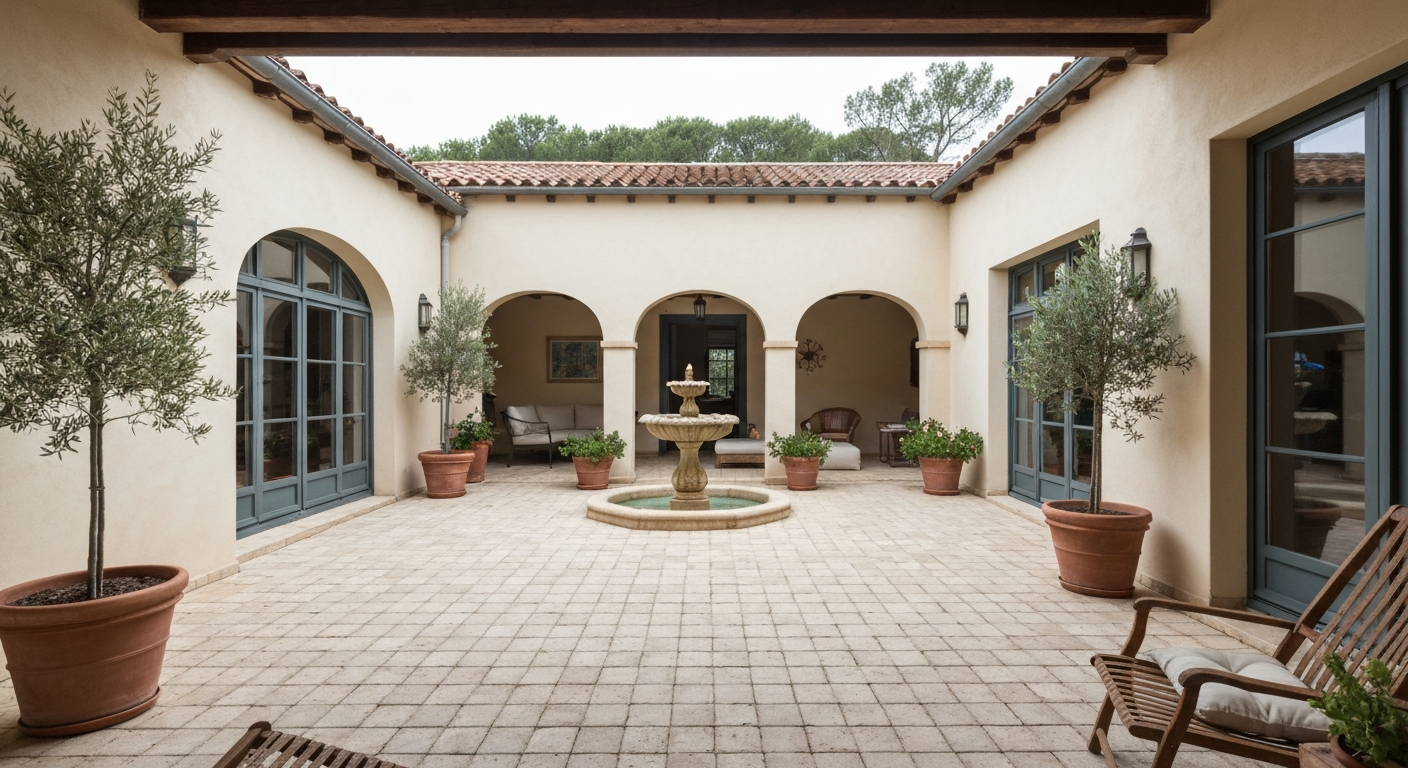
In Australia, a patio is a ground-level outdoor area, usually paved, attached to the back or side of a house and used for entertaining, dining, or relaxing outdoors. It can be open to the sky or covered by a roof, pergola, or shade structure. The word comes from Spanish, where 'patio' originally meant an inner courtyard, but in Australian everyday use and property listings it simply means a hard-surfaced outdoor living space that sits at or near ground level.
What Is a Patio in Australia: Definition, Types & Tips and Buyers' Guide

Ada Hollis
28 Jul 2026
What exactly counts as a patio in Australia?
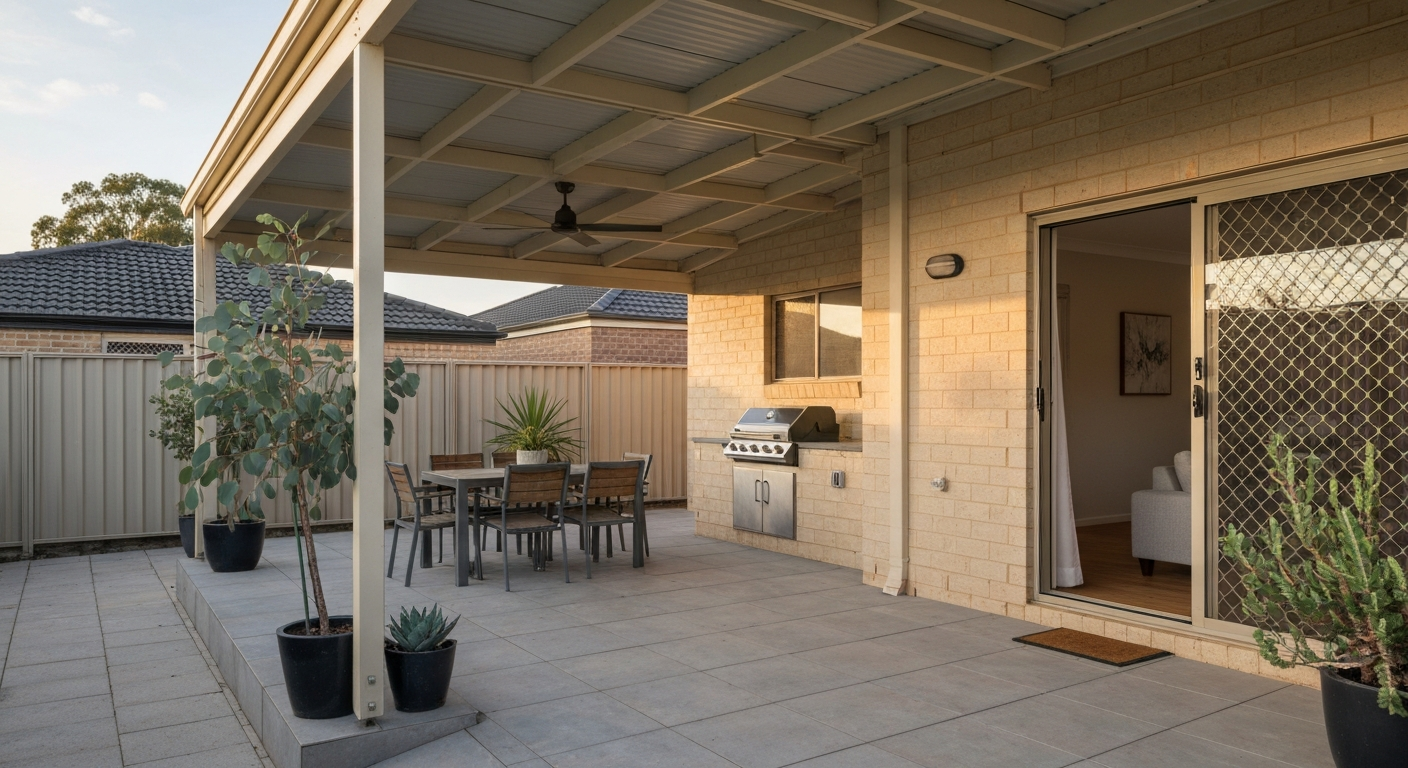
The clearest way to picture an Australian patio is this: step out of the back sliding door, put your feet on a paved or concreted surface, and you are standing on a patio. It is attached to the house (or sits directly alongside it), it is at ground level, and it is designed for people to use outdoors. Planning documents across New South Wales and Queensland group 'patio' with balcony, deck, pergola, terrace, and verandah when calculating approved floor area and applying complying-development rules, which tells you something important: regulators treat it as a recognised, defined structure, not just a slab of concrete.
Cambridge and Oxford dictionaries both define the word as 'an outdoor area, often paved, next to a house used for sitting or eating outdoors,' and that description matches how Australians use the term in daily conversation, property ads, and council applications. The Macquarie Dictionary is the official dictionary authority cited in Australian government and valuation documents, and its sense of 'patio' aligns with this same plain reading: a paved domestic outdoor area. No upper floors, no elevated timber frame, and no requirement for a roof, though a roof is common.
How Australians actually use their patios
Outdoor entertaining is central to Australian domestic life, and the patio is where most of it happens. The typical setup is a table and chairs for meals, a barbecue or built-in outdoor kitchen against one wall, and some form of shade overhead for the hotter months. In states like Queensland and Western Australia, the covered patio (sometimes labelled 'alfresco' in property listings) is almost a standard room: it is used for breakfast, afternoon drinks, and family dinners for a good eight or nine months of the year.
Australian home design media and platforms like Houzz show outdoor kitchens, lounge settings with weatherproof sofas, ceiling fans, outdoor heaters, and even wall-mounted screens becoming normal additions. The patio has moved well beyond a plain concrete pad. Property listings on realestate.com.au and Domain routinely feature 'alfresco patio' as a headline marketing point, sitting alongside pool and garage in the feature list, which reflects how buyers and renters weight it when comparing homes.
Common patio materials and styles across Australia
The surface material is one of the first choices a homeowner makes, and it affects both look and maintenance. Bunnings and Australian trade resources point to five dominant options: poured concrete, concrete pavers, natural stone (limestone, travertine, sandstone), ceramic or porcelain outdoor tiles, and brick. Each suits different budgets, climates, and aesthetics.
Surface materials at a glance
- Poured concrete: the most affordable and durable base; can be plain, exposed aggregate, or stencilled for a more decorative finish.
- Concrete pavers: easy to replace individual units if cracked; available in a wide range of sizes and colours to suit contemporary or traditional homes.
- Natural stone (travertine, limestone, sandstone): high-end look popular in coastal and prestige properties; requires sealing in wet climates.
- Ceramic and porcelain tiles: clean, modern finish; large-format outdoor tiles are very popular in new builds across Victoria and Queensland.
- Brick: warm, traditional look that suits period homes; common in older Melbourne and Adelaide properties.
- Timber decking: technically makes the structure a deck rather than a patio, but many Australians blend both surfaces in the same outdoor zone.
Cover and shade options
An uncovered patio is simply an open slab. Once you add a roof or cover, the space becomes significantly more usable and more valuable. Common cover styles in Australia include a flat or skillion Colorbond steel roof attached to the house fascia (the classic 'patio roof'), a freestanding or attached timber or aluminium pergola (open-beam structure with or without shade cloth or polycarbonate), a bioclimatic louvre pergola with adjustable blades, and shade sails for a lower-cost alternative. In warmer states, a solid roofed patio that integrates ceiling fans is considered the most functional setup.
Patio vs verandah, porch, deck, balcony, courtyard and terrace
These terms get swapped around constantly in Australian conversation and property ads, which creates real confusion for buyers and renters. Here is how they actually differ from a patio, in plain terms.
A verandah is a roofed, open-sided structure that runs along the outside of a house, often wrapping around more than one side. It is a defining feature of Queensland colonial architecture and Victorian terraces with their cast-iron lacework. Unlike a patio, a verandah almost always has a roof as part of its definition, and it is typically a transitional space (between indoors and garden) rather than a destination entertaining zone.
A porch is a small covered area at the entrance to a house, usually at the front. It is functional rather than social: somewhere to stand while unlocking the door or to shelter from a sudden shower. It is much smaller than a patio and serves a different purpose entirely.
A deck is a raised platform, almost always made from timber or composite decking boards, sitting on a frame of bearers and joists above ground level. The elevation is the key distinction from a patio. Some properties have both: a paved patio at ground level and a raised timber deck off an upper living area. NSW and Queensland planning rules specifically separate 'deck' from 'patio' in their complying-development provisions.
A balcony is attached to an upper floor of a building and is elevated well above ground. It is common in apartments and two-storey homes. A patio is ground level; a balcony is not. In strata properties, the distinction matters legally because the strata plan must be checked to confirm whether a balcony or patio is part of your lot or classified as common property.
A courtyard is an outdoor space that is substantially enclosed by walls or buildings on multiple sides. Think of a small private garden surrounded by walls in a terrace house or inner-city townhouse. A patio can sit inside a courtyard, but the courtyard itself is defined by its enclosure rather than its surface.
A terrace has two meanings in Australia, which adds to the confusion. It can mean a raised paved outdoor area (essentially a patio elevated slightly above the garden level), or it can refer to a terrace house (a style of row housing common in inner Sydney and Melbourne). In property listings, 'terrace' used as an outdoor feature typically signals something slightly more formal or elevated than a standard patio.
Side-by-side comparison: patio and its close relatives
| Feature | Typical roof/cover | Level | Attachment | Typical materials | Common listing label |
|---|---|---|---|---|---|
| Patio | Optional (open or roofed) | Ground level | Attached to house | Pavers, concrete, stone, tile | Patio, alfresco, alfresco patio |
| Verandah | Always roofed | Ground level | Attached, often wraparound | Timber boards, tile, concrete | Verandah, wrap-around verandah |
| Deck | Usually open | Raised above ground | Attached or freestanding | Timber, composite decking | Deck, timber deck, entertaining deck |
| Balcony | Often open or part-roofed | Upper floor level | Attached to upper storey | Concrete, tile, timber | Balcony, Juliet balcony |
| Porch | Always roofed | Ground (entry level) | Front of house entry | Tile, concrete, stone | Porch, front porch, entry porch |
| Courtyard | Open to sky (usually) | Ground level | Enclosed by walls/fences | Pavers, stone, grass, gravel | Courtyard, private courtyard |
| Terrace | Usually open | Slightly raised or ground | Attached or stepped | Stone, tile, concrete pavers | Terrace, entertaining terrace |
Spelling, plural and how Australians pronounce 'patio'
The word is spelled p-a-t-i-o, with no variant spellings in standard Australian English. The plural is patios (p-a-t-i-o-s), formed by simply adding an 's' with no apostrophe. If you're unsure of the spelling, see how do you spell patios for the correct form. This is a straightforward regular plural, consistent with other nouns ending in a vowel like radios and ratios.
For pronunciation, Australian speakers follow the general English pattern closely. The Cambridge Dictionary entry titled blank" rel="noopener noreferrer">PATIO | English meaning - Cambridge Dictionary provides the standard British and American pronunciations for 'patio'. The Cambridge Dictionary gives the British English phonetic transcription as /ˈpæt.i.əʊ/ and the American English form as /ˈpæt̬.i.oʊ/. Australian pronunciation sits close to the British form: PAT-ee-oh, with the first syllable stressed and a short 'a' as in 'cat. For a quick audio and phonetic guide, see how to pronounce patio in Australia. For audio and a quick guide on how to pronounce 'patio', see how to pronounce 'patio'. ' You will occasionally hear PAH-tee-oh with a longer open 'a', particularly from speakers who associate the word with its Spanish origin, but PAT-ee-oh is the dominant Australian form. A quick phonetic rhyme to anchor it: patio rhymes with ratio, which shares the same -atio ending and the same three-syllable stress pattern. For a short list of words that rhyme with 'patio', see what rhymes with patio.
The French connection: 'patio' in French and its pronunciation
In French, the word 'patio' is used directly as a borrowed term (a loanword), and it carries essentially the same meaning as in English: an outdoor courtyard or paved outdoor area adjacent to a house. French speakers typically pronounce it closer to its Spanish roots: pah-TSYO or pah-TYO, with the stress shifting slightly and the 't' having a softer, more blended sound than in English. The French word for a simple garden terrace or outdoor sitting area is more often 'terrasse', and 'cour' refers to a courtyard in a more architectural sense. So if you are reading a French property description and see 'patio', it signals an open inner courtyard or paved outdoor area in much the way an Australian listing would use it. For an audio and phonetic guide, see how to pronounce patio in French.
What 'patio' means in a property listing or valuation
When you see 'patio' in an Australian property ad, it is usually signalling usable outdoor living space, and that has real dollar value. For a concise explanation aimed at buyers and renters, see c'est what patio. Covered or roofed patios, in particular, add to the effective living area of a property because they extend the usable space well beyond what is captured in the internal floor plan. A well-built roofed alfresco patio can meaningfully improve a property's appeal and market price, particularly in Queensland, WA, and coastal NSW markets where outdoor living is a primary lifestyle driver.
From a planning and approvals perspective, state rules treat patios alongside other structures when applying complying-development thresholds. In NSW, for example, State Environmental Planning Policy instruments explicitly list 'balcony, deck, patio, pergola, terrace or verandah' together when setting area limits for exempt or complying development. Queensland's Development Code references patios in pool-barrier safety rules. The National Construction Code covers balconies, patios, and terraces as occupiable external areas for fire-resistance and external opening requirements. In short: a patio is not just a slab of concrete; it is a regulated structure, and any new build or significant modification may require council approval or at minimum a complying-development certificate.
For strata property buyers, the patio question becomes even more specific. In apartments and townhouses, the strata plan determines whether a ground-floor patio or courtyard is part of your lot (meaning you own and maintain it) or classified as common property (meaning the owners corporation is responsible). NSW Government strata guidance and Consumer Affairs Victoria both advise buyers to read the registered strata plan and by-laws before assuming that the patio outside the back door is exclusively theirs to modify or enclose.
Checklist for buyers and renters assessing a patio
- Is the patio covered or open? A roofed patio adds year-round usability and is generally more valued.
- What is the surface material and condition? Look for cracked pavers, uneven concrete, or water pooling near the house.
- Is the patio included in the listed floor area or measured separately as an outdoor area?
- For strata or townhouse properties: check the registered strata plan to confirm whether the patio is part of your lot or common property.
- Has any cover structure (patio roof, pergola) been approved by council? Ask the agent or vendor for the building approval or complying-development certificate.
- Does the patio have adequate drainage, especially if it is enclosed on multiple sides?
- Are there pool-barrier or safety requirements if the patio adjoins a swimming pool (relevant in Queensland and other states)?
Questions worth asking the seller, agent, or inspector
- Was a building permit or complying-development certificate obtained for the patio cover or roof structure?
- Is the patio listed as an included area on the contract, and how is it described on the title or strata plan?
- Has any work been done to the drainage or waterproofing where the patio meets the house wall?
- Are there any by-law restrictions on enclosing or modifying the patio (relevant to strata properties)?
- Is the patio wired for outdoor lighting, power points, or ceiling fans, and are those installations certified?
Understanding exactly what a patio is in the Australian context, how it is built, what it is called in a listing, and what rules apply gives you a genuine edge when buying, renting, or renovating. The term sounds simple, but the practical and legal details behind it are worth knowing before you sign anything.
FAQ
What is a patio in Australia — plain-language definition?
A patio in Australia is an outdoor paved or paved-style area next to a house used for sitting, dining or entertaining. It can be at ground level or slightly raised, may be open to the sky or covered by a roof, pergola or awning, and is primarily an outdoor living/entertaining space rather than an enclosed room.
How does a patio differ from a verandah?
Verandah: typically a roofed, narrow, often wraparound sheltered walkway attached to the house façade (historically important in Australian architecture). Patio: usually a paved outdoor living area focused on entertaining; may be roofed but is not the same continuous sheltered porch that a verandah is.
How is a patio different from a porch, deck, balcony, courtyard and terrace (short comparison table)?
Porch — small covered entrance area at a door, mainly transitional. Deck — raised timber platform, often above ground level and timber‑finish. Balcony — elevated platform projecting from an upper floor, open to the air. Courtyard — enclosed open space, typically surrounded by walls/buildings. Terrace — can mean a paved or raised outdoor area or the outdoor space of a terraced house; sometimes interchangeable with patio. Patio — ground‑level (or slightly raised) paved outdoor living/entertaining area, may be covered.
What materials and styles are common for patios in Australia?
Common surface materials: poured concrete, concrete pavers, natural stone flags (limestone, travertine), outdoor tiles, brick and, less commonly, compacted aggregate. Styles/wraps: uncovered paved patios, roofed "alfresco" patios, pergola-covered patios (including bioclimatic pergolas), tiled terraces and integrated outdoor kitchens. Timber decking is often used where a raised platform is preferred, but that is usually called a deck.
Does a patio have to be paved?
Not strictly, but in everyday Australian usage a patio implies a paved, hard-surfaced area. Areas with loose paving, compacted gravel or timber decking may be described differently (e.g., gravel courtyard or deck), although people sometimes call a hard-packed gravel or compacted-surface area a patio informally.
What does 'alfresco' mean when used with patio in listings?
"Alfresco patio" or "alfresco" is marketing shorthand in Australian listings to indicate an outdoor entertaining area intended for dining and social use; it often implies a roof or cover, built-in amenities or a finished surface suitable for furniture.
Next Article
Patio definition francais : c'est quoi un patio ? Guide
Patio – définition en français : sens, genre, prononciations, usages régionaux, types, matériaux et checklist pour achè