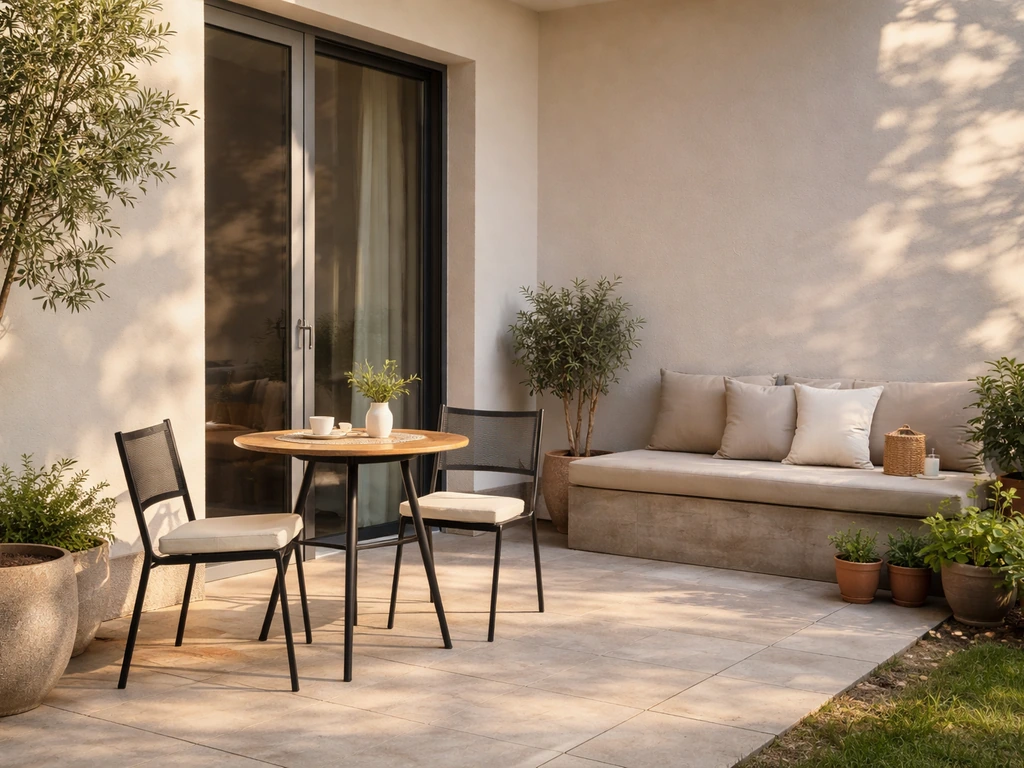
A wood patio is an outdoor living surface made from timber boards or planks, built at or near ground level alongside a home for sitting, dining, and recreation. In Hindi, 'patio' translates most naturally as आँगन (aangan), meaning an open courtyard or yard. A 'wood patio' specifically becomes लकड़ी का आँगन (lakḍī kā āṅgan) or लकड़ी का डेक (lakḍī kā ḍek) when the timber-platform sense is more relevant. If you came here looking for the right Hindi word to describe a wood patio on a property listing or just want to know what the term means, both of those phrases will serve you well.
Wood Patio Meaning in Hindi: Definition, Translations & Tips

Ada Hollis
12 Jul 2026
What this article covers and who it's for
This guide is written for homeowners, renters, and property shoppers who want a clear, no-jargon explanation of what a wood patio is, plus accurate translations of 'patio' and 'wood patio' into Hindi, Urdu, Punjabi, and Chinese. You'll also find pronunciation tips, a breakdown of common patio types, and a practical look at the pros and cons of choosing wood. Whether you're translating a real-estate listing, helping a family member understand a property feature, or deciding what material to build with, this article gives you the concrete answers you need.
What a patio actually is (plain-English version)
A patio is an outdoor area attached to or right beside a home, sitting at ground level, with a solid floor and no roof over it. You use it for relaxing, eating outside, or entertaining guests. It's paved or surfaced with a hard material, which is what makes it different from a plain lawn. The Cambridge English Dictionary defines it as 'an outdoor area with a solid floor next to a house, used for sitting,' and Merriam-Webster describes it as 'a paved outdoor area adjoining a residence used for dining or recreation.' That's the core idea: a hardscaped outdoor room without walls or a ceiling.
The word 'patio' comes from Spanish, where it originally meant an open inner court. That courtyard heritage is actually helpful when you're looking for Hindi equivalents, because आँगन (aangan) carries a very similar idea: an open, ground-level space attached to a home that the family uses for daily life. The English word entered common use in the US and UK to describe the paved outdoor seating area at the back or side of a house.
How a patio differs from a porch, deck, verandah, and terrace
These terms trip up a lot of people, and it matters when you're reading a property listing or describing a home. A porch is covered and usually at the front of the house, attached to the structure. A verandah is similar but typically wraps around the home and has a roof supported by posts. A balcony projects out from an upper floor. A terrace can be at ground or roof level and is often larger and more architectural. A deck or wood patio is specifically a raised or ground-level timber platform. The patio sits in the middle of all of these: ground-level, open to the sky, and paved or surfaced with a hard material.
| Space | Level | Has a Roof? | Material | Attached to House? |
|---|---|---|---|---|
| Patio | Ground | No | Paved/hard surface (concrete, stone, wood) | Usually, or very close to it |
| Deck / Wood Patio | Ground or raised | No | Timber or composite boards | Usually yes |
| Porch | Ground or raised | Yes | Wood, concrete | Yes, front/side |
| Verandah | Ground | Yes (roof/overhang) | Wood, tile | Yes, wraps around |
| Balcony | Upper floor | Sometimes | Concrete, metal, wood | Yes, projects out |
| Terrace | Ground or roof | No | Stone, tile, concrete | Varies |
Exact Hindi translations for 'patio' and 'wood patio'
Hindi does not have one single word borrowed directly from English for 'patio,' so bilingual dictionaries map it to the closest cultural equivalent. For a concise definition and common usage, see patio meaning in Hindi. Collins English Dictionary and Shabdkosh both list आँगन as the standard Hindi translation for 'patio. See Collins English Dictionary, 'patio' translations (lists Hindi 'आँगन') for the entry mapping 'patio' to आँगन (aangan) blank" rel="noopener noreferrer">Collins English Dictionary — 'patio' translations (lists Hindi 'आँगन'). ' Aangan refers to an open courtyard or yard space within or immediately beside a home, and the concept maps closely to what English speakers mean by a patio.
| English Term | Hindi (Devanagari) | Transliteration | Literal Meaning |
|---|---|---|---|
| Patio | आँगन | āṅgan / aangan | Courtyard, open yard next to home |
| Wood patio (general) | लकड़ी का आँगन | lakḍī kā āṅgan | Wooden courtyard / wooden yard |
| Wood patio (deck sense) | लकड़ी का डेक | lakḍī kā ḍek | Wooden deck / timber platform |
| Outdoor patio | बाहरी आँगन | bāharī āṅgan | Outer/exterior courtyard |
In everyday Hindi conversation and property listings in India, you will hear आँगन used for any open attached outdoor space. When the timber-deck construction is specifically what's being described (a raised or framed wooden platform), लकड़ी का डेक (lakḍī kā ḍek) is the more precise phrase and is increasingly understood in urban Indian real-estate contexts because 'deck' has been borrowed into Indian English. Use लकड़ी का आँगन if you're speaking to someone unfamiliar with modern deck terminology, and लकड़ी का डेक if you're writing a listing or speaking with an architect.
Short Hindi phrases for everyday use
- हमारे घर में एक लकड़ी का आँगन है। (hamāre ghar meṃ ek lakḍī kā āṅgan hai.) — Our house has a wood patio.
- यह आँगन लकड़ी से बना है। (yah āṅgan lakḍī se banā hai.) — This patio is made of wood.
- क्या इस घर में आँगन है? (kyā is ghar meṃ āṅgan hai?) — Does this house have a patio/courtyard?
- आँगन में बैठने की जगह है। (āṅgan meṃ baiṭhne kī jagah hai.) — There is a sitting area in the patio.
Translations in Urdu, Punjabi, and Chinese
Because this site also covers related languages, here are accurate translations for 'patio' and 'wood patio' across Urdu, Punjabi, and Chinese. Each language handles the concept slightly differently, so the notes below give you the nuance you actually need.
| Language | Word for 'Patio' | Script | Transliteration | 'Wood Patio' | Notes |
|---|---|---|---|---|---|
| Urdu | آنگن / صحن | Nastaliq | aangan / sahn | لکڑی کا آنگن (lakṛī kā āṅgan) | Aangan is shared with Hindi; sahn leans toward a formal courtyard |
| Punjabi | ਵਿਹੜਾ | Gurmukhi | vihaṛā | ਲੱਕੜ ਦਾ ਵਿਹੜਾ (lakkaṛ dā vihaṛā) | Vihaṛā means yard/open space beside the home |
| Chinese (Simplified) | 露台 / 庭院 | Simplified Han | lù tái / tíng yuàn | 木制露台 (mùzhì lù tái) | Lù tái = open terrace/deck; tíng yuàn = courtyard; mùzhì = wooden/timber |
In Urdu, the word آنگن (aangan) is shared with Hindi and is the most natural choice for a patio in a home context. صحن (sahn) is also used, but it tends to suggest a more formal or larger courtyard. For the wood-patio sense, لکڑی کا آنگن works well in conversation. For a brief glossary entry on house patio meaning in Urdu, see the linked explanation for the precise Urdu terms and usage. In Punjabi, ਵਿਹੜਾ (vihaṛā) is the standard term for the open space beside a house, and ਲੱਕੜ ਦਾ ਵਿਹੜਾ adds the wood specification clearly. For patio meaning in Punjabi, see the concise Punjabi translation and pronunciation notes that explain ਵਿਹੜਾ (vihaṛā) and ਲੱਕੜ ਦਾ ਵਿਹੜਾ in everyday usage. In Chinese, 露台 (lù tái) is most commonly used in modern property listings to describe an open outdoor platform or terrace, and 木制露台 (mùzhì lù tái) is the precise phrase for a wood patio or timber deck.
Short phrases in Urdu, Punjabi, and Chinese
- Urdu: ہمارے گھر میں لکڑی کا آنگن ہے۔ (hamāre ghar meṃ lakṛī kā āṅgan hai.) — Our house has a wood patio.
- Punjabi (Gurmukhi): ਸਾਡੇ ਘਰ ਵਿੱਚ ਲੱਕੜ ਦਾ ਵਿਹੜਾ ਹੈ। (sāḍe ghar vicc lakkaṛ dā vihaṛā hai.) — Our house has a wood patio.
- Chinese: 我们家有一个木制露台。(Wǒmen jiā yǒu yīgè mùzhì lùtái.) — Our home has a wood patio/deck.
How to pronounce each translation
Pronunciation is one of the biggest hurdles when using translated terms in conversation or when reading a listing aloud. Here are practical tips for each language, written for non-native speakers.
| Language | Word / Phrase | Pronunciation Guide | Key Sound Tips |
|---|---|---|---|
| Hindi | आँगन (āṅgan) | AHN-gun | The 'aa' is a long open vowel like in 'car'; the nasal anusvara (ँ) gives a soft nasal 'n' before 'g'; the final 'an' is short and unstressed |
| Hindi | लकड़ी का डेक (lakḍī kā ḍek) | luk-DEE kaa DAYK | 'Lakḍī' has a retroflex 'ḍ' (tongue curls back); 'kā' rhymes with 'car'; 'ḍek' sounds close to the English 'deck' |
| Urdu | آنگن (aangan) | AHN-gun | Near-identical to Hindi pronunciation; slight regional variation in vowel length in Pakistani Urdu |
| Punjabi | ਵਿਹੜਾ (vihaṛā) | vih-RAH | The retroflex 'ṛ' is a flap sound; 'vi' is short like 'vih'; stress on the second syllable |
| Chinese | 木制露台 (mùzhì lù tái) | moo-JR loo-TYE | 'Mù' is falling tone (4th); 'zhì' is also 4th tone; 'lù' is 4th tone; 'tái' is rising (2nd tone); the 'zh' is like 'j' in 'judge' |
For the English word 'patio' itself, US English uses /ˈpæt.i.oʊ/ (PAT-ee-oh) and UK English uses /ˈpæt.i.əʊ/. The 'a' in 'pat' is short and clipped, not the long 'ah' sound. Many Hindi and Urdu speakers will also recognize 'patio' itself in conversation because it appears directly in urban Indian English property listings.
Common patio types and how wood fits in
Patios come in several surface materials, and each has a different feel underfoot, a different cost, and a different maintenance profile. Here is a quick rundown of the main types homeowners encounter.
- Concrete patio: the most common and affordable type; poured as a slab and can be left plain, stamped, or painted; durable but can crack over time in freeze-thaw climates
- Paver patio: individual bricks, concrete pavers, or cobblestones laid on a compacted base; easier to repair (replace individual pavers) but more labor-intensive to install
- Natural stone patio: flagstone, slate, travertine, or bluestone; beautiful but expensive and requires leveling; very durable when installed correctly
- Tile patio: ceramic or porcelain tiles laid on a concrete base; popular in warm climates and Mediterranean-style homes; can become slippery when wet
- Gravel or decomposed granite patio: loose material over a weed barrier; low cost and good drainage but shifts underfoot and requires periodic topping-up
- Wood patio (deck): timber or composite boards on a framed structure; warm and natural feel; popular in North America, Australia, and increasingly in urban India
Wood patios (often called wood decks) stand out because they are the only common type that uses a framed structural system rather than a flat slab or laid units. That framing means they can span uneven ground, step up or down across a slope, and be built partially elevated above grade. They also offer the warmest underfoot feel of any patio surface, which is a genuine comfort advantage in bare feet.
What exactly is a wood patio: materials, construction, and features
A wood patio, in the most common construction sense, is a timber-framed platform with decking boards laid across it. The frame consists of posts set into or resting on concrete footings, beams spanning between posts, and joists running perpendicular to the decking direction. Decking boards are then fastened on top, typically with a small gap between them for water drainage and airflow. The whole assembly sits at or slightly above ground level and is usually attached to the house at a ledger board.
The most commonly used wood species for patios and decks include pressure-treated pine (the most affordable and widely available), western red cedar (naturally rot-resistant with a warm reddish colour), redwood (similar to cedar, grown mainly in California), and tropical hardwoods like ipe and cumaru (extremely dense and durable, but more expensive and heavier to work with). Composite decking, which blends wood fibre and polymer, is also often grouped with wood patios in the trade because it looks like timber but requires less maintenance.
In terms of features, a wood patio can include built-in benches along the perimeter, planters, pergolas or shade sails overhead, integrated lighting in the deck boards or risers, and railings if the surface is elevated. Many homeowners in India and South Asia who install timber platforms in courtyards or rear yards create a hybrid: a wooden platform laid within a traditional aangan, which blends the wood patio concept directly with the आँगन (aangan) it sits inside.
Wood patio pros and cons: the honest breakdown
Wood patios have a loyal following for good reasons, but they also have real limitations that affect your decision if you're buying, building, or maintaining one. Here is a straight look at both sides.
The genuine advantages
- Comfort and feel: timber is warmer underfoot than concrete or stone, especially in the morning, and has a slight flex that makes it more comfortable for extended outdoor dining or lounging
- Aesthetic appeal: natural wood grain and warm tones integrate well with gardens and landscaping, and age gracefully if maintained; most homebuyers respond positively to a well-kept timber deck
- Resale value: deck additions consistently appear in remodelling cost-versus-value analyses as solid investments; industry data from 2025 shows wood deck additions can return a meaningful portion of their cost at resale, and decks and patios are repeatedly flagged by realtor surveys as features that improve buyer appeal and marketability
- Adaptability: timber framing can be built over uneven ground, slopes, or existing landscaping without requiring extensive groundwork; it can also be designed in shapes and configurations that concrete slabs cannot match easily
- Repairability: individual boards or sections can be replaced without rebuilding the whole structure
The real limitations
- Moisture risk: wood in contact with or near the ground is vulnerable to rot, particularly at post bases, ledger connections, and anywhere water pools; proper flashing, drainage gaps, and ventilation under the deck are essential and often under-installed
- Insect damage: termites and carpenter ants target timber structures; pressure-treated wood offers some protection, but tropical and humid climates (common across South Asia) increase the risk significantly and require more frequent inspection
- Ongoing maintenance: natural wood needs to be cleaned, sanded, and refinished or re-stained every one to three years depending on climate and species; skipping maintenance leads to cracking, splintering, and premature greying
- Cost over time: while the initial installed cost of a pressure-treated deck (typically in the mid-$10,000 to $25,000 range nationally for a medium-sized addition, per 2025 industry figures) can be comparable to a paver patio, the lifetime maintenance cost of natural wood is higher than concrete or composite alternatives
- Permits and inspections: in many jurisdictions, an attached or elevated deck is treated as a structure requiring a building permit, structural footings, and inspections; failing to pull permits can create complications when selling a property
- Splinter risk: aged or poorly maintained softwood decking can splinter, which is a safety concern for children and bare feet
Wood patio vs. other patio types: a quick comparison
| Patio Type | Typical Cost (installed) | Maintenance Level | Durability | Comfort Underfoot | Best For |
|---|---|---|---|---|---|
| Concrete slab | Low | Low | High (but cracks) | Hard/cold | Budget-conscious, low-maintenance homeowners |
| Paver | Medium | Low–Medium | High (repairable) | Firm, slightly textured | Traditional or classic aesthetics |
| Natural stone | High | Medium | Very high | Cool, uneven feel | Premium homes, Mediterranean climates |
| Tile | Medium–High | Medium | Medium (chips/cracks) | Smooth, can be slippery | Warm dry climates, covered patios |
| Wood / deck | Medium–High | High | Medium (with maintenance) | Warm, slightly flexible | Gardens, sloped lots, natural aesthetics |
| Composite deck | High upfront | Low | High | Similar to wood | Low-maintenance wood look |
What wood patios mean for property listings and ownership
If you're reading a real-estate listing that mentions a 'wood patio' or 'timber deck,' there are a few practical things worth checking. First, ask about the age of the structure. A pressure-treated deck typically lasts 15 to 25 years with regular maintenance; an older deck may look fine on the surface but have hidden rot at the ledger board, post bases, or joist ends. Second, ask whether permits were pulled when it was built. An unpermitted deck can trigger issues during a home inspection and may need to be removed or brought up to code at the buyer's expense. Third, factor in the ongoing maintenance cost when comparing properties.
For rental properties, a wood patio is generally maintained by the landlord as part of the structure, but tenants should clarify responsibility for cleaning, furniture, and reporting of rot or damage. For owner-occupiers, a well-maintained wood patio is a genuine lifestyle asset that extends your usable living space outdoors and adds to the home's appeal when you eventually sell.
In an Indian context, a wooden platform or deck within or beside an आँगन (aangan) is becoming more common in newer villa developments and premium housing projects. The National Building Code of India (NBC 2016) governs adjacent outdoor platforms under broader definitions of verandah and courtyard elements, so local building rules apply even for outdoor timber structures. If you're installing a wood patio in India, check with your local municipal authority before construction.
A note on 'patio meaning in math'
'Patio' has no established meaning in mathematics. If you've seen the phrase 'patio meaning in math,' it most likely appeared in a language-learning or translation context where 'math' was used loosely to mean 'calculation' or 'logic' in a non-English setting, or it was a search query mismatch. In geometry, architecture, and engineering, outdoor spaces like patios are described in terms of area (square feet or square metres), perimeter, and surface materials, but the word 'patio' itself carries no mathematical definition. The term exists entirely in the domain of architecture and everyday home language.
Practical guidance: building, buying, or repairing a wood patio
If you're deciding whether to build, buy a home with, or repair a wood patio, here are the most useful practical points to keep in mind.
- Check local permit requirements before starting any construction: attached or elevated decks almost always need a permit, and the approval process protects you legally at resale
- Choose your wood species based on climate: cedar and redwood suit moderate climates well; pressure-treated pine is the most cost-effective option in most markets; tropical hardwoods like ipe offer the longest lifespan but come with higher cost and environmental considerations
- Inspect existing decks at ledger boards and post bases first: these are the highest-failure points and are easy to miss on a casual walk-around
- Budget for maintenance from day one: plan to clean and refinish natural wood every one to two years; factor this into your total cost of ownership
- Consider composite if low maintenance is a priority: composite decking costs more upfront but avoids the annual refinishing cycle and resists insects and moisture far better than natural wood
- Use the correct Hindi or regional-language terminology when discussing with local contractors or in property searches: लकड़ी का डेक (lakḍī kā ḍek) for a deck-style platform, or लकड़ी का आँगन (lakḍī kā āṅgan) for a wooden courtyard area
FAQ
What is a patio in simple English?
A patio is an outdoor area next to a home with a solid floor (paved, stone, concrete, or wood) used for sitting, dining, or recreation. It is usually ground level and may be open to the sky or partly covered.
What does 'wood patio' mean?
A wood patio is an outdoor flat area or platform made mainly of timber decking boards and a supporting frame (often called a deck). It can be built at ground level or raised slightly and is used like any patio for seating, dining, and socializing.
How is 'patio' translated and written in Hindi (Devanagari) and how do you pronounce it?
Common Hindi words: आँगन (aangan) — literally 'courtyard' and often used for patio; पैटीओ (paṭīo) — phonetic loan 'patio' used in some listings. Pronunciation: आँगन = aangan (approx. "AAN‑gun"), पैटीओ = paṭīo ("PA‑tee‑oh"). For 'wood patio': लकड़ी का आँगन (lakḍī kā aangan) or लकड़ी का डेक (lakḍī kā dek) — pronounced "LUK‑dee ka AAN‑gun" or "LUK‑dee ka DEK".
How do you say 'patio' and 'wood patio' in Urdu (Perso‑Arabic script) and how to pronounce?
Common Urdu words: آنگن / صحن (aangan / sahn) — used for courtyard/patio. 'Patio' is also sometimes written فیٹیو or پیٹیو (phonetic). 'Wood patio' can be لکڑی کا آنگن or لکڑی کا ڈیک. Transliteration/pronunciation: آنگن = aangan ("AAN‑gun"), صحن = sahan/sahn ("SAHN"), لکڑی کا آنگن = lakṛī kā aangan ("LUK‑ree ka AAN‑gun").
How do you say 'patio' and 'wood patio' in Punjabi (Gurmukhi) and pronunciation?
Punjabi (Gurmukhi): ਆਂਗਣ (āngaṇ) — courtyard/patio; ਡੇੱਕ (ḍek) for deck. 'Wood patio' = ਲੱਕੜ ਦਾ ਆਂਗਣ (lakaṛ dā āngaṇ) or ਲੱਕੜ ਦਾ ਡੇੱਕ (lakaṛ dā ḍek). Pronunciation: ਆਂਗਣ = AAN‑gun, ਲੱਕੜ ਦਾ ਡੇੱਕ = LUCK‑ar da DEK.
How is 'patio' and 'wood patio' written and pronounced in Chinese (Simplified + pinyin)?
Chinese (Simplified): 庭院 (tíngyuàn) — courtyard/patio; 露台 (lùtái) or 平台 (píngtái) for terrace/platform. 'Wood patio' can be 木质露台 (mùzhì lùtái) or 木制平台 (mùzhì píngtái). Pronunciations: 庭院 = tíng‑yuàn, 木质露台 = mù‑zhì lù‑tái.
Next Article
Outdoor patio meaning in Hindi: porch, balcony vs courtyard
Outdoor patio का Hindi अर्थ, porch balcony courtyard से फर्क, और listing में सही शब्द चुनने का गाइड