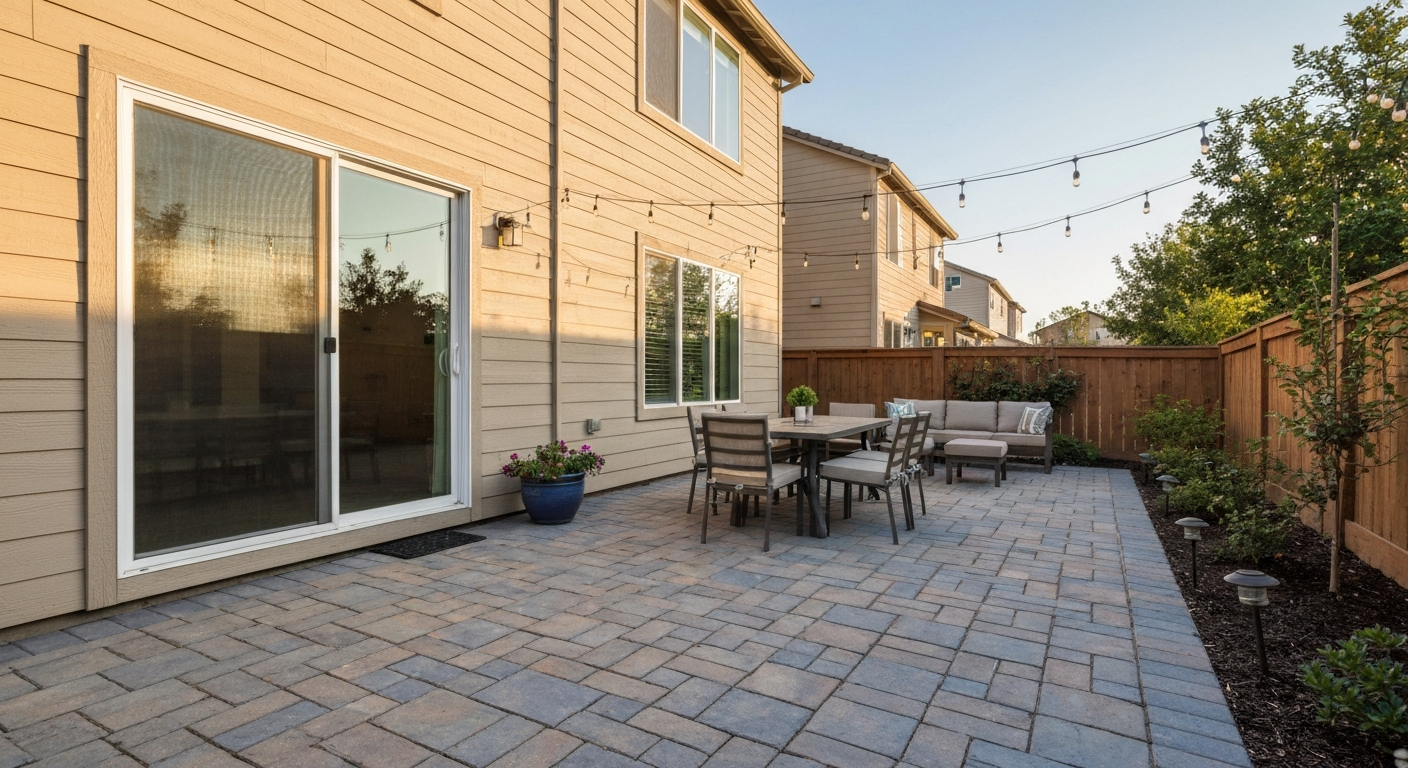
A patio is a paved outdoor area at ground level, positioned next to or immediately behind a house, and used for sitting, dining, or relaxing outside. It has no roof by default, sits directly on the ground (not elevated on posts or a frame), and is typically made from concrete, pavers, flagstone, or brick. That is the core definition, and it holds whether you are reading a real estate listing, looking up the word in a dictionary, or trying to figure out what your backyard slab is actually called.
Patio Dress Definition: What a Patio Is for Homeowners

Ada Hollis
7 Aug 2026
Plain-language patio definition (for homeowners, renters, and buyers)
Merriam-Webster defines a patio as "a paved area outside a house." Cambridge Dictionary adds that it is "an area for outdoor living, usually paved and next to a house." Put both together and you get a working definition that covers almost every real-world use of the word: a ground-level, hard-surfaced outdoor space attached or adjacent to a residential building, designed for everyday outdoor living.
The word itself comes from Spanish, where "patio" originally referred to an inner courtyard or open space within or attached to a building. That origin explains why the term sometimes appears in listings for properties with enclosed or semi-enclosed outdoor spaces, particularly in the American Southwest and in Mediterranean-influenced architecture. In everyday American English, though, a patio almost always means the slab or paved area at the back (or side) of a house.
For renters and buyers, the practical implication is this: a patio does not add structural square footage to the home. It is an outdoor improvement. That distinction matters for property valuations, permit requirements, and what you can realistically expect to maintain or modify without major construction.
Common patio types with examples
Patios are not all the same, and listing language often uses type-specific terms that are worth understanding before you visit a property or start a backyard project.
- Attached patio: the most common residential type, directly connected to the home's rear or side door. You step out of the kitchen or living room straight onto it. Usually poured concrete or pavers, and often the first thing installed by builders on new construction.
- Detached patio: a paved area in the yard that is not directly connected to the house. Sometimes used as a dedicated fire pit zone, a garden seating area, or a separate entertaining space away from the main structure.
- Covered patio: an attached or detached patio with a permanent or semi-permanent roof structure above it — often a pergola, solid patio cover, or aluminum awning. It remains a patio as long as it stays at ground level; once you add walls and a proper roof, it edges toward a covered porch or sunroom.
- Screened patio: enclosed on the sides with screen panels to keep out insects while keeping the outdoor feel. Common in Florida and the Gulf Coast region. Often called a "lanai" in Hawaii and Florida real estate listings.
- Roof terrace-style patio: found in urban townhomes and condos where a rooftop area is finished with pavers or decking tiles to create a usable outdoor space. These are sometimes marketed as "rooftop patios" in listings, though technically they share traits with terraces and are elevated rather than ground-level.
In listings, watch for the phrase "patio/deck", it often signals an ambiguous space that could be either a ground slab or a raised platform. When you see that slash, ask the agent to confirm whether the surface is at grade or elevated, because that determines permit history, structural maintenance, and insurance implications.
Typical patio materials: what they cost and how they hold up
The material a patio is made from affects cost, durability, maintenance, and frankly how much a buyer will notice it in a listing. Here is a straightforward breakdown of the main options, with approximate installed cost ranges based on 2025-2026 U.S. market data.
| Material | Typical Installed Cost (per sq ft) | Lifespan | Main Pros | Main Cons |
|---|---|---|---|---|
| Poured concrete | $4–$15 | 20–40+ years | Lowest cost, versatile, easy to maintain | Can crack over time; limited aesthetic options unless stamped |
| Concrete pavers | $8–$30+ | 25–50+ years | Repairable (individual units), many styles | Higher upfront cost; joints need re-sanding over time |
| Natural stone / flagstone | $15–$50+ | 50+ years | High durability, premium appearance, strong resale signal | Most expensive; irregular surfaces can be uneven underfoot |
| Brick | $10–$30 | 25–50+ years | Classic look, durable in moderate climates | Can shift in freeze-thaw cycles; may require re-leveling |
| Gravel / pea gravel | $1–$6 | Ongoing (replenished) | Cheapest option, excellent drainage | Not firm underfoot; migrates; higher ongoing maintenance |
| Composite decking tiles (on grade) | $5–$20 | 15–25 years | DIY-friendly, comfortable underfoot | Not traditional patio material; less durable in sun/moisture |
Bluestone is worth a specific mention: Zillow's listing analysis found that homes where listings explicitly named "bluestone patio" in the description sold for roughly 2.2-2.3% more than comparable homes, equivalent to around $10,000 on a median-priced home. If you are selling, naming the material specifically in your listing text is a legitimate price signal, not just filler.
Common patio features and accessories
A bare slab is just a starting point. Most patios people actually enjoy include at least a few of these additions, and many of them show up in listing descriptions as selling points.
- Fire pit or outdoor fireplace: one of the most popular patio additions. The 2024 International Fire Code (Section 307) specifies that recreational fires must sit at least 25 feet from any structure, and portable outdoor fireplaces at least 15 feet — though many municipalities adopt stricter local rules. Check your city's specific ordinance before placing any fire feature.
- Pergola: an open-roofed structure with posts and overhead beams, often installed over a patio to provide partial shade and a defined outdoor room feel. It does not fully weatherproof the space but dramatically improves comfort and usability.
- Built-in seating: low concrete or masonry walls along the edge of the patio that double as bench seating. Reduces the need for moveable furniture and gives the patio a more finished, permanent look.
- Outdoor lighting: string lights, recessed deck lights in the slab, or post-mounted lanterns. Lighting is consistently ranked among the highest-satisfaction outdoor upgrades because it extends usable hours into the evening.
- Patio heaters: freestanding propane or electric heaters that extend the usable season into cooler months. Particularly common on restaurant and bar patios in northern climates, and increasingly popular in residential settings.
- Outdoor kitchen or pizza oven: a more significant investment that adds both function and resale value. Zillow's research found pizza oven mentions in listing descriptions correlated with sale price premiums, making them one of the few specific accessories that demonstrably influences buyer perception.
- Shade sails and pergola canopies: less permanent than a full patio cover but effective for sun control and rain protection.
Patio vs. related outdoor spaces
This is where most confusion lives, and it matters in real estate because the terms affect what you should expect from a space structurally, legally, and in terms of maintenance. Here is a direct comparison across all the spaces that get mixed up with patios.
| Space | At Ground Level? | Has a Roof? | Attached to House? | Structural/Elevated? | Key Distinguishing Feature |
|---|---|---|---|---|---|
| Patio | Yes | No (unless 'covered patio') | Usually, but can be detached | No | Ground-level paved slab or surface |
| Porch | Usually (front) | Yes | Yes, always | No (typically) | Covered and attached, traditionally at the front entry |
| Deck | No — elevated | No (unless covered) | Usually attached | Yes — built on posts/frame | Raised wood or composite platform off the house |
| Balcony | No — elevated | Sometimes | Yes, always | Yes — cantilevered or supported | Small elevated platform off an upper floor of the building |
| Verandah | Ground level or slightly raised | Yes — always | Yes, wraps around building | Slightly raised with steps | Roofed wraparound structure, larger than a porch |
| Courtyard | Ground level | No (open to sky) | Surrounded by building on multiple sides | No | Enclosed outdoor space between wings of a building |
| Terrace | Ground level or stepped | No (usually open) | Adjacent to building | Sometimes stepped/raised on a slope | Broad flat outdoor area, often at the rear; used interchangeably with patio in some regions |
The clearest rule of thumb: if it is on the ground and paved, it is most likely a patio. If it is elevated on posts, it is a deck. If it has a roof and wraps the house, it is a verandah or porch. If it is surrounded by the building itself, it is a courtyard. Listing agents sometimes use these terms loosely, so when in doubt, ask specifically whether the surface is at grade and whether it has any roof structure.
Patio season: what it means and when it runs
"Patio season" is an informal but widely understood phrase that describes the time of year when outdoor patio spaces are comfortably usable. It does not have a fixed official start and end date, it shifts by climate, personal cold tolerance, and whether your patio has features like heaters or a covered roof.
In most of the northern United States and Canada, patio season is roughly understood to run from late April or May through September or October. Canadians in particular treat the start of patio season as a cultural moment: restaurant and bar patios reopening in the spring after a long winter draws genuine enthusiasm, and the phrase carries a festive connotation. In the American South, Southwest, and California, patio season is essentially year-round, interrupted only by extreme summer heat or occasional cold snaps.
For homeowners, patio season has practical maintenance implications too. The end of the season is a natural prompt to clean and seal your patio surface, store cushions and furniture indoors or in weatherproof covers, and inspect for any heaving or cracking caused by ground movement. The start of the season is the right time to re-sand paver joints, check for winter damage, and power-wash the surface before setting up for use.
Patio terminology: other terms readers frequently search
Patio skirt
A patio skirt is the decorative fabric panel that hangs around the base of a table or occasionally around furniture pieces on a patio, concealing the legs or storage below. You will also see the term applied to the fabric skirting used on outdoor bar carts, catering tables, and folding tables at outdoor events. It is a purely decorative or functional soft furnishing accessory, not an architectural element. If you see "patio skirt" in a shopping context, it refers to outdoor-grade fabric panels designed to withstand sun, moisture, and outdoor conditions.
Patio cover
A patio cover is any overhead structure built to shelter a patio from rain and sun. It can be a solid aluminum or wood roof, a lattice pergola, a retractable awning, or a shade sail. Solid, attached patio covers almost always require a building permit because they attach to the house structure, and some municipalities categorize a fully enclosed patio cover as an addition to living space, which triggers more involved permitting. A permit-exempt ground-level concrete patio can become a permit-required project the moment you add a roof to it.
Patio door
A patio door is the door that leads from the interior of the home directly out to the patio. It is almost always either a sliding glass door or a hinged French door. The term is used by builders, agents, and homeowners alike, "patio door" in a listing simply means the home has a direct glass-panel access point to an outdoor area, typically the kitchen, dining room, or living room.
Patio furniture
Patio furniture refers to any seating, tables, loungers, or storage pieces designed for outdoor use. Materials typically include powder-coated steel, aluminum, teak, all-weather wicker/rattan, or high-density polyethylene (HDPE) plastic. Unlike indoor furniture, patio furniture is rated for UV exposure and moisture. In listings, "patio furniture included" is occasionally noted as a bonus feature in furnished rentals or staged sales.
Patio heater
A patio heater is a freestanding, wall-mounted, or ceiling-mounted heating unit used to warm outdoor patio spaces in cooler temperatures. Propane mushroom-top heaters are the most recognizable residential form. Electric infrared versions are increasingly common for covered patios where propane ventilation is a concern. Patio heaters effectively extend usable patio season by several weeks or months in moderate climates.
Patio permits, maintenance, and what it means for property value
Many homeowners are surprised to learn that a simple concrete or paver patio at ground level often does not require a building permit, while a covered or elevated version of the same space typically does. International Residential Code guidance and most municipal building departments distinguish a ground-level slab on grade from elevated or covered structures. As a specific example, The Colony, Texas requires a building permit for any patio or deck greater than 30 inches above grade or 120 square feet or larger. Your municipality may draw the line differently, but those are representative thresholds.
From a resale standpoint, the National Association of Realtors' Remodeling Impact Report on outdoor features estimates the average cost of a new patio at around $10,500, and places patio projects among the outdoor improvements with the strongest owner satisfaction and resale recovery. That does not mean every patio adds $10,500 in value, it means the investment tends to pay back proportionally better than many interior upgrades, particularly in markets where outdoor living is a strong buyer priority.
Buyers should pay attention to listing language. Realtor.com's listing guidance recommends sellers use function-forward descriptions like "covered patio perfect for al-fresco dining" or "private backyard with large patio." When you see specific materials called out ("bluestone patio," "travertine pavers"), that is usually an intentional price signal. Zillow's research found bluestone patio mentions associated with roughly 2.2-2.3% sale price premiums over comparable listings that did not name the material.
Buyer and owner checklist
- Confirm whether the patio is at grade or elevated — this determines whether it is technically a patio or a deck, which affects permits and structural maintenance.
- Ask for permit history on any covered patio structure, pergola, or patio addition connected to the house.
- Check the material: concrete slabs should be inspected for cracks and drainage slope; pavers should be checked for settled or missing units and re-sanded joints.
- Note the drainage direction — water should run away from the house foundation, not toward it.
- For properties with a fire pit or fireplace, confirm it meets local fire code setback distances from the structure.
- If you plan to add a patio cover or outdoor kitchen, check local permit requirements before purchasing materials.
- Reseal concrete patios every 3–7 years; re-sand and reset shifted pavers as needed; inspect annually for frost heave damage after winter.
Where patios typically sit on a property (and how to spot one in a listing)
Most residential patios are located at the rear of the property, accessible directly from the kitchen, dining room, or main living area via a patio door or sliding glass door. This placement prioritizes privacy from the street and a direct indoor-outdoor flow for cooking and dining. Side-yard patios are less common but appear on corner lots or narrow urban properties. Front-entry patios exist but are more often categorized as courtyards or entry plazas in listings.
In listing descriptions, look for phrases like "step out to your private patio," "backyard entertaining patio," or "covered patio off the kitchen." These all point to a rear-facing patio. If the listing says "patio/courtyard" or "patio/terrace," the space may be enclosed or slightly elevated, worth clarifying before visiting. Aerial photos in listings often show the patio footprint clearly if the photography includes a drone shot.
Hosting and what to wear to a patio party
Patios are among the most common residential entertaining spaces, used for everything from casual weekend barbecues to formal dinner parties and holiday gatherings. For practical hosting tips and suggested layouts, see the guide where is party on the patio. A well-configured patio with lighting, comfortable seating, and some form of shade or weather protection handles most occasions. If you are hosting, the combination of overhead string lights, a defined seating area, and a central table or fire feature tends to do more for atmosphere than any single expensive accessory.
For attire, a patio party is generally a smart-casual or casual occasion. Think lightweight linen or cotton in warm months, with a layer available if the evening cools. Flat or low-heeled shoes are the practical choice since paver and stone surfaces can be uneven. If the event has a more dressed-up feel, a summer dinner party, for example, a sundress or open-collar shirt and chinos lands the right note without being overdressed for an outdoor setting. When in doubt about the vibe, the gathering itself is a great place to start figuring out the social code, similar to thinking through what to wear to a patio party for a range of occasions.
FAQ
What is a patio (plain-language definition)?
A patio is a paved or otherwise finished outdoor area at ground level, usually next to a house, used for seating, dining, grilling, or recreation. Dictionaries (Merriam‑Webster, Cambridge, Oxford) define it as an outdoor paved area adjacent to a home — think of it as an outdoor room that opens onto the yard.
What are common patio types and examples?
Common patio types: - Poured concrete slab (simple, durable) - Concrete pavers (modular, repairable) - Natural stone / flagstone (high-end look) - Brick or cobblestone (classic style) - Gravel or decomposed granite (low cost, good drainage) - Tile (formal, can be slippery when wet) Example: a bluestone patio with a built‑in fire pit; a small pea‑gravel patio under a pergola.
What materials are typically used and pros/cons?
Materials and quick pros/cons: - Poured concrete: low–moderate cost, durable, can crack. - Concrete pavers: moderate cost, easy to repair, many patterns. - Natural stone: attractive, very durable, higher cost. - Brick: classic look, moderate cost, needs good base. - Gravel/DG: cheapest, drains well, more maintenance. Typical lifespans: gravel/pebble (years with maintenance), concrete/pavers (20–50+ years), natural stone (50+ years). Installation and local labor affect cost and longevity.
What features are common on patios?
Common features: seating/dining areas, pergolas or shade sails, outdoor kitchens or grills, fire pits/fireplaces, built‑in seating or planters, outdoor lighting, heaters, and hardscaping details (steps, retaining walls). Drainage, grade, and drainage channels are also important features to keep water away from the house.
How is a patio different from a porch, deck, balcony, verandah, courtyard, and terrace?
Short comparison (plain language): - Patio: ground‑level paved area next to a house. - Porch: a covered platform attached to the house at the entrance (often roofed and sometimes enclosed). - Deck: often elevated, made of wood/composite, structural framing; may require permits if raised. - Balcony: small platform projecting from an upper floor, with railing. - Verandah (veranda): a long covered porch, often wrapping around the house. - Courtyard: an enclosed outdoor space surrounded by walls or buildings. - Terrace: can be elevated or terraced on a hillside; often larger and more formal than a patio. Tip: if it’s on the ground and paved, it’s usually a patio; if it’s elevated or structural, it’s often a deck or terrace.
What does “patio season” mean?
“Patio season” refers to the time of year when weather is pleasant enough to spend extended time outdoors on patios — typically spring through early fall in most temperate climates. It’s shorthand for months when homeowners use patios for dining, socializing, and gardening; in warm climates, patio season may be year‑round.
Next Article
What Is a Patio Skirt: Types, Uses, Costs & Installation Guide
What is a patio skirt? Answers for deck skirting, table skirts, and casual patio outfits, DIY tips & costs.