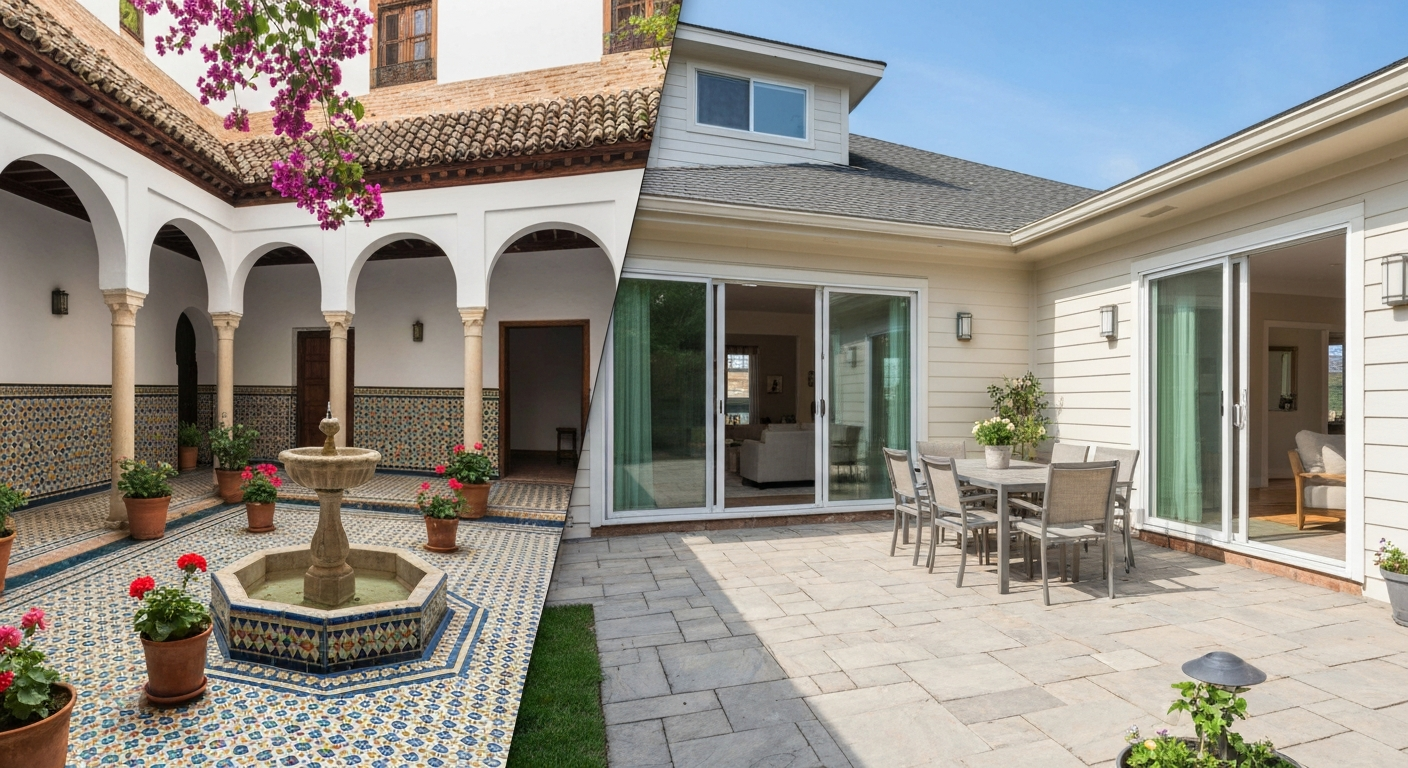
A patio is a flat, hard-surfaced outdoor area attached to a house, typically at ground level, where people sit, eat, and relax. It is almost always paved with concrete, stone, brick, or tile, and it usually sits at the back of the house rather than the front. So, when you look up patio area meaning, it usually means a paved outdoor space beside or attached to a home for sitting, eating, and relaxing. That is the core meaning you will find in every major English dictionary, and it is the meaning that applies whether you are reading a real estate listing, a home improvement article, or a weather app that mentions "patio weather."
Patio Meaning in English: Definition, Pronunciation, and Examples

Ada Hollis
28 Apr 2026
What a patio actually is (the plain-English definition)
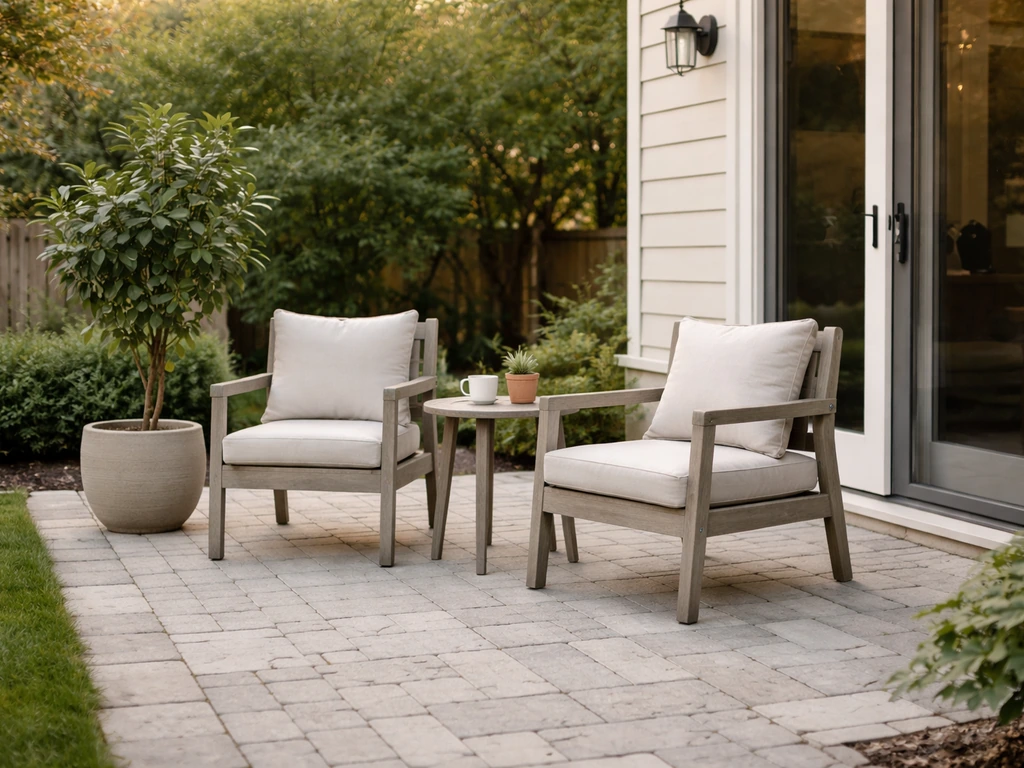
Merriam-Webster defines a patio as "a recreation area that adjoins a dwelling, is often paved, and is adapted especially to outdoor dining." Oxford Learner's Dictionaries puts it even more simply: "a flat hard area outside, and usually behind, a house where people can sit." Cambridge calls it "an area outside a house with a hard floor, where people can sit to eat and relax." All three definitions agree on the same three things: it is outside, it has a hard surface, and its purpose is leisure.
In practical terms, a patio is a ground-level outdoor room without walls or a roof. You might furnish it with a table and chairs, a grill, potted plants, or string lights. It is not a separate structure. It is simply an extension of the living space out into the yard. If the description on a property listing says the home has a patio, you can picture a paved area just outside the back door where the previous owners probably had their morning coffee or summer barbecues.
"A patio" vs "on the patio" and how the word is used in sentences
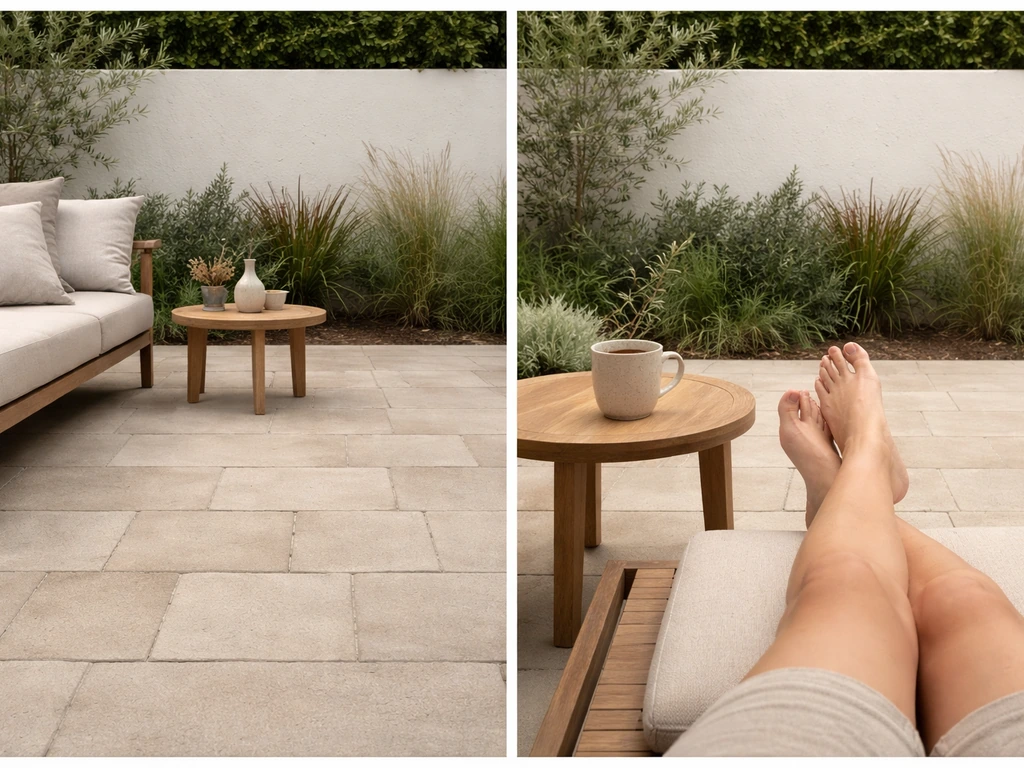
You will hear both "a patio" and "on the patio" constantly in everyday English, and the difference is straightforward. "A patio" refers to the space itself: "They built a patio last summer" or "The house has a large patio." "On the patio" describes being located there or doing something there: "We had dinner on the patio" or "The kids are playing on the patio." You sit on the patio, you eat on the patio, you relax on the patio. It follows the same pattern as "on the deck" or "on the terrace."
One nuance worth noting: in real estate listings, you will sometimes see "patio home" or "patio-style home," which refers to a type of single-story attached or detached house (common in retirement communities) rather than a home with a specific patio feature. The word is being used as an adjective there, describing a housing style that implies low-maintenance outdoor living. If you see that phrase in a listing, it is describing the home's architecture, not just its backyard.
Patio meaning in English and where the word comes from
The word "patio" came directly into English from Spanish, with its first known use in English recorded in 1764 according to Merriam-Webster. In Spanish, "patio" originally referred to an inner courtyard of a building, open to the sky and typically enclosed by the walls of the structure around it. Think of the classic Spanish or Latin American architectural style where the social life of a home centered on a central courtyard rather than a backyard. That enclosed courtyard was the patio.
When English speakers adopted the word, the meaning shifted slightly. Instead of an enclosed inner courtyard, "patio" came to mean any paved outdoor area adjoining a house, most commonly at the back and open to the surrounding yard. The core idea, a hard-surfaced outdoor living area attached to a home, stayed the same, but the enclosed-courtyard element was largely dropped in everyday American and British usage. This patios definition matches the common everyday meaning: a hard-surfaced outdoor living space attached to a home. There is no meaningful difference in how British and American English define the word. If you are also wondering about patio view meaning, it usually relates to how the patio is positioned for sightlines and scenery rather than changing the basic patios definition. Both use it to mean the same thing: a paved outdoor area next to a house for sitting and leisure.
How to pronounce patio
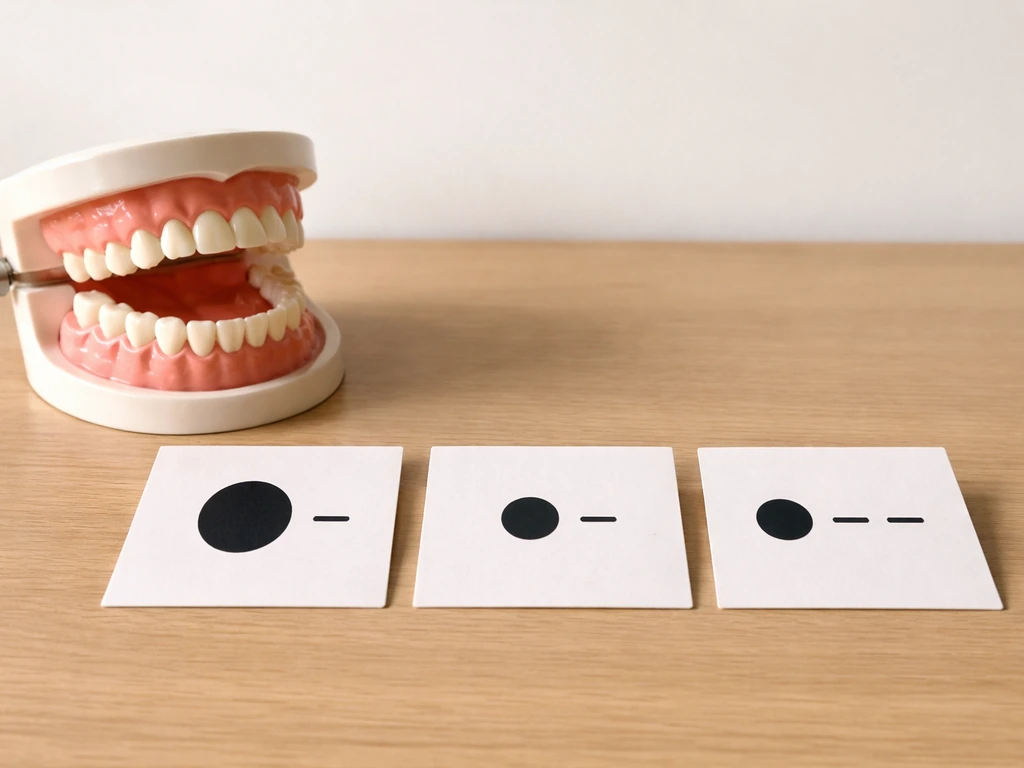
In standard American and British English, patio is pronounced PAT-ee-oh. The stress falls on the first syllable. The "a" in "pat" sounds like the short "a" in "cat," and the ending is a simple long "o" sound. Broken into syllables it is PAT / ee / oh, three syllables total. You will occasionally hear people say PAH-tee-oh with a broader first vowel, but PAT-ee-oh is the standard pronunciation in both American and British English and is what every major dictionary records.
Does "patio" have any slang or figurative meaning?
Straightforward answer: no, not really. "Patio" does not have an established slang meaning in mainstream English. It is not used as slang in the way that, say, "crib" (home) or "pad" (apartment) are. If you searched for "patio meaning slang" expecting to find a hidden secondary meaning, you can set that aside. The word means exactly what it looks like it means: an outdoor paved area next to a house.
That said, you will occasionally see "patio" used figuratively or informally in specific contexts. Restaurant and bar culture uses it to mean any outdoor seating area, even one that is technically a terrace or a sidewalk extension. Some people use "patio season" as a casual shorthand for warm weather. And in some regions, a bar or restaurant advertising "patio vibes" is signaling a relaxed, outdoor, social atmosphere. These are extensions of the core meaning rather than distinct slang definitions. The architectural meaning remains the anchor.
Patio vs porch, balcony, veranda, and courtyard
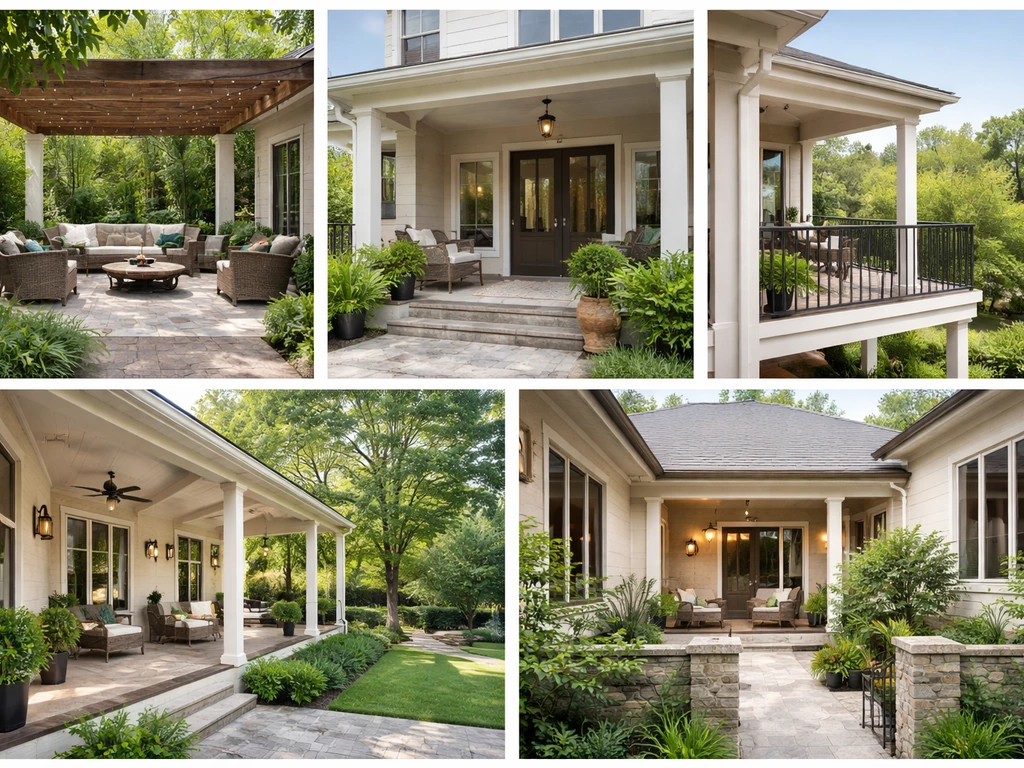
This is where a lot of confusion happens in property listings and everyday conversation. These five terms all describe outdoor spaces attached to a home, but they are not interchangeable. Here is how they actually differ.
| Space | Level | Roofed? | Attached to building? | Typical location |
|---|---|---|---|---|
| Patio | Ground level | No (usually open sky) | Yes, adjoins the house | Back or side of house |
| Porch | Ground level or slightly raised | Yes (covered) | Yes, part of the structure | Front of house (usually) |
| Balcony | Upper floor (elevated) | Sometimes | Yes, projects from upper floor | Front, side, or rear |
| Veranda / Verandah | Ground level | Yes (roofed, open sides) | Yes, wraps around the house | Front and/or sides |
| Courtyard | Ground level | No (open sky) | Enclosed by walls or building | Center or interior of property |
Patio vs porch
The clearest difference is the roof. A porch is covered. A patio is not. A good rule of thumb is that a patio is an outdoor area with a hard surface next to a house, which matches the patios definition you are looking for. Porches are also typically at the front of the house and are often slightly raised with steps leading up to them. If you can sit outside during light rain without getting wet, you are probably on a porch. If rain would send you running inside, you are on a patio. Porches are also usually built as part of the home's original structure, while patios are often added afterward by laying pavers or pouring concrete.
Patio vs balcony
A balcony is elevated and accessed from an upper floor. That is the key distinction. If you step outside from a second-floor bedroom or living room onto a small outdoor platform, that is a balcony. A patio is always at ground level. You walk out of the back door straight onto it. In apartment buildings, what developers sometimes call a "patio" on the ground floor is essentially the same as a balcony above it, just at street level, and it usually has a privacy wall or fence enclosing it.
Patio vs veranda (or verandah)
A veranda is ground-level like a patio but it is roofed and typically wraps around part or all of the house. It is more architectural, more permanent, and more protected from the elements. The veranda is a prominent feature in Australian, South Asian, and Southern US residential architecture. A patio tends to be a simpler paved area. Think of a veranda as a covered outdoor hallway around the house and a patio as a paved outdoor room behind it.
Patio vs courtyard
A courtyard is enclosed, usually by walls, fencing, or the building itself on multiple sides. It may or may not be paved. The original Spanish meaning of "patio" was actually closer to what we today call a courtyard: an interior open-air space surrounded by the home's walls. In modern English, a courtyard implies enclosure and privacy, while a patio is more open to the surrounding yard. You might find courtyards in apartment complexes, townhouses, or Spanish Colonial-style homes. In everyday suburban homes, it is usually called a patio even if it has a partial fence.
What this means when you are looking at a property
When you see "patio" in a real estate listing, you can reasonably expect a ground-level paved area, usually at the back of the property, open to the sky, suitable for outdoor furniture. Merriam-Webster’s definition of a patio describes it as a recreation area that adjoins a dwelling, is often paved, and is adapted especially to outdoor dining ground-level paved area adjoining a house, adapted especially to outdoor dining. If you want shade or rain protection, ask whether there is a pergola, awning, or covered structure over the patio, because the word itself does not imply any of that. A listing that says "covered patio" or "screened patio" is specifying something beyond the baseline meaning.
If you are comparing a property with a patio to one with a porch or veranda, think about how you actually want to use the space. Open patios are more flexible for furniture arrangements and feel more connected to the yard, but they offer no weather protection. Porches and verandas are covered but more fixed in layout. Balconies are ideal for views and small-space outdoor access but are not practical for large gatherings. Knowing what each word actually means helps you filter listings and ask the right questions before visiting a property.
FAQ
Does patio always mean the patio is at ground level, or can it be raised?
In standard English, patio implies ground level, open to the sky, and directly accessible from the yard, but real estate listings sometimes label a slightly raised slab as a patio. If the listing mentions “step-up patio,” “platform patio,” or a deck height difference, treat it as a borderline case and confirm the height and access.
What surface types count as a patio, is grass or gravel a patio?
A patio typically has a hard, paved surface (concrete, stone, brick, tile). Grass, mulch, or loose gravel areas usually would be described as a garden or yard feature unless the gravel is clearly part of a paved/compacted hardscape. If the description says “pavers” or “paved patio,” that confirms the hard-surface expectation.
Is a covered patio still a patio, even though it has a roof?
Yes. “Covered patio” and similar phrases usually mean the baseline patio idea (outdoor paved area attached to a home) plus weather protection (roof, pergola, awning). The base word does not guarantee coverage, so the modifier matters.
What is the difference between a patio and an outdoor deck in everyday listings?
A deck is usually wood (or sometimes composite) and is often freestanding or built from framing, sometimes elevated, while a patio is generally a masonry or hard-surfaced extension at ground level. If the listing uses both terms, it may mean a paved patio plus a separate deck area, or a deck built on top of concrete, so check for separate square-footage descriptions.
Can “patio” refer to a central courtyard inside an apartment complex?
It can, especially in some Spanish-influenced design contexts, but many English speakers will still call an enclosed multi-side space a courtyard. If the area is enclosed on multiple sides for privacy, expect it to be described as a courtyard, enclosed courtyard, or sometimes a courtyard-style patio, depending on the region and listing style.
When someone says “on the patio,” does it always mean dining?
Not necessarily. The phrase “on the patio” just means physically located there, and the activity can be eating, relaxing, or socializing. In restaurant or hotel contexts, “on the patio” often implies dining, but in residential contexts it can mean anything you would do outdoors.
Is “patio view” about scenery from the patio, or does it mean the patio faces a particular direction?
Usually it refers to how the patio is positioned for sightlines (water view, garden view, skyline, street view). Listings may also mean orientation and light (morning sun, sunset view), so if the wording includes “view,” “exposure,” or “orientation,” interpret it as both visual and directional advantages, not just furniture placement.
Is there any “patio slang” meaning I should worry about when reading reviews?
In mainstream English, “patio” does not have a hidden slang sense. Informal phrases like “patio vibes” or “patio season” are marketing-style extensions meaning a relaxed outdoor atmosphere or warm-weather use, not a different word meaning.
How can I quickly tell whether a listing’s outdoor space is a patio, porch, veranda, or balcony?
Use two checks: roof presence and level. Patio is typically open and at ground level, porch is often covered and may be at the front, veranda is usually covered and wraps or extends prominently, and balcony is elevated with access from an upper floor. If the listing includes “covered,” “wraparound,” “second-story,” or “steps,” that usually settles it.
Next Article
Patio Origin and Meaning: Definition, Types & Real Estate
Patio: clear definition, origin, types, comparisons and real‑estate impact for homeowners and buyers.