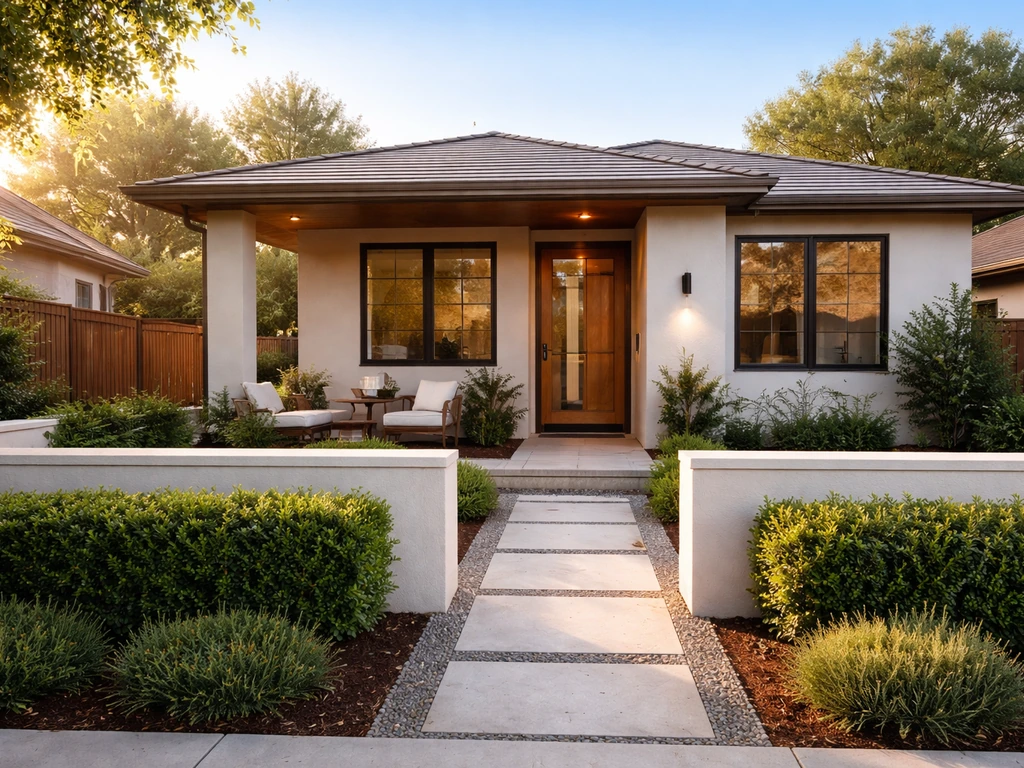
A typical residential patio looks like a flat, hard-surfaced pad at or near ground level, sitting right outside a door (usually the back or side of a house), open to the sky, with no roof or railings. You'll see paving materials like concrete, brick pavers, or flagstone, often with outdoor furniture arranged on top. That's the core visual: a solid floor, ground-level, open-air, directly accessible from the house.
What Does a Patio Look Like? Real Examples and How to Tell

Ada Hollis
14 May 2026
Quick visual definition: the typical patio look
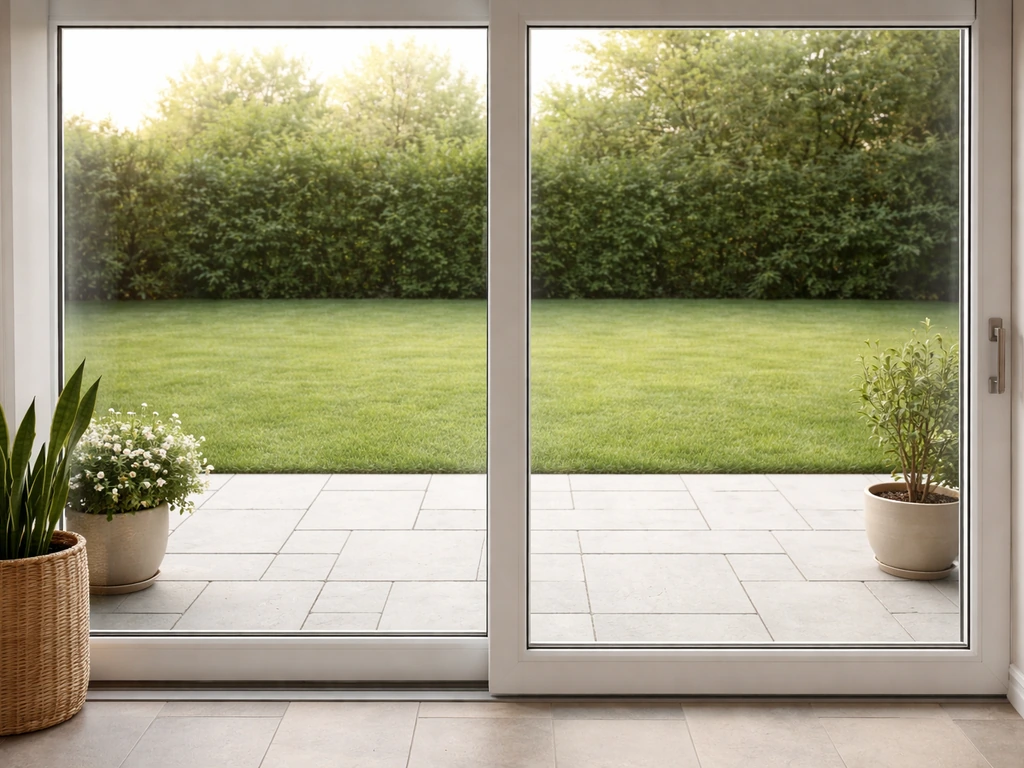
Picture stepping out through a sliding glass door or French doors onto a paved rectangular surface at the same level as the lawn. There's no step up, no railings, no overhead structure blocking the sky. The floor is solid and uniform, whether that's a smooth concrete slab, interlocking pavers, or irregular flagstone. Lawn or garden usually borders two or three sides. A set of chairs and maybe a table sits on top. That's a textbook patio.
The Cambridge English Dictionary nails the key traits concisely: an outdoor area next to a house with a solid floor and no roof, used for sitting and eating in good weather. Those three elements, solid floor, ground-level adjacency to the house, and open to the sky, are your visual anchors whenever you're looking at a listing photo and trying to confirm you're actually looking at a patio.
In real estate photos specifically, a patio almost always appears in the backyard or side yard, framed between the house's rear wall and the garden. You'll see the door or doorway it connects to, the paved surface extending outward, and usually some kind of border or edge where the hard surface meets grass, gravel, or landscaping. No elevation, no railings, no roof overhead.
Common patio materials and finishes (what you'll see in photos)
The surface material is one of the first things you notice in any patio photo, and it varies a lot. Here are the most common looks and how to identify each.
Concrete slabs
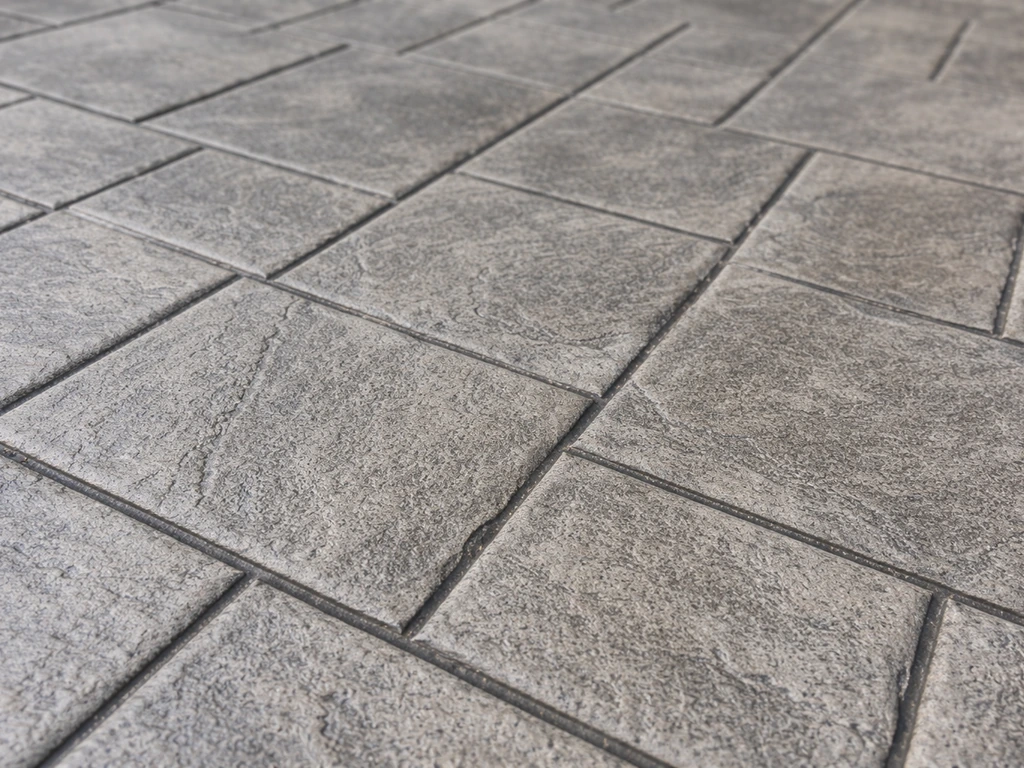
Plain concrete patios look like a continuous gray pad, smooth or lightly textured. Stamped concrete takes it further: photos show a repeating pattern pressed into the surface that mimics brick, slate, flagstone, or cobblestone. The giveaway is that the 'stone' pattern is too uniform and the color a bit flat compared to real natural stone. There are no individual units or seams, just a monolithic surface with an impressed design. It's one of the most common patio finishes in North America because it's affordable and durable.
Paver patios
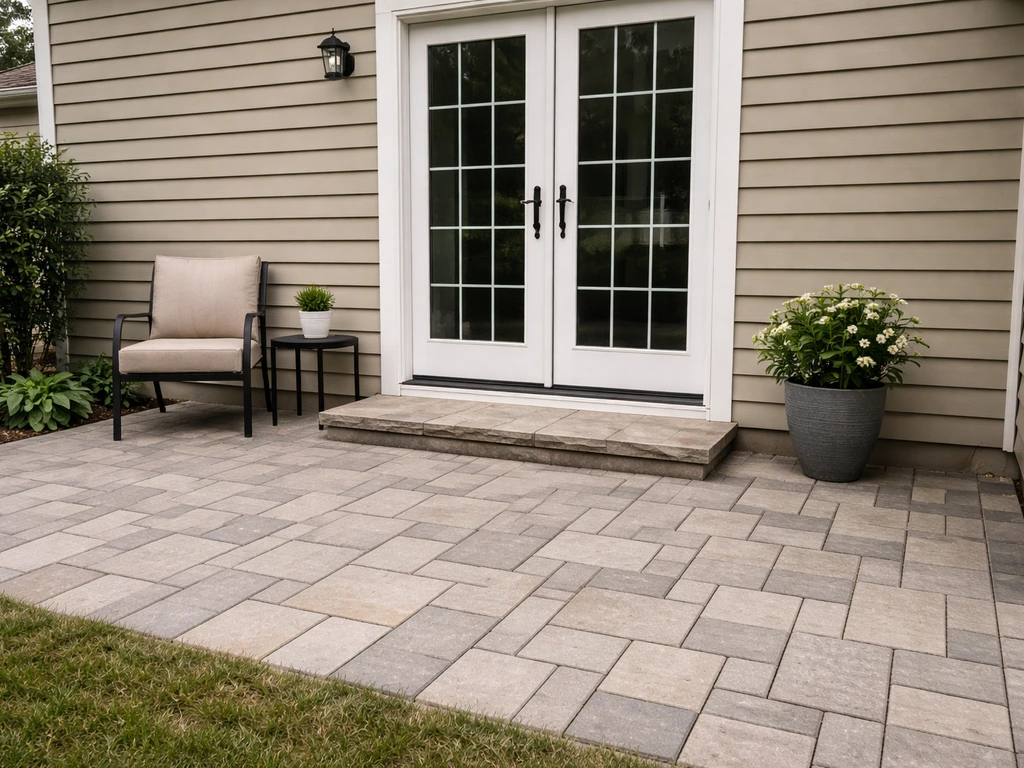
Paver patios are made of individual concrete or clay units laid in patterns, and the visible seams or joints between units are the clearest photo clue. Common patterns include running bond (like a brick wall laid horizontally, with each row offset by half a unit), herringbone (a V-shaped zigzag, often set at 45 degrees to the patio edge), and basket weave (pairs of units alternating perpendicular directions for a woven look). Many paver patios also have a contrasting border or 'soldier course' around the perimeter, which gives the space a defined, finished frame that photographs well.
Flagstone
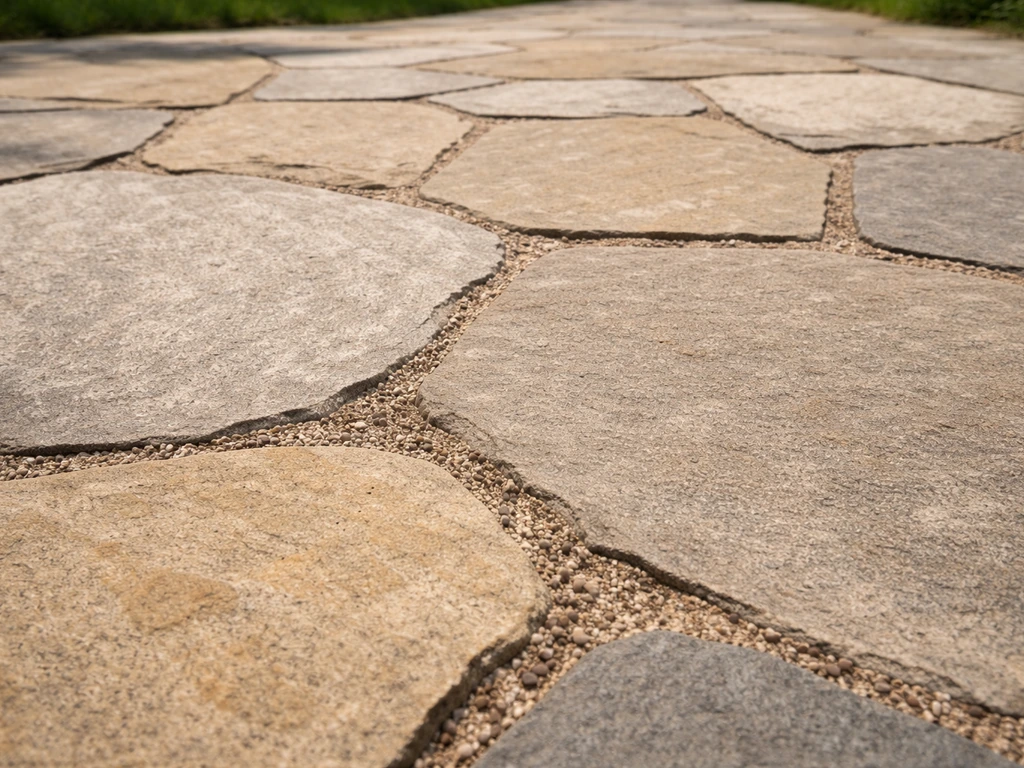
Flagstone patios use irregular, natural stone pieces and have a more organic, uneven look than pavers or concrete. Dry-laid flagstone shows wider, irregular joints, sometimes filled with gravel or groundcover plants, giving a rustic, permeable appearance. Mortared flagstone on a concrete base looks more polished, with tighter joints and a more consistent surface. Either way, the irregular shape of each stone is the visual tell. No two pieces match exactly.
Other materials you might see
- Brick: laid in the same patterns as pavers, with a classic reddish-brown color and uniform rectangular units
- Gravel or decomposed granite: loose material filling a defined area, usually bordered by edging; less common but counts as a patio surface in some definitions
- Porcelain or ceramic tile: sometimes used in warmer climates; looks very clean and smooth, similar to indoor tile, often large-format squares
- Natural slate or bluestone: a premium flagstone variant with a flat, layered texture and blue-gray tones
Common layouts and sizes (small, large, off-door, corner, and linear)
Patio layouts follow the shape of the house and yard, so you'll see a range of configurations in listing photos. Understanding these helps you size up a space quickly, even from a single photo.
Size-wise, patios range from compact to generous. A small patio is typically 6x6 or 8x8 feet, which in photos looks like just enough space for two chairs and a side table. Medium patios run 10x10 to 14x14 feet, the most common residential size, fitting a dining table for four to six people comfortably. Large patios exceed 16x16 feet and often include multiple seating zones or a built-in grill area. When you see a listing photo, you can roughly gauge the size by the furniture: a small table with two chairs suggests a compact pad, while a full outdoor dining set plus a lounge area signals something bigger.
The most common layout is a simple rectangle or square placed directly off the main back door, usually the kitchen or living room sliding door. This 'off-door' placement is the dominant pattern in suburban homes and is what most people picture when they imagine a patio. Corner patios wrap around two sides of the house, giving more usable area and often appearing in homes with an L-shaped rear wall. Linear patios run along the full length of a back wall, appearing as a long, narrow band of paving that works well for row houses or narrow lots.
Some larger patios use a multi-zone approach where a paved area directly off the house transitions into a secondary seating or fire pit area a few feet away, sometimes at a slightly different level. That terraced or stepped appearance is a patio-adjacent look that blurs into 'terrace' territory, but if the surfaces are all ground-level hardscape, it's still fundamentally a patio layout.
Covered vs. uncovered patios (roof, pergola, and enclosure clues)
Not all patios are fully open to the sky, and this is where listing descriptions can get confusing. The classic definition says patios have no roof, but in practice, homeowners add shade structures and the space is still called a patio. Here's how to read the visual clues.
A fully open patio shows sky in the background, no overhead structure, and direct sun or shadows from nearby trees. This is the cleanest photo to identify: paved ground surface, open air above, furniture below.
A pergola-covered patio has an open-frame overhead structure: you'll see parallel beams or rafters crossing overhead, with clear sky visible between the slats. Pergolas filter light rather than block it, so the patio below isn't in full shade. The lattice or open-beam pattern is a strong photo signature. This is still generally called a patio in listings, even though there's an overhead structure, because the roof is not solid.
An awning-covered patio shows a retractable or fixed fabric (or metal) overhang projecting from the house wall above the patio. You'll see the angled cover in photos, usually with striped or solid fabric, extending over part of the paved area. Again, most listings still call this a 'covered patio.'
A fully roofed patio, with a solid ceiling attached to the house, is where the line between patio and porch starts to blur. If the roof is solid, attached to the house structure, and the area has walls or screens, you're looking at something closer to a porch, enclosed patio, or veranda depending on the region. The key photo test: can you see sky directly overhead from the seating area? If yes, it's a patio or open pergola. If there's a solid ceiling, it's likely a covered porch or some variation.
Patio vs. porch vs. deck vs. balcony vs. courtyard (how their appearances differ)
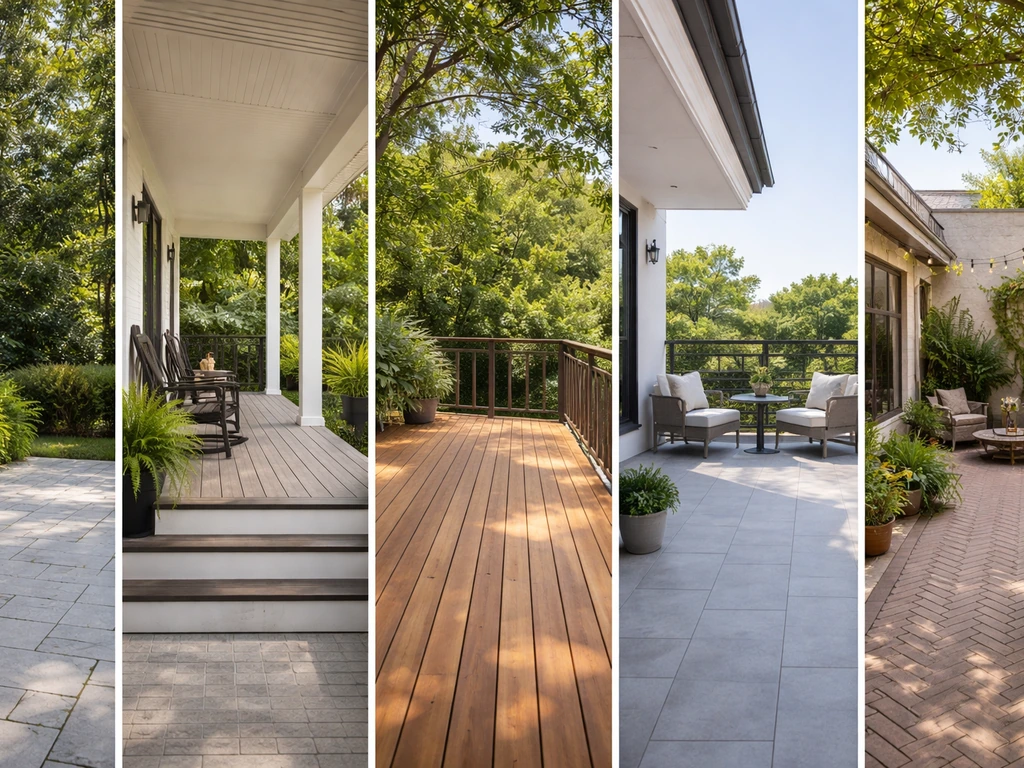
This is the section that clears up most of the confusion in real estate listings. Each of these outdoor spaces has a distinct visual profile, and once you know what to look for, you can usually identify them from a single photo.
| Space | Level | Overhead | Material | Railings | Key photo clue |
|---|---|---|---|---|---|
| Patio | Ground level | Open sky (or pergola/awning) | Concrete, pavers, stone | No | Flat paved pad, doors open directly onto it, no elevation |
| Porch | Ground or slightly raised | Solid roof attached to house | Wood or concrete floor | Often yes | Covered ceiling overhead, typically at front of house, often has columns |
| Deck | Raised above grade | Open sky | Wood or composite planking | Yes (required by code) | Elevated platform with visible decking boards and perimeter railing |
| Balcony | Upper floor, raised | Open sky or partial cover | Concrete, tile, or decking | Yes (required) | Attached to upper story, accessible only from inside, always has railing |
| Courtyard | Ground level | Open sky | Various hardscape | No (walls instead) | Enclosed or semi-enclosed by walls/buildings on multiple sides |
| Veranda | Ground or slightly raised | Solid roof attached to house | Wood or tile floor | Often yes | Roofed, open-sided, wraps around or runs along the house exterior |
A porch is the most commonly confused with a patio, but the roof is the giveaway: porches have a solid overhead cover that's part of the house structure. Porches also tend to appear at the front of the house, while patios are typically at the rear or side. A veranda is essentially a roofed, open-walled porch, often wrapping around the house, and the term is more common in Australian, British, and South Asian real estate contexts.
Decks are raised, and that elevation plus the perimeter railing is unmistakable in photos. Angi notes that decks are raised platforms, and that elevation plus perimeter railing are key visual cues. You can usually see the space below the deck (crawl space, posts, or air gap) in wider shots, and the horizontal deck boards are a texture you won't confuse with concrete or stone. Balconies are also raised but attached to an upper floor and accessible only from inside, so you'd never step out of a ground-floor door onto a balcony.
Courtyards share the ground-level, open-sky look of a patio but are distinguished by enclosure: walls or buildings surround the space on most sides. A patio is open on at least two or three sides. If a listing shows a paved outdoor area that feels like an outdoor room with walls on every side, it's likely a courtyard. This distinction matters most in Mediterranean-style homes, townhouses, and urban properties. Patio homes (a distinct property type) can also feature courtyards or private patio areas as part of their design, which is a separate concept worth understanding on its own. Courtyards share the ground-level, open-sky look of a patio but are distinguished by enclosure: walls or buildings surround the space on most sides patio homes. A paired patio home is a type of patio home designed as a matched, side-by-side pair that shares a common wall or layout between two units. A detached patio home is a standalone house design that includes a private patio as part of the property layout.
How to spot a patio in real estate listings: photo checklist and red flags
Listing photos and descriptions don't always use terms consistently, so here's a practical checklist you can run through when you're reviewing a property.
What to look for in photos
- Ground-level surface: the paved area should be at or very close to the grade of the surrounding yard. No visible posts, air gap underneath, or multi-step elevation.
- Solid hard surface: concrete (smooth, stamped, or brushed), pavers (with visible joints), flagstone (irregular shapes), brick, or tile. No wood decking.
- Direct door connection: a sliding glass door, French doors, or regular exterior door opening directly onto the paved surface, usually from the kitchen, dining room, or living room.
- Open sky above: no solid ceiling or roof over the main sitting area. A pergola or awning is okay and still consistent with a 'covered patio' label.
- No perimeter railings: patios don't need railings because they're at grade. If you see railings, you're likely looking at a deck or porch.
- Edge transition: where the paving meets the lawn, garden, or landscape is visible and relatively clear. Borders, edging strips, or a simple grass-meets-stone transition.
- Furniture as a scale reference: dining sets, lounge chairs, grills, and planters sitting directly on the surface help confirm it's used as an outdoor living area.
Red flags and common listing mismatches
- A listing says 'patio' but photos show a raised wooden platform with railings: that's a deck, not a patio. Different maintenance, different materials, different structural considerations.
- The 'patio' has a solid ceiling overhead: it may actually be a covered porch, lanai, or enclosed veranda. Ask whether the roof is part of the house structure or a separate add-on.
- The space is enclosed by walls on three or four sides: this may be a courtyard rather than a true patio, which affects privacy, light, and airflow.
- A very small paved area (under 6x6 feet) at the back door is sometimes called a patio in listings, but functionally it's more like a stoop or landing. Check whether furniture actually fits.
- Stamped concrete that looks like stone or brick in a thumbnail photo: zoom in on the pattern. Uniform repetition and absence of natural variation usually confirms it's stamped concrete, not real flagstone or brick.
- Drainage: ground-level patios should slope slightly away from the house. If listing photos show water pooling or the patio looks sunken, that's a potential drainage problem worth checking in person.
- No door visible in the patio photo: if the paved area appears disconnected from the house with no door access shown, confirm whether it's actually accessible or just a decorative hardscape feature.
Five common patio scenarios in listings
Small entry or side patio: a compact 8x8 or 10x10 concrete or paver pad at the side door of a house. Often shows just enough room for two chairs, a small bistro table, and a planter. Common in row houses and smaller suburban homes.
Backyard patio off the kitchen: the most common scenario. A rectangular paved area, often 12x16 or larger, accessed through sliding or French doors from the kitchen or living room. Photos typically show an outdoor dining set, maybe a grill, and lawn beyond the paved edge.
Covered patio with pergola or awning: same ground-level layout as above, but with an overhead structure visible in photos. Look for open beam/rafter patterns (pergola) or a fabric or metal overhang (awning). The ceiling is not solid, which distinguishes it from a roofed porch.
Multi-level or terrace-style patio: two or more paved areas at slightly different grades, connected by a low step. Often found on sloped lots. Photos show the step transition between levels, and each level may have its own furniture zone. The entire space may be labeled a 'patio' even though it has mild elevation changes.
Shared or courtyard-style patio: more common in townhouses, patio home communities, and Mediterranean-style properties. Photos show a paved area enclosed or semi-enclosed by walls or adjacent structures. If you're researching patio home properties specifically, this courtyard-adjacent look is worth understanding in context of how patio homes are designed and what they include as outdoor living space.
FAQ
What does a patio look like in a photo if the yard is shaded or covered by trees?
Look for sky openings above the seating, not just bright light. Even in shade, you should still see an unblocked background and a ground-level paved surface. If the area has a solid ceiling or fully enclosed walls, it usually reads as a porch or enclosed patio instead.
How can I tell a patio from a “covered porch” when both connect to the same sliding door?
Use the ceiling type: a patio typically has an open-frame cover (pergola) or an angled fabric/awnings that leave visible sky and let light through. A porch usually has a solid overhead structure tied to the house, and often has screened or wall sections that interrupt the open-air feel.
Do patios always have to be directly attached to the house door?
No. Some patios sit just a few feet away with a walkway connection, or they form part of a side-yard sitting area. The key visual is still the same: ground-level hardscape that’s open to the sky on at least two or three sides, with a visible boundary where pavement meets landscaping.
In listings, what does “patio” look like when it’s more of a sitting zone than a full dining space?
You’ll often see a smaller table with two chairs, a loveseat or lounge set, or a fire feature on a paved pad. The patio floor still appears as a continuous hard surface, but the furniture grouping will be compact and clustered near the door or along one edge.
What’s the fastest way to tell a paver patio from a stamped concrete patio?
Check for joints and units. Pavers show individual blocks with distinct seams and grout lines, sometimes with a patterned border around the edge. Stamped concrete looks monolithic, with an impressed design repeated across the whole slab and no visible individual unit spacing.
Why might a “patio” look raised or uneven in a photo, even if it’s ground-level?
Perspective and photography angle can make a flat patio seem higher than it is. Also, patios on sloped lots can have small grade changes or low steps between sections. Confirm by watching for a step transition to grass or the next level, rather than expecting the entire surface to be perfectly level.
How do I identify a patio that’s actually closer to a courtyard in a townhouse listing?
Courtyards are typically surrounded by walls or adjacent building faces on most sides, so the open-sky view is narrower. If the paved area feels like an “outdoor room” with hard boundaries on three or four sides, it’s more likely a courtyard than an open patio.
Can a patio include a grill or built-in features, and does that change what it looks like?
Yes. Larger patios often include an outdoor dining setup, a grill island, or a designated fire pit zone, and that can create multiple furniture areas. The defining look still holds: paved ground surface at grade, open sky above, and no fully enclosed solid ceiling over the main seating.
What does a patio look like when the surface is gravel, wood, or artificial turf?
Traditional patios in listings usually have a hard-surfaced floor like concrete, pavers, or flagstone. If you see loose gravel without a stable paved pad, or raised deck-like boards, those are typically described as different outdoor spaces. Artificial turf can appear around patios, but the patio itself usually reads as a fixed, walkable hardscape area.
How can I tell if a “balcony” is being mislabeled as a patio in photos?
A balcony is raised and attached to an upper floor, so you’ll often see railing or a clear vertical drop to the space below. Also, the access door will open onto the upper level, not from a ground-floor exterior door onto a paved pad.
Next Article
What Is a Patio Home? Definition, Features, and Differences
Clear definition of patio home, key features, and how patio-home communities and patio vs porch comparisons work.