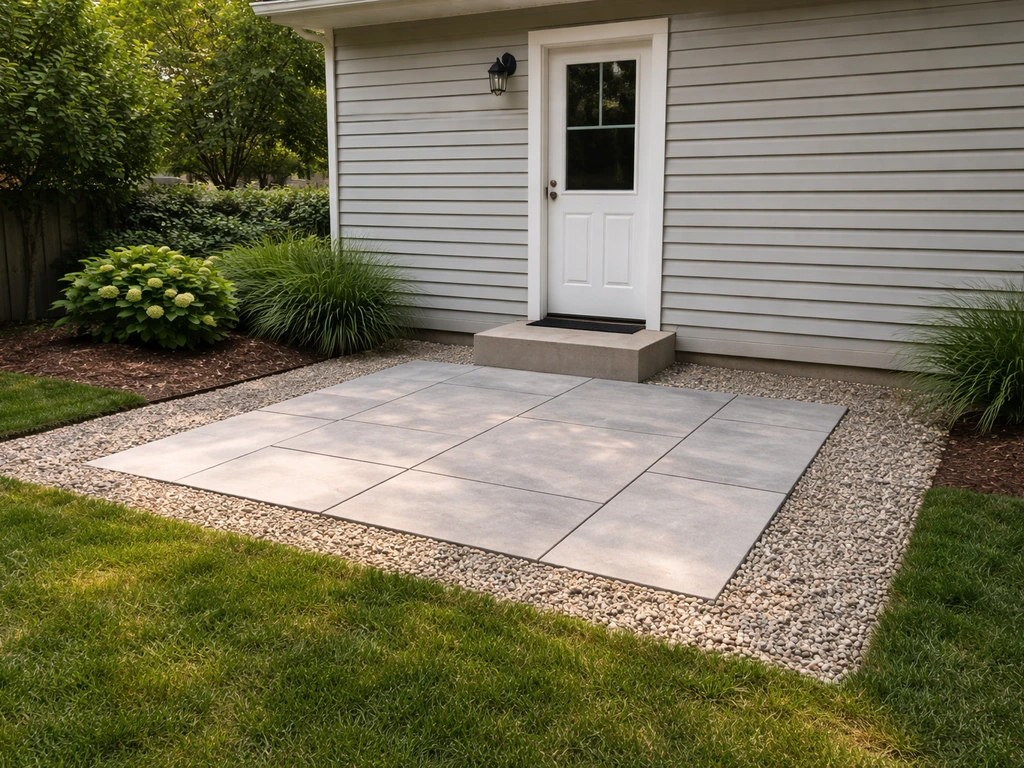
A patio is a flat, hard outdoor area attached to a home, usually at ground level, with no roof overhead. You sit on it, eat on it, and relax on it. It is paved or surfaced with concrete, stone, brick, or pavers, and it sits directly on the ground rather than being raised on a structure. That is what 'patio' means in plain English, and it is how the word is used in real estate listings, home design, and everyday conversation.
What Does Patio Mean? Easy Definition and Examples

Ada Hollis
3 May 2026
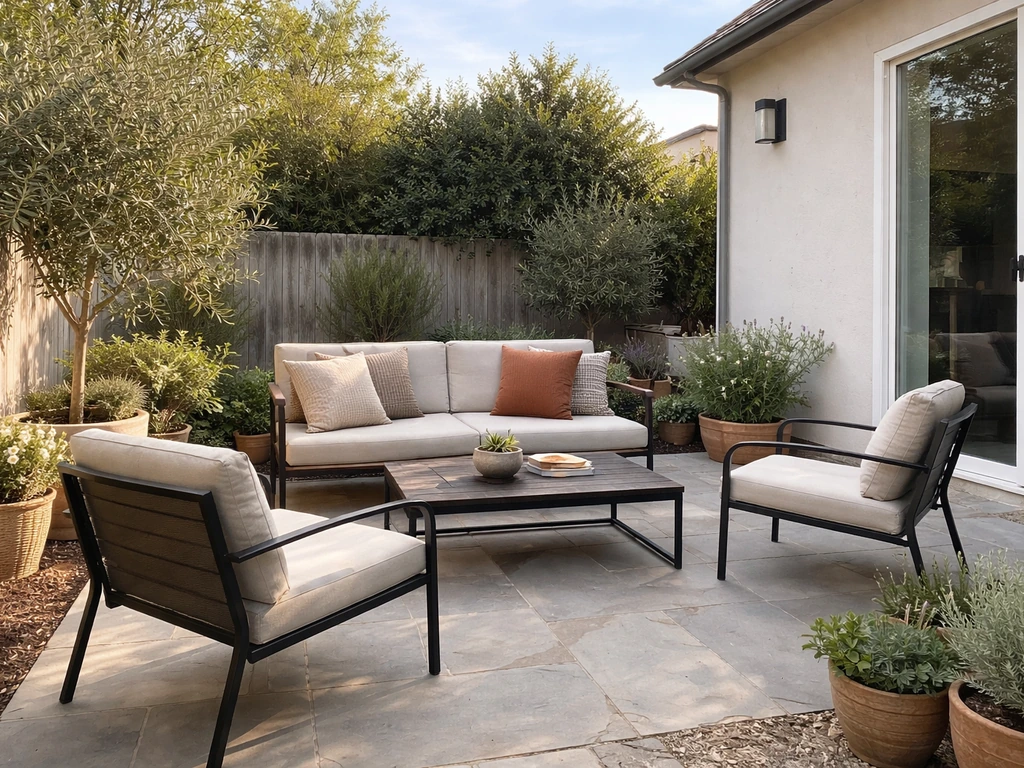
The straightforward definition of a patio
Every major dictionary lands in the same place. Cambridge says a patio is 'an area outside a house with a solid floor but no roof.' Oxford describes it as blank" rel="noopener noreferrer">'a flat hard area outside, and usually behind, a house where people can sit.' blank" rel="noopener noreferrer">Merriam-Webster frames it as 'a recreation area that adjoins a dwelling, is often paved, and is adapted especially to outdoor dining.)' Put those together and you get a clear picture: it is an outdoor, ground-level, hard-surfaced space connected to a home, open to the sky, designed for leisure. A patio garden is a patio space designed for growing plants and herbs, often using containers, raised planters, or ground beds around the seating area.
The word 'patio' is used widely and casually in English-speaking countries, particularly in North America, the UK, and Australia. It does not carry a formal architectural qualification. If a homeowner pours a concrete slab in their backyard and puts a chair on it, that is a patio. The word has Spanish roots (it historically referred to an inner courtyard), but in modern English the meaning has evolved into something much simpler and more common.
What a typical patio actually looks like
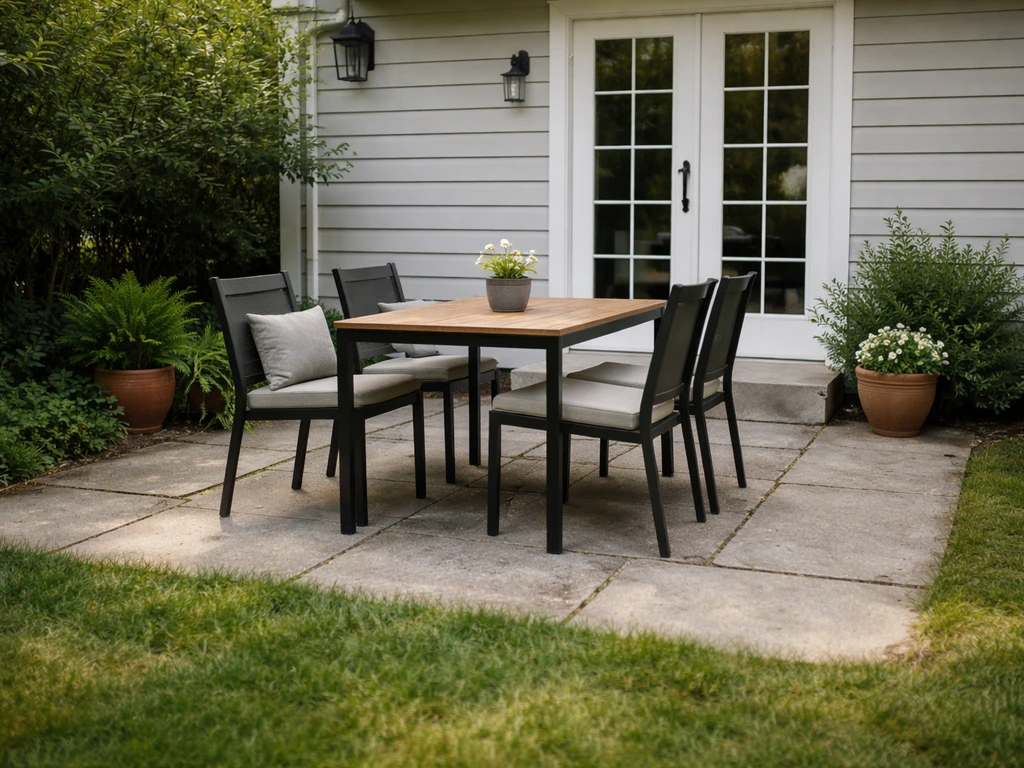
Most patios share a handful of consistent features, which makes them easy to identify in person or in a listing photo.
- Location: almost always at the back of the house, though side-yard and front patios exist. It sits at or very near ground level.
- Surface material: concrete slabs, concrete pavers, natural stone (flagstone, slate, bluestone), brick, or porcelain tile. Gravel or decomposed granite sometimes fills the gaps.
- No roof: open to the sky by definition. If it has a permanent roof structure, it starts becoming a covered patio, porch, or pergola space.
- Direct access: typically reached through a sliding door, French doors, or a back door leading from the kitchen or living area.
- Drainage slope: a properly built patio slopes slightly (roughly a quarter inch per foot) away from the house so water runs off rather than pooling near the foundation.
- Furniture and use: outdoor seating, dining sets, grills, fire pits, and potted plants are the typical additions.
The most common patio materials you will see in listings and real-world homes are concrete pavers and poured concrete. Both are durable, relatively low-maintenance, and widely available. Natural stone looks more upscale and often shows up in higher-end properties. Brick gives a classic, traditional feel. The material matters for maintenance and cost, but it does not change whether the space counts as a patio.
Patio vs porch vs verandah: what's actually different
These three terms confuse a lot of people, understandably. They all describe outdoor living spaces attached to a house, but the differences come down to two things: whether there is a roof, and where the structure is positioned.
| Feature | Patio | Porch | Verandah |
|---|---|---|---|
| Has a roof? | No (open to sky) | Yes (covered) | Yes (covered) |
| Ground level? | Yes | Yes (usually) | Yes (ground floor) |
| Location on home | Usually rear or side | Usually front entrance | Wraps around one or more sides |
| Enclosed? | No | Partially or fully | Open-sided with railing |
| Attached to home? | Yes | Yes | Yes |
A porch is a covered entrance structure, usually at the front of the home, attached to the doorway and sheltered by its own roofline. Merriam-Webster defines it as 'a covered area adjoining an entrance to a building and usually having a separate roof.' So the roof is the key marker: no roof, it is a patio; add a roof near the front door, it becomes a porch.
A verandah (also spelled veranda) is similar to a porch but typically longer, wrapping around the side or full perimeter of a house. Wikipedia describes it as 'a roofed, open-air hallway or porch attached to the outside of a building, often partly enclosed by a railing.' You see verandahs commonly on older homes, farmhouses, and properties in warmer climates like Queensland, Australia or the American South. The roofed, wraparound quality is what separates a verandah from a straightforward patio.
Patio vs balcony vs courtyard: a different kind of confusion
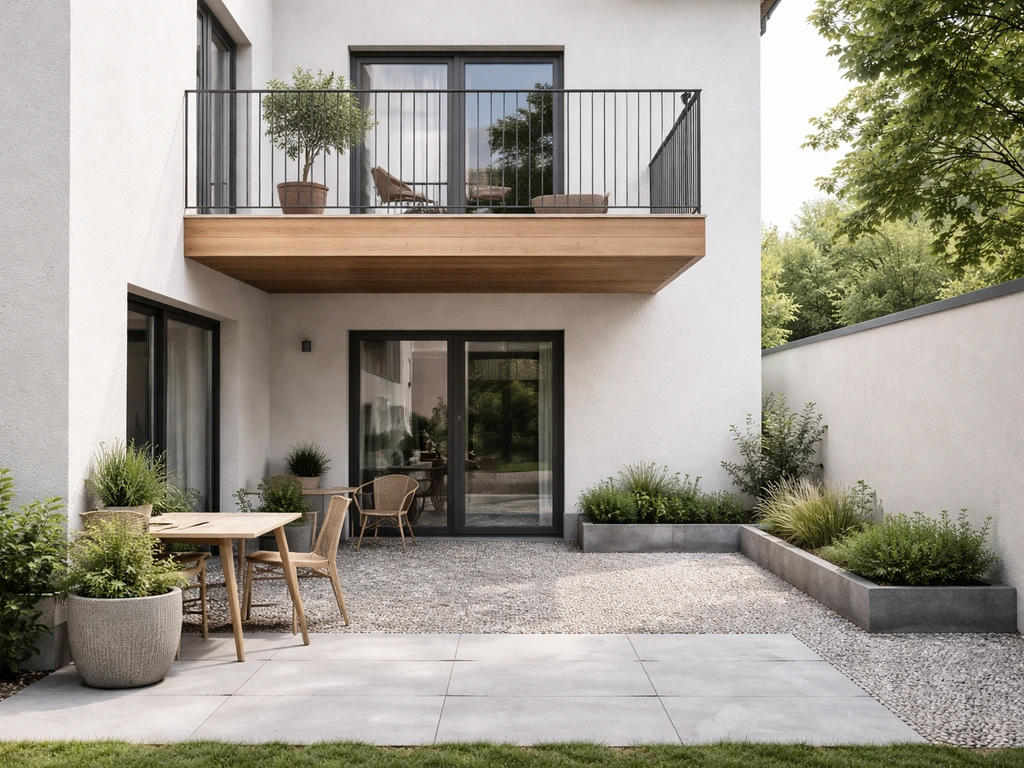
Balconies and courtyards get lumped in with patios sometimes, but the distinctions are pretty clear once you know what to look for.
A balcony is elevated. It projects from the wall of a building on an upper floor and is enclosed by a railing or parapet. Merriam-Webster defines it as 'a platform that projects from the wall of a building and is enclosed by a parapet or railing.' Washington State's Department of Revenue puts it even more plainly: 'a small railed elevated platform projecting from the wall of the residence.' If you have to step outside from a second-floor bedroom onto an outdoor platform, that is a balcony, not a patio. Patios sit on the ground.
A courtyard is enclosed. It is an outdoor area open to the sky, but it is surrounded by buildings or walls on most or all sides. Britannica defines it as 'an open space that is surrounded completely or partly by a building or group of buildings.' So a courtyard feels more like an outdoor room with walls around it, while a patio is simply an outdoor surface area attached to one side of a home, open on multiple sides. The Collins definition of patio, interestingly, includes a courtyard-like usage (referring to an enclosed yard), which hints at why people mix them up. In everyday modern English usage, though, a patio is generally not considered enclosed.
| Space | Elevated? | Enclosed by walls? | Has a roof? | Ground level? |
|---|---|---|---|---|
| Patio | No | No | No | Yes |
| Balcony | Yes | Partial (railing) | No | No |
| Courtyard | No | Yes (walls/buildings) | No | Yes |
| Porch | No | No/partial | Yes | Yes |
| Verandah | No | No (open-sided) | Yes | Yes |
How to spot a patio in a real estate listing or on a walkthrough
When you are scrolling through property listings or walking through a home, you can identify a patio quickly with a few reliable cues.
- Look at the photos for a hard surface at the rear or side of the home, sitting flush with or just slightly above the ground. If the outdoor area is at ground level and has a solid floor made of concrete, pavers, brick, or stone, it is almost certainly described as a patio.
- Check whether there is a roof over it. If the listing says 'covered patio,' there is some kind of overhead structure (a pergola, shade sail, or solid roof). An uncovered patio is fully open-air.
- Notice how you access it. A sliding glass door or French doors from the kitchen or living room leading directly onto a hard-surfaced outdoor area is the classic patio setup.
- Compare the listing language. 'Patio' usually means ground-level and uncovered. 'Deck' means it is raised on a wood or composite frame (sometimes several feet off the ground). 'Porch' means there is a roof. If it says 'balcony,' expect it to be on an upper floor.
- On a walkthrough, check the slope of the surface. Water should drain away from the house. A properly built patio slopes roughly a quarter inch per foot away from the home's foundation. If water is pooling against the house, that is a maintenance flag.
Listing agents sometimes use 'patio' loosely to describe any outdoor seating area, so the photos matter more than the label. A photo showing a raised wooden platform is a deck, regardless of what the listing calls it. A ground-level stone surface is a patio.
What patios are actually used for, and what upkeep looks like
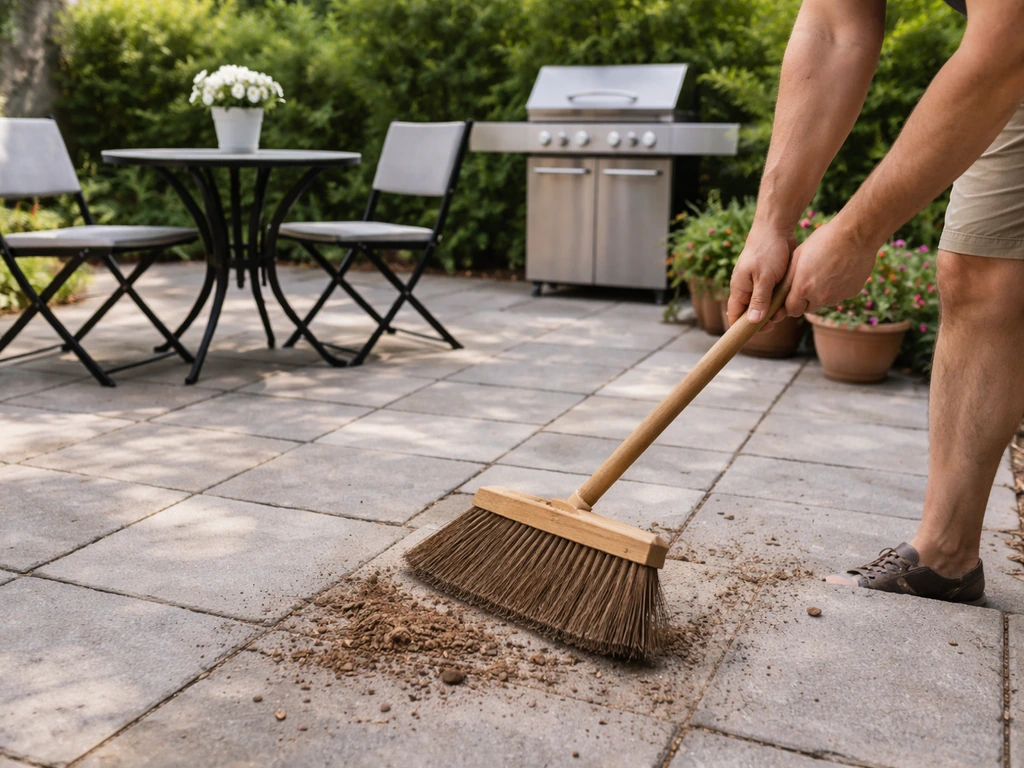
A patio is primarily a leisure and dining space. People put outdoor furniture, barbecues, fire pits, and container gardens on them. Because they are at ground level and directly accessible from the main living areas, they become a natural extension of the indoor living room or kitchen, especially in warm months. Families use them for weekend breakfasts, evening dinners, kids' play areas, and casual gatherings.
From a practical maintenance standpoint, patios are generally lower effort than decks (no wood to sand, stain, or treat for rot). The main upkeep tasks are:
- Keeping the surface clean: sweeping regularly, occasional pressure washing for concrete or pavers.
- Checking drainage: water should always flow away from the foundation. If you notice standing water or soil eroding toward the house, the slope may need correcting.
- Watching for cracks: concrete slabs can crack over time due to ground movement. Small cracks can be sealed; large ones may need professional attention.
- Weed management: pavers and jointed surfaces can get weeds in the gaps. Polymeric sand in the joints helps suppress growth.
- Inspecting for mold or algae: shaded patios in damp climates can develop a slippery green film. A diluted bleach solution or commercial cleaner handles it quickly.
A patio adds usable square footage to a home's outdoor living space without the structural complexity of a deck or the permit burden of an enclosed room addition. That makes it one of the more practical and accessible home improvements for both existing homeowners and buyers evaluating a property.
Common confusion terms and a quick recognition checklist
A few terms consistently trip people up when they are reading listings or talking about outdoor spaces. Here is the short version of how to sort them out.
- Patio vs deck: a patio is on the ground, made of stone, concrete, or brick. A deck is raised on a wood or composite frame and is typically built where the ground slopes away from the house.
- Patio vs porch: a porch has a roof and is usually at the front of the home by the entrance. A patio has no roof and is typically at the rear.
- Patio vs verandah: a verandah has a roof and often wraps around the house. A patio is open to the sky.
- Patio vs balcony: a balcony is on an upper floor, projecting from a wall. A patio is at ground level.
- Patio vs courtyard: a courtyard is enclosed by walls or buildings on most sides. A patio is open on the sides.
- Patio vs terrace: these terms overlap heavily and are often used interchangeably, especially in British English. A terrace can imply a slightly more elevated or formal outdoor platform, but in casual use and most listings, the two words describe the same kind of space.
If you want a quick on-the-spot checklist when you are standing in front of a space and trying to name it: Is it outside? These quick “is it outside” questions can also help you understand what “patio” means as a term, not as a language. Yes. Is it hard-surfaced?
Yes. Is it at ground level? Yes. Does it have a roof?
No. Is it enclosed by walls? No. That is a patio.
If any of those answers flips, you are looking at something else. The definition of a patio is really that simple, which is why it is one of the most commonly used outdoor-space terms in residential real estate today. If you want to compare it to related spaces, check how patios differ from porches, verandahs, balconies, and courtyards definition of a patio.
FAQ
Does “patio” always mean it is paved, or can it be gravel or dirt?
In common usage, a patio is typically a hard, solid surface. Gravel can function like one, but dirt or bare ground usually gets called a yard, terrace (depending on region), or outdoor space rather than a patio, especially in listings.
If a patio is attached to the house, does it have to be directly outside a door or can it be around the side?
It does not need to be directly in the backyard behind the house. As long as it is an outdoor hard area connected to a dwelling (for example, wrapping around a side entrance), it can still be described as a patio.
What is the difference between a patio and a terrace?
A terrace is often used for a paved outdoor area that may be raised or more formal, sometimes on a slope. “Patio” usually implies ground-level and open to the sky, so a raised patio is less straightforward and may be marketed as a terrace depending on the seller.
Can a patio have a roof or cover and still be called a patio?
Sometimes you will hear “covered patio” in everyday speech, meaning the seating area is roofed or partially roofed while remaining ground-level and open on other sides. If the roof is clearly part of an entrance structure near a doorway, many people will call it a porch instead.
Is a screened-in or enclosed patio still a patio?
It can be, but many listings shift terminology when the space is enclosed. If it is mostly open-air with the floor still on the ground, “patio” may be used as a description of the original space, but fully enclosed areas are often called sunrooms or porches.
How can I tell if something is a patio or a deck in photos?
Look for elevation cues. A deck is usually raised and built on posts or a frame, with railings or steps. A patio sits at ground level with no structural underlayer visible, and the surface looks like it is laid directly over the ground.
Can an apartment balcony be called a patio?
Usually not. A balcony is elevated and projects from an upper floor. Even if it is used for dining, the elevation and railing are the key signs that it is a balcony rather than a patio.
Do patios require a permit or approval when adding one?
It depends on local rules, but ground-level patios often require less permitting than decks. Still, changes to drainage, structural attachments, fences, or large footprint work can trigger permits, so check your city or county requirements before building.
Does “patio garden” mean the entire patio is for planting?
Not necessarily. “Patio garden” typically means gardening is incorporated into the patio area, often with container plants, planter boxes, or small beds around the seating. The patio still functions as a dining or leisure surface.
Why do some real estate listings label a space “patio” even if it looks different?
Agents sometimes use “patio” loosely for any outdoor seating area. The most reliable approach is to ignore the word and confirm the features: outside, hard-surfaced, ground-level, open to the sky, and not enclosed by the main structure.
Next Article
Definition of a Patio: What Counts and What Does Not
Clear patio definition, what counts vs not, plus comparisons to porches, balconies, courtyards, and real tips to identif