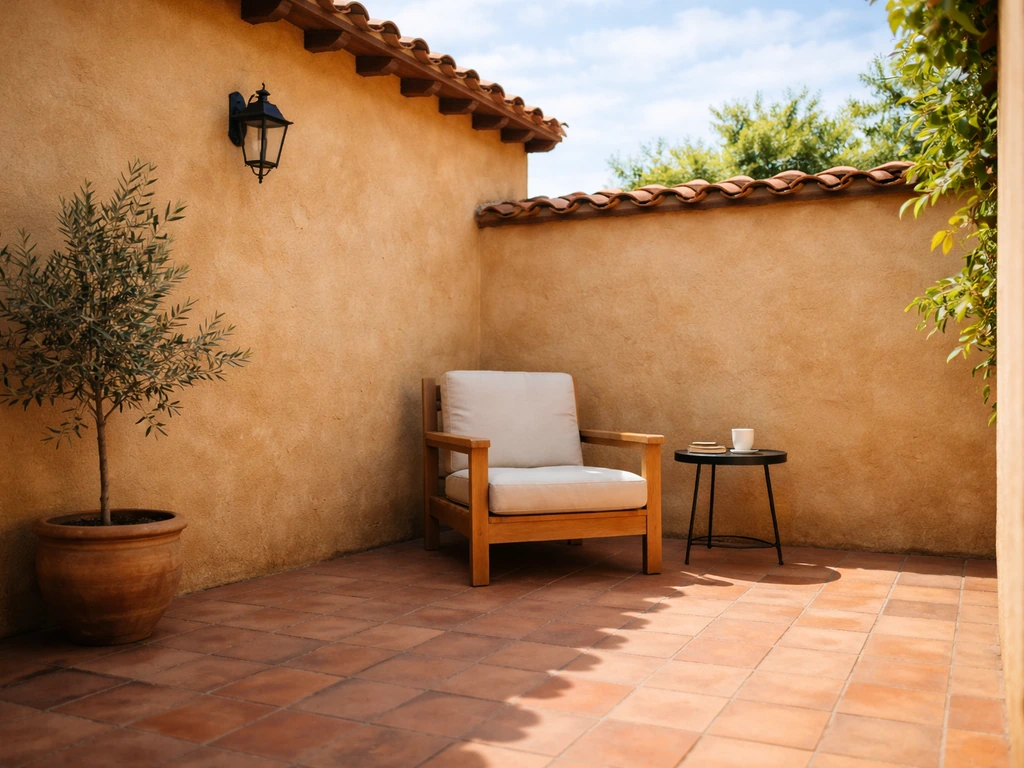
The most common alternatives to "patio" are terrace, deck, courtyard, veranda (or verandah), and lanai. None of them is a perfect one-to-one synonym, though, because each word carries its own assumptions about elevation, roofing, enclosure, and relationship to the house. The right word depends on what your space actually looks like, where you are in the world, and whether you're describing it casually or in a real estate listing.
What Is Another Word for Patio? Key Alternatives

Ada Hollis
28 May 2026
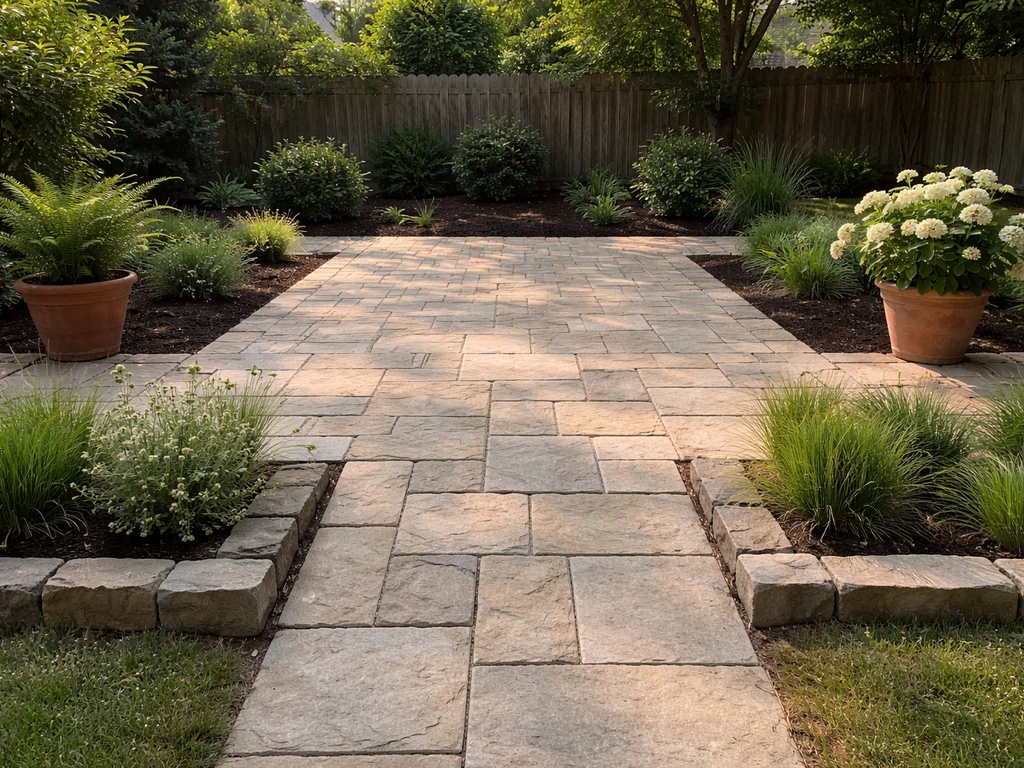
Common alternatives to "patio" at a glance
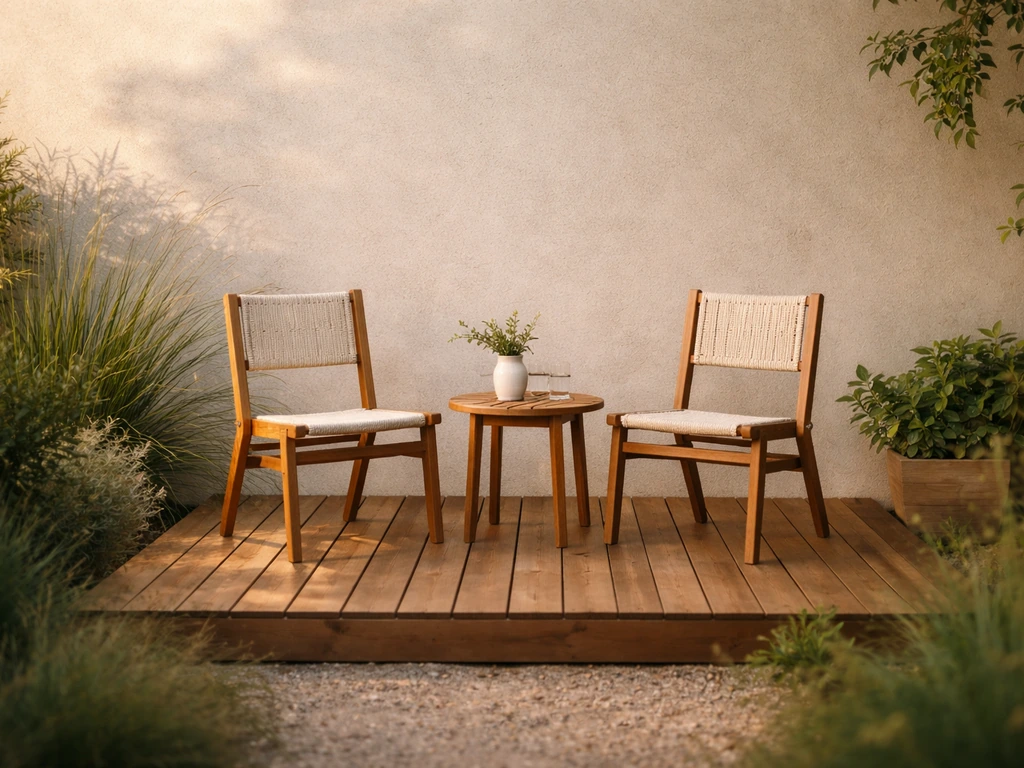
Dictionaries and thesauruses do group these terms together. The Cambridge Dictionary Thesaurus lists terrace, veranda, deck, and lanai as synonyms for patio. Collins adds sun deck to that list. In everyday speech, most people use these words interchangeably without causing confusion, but if you're writing a listing, filling out a permit form, or just want to be precise, the differences matter.
- Terrace: The closest general-purpose synonym. Used widely in British English and in real estate across the US and UK to describe a ground-level or slightly raised hard-surfaced outdoor area connected to a home.
- Deck: Common in North America for an outdoor platform, but typically made of wood or composite material and often elevated above grade. If it's timber and raised, deck fits better than patio.
- Courtyard: Works when the space is enclosed or partially surrounded by walls or the building itself, rather than simply opening onto a yard.
- Veranda / Verandah: Best used when the space has a roof and runs along the side of the house. Spelled "verandah" in Australian and New Zealand English.
- Lanai: Used primarily in Hawaii and some parts of the US South to describe a roofed outdoor living space, often screened.
- Sun deck: A North American and Canadian term for an open, sun-exposed outdoor area, often used interchangeably with patio or deck.
- Outdoor living area / outdoor living space: Generic phrases used in listings and planning documents when the exact type of space is unclear or mixed.
What actually makes a patio a patio
A patio has three defining features: it sits at ground level, it has a hard surface (concrete, brick, stone, or pavers), and it has no roof. Cambridge Dictionary defines it as "an area outside a house with a solid floor but no roof, used in good weather for relaxing, eating, etc." Merriam-Webster adds that it "adjoins a dwelling" and is "often paved." Britannica is even more specific, noting it is "usually behind a house."
Those three details, ground-level, hard-surfaced, and uncovered, are what separate a patio from a deck (which is elevated and usually wood), a veranda (which has a roof), and a courtyard (which is enclosed). If your outdoor space checks all three boxes, patio is your most accurate word. If it fails even one of them, a different term probably fits better.
Patio vs. porch vs. veranda vs. balcony vs. terrace vs. courtyard
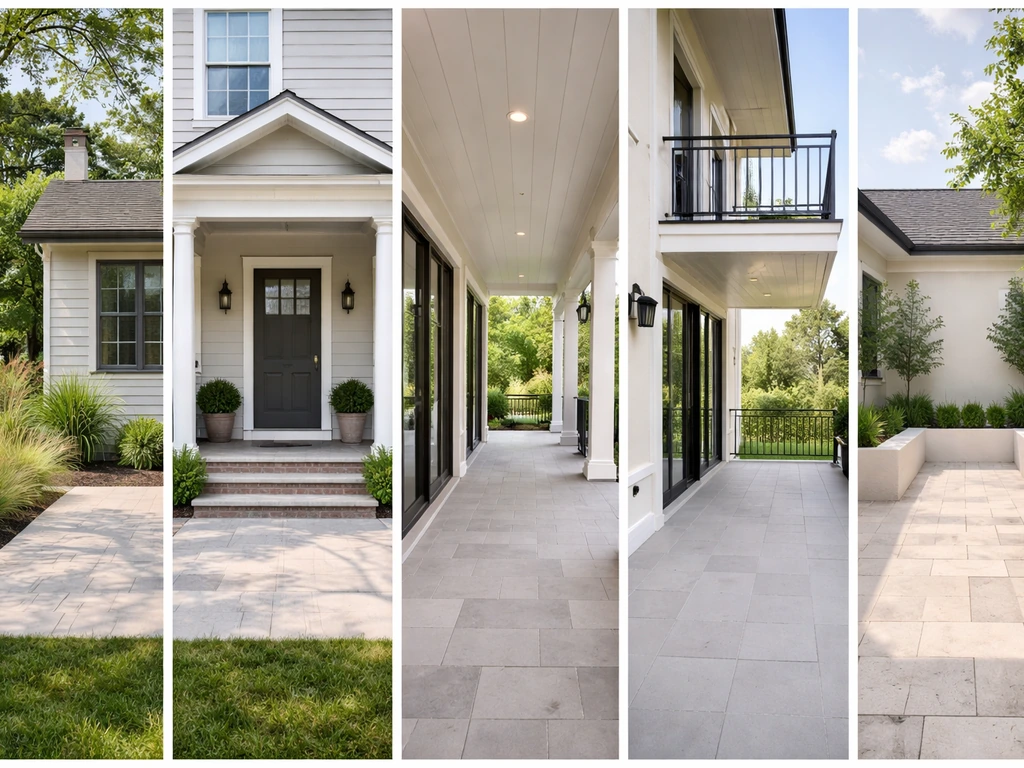
This is where most of the confusion lives. Here's a side-by-side breakdown of how these spaces differ across the features that matter most.
| Term | Ground level? | Has a roof? | Attached to house? | Enclosed or open? | Typical surface |
|---|---|---|---|---|---|
| Patio | Yes | No | Usually, at rear or side | Open | Hard (concrete, stone, brick) |
| Terrace | Ground or slightly raised | No | Yes | Open | Hard (stone, tile, pavers) |
| Deck | Often elevated | No (usually) | Yes | Open | Wood or composite |
| Porch | Ground level (front/rear) | Yes | Yes, at entrance | Partially open or screened | Wood, concrete, or tile |
| Veranda / Verandah | Ground level | Yes | Yes, runs along side(s) | Open-sided but roofed | Wood or hard surface |
| Balcony | Above ground floor | No (usually) | Projects from wall | Open with balustrade | Concrete, tile, or wood |
| Courtyard | Ground level | No | Surrounded by building/walls | Enclosed or semi-enclosed | Hard or mixed |
Patio vs. terrace
These two are genuinely close. In British English, "terrace" is often preferred over "patio" for the same kind of space. In the US, "terrace" sometimes implies a slightly more formal or elevated layout (think a restaurant terrace or a rooftop terrace), while patio stays more residential and casual. For most homeowners describing a backyard slab, both words work, but terrace sounds a touch more upscale.
Patio vs. porch
The roof is the key difference. A porch is covered, typically projects from the front or rear entrance of the house, and often has its own roofline separate from the main house. Merriam-Webster defines a porch as "a covered area adjoining an entrance to a building." A patio has no roof. If you can sit outside under cover without getting wet in the rain, it's a porch (or a veranda), not a patio.
Patio vs. veranda / verandah
A veranda is roofed and typically wraps around one or more sides of the house at ground level. Oxford Learner's Dictionaries notes that in North American English, what Australians and British speakers call a veranda is usually called a porch. In Australia, the term "patio" is sometimes used even for roofed structures, which adds to the confusion. If the space has a roof and runs along the side of the house, veranda (or verandah in Australian and New Zealand English) is the precise term.
Patio vs. balcony
Elevation solves this one. A balcony projects from a wall above the ground floor, enclosed by a railing or balustrade. If you need to step out of an upper-floor door or window to reach it, it's a balcony, not a patio. There's essentially no overlap in a well-described listing.
Patio vs. courtyard
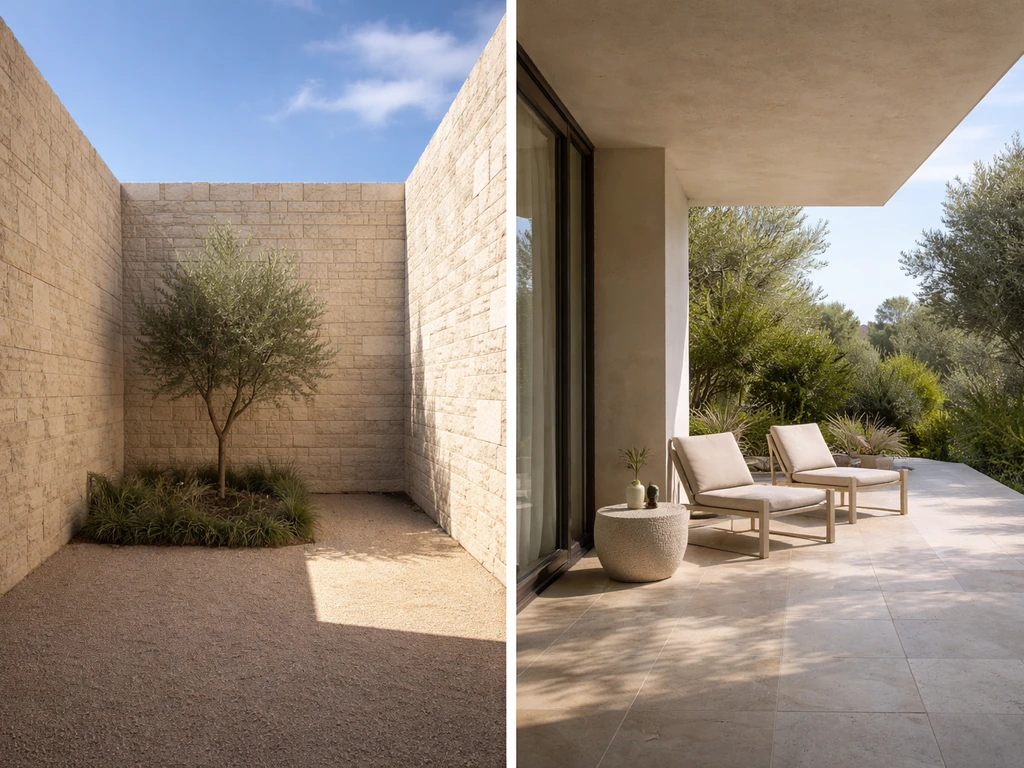
A courtyard is defined by enclosure, not surface or roofing. Cambridge Dictionary defines “courtyard” as an enclosed yard or space, which matches that enclosure-based definition A courtyard is defined by enclosure.
Oxford Learner's Dictionaries describes it as "an open space that is partly or completely surrounded by buildings. " A patio can sit against one wall of a house and open onto a garden; a courtyard is hemmed in on multiple sides. Many Spanish-style and Mediterranean homes have internal courtyards that people casually call patios, which is understandable given that the Spanish word "patio" literally translates to "courtyard" in English (both Cambridge and Larousse confirm this).
That Mexico origin is why you still see many Spanish-style courtyards called patios, even when they function a bit differently from a modern outdoor slab patios originally built in Mexico. That translation overlap is its own rabbit hole worth exploring separately.
How real estate listings and official documents describe patios
If you're searching listings or filling out a permit application, the terminology gets more structured. Zillow and MLS forms use combined labels like "Patio & Porch" with sub-descriptors: Covered, Open, Screened, Enclosed. A single property might have entries for Patio, Deck, Terrace, Courtyard, and Lanai as separate checkboxes on an blank" rel="noopener noreferrer">MLS input form. That means real estate data doesn't treat these as synonyms at all, it treats them as distinct feature types.
In practice, if you're searching for a home with a specific kind of outdoor space, use the precise term in your filter. Searching for "terrace" in a US market may return fewer results than "patio" for the exact same type of space, simply because listing agents in that market default to one word or the other. In British or Australian markets, the opposite may be true. Local convention matters as much as dictionary definitions here.
Planning and permit documents tend to be the most literal. City guidelines (like those used in Cambridge, MA) define a patio as an outdoor area that must be "directly in front of, adjacent to and contiguous" with the building, and they treat it as a distinct regulated category from decks or enclosed porches. If you're pulling a permit or filling out a zoning form, use whatever term the local authority uses in their own documents, not a synonym.
Regional and cultural naming differences worth knowing
The word you reach for first often depends on where you grew up or where you live now. Here's a quick map of how the terminology shifts by region.
- United States: "Patio" is the dominant term for a ground-level hard-surfaced outdoor area at the rear of a home. "Deck" takes over when the surface is wood or elevated. "Porch" covers the roofed front or back entrance area.
- United Kingdom: "Terrace" is more commonly used where Americans would say patio. "Patio" is understood but slightly less natural in everyday British speech.
- Australia and New Zealand: "Verandah" (with the h) is common for a roofed outdoor area attached to the house. "Patio" is used, but can refer to roofed structures too, which differs from the US definition.
- Hawaii and parts of the US South: "Lanai" refers to a covered, often screened outdoor living space. It appears on MLS forms in Florida and Hawaii as a distinct property feature.
- Spanish-speaking contexts: "Patio" in Spanish refers to a courtyard, typically enclosed. The modern English "patio" borrowed the Spanish word but narrowed its meaning to an open, uncovered backyard space. This is why translating between the two requires care.
The Spanish connection is especially interesting for anyone researching patio history or trying to understand why the English word exists at all. The original Spanish patio was an interior courtyard, often found in Mexican colonial architecture, enclosed on all four sides. That original meaning is closer to what English speakers now call a courtyard than what we call a patio today. If you're curious about that history or how to say patio in Spanish, those are genuinely separate questions worth digging into. If you just need the phrase, you can ask for a “patio” and you will be understood how to say patio in Spanish.
How to pick the right word for your space
Work through these questions in order and you'll land on the most accurate term every time.
- Is it above the ground floor? If yes, it's a balcony (or a rooftop terrace if it's on top of a building).
- Is it enclosed or semi-enclosed by walls or the building on multiple sides? If yes, it's a courtyard.
- Does it have a roof or overhead cover? If yes, it's a porch (if it's at the entrance), a veranda/verandah (if it runs along the side), or a lanai (if it's screened, especially in Hawaii or Florida).
- Is the surface wood or composite and elevated above grade? If yes, it's a deck.
- Is it ground-level, hard-surfaced (concrete, stone, brick, pavers), open to the sky, and connected to the house? That's a patio. In British English, you'd likely call it a terrace.
- Is it formal, slightly raised, or attached to a restaurant, hotel, or public building? Terrace is usually the better word in those contexts.
If you're writing a real estate listing, use whatever term the local MLS form uses as its primary label, then add descriptors (covered, open, screened, enclosed) to give buyers the actual picture. If you're just describing your space to a friend or contractor, patio, terrace, and deck are close enough that the context will handle any ambiguity. Where it matters to get it right is in permits, listings, and insurance documents, and in those cases, the physical features of the space should always drive the word choice, not personal preference.
FAQ
When should I avoid using “patio” and pick a different word instead?
In most real estate and permit contexts, “patio” is best reserved for an uncovered, ground-level, hard-surfaced area tied to the house. If any one of those is off, switch terms, for example “deck” for elevated wood, “veranda” for a roofed side space, or “courtyard” when it is enclosed on multiple sides.
If my outdoor space has a table and chairs, can I still call it a patio even if it is partly covered?
Don’t rely on the presence of furniture. A covered area used for dining, even if it feels like a patio, is typically classified as porch or veranda in listings that use “covered vs open” descriptors.
What is the best search strategy if I want to find homes with the same kind of patio but listings use different words?
For filters and searches, try both the likely local label and the closest alternative. For example, if you are searching in the US, check “patio” and “terrace,” but if you are in a market where agents prefer “terrace,” you may need “terrace” as your primary term to avoid missing matches.
Can “sun deck” be used as another word for patio?
Yes, but be consistent about what you mean. A “sun deck” is often a deck-like outdoor surface, usually open to the sky, but it can be coded as a distinct feature in some databases. If the surface is ground-level and uncovered, “terrace” or “patio” may fit better than “sun deck” in some contexts.
Is “lanai” interchangeable with “patio” in everyday English and on listings?
In English listings, “lanai” usually points to a ground-level, often residential outdoor room in certain regions (commonly associated with Hawaii). Because it is regionally specific, it can be more confusing than “terrace” or “deck” when you are describing a space outside that area.
How do I choose between “patio,” “veranda,” and “porch” when the space runs along the side of the house?
If it wraps around the house with a roof and connects to exterior doors, it is more often called a veranda (or porch in North American usage). If the space is open, uncovered, and flush with the ground, it is more often patio or terrace.
What if my space looks like a patio but it is reached from an upstairs door, is it still a patio?
Usually not. “Balcony” implies an upper-level platform reached from an upstairs door, plus a railing. If you have to step down from an upper floor but the actual sitting area is at ground level, re-check whether the structure is truly elevated or just has raised decking.
What should I do if my permit or insurance form forces me to choose only one term?
In permits and insurance paperwork, use the exact term used by the form, then describe the physical attributes in the notes if there is room. If the form offers separate checkboxes, do not mark multiple fields as “close enough,” because these categories can affect approvals and coverage.
How should I label an interior or semi-enclosed outdoor area that people sometimes call a patio?
If the space is enclosed by walls on multiple sides, especially interior-facing in styles like Spanish or Mediterranean architecture, “courtyard” is usually the safest choice. If it is open to one side and functions like an outdoor slab by the home, “patio” is often more accurate.
I’m talking to a contractor, should I worry about exact wording, or focus on describing the features?
When you describe it verbally to a contractor, you can start with “patio” but confirm the key specs: ground level or raised, uncovered or covered, and whether it is enclosed. If you tell them those three details, the exact word becomes less critical than matching the correct scope for construction and materials.
Next Article
How to Say Patio in Spanish: Meaning, Pronunciation
Translate patio into Spanish, get native pronunciation, meaning, and choose the right word in real estate listings.