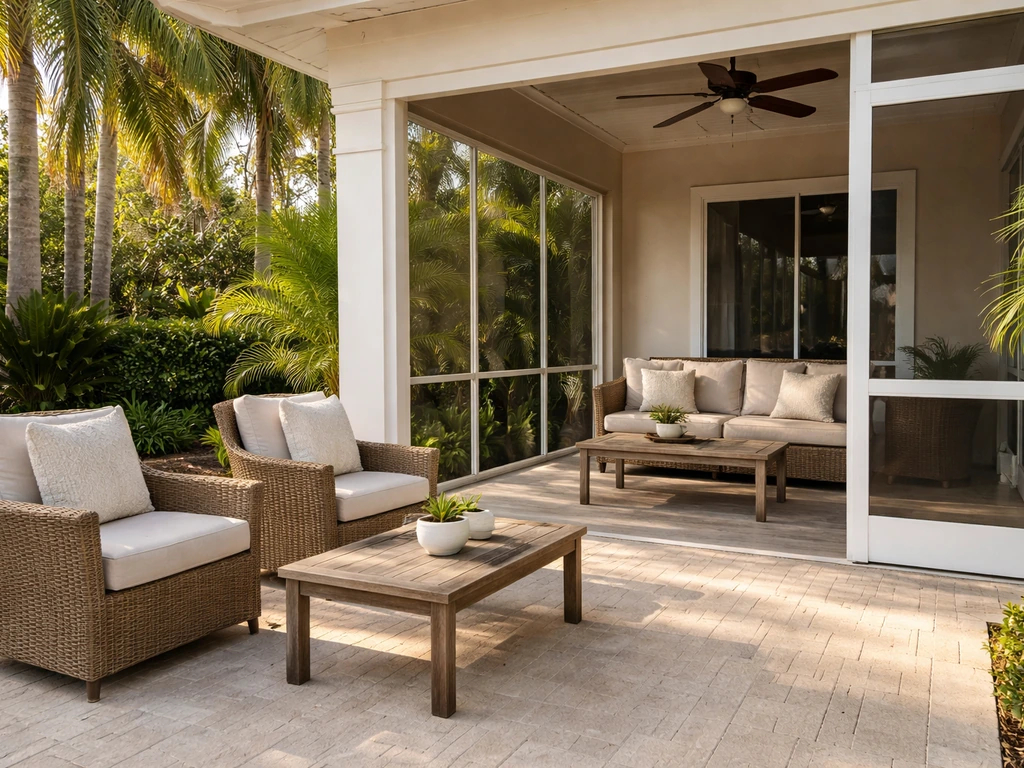
Title: Lanai Definition vs. Patio: What's the Difference and How Each Term Is Used
Lanai Definition vs Patio: Clear Differences & Usage

Ada Hollis
15 Jul 2026
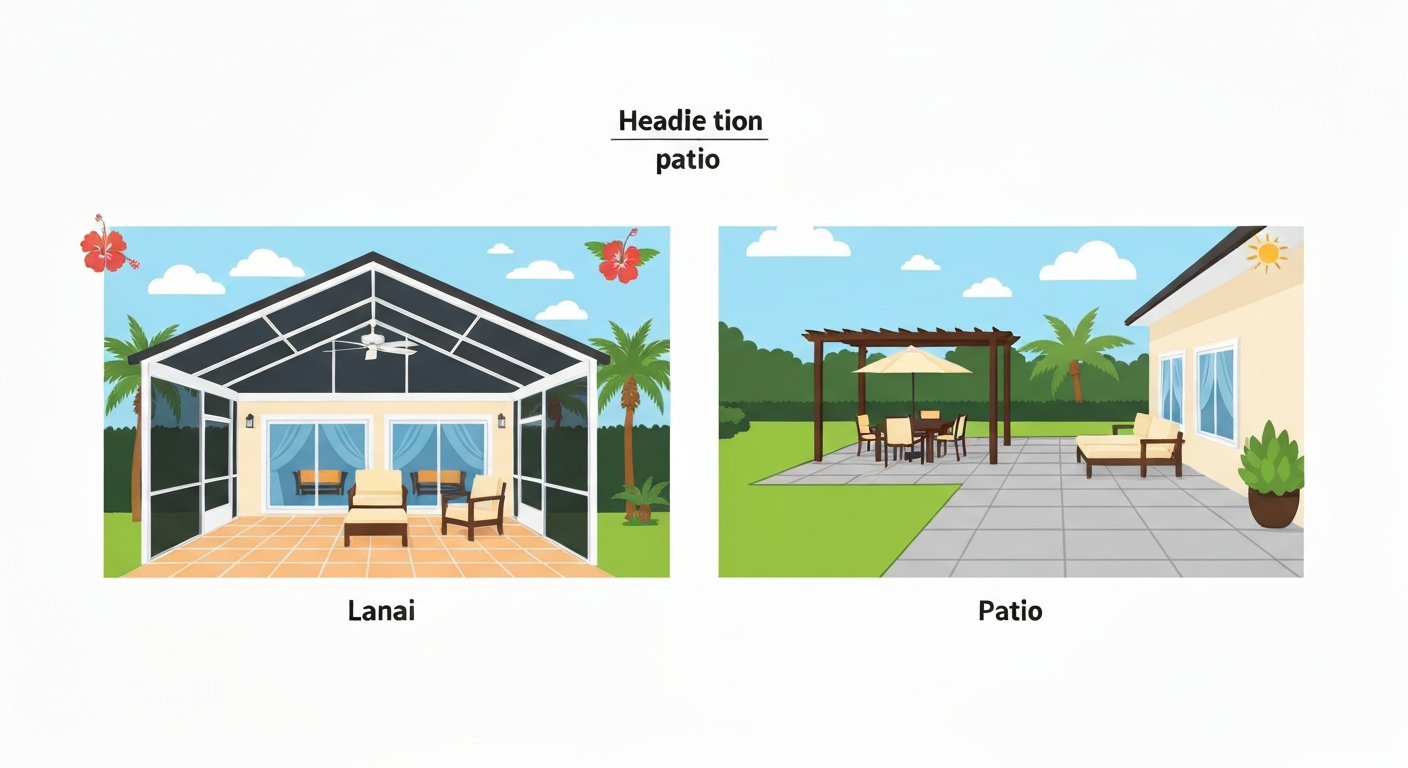
Description: Learn the difference between a lanai and a patio, including regional uses in Hawaii and Florida, related outdoor terms, and real estate implications.
A lanai is a roofed, covered porch or veranda, a word borrowed directly from Hawaiian, while a patio is an open, ground-level outdoor surface adjoining a home, typically paved and open to the sky. The two terms overlap in everyday speech, especially in Florida, but they are not the same thing. A lanai implies overhead coverage and often some degree of enclosure or screening. A patio implies an open-air surface. Knowing which is which matters when you're reading a real estate listing, planning a renovation, or pulling a permit.
What each word actually means
Merriam-Webster defines lanai simply as "a roofed porch; veranda," tracing it to the Hawaiian word lānai, with the first recorded English use in 1823. Merriam‑Webster defines lanai as "a roofed porch; veranda," tracing it to Hawaiian lānai and recording its first known English use in 1823 Merriam‑Webster defines lanai as "a roofed porch; veranda.". Hawaiian lexical sources (Pukui and Elbert) describe the original lānai as a roofed structure with open sides, essentially a covered platform or porch attached to a building. The defining feature has always been the roof overhead, not the flooring beneath.
Patio has a different origin entirely. It comes from Spanish, where patio means an inner courtyard, typically open to the sky and enclosed by the walls of a building on multiple sides. In modern American English, Merriam-Webster extends this to mean any paved recreation area adjoining a dwelling, think a concrete or paver slab behind a house used for outdoor dining. See PATIO Definition & Meaning - Merriam‑Webster for a definition that calls a patio a courtyard open to the sky and a paved recreation area adjoining a dwelling. The critical distinction is that a traditional patio has no roof. It is exposed.
In casual conversation, many people use "lanai patio" as a compound to describe a covered or screened outdoor living area. That phrase is technically imprecise, it blends two different concepts, but it communicates what most people mean: a sheltered outdoor space attached to the home. If you see it in a listing, it almost always means a covered, often screened, ground-level structure.
Lanai vs. patio: a direct comparison
| Feature | Lanai | Patio |
|---|---|---|
| Roof or overhead cover | Yes — by definition roofed or covered | No — traditionally open to the sky |
| Screening or enclosure | Often screened or partially enclosed; can be fully enclosed | Rarely screened; usually open on all sides |
| Attachment to home | Attached and integrated with the structure | Attached at ground level or freestanding |
| Floor level | At or near grade; occasionally slightly elevated | At grade (ground level) |
| Floor material | Concrete slab, tile, pavers, or wood decking | Concrete, pavers, brick, stone, gravel |
| Cultural/linguistic origin | Hawaiian (lānai) — first recorded in English 1823 | Spanish (patio — inner courtyard) |
| Typical use in real estate listings | Common in Hawaii and Florida MLS listings | Used nationally across all U.S. markets |
| HVAC or climate control | Usually not conditioned (open-air or screened) | Not conditioned — fully open air |
The practical upshot: if a space has a roof attached to the house and screens or walls on the sides, call it a lanai. If it's a flat, open slab behind the house with no covering, it's a patio. Real estate agents and appraisers in Hawaii and Florida do treat these differently, and the distinction can affect square footage calculations and listing accuracy.
How a lanai differs from a porch, balcony, veranda, courtyard, and terrace
These terms get mixed together constantly. Here's how each one is actually defined, and what separates them from a lanai.
Porch
A porch is a covered structure attached to the exterior of a home, most often at the front or back entrance. It has a roof supported by posts or columns, and it sits at or near the same level as the first floor. A lanai is essentially a Hawaiian and Florida variation of a porch, the words describe very similar structures, with "lanai" being the regional preference in certain parts of the U.S.
Balcony
A balcony is an elevated platform projecting from an upper floor of a building, enclosed by a railing. It is not at ground level. Hawaii's administrative rules actually group lanai and balcony together in land-use definitions, requiring that at least one side be permanently open to the exterior and that open sides make up at least 25% of the perimeter, a meaningful legal distinction used in floor-area calculations.
Verandah (or veranda)
A verandah is a roofed, open-sided platform that wraps around one or more sides of a house, typically at ground level or the first floor. It's one of the closest cousins to a lanai, Merriam-Webster even defines lanai as a "veranda." The difference is mostly geographic and cultural: verandah is the common term in Australia, New Zealand, South Asia, and parts of Britain. In Hawaii and Florida, the same space gets called a lanai.
Courtyard
A courtyard is an outdoor, unroofed space enclosed (partially or fully) by the walls of a building or buildings. It's open to the sky, which puts it closer to a patio than a lanai. The original Spanish meaning of "patio" was essentially a courtyard, which is why the two words are sometimes used interchangeably in architecture.
Terrace
A terrace is a flat, raised outdoor area, either at ground level or on a raised platform, and it is almost always open to the sky. In British English, "terrace" can also refer to a row of townhouses. In American residential design, a terrace typically means a paved or landscaped outdoor platform, essentially a more formal version of a patio. Neither a terrace nor a patio implies a roof; a lanai always does.
How "lanai" is used in Hawaii
In Hawaii, lanai is the standard everyday word for what the rest of the country might call a porch, patio, or balcony. It appears on single-family homes, condominiums, and apartment buildings alike. The word is so embedded in local real estate practice that Hawaii's MLS (HiCentral) includes dedicated data fields for "SQFT Covered Lanai" and "SQFT Open Lanai Area" on property listing sheets. These are formal, tracked attributes, not marketing language.
A covered lanai in a Hawaii listing means a roofed outdoor living area with a roof overhead, often with open or screened sides. An open lanai is an elevated or ground-level platform without a roof, functionally similar to a deck or open patio. Both count separately in Hawaii real estate documentation. If you're shopping for a home in Honolulu or Maui, the lanai square footage in the listing is a legitimate measurement with practical implications for how you use the space and how it's valued.
The Pukui and Elbert Hawaiian dictionary records lānai as a historic structural term describing a roofed, open-sided platform attached to a dwelling, consistent with how it's used today. What is a patio called in Hawaii? Almost always a lanai, regardless of whether it has a roof. The word has become the all-purpose term for attached outdoor living space across the state.
How "lanai" and "patio" are used in Florida
Florida has borrowed the word lanai heavily from Hawaiian usage and applied it to a specific type of outdoor structure that's especially common in the state's warm, humid climate: the screened lanai. In Florida construction and real estate, a lanai almost always refers to a covered, screen-enclosed outdoor room attached to the back of the house. It sits on a concrete slab, has an aluminum or structural roof overhead, and is wrapped in aluminum-framed screen panels to keep out insects while allowing air circulation.
Florida builders and contractors market screened lanai packages and lanai enclosure services explicitly. Walk through any new-construction community in Central Florida, Southwest Florida, or the Tampa Bay area and you'll see this structure on the majority of homes. It's a near-standard feature, not an upgrade, in many Florida subdivisions.
The word "patio" in Florida usually refers to the open, uncovered concrete or paver slab that may exist outside the screened lanai, or as a simpler outdoor space on a property that doesn't have a full lanai enclosure. In Florida listings on Realtor.com or Zillow, you'll commonly see both terms in the same description: "screened lanai with adjacent patio area." Patio means no roof; lanai means covered and screened. Understanding that distinction helps you read listings accurately. For a deeper dive into what outdoor spaces are called in the Sunshine State, the topic of what a patio is called in Florida has additional regional context worth reviewing.
What "patio home" means in Florida real estate listings
"Patio home" in a Florida listing has nothing to do with whether the property has a patio or lanai. It's a real estate classification term describing a housing type: typically a small single-family detached home on a compact or zero-lot-line lot, often in a cluster or planned community with shared HOA maintenance. The appeal is low-maintenance living with some private outdoor space, but the lot is small, often with minimal yard.
The Winter Haven, Florida municipal code offers a formal example: the city's ordinances define "patio home" explicitly as a planning and zoning classification, establishing minimum lot sizes and setbacks for this housing type. Other Florida municipalities have similar provisions, though the specific requirements vary. Industry sources like Angi and Redfin note that patio home is a flexible marketing label with no consistent federal legal definition, what qualifies in one county may not in another.
If you're a buyer considering a patio home in Florida, check the actual municipal code and HOA documents, not just the listing label. You want to know what the HOA maintains, what the setbacks are, and whether there's actually a covered outdoor space (lanai or patio) included. The name "patio home" does not guarantee any particular outdoor structure. The topic of patio homes in Florida real estate covers these distinctions in more detail.
Types of lanais and covered patios: what to expect
Not all lanais and covered patios are built the same way. The most common configurations you'll encounter in listings and contractor quotes fall into a few clear categories.
Screened lanai
This is the most common type in Florida. It's a concrete slab under an aluminum-frame roof structure, with aluminum-framed screen panels enclosing the sides. The space is not air-conditioned, it's open to the outside air through the screen mesh, so temperatures follow the outdoor ambient. Screen keeps out insects, debris, and some UV. Size varies widely: a typical Florida screened lanai runs anywhere from 150 to 400 square feet, though larger custom versions can exceed 600 square feet. Common additions include ceiling fans, outdoor-rated lighting, and tile or paver finishes over the slab.
Covered patio
A covered patio adds a roof over an otherwise open patio slab, often as a pergola, attached aluminum cover, or solid roof extension. The sides remain open, no screens or walls. This is a common configuration in drier climates where insects are less of a concern but shade matters. Materials include aluminum pan covers, wood pergolas, and insulated metal panel roofs. A covered patio is warmer than a screened lanai in direct sun because hot air doesn't circulate as freely.
Enclosed sunroom or Florida room
A sunroom (sometimes called a Florida room) takes the screened lanai one step further: it replaces the screen panels with glass or polycarbonate glazing and typically adds HVAC. This converts the space into something closer to conditioned living area. Contractor guidance and HomeAdvisor data make clear that converting a screened lanai to a glazed sunroom is a significantly larger project, it requires structural upgrades, new foundation/roof ratings, permits, and electrical work. A sunroom can qualify as habitable square footage on an appraisal; a screened lanai generally does not.
Materials and common additions
- Floor: Concrete slab (most common), ceramic or porcelain tile, natural stone pavers, travertine, brick
- Roof/frame: Aluminum pan system (Florida), wood or steel framing, attached to the home's existing roofline
- Screening: Fiberglass mesh screen (standard), no-see-um mesh (finer weave for smaller insects), solar screen (reduces heat gain)
- Ceiling fans: Near-standard in Florida lanais — 52-inch outdoor-rated fans improve comfort significantly
- Lighting: Recessed outdoor-rated cans, pendant lights, or string lights along the ceiling
- Furniture and outdoor kitchen: Many homeowners add built-in grills, sink stations, and outdoor sofas in larger lanais
Real estate listings, property value, permits, and maintenance
How lanais and patios appear in listings
In Hawaii, lanai square footage is tracked separately by the MLS with dedicated fields. A covered lanai adds measurable value and should be listed accurately with dimensions. In Florida, a screened lanai is typically described in the listing narrative and may be noted in lot features or room lists. It generally does not count toward the home's conditioned square footage unless it has been enclosed and permitted as a sunroom. Open patios are usually not assigned separate square footage in most U.S. MLS systems outside of Hawaii.
Property value and ROI
The Cost vs. Value Report (Remodeling/JLC) national data show that a backyard patio project typically recoups around 46% of its cost at resale, meaning it adds value but not dollar-for-dollar. Screened lanais in Florida markets often fare better locally because they are expected features in many price brackets, and their absence can hurt a home's desirability more than their presence adds to it. Sunroom additions tend to recoup a lower percentage of cost at resale than outdoor patio projects in most markets, according to the same data. The practical advice: add a screened lanai or patio because you'll use it, not primarily as an investment vehicle.
Permits and zoning
Building permit requirements vary by county and municipality, but the general rule is: a simple open patio slab at grade often requires only a basic permit or none at all, while a covered lanai with an attached roof structure will require a building permit in virtually every Florida and Hawaii jurisdiction. Converting a screened lanai to an enclosed sunroom almost always triggers a full building permit with structural review, new load calculations, and in some cases a re-inspection of the foundation. Always check with your local building department before starting work, operating without permits can complicate a future sale.
Maintenance differences
- Open patio: Lowest maintenance — occasional pressure washing, re-sealing pavers every 2-3 years, replacing cracked sections
- Screened lanai: Annual screen inspection for tears or holes, cleaning aluminum frames, checking for corrosion at fastener points in coastal areas, replacing damaged screen panels (typical cost: $1–$3 per square foot for screen replacement)
- Covered patio (no screens): Clean the roof surface periodically, check attachment points to the house for water intrusion, maintain any wood components against rot
- Enclosed sunroom: Highest maintenance cost — HVAC servicing, glazing seal inspections, structural checks, and the same maintenance demands as interior living space
Which term to use in listing photos and descriptions
If you're writing a listing or labeling listing photos, use the term that accurately describes the structure: call a screened, covered space a lanai (especially in Hawaii or Florida where the term is standard); call an open, uncovered slab a patio. Don't call an open concrete pad a lanai to make it sound more appealing, buyers in these markets will notice. If the space is enclosed with glass and conditioned, it's a sunroom or Florida room, not a lanai, and mislabeling it can create disclosure issues.
For listing photos specifically: photograph a screened lanai from outside looking in through the screen to show its scale, and from inside looking out to show the view. For a patio, shoot from above or at a low angle to communicate the size and surface quality. Both spaces photograph best in late afternoon light, when shadows define the space without harsh overhead glare.
Quick reference: which term fits your space
| Your space looks like this | The right term |
|---|---|
| Open concrete or paver slab, no roof, no walls | Patio |
| Covered slab with roof and screen panels, not air-conditioned | Screened lanai (Florida) or lanai (Hawaii) |
| Covered slab with roof, open sides, no screens | Covered patio or covered porch |
| Glazed enclosure with HVAC, attached to house | Sunroom or Florida room |
| Elevated platform on upper floor with railing | Balcony (or lanai in Hawaii condo context) |
| Covered structure wrapping around exterior of house | Verandah or porch |
| Open, sky-exposed space enclosed by building walls | Courtyard |
| Small single-family home on compact lot in a planned community | Patio home (real estate classification — not a space type) |
The lanai vs. patio question comes up constantly in home buying, renovation planning, and listing descriptions, and it matters more than most people realize. Getting the terminology right helps you read listings accurately, pull the right permits, and make decisions about your outdoor space with clear expectations. A lanai keeps you outside while keeping insects and rain out. A patio gives you open sky and fresh air with no filter. Both are worth having; they're just different tools for different kinds of outdoor living.
FAQ
Concise SEO‑friendly title and meta description (≤160 characters)
Title: Lanai vs Patio: Clear Definitions, Differences, and Real‑Estate Guidance Description: Define lanai and patio, compare features, regional usage (Hawaii/Florida), and listing/permit tips.
What is a lanai (plain‑language definition)?
A lanai is a roofed, often open‑sided porch or veranda originating in Hawaii. In everyday use it means an outdoor living area attached to a home that usually has a roof and may be open, screened, or partly enclosed.
What is a patio (plain‑language definition)?
A patio is an outdoor area next to a house used for dining or relaxing, typically at ground level and usually open to the sky. Patios are often paved and can be uncovered, covered, or screened.
Side‑by‑side comparison: lanai vs patio (features, roof/screening, attachment, floor level, cultural origin)
Features: Lanai—roofed porch/veranda; Patio—paved outdoor area for dining/relaxing. Roof/Screening: Lanai—commonly roofed and frequently screened or partly enclosed; Patio—often open, sometimes covered or screened. Attachment: Both attach to the house, but 'lanai' implies a defined porch area; 'patio' can be an extension of yard hardscape. Floor level: Lanai—usually same level as interior floor or slightly elevated; Patio—usually ground level. Cultural origin: Lanai—Hawaiian term (lānai) historically meaning a sheltered veranda; Patio—Spanish origin, meaning an inner courtyard or open outdoor space.
How do related terms differ: porch, balcony, verandah/veranda, courtyard, terrace?
Porch—roofed entrance/covered area attached to the front or back of a house (can be enclosed or open). Balcony—elevated platform projecting from an upper floor with a railing. Verandah/veranda—long, roofed gallery or porch, often wrapping around a home (similar to lanai in meaning). Courtyard—enclosed outdoor space typically surrounded by walls or buildings. Terrace—raised flat outdoor area, often paved; can be at ground or elevated level.
What does 'lanai' mean in Hawaii and how is it used in local listings and rules?
In Hawaii 'lanai' is the standard term for a roofed porch or veranda and appears as a distinct MLS field (e.g., 'covered lanai', 'open lanai area'). Local administrative rules may define lanais for zoning/floor‑area calculations (often as an accessory area with open sides).
Next Article
What Is a Patio Called in Florida? Lanai and More
Florida patio term guide: what lanai means, how it differs from porch, balcony, veranda, and courtyard spaces.