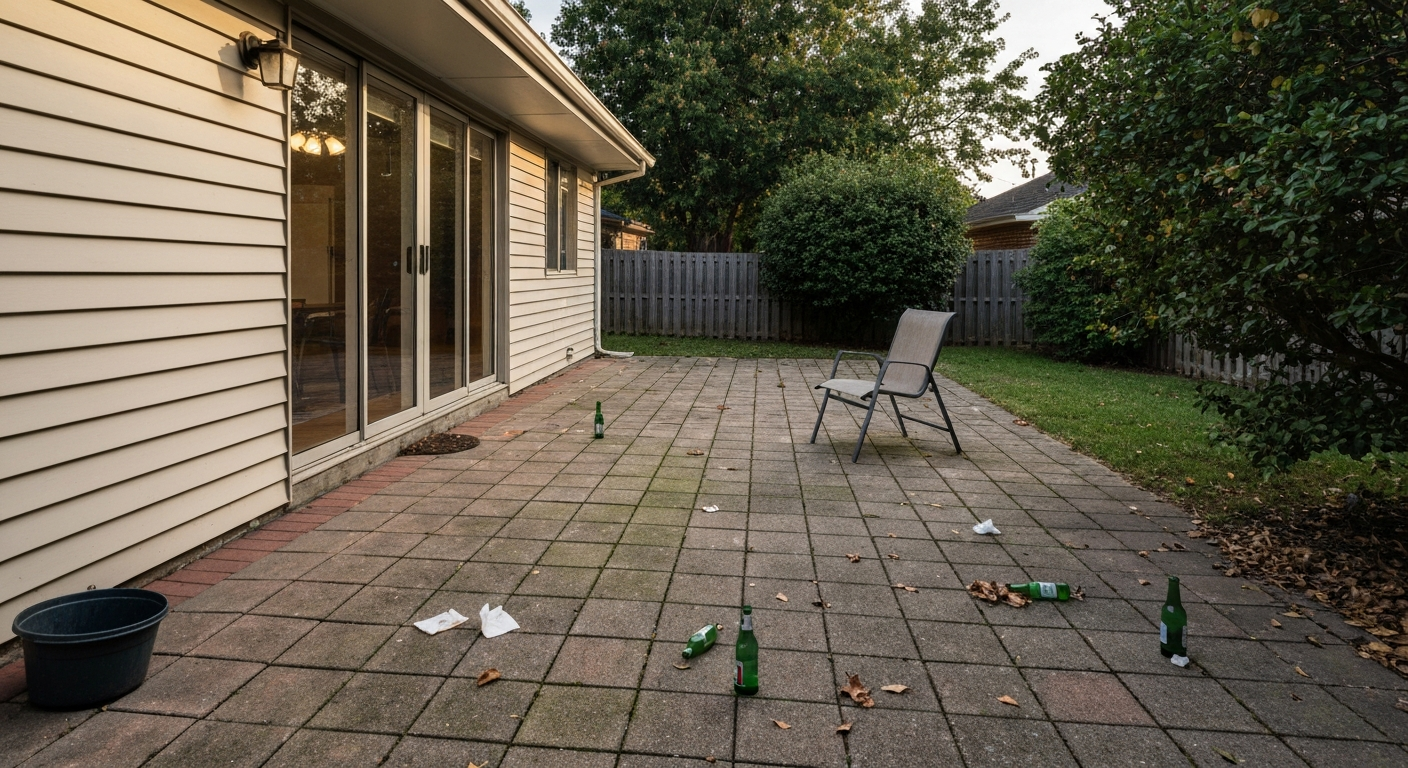
A littered patio is an outdoor hard-surface area next to a home that has debris, waste, or scattered objects strewn across it. That debris might be windblown trash, fallen leaves, food and drink remnants from a recent gathering, misplaced furniture, or accumulated household junk. The word 'littered' does not always mean illegal dumping: Merriam-Webster defines it simply as objects scattered about a surface, so in real-estate listings you will sometimes see 'a lot littered with mature trees,' meaning dotted or strewn with them. Context tells you whether the scattering is charming or a problem.
Littered Patio Meaning: Definition, Risks, Cleanup Guide 101

Ada Hollis
27 Jul 2026
What 'littered patio' actually means, word for word
Start with the noun: a patio is a ground-level, hard-surfaced outdoor area attached to a home, typically unroofed and unenclosed, used for relaxing and dining. Cambridge Dictionary is unambiguous on this. Add 'littered' and you are describing that same surface in a state of disorder. The scattering can be light (a few fallen leaves after a storm) or severe (broken furniture, overflowing bins, months of windblown rubbish).
Three distinct subtypes come up constantly in practice. First, the general littered patio: mixed debris from multiple sources including food wrappers, bottles, dirt, and odds and ends. Second, the leaf-littered patio: seasonal or persistent coverage by organic matter, which looks untidy and can harbour pests. Third, the cluttered patio: furniture, planters, tools, and personal items piled up without being 'trash' per se, but making the space unusable and visually chaotic. Each type carries different cleaning demands and different implications for health, safety, and property perception.
Littered vs. cluttered vs. leaf-littered vs. neighbouring outdoor spaces
People use these terms interchangeably, but they are not identical, and the distinction matters when you are writing a listing description, filing a code-compliance complaint, or planning a cleanup. The table below maps out the key differences.
| Space / Condition | What it describes | Typical debris or clutter | Primary concern | Usual remedy |
|---|---|---|---|---|
| Littered patio | Ground-level hard surface strewn with mixed debris | Trash, bottles, food waste, windblown rubbish | Health, pest attraction, code violation | Sweep, bag rubbish, pressure-wash |
| Cluttered patio | Hard surface filled with accumulated belongings that are not necessarily trash | Excess furniture, tools, planters, boxes | Visual disorder, unusable space | Edit, store, or donate items; rearrange furniture |
| Leaf-littered patio | Hard surface covered by fallen organic matter | Leaves, twigs, pine needles, seed pods | Pest harborage, slip hazard, fire risk near structures | Blow or sweep leaves, treat moss/algae, seal surface |
| Porch | Covered structure attached to front or rear of a home, often raised | Similar debris types apply | Enclosed feel; debris trapped under roof | Same cleaning methods; check gutters overhead |
| Balcony | Elevated platform projecting from an upper floor | Lighter debris blown by wind | Drainage blockage, structural weight limits | Regular sweeping; avoid heavy accumulations |
| Verandah | Roofed gallery wrapping one or more sides of a home (common in South Asian and Australian architecture) | Dust, leaves, cobwebs | Airflow blockage; pest entry points | Sweep, wipe railings, check screens |
| Courtyard | Enclosed outdoor area surrounded by walls or building wings | Trapped debris with no wind escape | Debris accumulates faster; drainage critical | Regular clearing; ensure drain channels are open |
Who actually cares about a littered patio
Homeowners
For homeowners, a littered patio is mostly a maintenance signal. Left unchecked it signals neglect to neighbours and visitors, invites pests, and can lead to municipal code notices. Homeowners in HOA communities face an additional layer: many association rules adopt language requiring exterior property to be free of debris, trash, and junk. Violations can trigger written warnings and fines. On the practical side, a persistently littered patio loses its livability quickly. A surface you want to use for morning coffee or weekend barbecues becomes unappealing and eventually unsafe.
Renters
Renters face a dual concern. If a patio arrived littered at move-in, documenting it with date-stamped photos before signing a lease protects against deposit deductions at move-out. If a renter has allowed debris to accumulate during tenancy, most standard lease agreements and local property maintenance codes treat that as a lease violation. Many municipal codes (modelled on the International Property Maintenance Code) explicitly require exterior premises to be free of accumulations of debris, litter, and garbage. That means the obligation often falls on whoever is in possession of the space.
Real-estate shoppers and sellers
For buyers, a littered patio in listing photos or at a showing raises a question about overall property maintenance. Research from the National Association of REALTORS' 2025 Profile of Home Staging confirms that outdoor presentation materially affects buyer interest and the ability to visualise living in the space. A littered or cluttered patio can push perceived value down without the underlying structure having any actual defect. Sellers, by contrast, have a clear incentive to sweep, stage, and photograph a clean patio: professional listing-prep checklists routinely call out sweeping patios, removing visible debris, hiding hoses and bins, and arranging furniture into a single cohesive seating vignette before any photography session.
Common causes of a littered patio
- Wind: the most overlooked cause. Even a clean patio collects leaves, wrappers, and seed pods overnight after a moderate breeze.
- Food and drink gatherings: bottles, cans, napkins, and food packaging left after patio dining or a patio party are the most visible short-term cause.
- Seasonal leaf fall: deciduous trees drop leaves that mat down, retain moisture, and accelerate moss and algae growth on concrete and pavers.
- Furniture and equipment accumulation: broken loungers, unused patio tables, spare plant pots, and garden tools create a cluttered-littered hybrid.
- Pest activity: rodents and raccoons scatter bin contents; birds drop food debris; insects bring organic matter into gaps in paving.
- Construction or renovation projects nearby: dust, offcuts, and packaging material migrate onto adjacent outdoor surfaces.
- Neglected gutters: gutters that overflow deposit debris directly onto patios below.
Health, safety, and pest risks you should not ignore
Leaf litter and mixed debris are not just cosmetic problems. University extension entomology research identifies accumulated organic matter near foundations as a primary harborage zone for cockroaches, ants, spiders, and other arthropods. Terminix and Orkin both list leaf litter, mulch piles, and patio debris among the most reliable cockroach and rodent attractants. The University of Missouri and University of Florida IFAS extensions flag leaf piles and groundcover debris as cover and nesting sites for voles and mice.
Rodent activity carries real health implications. The CDC identifies rodent droppings, urine, and nesting material as transmission routes for hantavirus and other diseases, and recommends removing outdoor debris that attracts rodents as a baseline prevention step. Tick management research published by the National Collaborating Centre for Environmental Health identifies leaf litter and shaded groundcover as preferred tick habitat and recommends removing leaf litter and creating gravel or wood-chip barriers at patio perimeters to reduce tick encounters.
There is also a fire angle that rarely gets discussed in suburban contexts. The Colorado State Forest Service and NFPA Home Ignition Zone guidance both flag accumulated leaf litter, pine needles, and combustible debris near patios and decks as an ignition risk from wind-driven embers. The recommendation is to keep the 0-5 foot zone immediately around any structure clear of leaf litter and combustible debris. The Home Ignition Zone, Colorado State Forest Service recommends keeping the 0–5 ft zone immediately around structures clear of leaf litter and other combustible debris blank" rel="noopener noreferrer">The Home Ignition Zone — Colorado State Forest Service. In dry climates or during drought conditions, that guidance applies even to urban residential patios.
Legal and property code implications
Most municipalities that enforce property maintenance standards use IPMC-based language requiring exterior property to be 'free from any accumulation of debris, trash, litter, garbage, or junk. The City of Apache Junction's Property Maintenance Standards require exterior property to be 'free from any accumulation of debris, trash, litter, garbage or junk.' Property Maintenance Standards — City of Apache Junction (example municipal code requiring exterior property free of debris). ' Enforcement typically starts with a written notice, followed by escalating fines if the condition is not corrected within a set period. Some jurisdictions allow the municipality to clean the property and bill the owner. HOA covenants often have shorter timelines and steeper fines than municipal codes because they are contract-based rather than statutory. Knowing which rules apply to your address (city code, HOA rules, or both) determines how quickly you need to act and who is responsible for acting.
Cleaning a littered patio: practical steps and costs
The basic cleanup sequence
- Remove large items first: pick up furniture, planters, and anything that does not belong on the surface.
- Bag all loose debris: sweep leaves, wrappers, and organic matter into bags before any water is applied. Wetting debris makes it harder to remove.
- Blow or sweep remaining dust and fine material off the surface.
- Treat biological growth: apply an oxygen bleach solution or commercial moss/algae treatment to any green or black staining. Let it dwell for the manufacturer's recommended time.
- Wash the surface: concrete and pavers respond well to pressure washing at 1,500-3,000 PSI with a fan tip. Use a lower pressure and a soft-wash approach on natural stone or timber decking to avoid surface damage and joint displacement.
- Rinse thoroughly and allow to dry before replacing furniture.
- Inspect and re-sand joints in paving if washing has dislodged joint sand.
Approximate costs
A basic DIY sweep and bag operation costs nothing beyond your time and bin bags. Renting a pressure washer runs roughly $60-100 per day in most US markets. Hiring a professional pressure-washing company for a standard patio (200-400 square feet) typically costs $150-400 depending on surface type, condition, and region. If moss or algae treatments are included, add $50-100. Full patio staging for a listing (cleaning, furniture edit, accessory placement) handled by a professional stager can range from $200 to $600 for an outdoor area, though many sellers handle this themselves following a staging checklist.
When to call a professional
Hire a pro if the patio surface is natural stone, premium pavers, or hardwood decking where incorrect pressure or cleaning agents could cause irreversible damage. Also call in professional help if there is visible rodent activity, evidence of pest nesting in debris, or if the debris removal is large enough to require a skip hire or specialised disposal. For a standard residential sale, a professional pre-listing cleaning service is often worth the cost purely for the quality of before/after photos.
Staging a patio for photos or a sale
The goal of staging a patio is to help a buyer immediately picture themselves using the space, not to deceive them about its condition. NAR staging research and professional photography prep guides converge on the same practical checklist. Follow it whether you are preparing for a listing photographer or simply want the space to look its best for a party or a rental showing.
- Sweep and pressure-wash the surface at least 48 hours before photography so it has time to dry fully.
- Remove all items that are not part of a deliberate furniture grouping: hoses, bins, children's toys, spare pots, tools.
- Edit furniture down to one cohesive seating vignette: a table with chairs, or a sofa-style lounge arrangement, not both unless the space is large enough to support two distinct zones.
- Add simple accessories: a folded throw, two matching cushions, a potted plant or two. These signal 'liveable space' without cluttering.
- Ensure lighting is functional: replace any burned-out string lights or lanterns.
- Check the surrounding view from the patio: bins, compost heaps, and adjacent structures visible from the patio affect the perceived quality of the space.
- Photograph in the golden hour (early morning or late afternoon) for the most flattering natural light on hard surfaces.
How patio dining, drinks, loungers, parties, and tables connect to litter
Most patio litter has a direct human cause, and the most common one is enjoyable outdoor living left slightly unfinished. Patio dining creates food packaging, napkins, and leftover scraps. For a concise definition of the term and what activities it includes, see patio dining meaning. Patio drinks add bottles, cans, and glasses that are easy to forget when it gets dark. For a concise definition, see patio drinks meaning (internal reference f1e7ac68-ced5-4385-9cd7-24a7147e502b). A patio lounger left in the same position for weeks can trap leaf litter, moisture, and debris underneath it, creating a hidden harborage zone. A patio party is the fastest way to turn a clean surface into a littered one: mixed guest groups, multiple food stations, and late-evening cleanup all contribute. Even a permanent patio table creates litter-collection zones if its legs are close-set and debris blows underneath and becomes trapped. For a clear definition of what is meant by a patio table, see patio table meaning. Understanding these functional patterns helps you build maintenance habits around how you actually use the space, rather than reacting to mess after it builds up. For a concise definition of how gatherings produce outdoor mess, see patio party meaning.
Visual examples: what a littered patio looks like
Photographs are the fastest way to communicate the spectrum from mildly untidy to genuinely problematic. The image types below describe what editorial photography for this topic should capture.
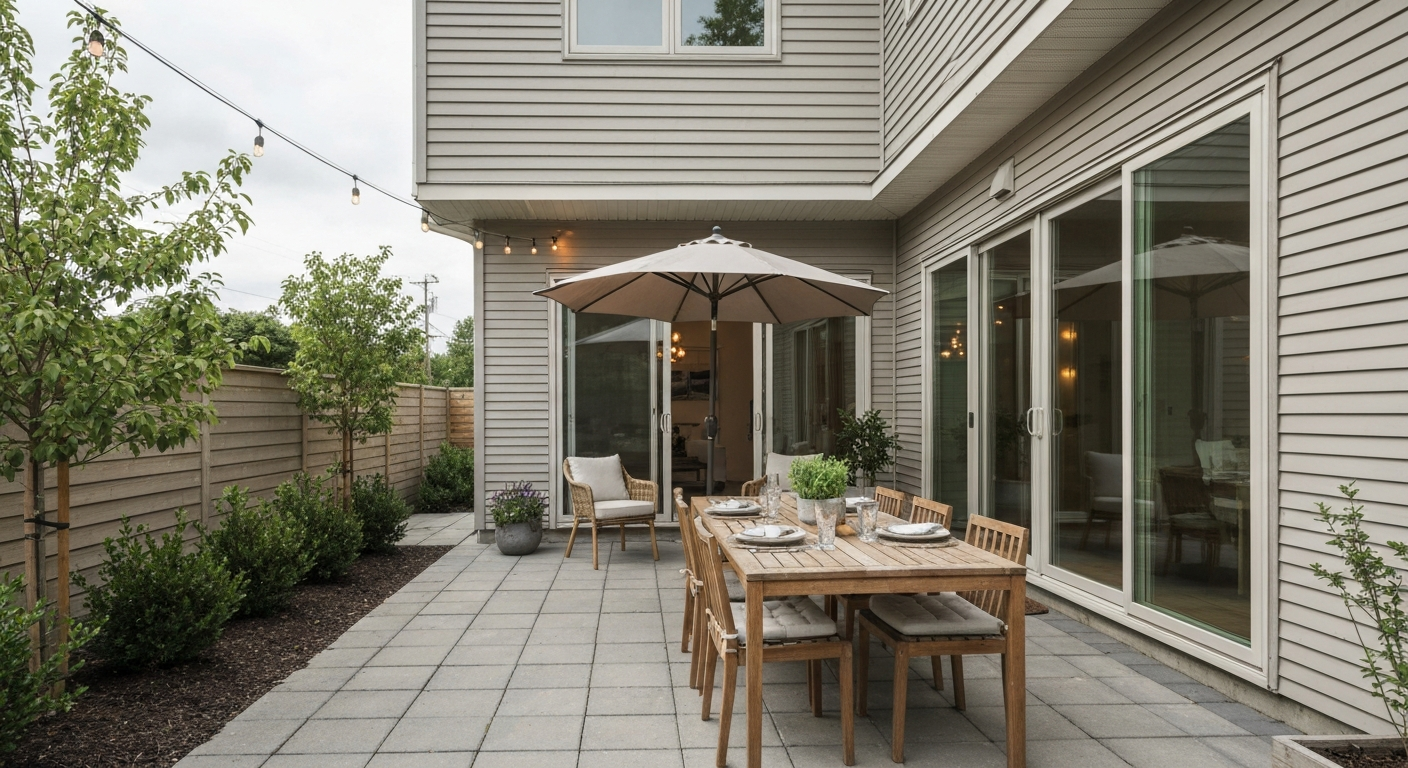
- Before/after pair: the same concrete patio photographed with scattered leaves, empty bottles, and a displaced chair, then again after sweeping, pressure-washing, and minimal staging with a small table and two chairs. Caption suggestion: 'The same 12x14 ft concrete patio before and after a two-hour cleanup and basic staging.'
- Debris close-up: a ground-level macro shot of a paver surface showing mixed leaf litter, windblown crisp packets, and visible algae staining between joints. Caption: 'Leaf litter and organic debris between pavers accelerate joint deterioration and attract insects.'
- Leaf-littered autumn patio: a wide shot of a patio buried in maple or oak leaves, showing how completely a surface can disappear under seasonal drop. Caption: 'A leaf-littered patio in autumn. Leaves mat down quickly and trap moisture that encourages moss.'
- Cluttered vs. littered comparison: side-by-side of a patio crowded with excess furniture and planters (clutter) next to a patio with visible rubbish and food waste (litter). Caption: 'Cluttered means too much stuff; littered means scattered debris. Both reduce usability and buyer appeal.'
- Staged patio after cleanup: a styled outdoor area with a clean stone surface, a small dining set, and a couple of potted plants. Caption: 'A staged patio signals move-in ready condition to buyers and appraisers.'
Regional and cultural phrasing differences
The word 'patio' itself is Spanish in origin (from the Old Spanish meaning inner courtyard or back area of a house), so in Spanish-speaking contexts a littered patio might be described as 'un patio lleno de basura' (a patio full of rubbish) or 'un patio desordenado' (a disordered patio). In British English, 'littered' carries a slightly stronger connotation of antisocial behaviour than the American usage, where it more commonly means simply scattered. In Australian and South African English, the equivalent outdoor hard-surface area is sometimes called a 'paved entertaining area' or simply 'the paving,' and 'littered' tracks closely with the British usage.
In South Asian contexts (Hindi, Urdu), an outdoor ground-level area of this type might be called an 'aangan' (inner courtyard) or simply the 'terrace' in urban multi-storey buildings, where 'littered' translates broadly to 'gaanda' (dirty/messy) or 'bikra hua' (strewn/scattered). Hawaiian residential architecture uses the term 'lanai' for a covered outdoor living area, which functions similarly to a patio but is typically roofed and screened. A littered lanai carries the same maintenance and pest-harborage concerns as a littered patio, with additional attention paid to keeping screens intact so debris does not become a path for insects. These distinctions matter when reading international listings or communicating with neighbours and tenants across language backgrounds.
Maintenance habits that prevent a littered patio
Prevention takes less time than remediation. A five-minute weekly sweep removes the leaf and dust layer before it mats down or stains the surface. A rule of clearing the patio of food and drink items the same evening as a gathering prevents pest activity overnight. Moving furniture slightly away from walls and fences during autumn allows you to blow or sweep underneath without lifting it. Installing a small outdoor bin with a lid on the patio gives guests a clear place for waste during a patio party and dramatically reduces post-event cleanup time. A seasonal deep-clean twice a year (spring and late autumn) handles what weekly maintenance misses. For another relevant comparison, see patio lounger meaning.
FAQ
SEO title and meta description to use for this article
Title: What a “Littered Patio” Means: Definition, Risks, Cleaning & Staging Meta description: Clear definition of “littered patio,” causes, risks, cleaning & staging tips for homeowners, renters and buyers (under 160 characters).
Plain‑English definition: What does “littered patio” mean?
A littered patio is an outdoor, ground‑level paved area (next to a home) that has trash, food/drink debris, scattered personal items or windblown rubbish strewn across it. 'Littered' emphasizes items lying about or scattered; it does not always imply illegal dumping—sometimes it simply means untidy or strewn.
Who should care about whether a patio is littered?
Homeowners (maintenance, fire/pest prevention), renters (lease compliance, security deposits), real‑estate shoppers and agents (curb appeal, staging), HOAs and landlords (property‑maintenance enforcement), and public‑health or pest professionals (infestation risks).
Visual examples and caption text suggestions for images
Image A (before): patio with food wrappers, disposable cups, windblown plastic and leaf piles — caption: “Littered patio before cleanup: food and windblown trash.” Image B (after): same patio swept, furniture arranged and planters in place — caption: “After: cleaned and staged patio improves appeal.” Image C: leaf‑littered patio showing heavy leaf piles near foundation — caption: “Leaf‑littered patio: pest and fire risk.” Image D: cluttered patio with stored boxes and stacked chairs — caption: “Cluttered (organized storage) vs. littered.”
How is a littered patio different from a cluttered patio, leaf‑littered patio, porch, balcony, verandah and courtyard?
Comparison highlights: - Littered patio: scattered trash/debris on a ground‑level paved area. - Cluttered patio: many items/furniture intentionally stored or arranged (may be messy but not trash). - Leaf‑littered patio: primarily natural debris (leaves, needles) rather than human trash. - Porch/verandah: usually roofed entry areas attached to house (covered). - Balcony: elevated platform off an upper floor. - Courtyard: enclosed or semi‑enclosed outdoor space often larger and landscaped. (Include a simple comparison table in article showing surface, enclosure, typical debris and common concerns.)
Common causes and contexts that produce a littered patio
Typical causes: - Outdoor dining/parties: food scraps, plates, cups, napkins. - Drinks: spilled bottles, cans, glass fragments. - Loungers/furniture: cushions and accessories left out and scattered. - Windblown trash: neighborhood litter, plastic bags or leaves moved by wind. - Storage overflow: boxes or yard supplies temporarily dumped. - Seasonal yard debris: leaves, pine needles and seed pods accumulating.
Next Article
Patio Dining Meaning: Clear Definition, Examples & Tips
Patio dining explained: what counts, examples, furniture, safety, etiquette, and lease/HOA tips for homeowners.