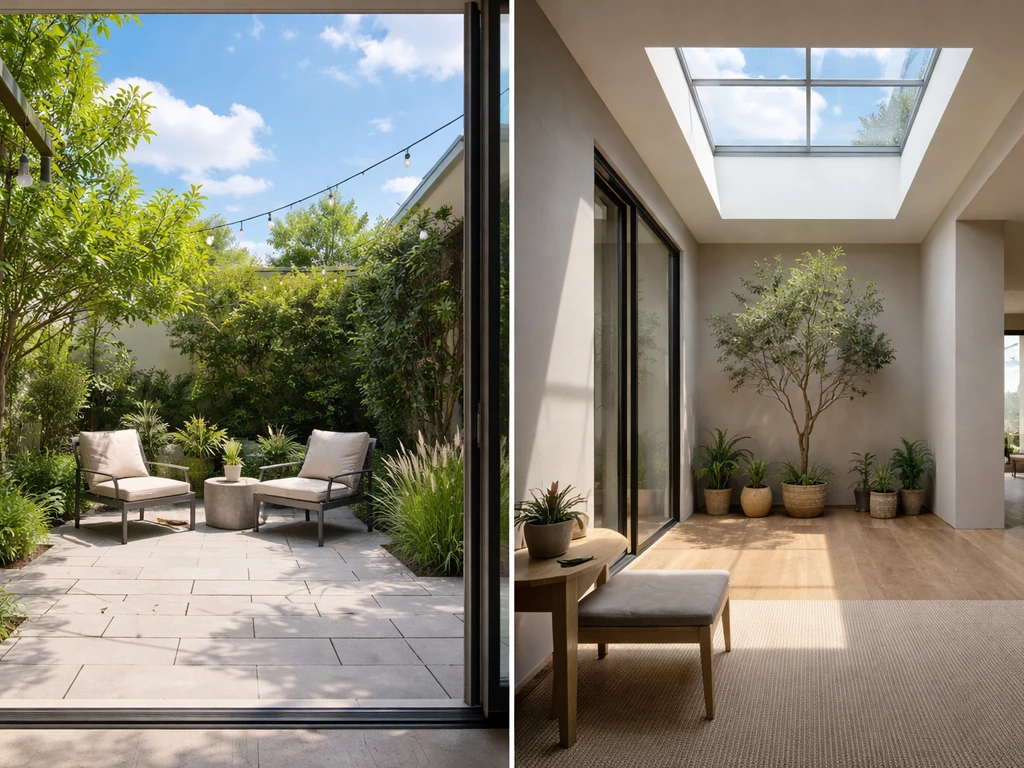
A patio is a paved or hard-surfaced outdoor area at ground level, directly adjoining a house, used for dining, relaxing, and entertaining. Grass (a lawn) is a planted turf area serving similar outdoor living purposes but in a soft, natural surface. The core difference is surface type: a patio is hardscape, a lawn is living vegetation. For most homeowners, the choice comes down to how you want to use the space, how much time you are willing to spend maintaining it, and what tradeoffs you are comfortable making on cost, water use, and biodiversity.
Patio vs Grass: Choosing Between Hardscape and Lawn Areas

Ada Hollis
29 Jul 2026
What exactly is a patio?
Oxford, Cambridge, and Merriam-Webster all define a patio consistently: a paved outdoor area adjoining a house, used for leisure and entertaining. The word comes directly from Spanish, where 'patio' means an inner courtyard or enclosed outdoor space. In residential architecture, a patio sits at ground level and is attached to or immediately outside the back (or side) of a home. It has no roof, no overhead structure, and no elevation above grade, which is what separates it from several closely related spaces.
A porch sits outside the main walls of a house but is typically covered by a roof extension and often raised slightly above grade. A balcony is elevated, attached to an upper floor, and has no ground-level access from the yard. A verandah (or veranda) is a roofed, open-sided gallery running along the exterior of a house, usually wrapping one or more sides. A courtyard is an enclosed outdoor space surrounded by walls or building wings, which may or may not be paved. A garden is a planted area for growing plants, flowers, or food, with no implied paved surface. The patio sits in the middle of this family of outdoor spaces: open-air, ground-level, paved, and functionally linked to the interior of the home.
How the name changes by region and culture
What people call their outdoor spaces shifts significantly by country, region, and language. In British English, the paved area behind a house is just as often called a 'terrace' as a patio, and in Australian and New Zealand English you will also hear 'alfresco area' for a paved outdoor dining zone. In Italian urban contexts, 'piazza' refers to a public square, not a private residential space, though the word carries into some American commercial design vocabulary. 'Loggia' (Italian origin) specifically means a covered exterior gallery or corridor, open on one side, which you might find on a larger home or villa. In South Asian English (Hindi and Urdu contexts), the word 'aangan' describes a courtyard, and 'verandah' is commonly used for a covered front or back gallery. In Spanish-origin cultures, the patio retains its original meaning of an inner courtyard, often tiled and shaded, central to the home's layout rather than tacked onto the back. Understanding these distinctions matters when you are reading real estate listings or comparing properties across regions: what one listing calls a 'terrace' and another calls a 'patio' may be the identical physical feature.
Closely related outdoor spaces that come up in comparative searches include the atrium (an internal open court, sometimes glass-roofed in modern homes), the loggia (a covered external gallery), and the piazza (a public square that borrowing into residential vocabulary usually just means a large tiled outdoor area). If you are exploring how those spaces compare to a patio in detail, the distinctions between an atrium and a patio, a loggia and a patio, and a piazza and a patio each deserve their own careful look, since they involve questions about enclosure, coverage, and indoor versus outdoor status.
Patio vs grass: the side-by-side
| Feature | Patio (hardscape) | Grass / Lawn (turf) |
|---|---|---|
| Surface | Concrete, pavers, natural stone, gravel, tile | Living turfgrass (cool- or warm-season varieties) |
| Installation cost (U.S., 2026) | $4–$30/ft² installed (concrete); $8–$20/ft² (pavers) | $1.00–$3.50/ft² for sod; $0.10–$0.50/ft² seeded |
| Installation time | Days to 1–2 weeks (site prep + curing for concrete) | 1–3 days for sod; 3–8 weeks to establish from seed |
| Expected lifespan | 25–100+ years (concrete); 25–50+ years (quality pavers) | Ongoing; turf must be overseeded/replaced periodically |
| Ongoing maintenance | Sweep, power-wash, reseal every 1–3 years | Weekly mowing in season; fertilize, aerate, irrigate |
| Time commitment | Low (a few hours per season) | ~30 hours/year on average for mowing and basic care |
| Water use | Minimal (cleaning only) | ~623 gal/1,000 ft² per week at 1 in/week irrigation |
| Biodiversity value | Low (no habitat); permeable pavers reduce runoff | Moderate (supports insects, birds) if managed organically |
| Stormwater impact | Can increase runoff (impermeable) unless permeable design used | Absorbs rain; roots filter some pollutants |
| Property value impact | Generally adds usable living space; valued positively | Expected by buyers in many markets; value depends on condition |
| Usability in wet weather | Immediately usable after rain drains off | Muddy and soft; unusable in heavy rain or after saturation |
| Heat island effect | Can retain heat (especially dark concrete); permeable/light materials reduce this | Stays cooler; grass transpires and cools surroundings |
| Accessibility | Flat, firm surface; wheelchair and mobility-aid friendly | Can be uneven; not reliably accessible for mobility aids |
| Best suited for | Outdoor dining, entertaining, grilling, furniture zones | Play space, sports, pets, visual greenery, ecological benefit |
Quick comparisons: patio vs garden, atrium, loggia, and piazza
Patio vs garden
A garden is about growing things: plants, flowers, vegetables, or trees. A patio is about using space: sitting, eating, socializing. In practice, many yards contain both, with a patio near the house and a garden beyond it. For a detailed comparison of use, maintenance, and design trade-offs, see patio vs garden. The terms become blurry only when someone calls a partly planted, partly paved backyard their 'garden' in the British sense, where 'garden' broadly means any back outdoor space regardless of what is growing. For decision-making purposes, keep them separate: patio equals hard surface, garden equals planted ground.
Atrium vs patio
An atrium is an interior space, historically the open central court of a Roman house, now often a glass-roofed interior hall in modern homes or commercial buildings. A patio is exterior and open to the sky. The defining split is inside versus outside. If rain falls directly on it, it is a patio. If it is enclosed by the building's structure, it is an atrium, even if it has a glass roof letting in light. For more detail, see our atrium vs patio comparison.
Loggia vs patio
A loggia has a roof and is open on at least one side. A patio has no roof at all. Both can sit at ground level. In practical homeowner terms, a covered patio or pergola-topped outdoor area that is fully enclosed on three sides starts to become a loggia in the architectural sense. For a deeper comparison of features and building-code implications, see our guide on loggia vs patio. The distinction matters if you are reading building codes or design specifications, where a loggia may have different permit implications than an open patio.
Piazza vs patio
A piazza in its original Italian meaning is a public town square, typically large, paved, and surrounded by civic buildings. In residential American usage, 'piazza' sometimes appears in listing descriptions for wide wraparound porches (especially in the American South and in older New England architecture) or for oversized tiled outdoor areas. For a focused comparison of piazza-style spaces and patios, see the lilia piazza vs patio guide. A residential patio is always private and typically smaller in scale. If you see 'piazza' in a real estate listing, it almost certainly means an impressive paved outdoor area, not a genuine Italian public square.
The honest pros and cons of a patio
Advantages
- Immediately usable outdoor living space in almost any weather once installed
- Very low ongoing maintenance: sweeping, occasional power-washing, and resealing every 1–3 years
- Long lifespan: properly installed concrete can last decades, quality pavers 25–50+ years
- Accessible for wheelchairs, walkers, and strollers on a flat, firm surface
- No mowing, watering, fertilizing, or seasonal replanting required
- Supports heavy outdoor furniture, grills, and fixtures without sinking or rutting
- Permeable paver options reduce stormwater runoff and qualify as green infrastructure under EPA guidance
- Generally adds measurable usable square footage to a property's functional living space
Disadvantages
- Higher upfront installation cost than seeding or sodding an equivalent area
- Impermeable concrete and tile increase stormwater runoff unless permeable materials are chosen
- Dark concrete and stone surfaces absorb heat, raising ambient temperatures in summer
- Provides no habitat for insects, birds, or soil organisms (low biodiversity value)
- Cracks and surface damage can be expensive to repair, especially in concrete slabs
- Removal and replanting later requires demolition, adding cost if you change your mind
- Weeds can grow in paver joints without regular maintenance of joint sand
The honest pros and cons of a grass lawn
Advantages
- Lower initial installation cost, especially from seed ($0.10–$0.50/ft² for seeded lawns)
- Cools surrounding air through transpiration, reducing urban heat island effect
- Absorbs rainfall naturally; healthy turf and root systems filter some surface pollutants
- Supports insects, birds, and soil microorganisms, especially if managed with reduced chemical inputs
- Soft and forgiving for children's play, sports, and pets
- Visually appealing and expected by buyers in most suburban residential markets
- Easily modified: can be overseeded, patched, or converted without demolition
Disadvantages
- Significant ongoing time commitment: roughly 30 hours per year on average for mowing and basic upkeep
- High water demand: approximately 623 gallons per 1,000 ft² per week at standard 1-inch irrigation during the growing season
- A 2,000 ft² lawn watered for 20 weeks requires nearly 25,000 gallons of water seasonally
- Requires fertilizer, herbicide, and pesticide inputs that can reduce biodiversity if over-applied
- Unusable when wet or saturated: muddy, soft, and damaging to turf if heavily trafficked after rain
- Not accessible for mobility aids: uneven or soft ground creates barriers for wheelchairs and walkers
- Ongoing cost of mowing equipment, fuel, and periodic professional lawn care services
Practical implications: use, design, cost, and property value
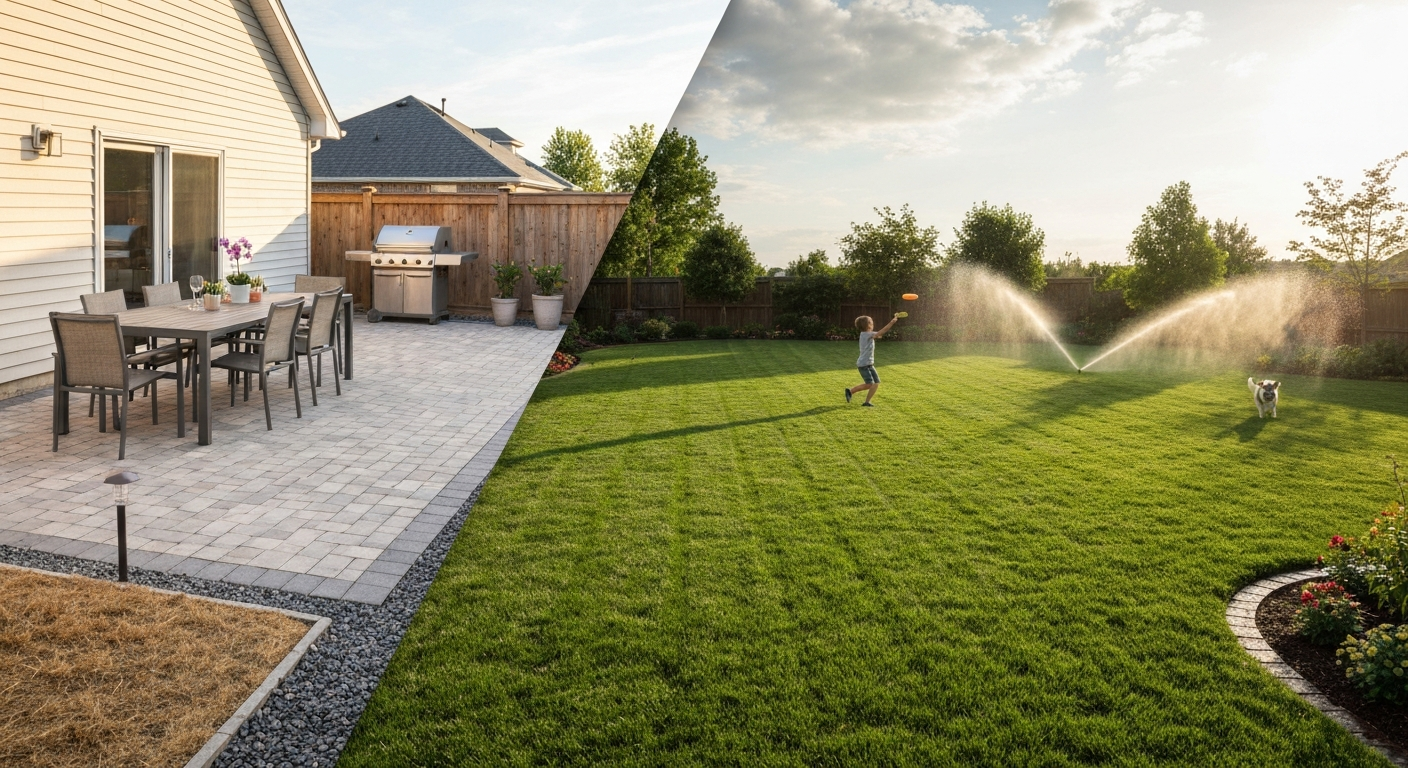
For everyday use, a patio wins on convenience. You can set furniture down permanently, place a grill without worrying about burning turf, and walk out barefoot on a dry surface the morning after heavy rain. A lawn wins on versatility for physical activity: you cannot throw a frisbee or let a dog run on a patio the way you can on grass. Many properties benefit from both, with a patio immediately adjacent to the house and lawn extending beyond it.
On cost, the gap is significant upfront. Poured concrete runs roughly $4–$30 per square foot installed in 2026, depending on finish and region. Paver patios typically cost $8–$20 per square foot. Sod installation averages $1–$3.50 per square foot. Seeding is cheaper still. But the lifetime cost picture shifts when you account for irrigation, lawn care services, and equipment over 10–20 years. For example, using 1 inch per week on a 2,000 ft² lawn for a 20-week season uses about 24,920 gallons; local calculators such as Lawn Water Usage Calculator: Irrigation Cost and Savings - CalculatorHub can help estimate costs. A well-installed patio with minimal maintenance can be cheaper over its lifespan than the cumulative cost of watering and maintaining a lawn.
On property value, both features are viewed positively by buyers, but in different ways. A patio or hardscaped outdoor area adds functional living space that buyers can immediately use. Real estate professionals generally describe well-designed patios as a value-positive improvement. A healthy lawn is often considered a baseline expectation in suburban markets, meaning its absence may hurt perceived value more than its presence boosts it. In markets where water costs are high or restrictions are in place (parts of the American Southwest, for example), replacing lawn with hardscape is increasingly viewed positively.
Biodiversity is a growing concern and an honest tradeoff. A standard lawn monoculture under heavy fertilizer and herbicide use supports little wildlife, but a managed lawn with native grasses, reduced chemical inputs, and varied plantings can support pollinators and soil health meaningfully. A patio, by contrast, supports almost no biodiversity unless you add container plantings or choose permeable pavers that allow some water and soil interaction. If ecological value matters to you, a partially planted design combining paving with planted beds is a stronger choice than either extreme.
How to decide: a guide by audience
For homeowners
- Identify your primary use: if it is outdoor dining, furniture, grilling, or entertaining, a patio is the stronger choice. If it is play space, pets, or sports, a lawn or a combination works better.
- Assess your maintenance appetite honestly. If you dislike mowing and watering, a patio saves significant time and water. If you enjoy gardening and outdoor upkeep, a lawn gives you more to engage with.
- Check your water situation. In drought-prone regions or areas with tiered water pricing, the ongoing cost of irrigating a lawn can add up to thousands of dollars over a decade.
- Consider accessibility now and in the future. If anyone in your household uses mobility aids, or might in the future, a level paved surface is meaningfully easier to navigate.
- Think about climate. In very hot climates, light-colored or permeable pavers with surrounding plantings reduce heat buildup. In cooler, wetter climates, grass stays green and functional for more of the year.
- Choose permeable hardscape materials if runoff or flooding is a concern on your property. Permeable pavers and pervious concrete are recognized by the EPA as effective stormwater management tools.
For renters
As a renter, the decision is mostly made for you by the property, but knowing what you are evaluating matters. A patio means an immediately usable outdoor space that requires almost no effort from you. A lawn means outdoor space that may require mowing under your lease terms. Clarify with your landlord who is responsible for lawn care before you sign. If you are evaluating two rental properties, a patio is generally lower-effort and more immediately functional for outdoor living. A lawn is a bonus for pets or children but comes with maintenance obligations you should confirm in writing.
For real estate buyers
When evaluating a property, look at the condition of both features. A cracked, sunken concrete patio is a remediation cost: plan for $4–$15 per square foot to repair or replace, depending on material. A patchy, weed-heavy lawn is generally cheaper to restore (overseed and fertilize) but signals neglected maintenance. A well-designed patio with quality materials, good drainage, and durable surface is a genuine asset. A healthy lawn in a market where green yards are expected is a baseline. Neither feature alone makes or breaks a purchase, but both signal how the property has been maintained overall.
Design and materials: what you need to know
For a patio, the most common materials in 2026 are poured concrete, concrete pavers, natural stone (flagstone, bluestone, slate), brick, and gravel. Each has tradeoffs. Poured concrete is the most affordable and durable option for large areas but cracks over time and needs resealing. This Old House notes that poured concrete patios can last up to 100 years with proper installation and care; industry guidance also indicates well‑installed interlocking pavers and natural stone commonly last 25–50+ years when the base is properly prepared. Pavers are more flexible (individual units can be replaced), offer better drainage options, and are visually varied, but cost more and require joint sand maintenance. Natural stone looks the best and lasts longest, but costs the most and varies in texture and slip resistance. Gravel is the cheapest and most permeable option, but not ideal for furniture or barefoot use.
Layout decisions matter as much as material. A patio placed too close to the house with poor drainage pitch can direct water toward the foundation. The general standard is a 1/8 to 1/4 inch per foot slope away from the house. Size the patio to fit your furniture with circulation space: a dining table for six needs at minimum a 12x12-foot area; most outdoor living zones work better at 16x16 feet or more. Include a path connecting the patio to other yard areas to avoid creating a disconnected island.
For accessibility, ensure there is no lip or step at the door threshold if mobility access matters. Keep surface texture consistent and avoid loose materials near seating zones. Lighting embedded in paver edges or post-mounted at perimeter corners significantly improves evening usability and safety. For lawn design adjacent to a patio, a clean mowing edge or border material (steel edging, stone, or concrete border) makes maintenance easier and keeps grass from invading paver joints.
Maintenance checklist and seasonal care
Patio maintenance by season
| Season | Task | Frequency |
|---|---|---|
| Spring | Power-wash surface; inspect for cracks or heaved pavers | Annual |
| Spring | Replenish polymeric joint sand in paver gaps | As needed (every 2–5 years) |
| Spring/Fall | Reseal stained or stamped concrete | Every 1–3 years |
| Summer | Sweep debris; spot-clean stains promptly | Weekly or as needed |
| Fall | Clear leaves before wet season to prevent staining and slip hazard | Seasonal |
| Winter (cold climates) | Avoid metal snow shovels on pavers; use plastic; do not use rock salt on concrete | Seasonal |
| Ongoing | Check drainage; ensure water still runs away from house after any settlement | Annually or after heavy storms |
Lawn maintenance by season
| Season | Task | Frequency |
|---|---|---|
| Spring | Dethatch and aerate if needed; apply pre-emergent weed control | Annual |
| Spring | Overseed bare patches; begin mowing as growth resumes | As needed |
| Summer | Mow weekly (do not remove more than one-third of blade height); irrigate at ~1 in/week if no rain | Weekly |
| Summer | Check irrigation system for coverage and efficiency | Monthly |
| Fall | Aerate and overseed cool-season grasses; apply fall fertilizer | Annual |
| Fall | Final mow before dormancy; clear leaves to prevent matting | Seasonal |
| Winter | Avoid heavy traffic on dormant or frozen turf; service mowing equipment | Seasonal |
What these spaces look like: image suggestions
If you are commissioning or selecting photography to accompany this topic, these images tell the story most clearly and usefully.
- A mid-size concrete paver patio with outdoor dining table, chairs, and a clearly visible house door threshold showing the ground-level transition (illustrates the standard residential patio definition)
- An aerial or wide-angle comparison shot of a backyard divided between a paved patio zone and an adjacent grass lawn, showing both surfaces and how they are separated by an edge border
- A close-up of permeable interlocking pavers with visible joint gaps, next to a detail shot of healthy turf close-up, to contrast the two surface types at human scale
- A before-and-after or split composition showing a cracked aging concrete slab versus a freshly laid natural stone patio, to illustrate the lifespan and material quality difference
- A lawn in use: children playing or a dog running, to capture the functional case for grass that a patio cannot replicate
- A maintenance comparison image: someone power-washing a patio on one side; someone mowing a lawn on the other, illustrating the different effort types involved
- A loggia, a verandah, and a patio shown side by side (or in a labeled composite) to visually distinguish the covered-versus-open-air distinction for readers comparing terminology
Glossary of key terms
| Term | Definition |
|---|---|
| Patio | A paved or hard-surfaced outdoor area at ground level, adjoining a house, open to the sky, used for leisure and entertaining. From Spanish 'patio' (courtyard). |
| Lawn / Turf | A planted area of turfgrass maintained by mowing and irrigation, used for play, aesthetics, or outdoor space. |
| Hardscape | Non-living outdoor surface materials: concrete, pavers, stone, brick, gravel. Contrasted with softscape (plants, turf, mulch). |
| Porch | A covered exterior structure attached to the outside of a main building wall, often slightly elevated, with a roof overhead. |
| Balcony | An elevated platform projecting from an upper floor of a building, accessed from inside, without ground-level yard access. |
| Verandah (Veranda) | A roofed, open-sided gallery or platform running along the exterior of a house, usually at ground or first-floor level. |
| Courtyard | An enclosed outdoor space surrounded by walls or building wings, which may be paved or planted. |
| Atrium | Originally the central open court of a Roman house; in modern architecture, an interior open space, sometimes glass-roofed, within a building. |
| Loggia | A covered exterior gallery or corridor, open on at least one side, derived from Italian architecture. Has a roof; contrasts with an open patio. |
| Piazza | An Italian public square or town plaza; in American residential usage, sometimes applied to large paved outdoor areas or wide wraparound porches. |
| Permeable pavers | Interlocking paving units with open joints or porous material that allows rainfall to pass through the surface into a prepared base, reducing runoff. |
| Pervious concrete | A type of concrete with a high void content that allows water to drain through, used in stormwater management. |
| Softscape | The living elements of a landscape: grass, garden beds, trees, shrubs, and planted ground cover. |
| Sod | Pre-grown turfgrass cut and rolled with its root mat for immediate installation; more expensive but establishes faster than seed. |
| Hardscape materials | Common patio surface options including poured concrete, concrete pavers, natural stone (flagstone, bluestone), brick, and compacted gravel. |
Your action checklist: how to choose and what to do next
- Define your primary outdoor use case: entertaining and dining (favors patio), play and pets (favors lawn), or both (consider a divided design).
- Measure your available outdoor space and decide what proportion makes sense for each surface type based on how you actually live.
- Check your local climate, water costs, and any irrigation restrictions. High water costs or drought conditions strengthen the case for a patio.
- Get at least three installer quotes for your preferred patio material, specifying the finished square footage, drainage slope, and edging details.
- If installing a lawn, choose a turfgrass variety suited to your region and sun/shade conditions. Ask your local cooperative extension service for variety guidance.
- If biodiversity or runoff is a concern, specify permeable pavers or pervious concrete for the patio, and add native plantings at the lawn edge.
- Review your local building permit requirements: patios over a certain size or made of poured concrete may require a permit in some jurisdictions.
- If you are a renter, clarify maintenance responsibility for lawn and outdoor surfaces in your lease before signing.
- If you are a buyer, inspect the existing patio for cracks, drainage direction, and surface integrity. Budget for reseal or repair costs accordingly.
- Revisit related comparisons as needed: how a patio differs from a garden, an atrium, a loggia, or a piazza each adds nuance to how you define and value outdoor space on a property.
FAQ
SEO title and meta description
Title: Patio vs Grass: How to Choose the Right Outdoor Space for Your Home. Meta description: Clear, practical comparison of patios and grass lawns — definitions, costs, maintenance, biodiversity, design tips, and guidance for homeowners, renters, and buyers so you can pick the best yard option for use, value, and upkeep.
Lead definition: what is a patio?
A patio is a paved or decked outdoor area at ground level adjacent to a house (or building) used for dining, seating, cooking (grill), and general outdoor living. Unlike a balcony or porch, a patio is usually ground-level and hard‑surfaced; unlike a garden, it emphasizes hardscape over planted turf or beds.
Patio versus related outdoor spaces (quick distinctions)
Porch: an exterior structure attached to the entrance, usually covered and elevated from grade. Balcony: a platform projecting from an upper floor. Verandah: a covered open gallery running along a building. Courtyard: an enclosed open space often surrounded by building walls. Garden: planted area focused on flowers, vegetables, or ornamental beds. Atrium: an internal open court inside a building (or roofed modern equivalent). Loggia: a covered exterior gallery (open on one or more sides). Piazza: an Italian term for a public square or plaza.
Side-by-side comparison: patio vs grass/lawn
Use: Patio — dining, entertaining, seating, cooking, outdoor furniture and hardscape features. Grass — play, sports, passive landscaping, soft surface for pets and children. Cost: Patio — upfront higher (materials + install) depending on material ($4–$30/ft² for concrete; $8–$20/ft² for pavers typical ranges). Grass — lower to moderate upfront (sod $1–$3.50/ft²; seed much less) but variable. Maintenance: Patio — sweeping, occasional power wash, resealing (periodic), joint maintenance for pavers. Grass — regular mowing, edging, fertilizing, irrigation, aeration/overseed. Water & environment: Patio — low irrigation demand; can be made permeable to reduce runoff. Grass — higher water use (often ~1 inch/week in growing season), provides cooling, carbon uptake, and habitat for some organisms. Biodiversity: Patio — low without added planters; grass — moderate for some pollinators and soil life but lower biodiversity than planted gardens. Longevity: Proper patios (concrete/pavers/stone) can last decades; lawns are ongoing living systems requiring continuous care. Property value: Patios often increase usable living space and appeal for entertaining; nice lawns can improve curb appeal and resale in neighborhoods that value green space. Practical trade-off: patio = low-activity, low-water, durable outdoor room; grass = soft, play-friendly, living surface needing regular upkeep.
Brief comparisons: patio vs garden, atrium, loggia, piazza
Patio vs Garden: Patio prioritizes hardscape for seating and pathways; gardens prioritize planted beds, vegetables, and pollinator habitat. Many homeowners combine both (patio + adjacent planting beds). Patio vs Atrium: Atrium is an interior or centrally located open court within a building footprint; patio is exterior and usually adjacent to a building. Patio vs Loggia: Loggia is a covered, often columned exterior gallery (architectural feature); patios are typically open to sky or covered with simple structures (pergolas). Patio vs Piazza: Piazza refers to a public urban square — scale, public function, and civic design distinguish it from a private home patio.
Cultural and regional naming differences
The word 'patio' comes from Spanish and is widely used in US, UK, Canada and Australia for paved outdoor seating areas. Regional differences: some places prefer 'terrace' (UK) or 'paving' terms for similar spaces; 'piazza' is used in Italy for public squares; 'verandah' is common in Australia and India for covered porches. Local building codes and homeowners' language influence which term is used and whether a structure requires permits (e.g., covered patios vs open patios).
Next Article
Atrium vs Patio: Key Differences and How to Tell Them Apart
Atrium vs patio explained with rules of thumb on enclosure, privacy, noise, weather exposure, and how to spot them on li