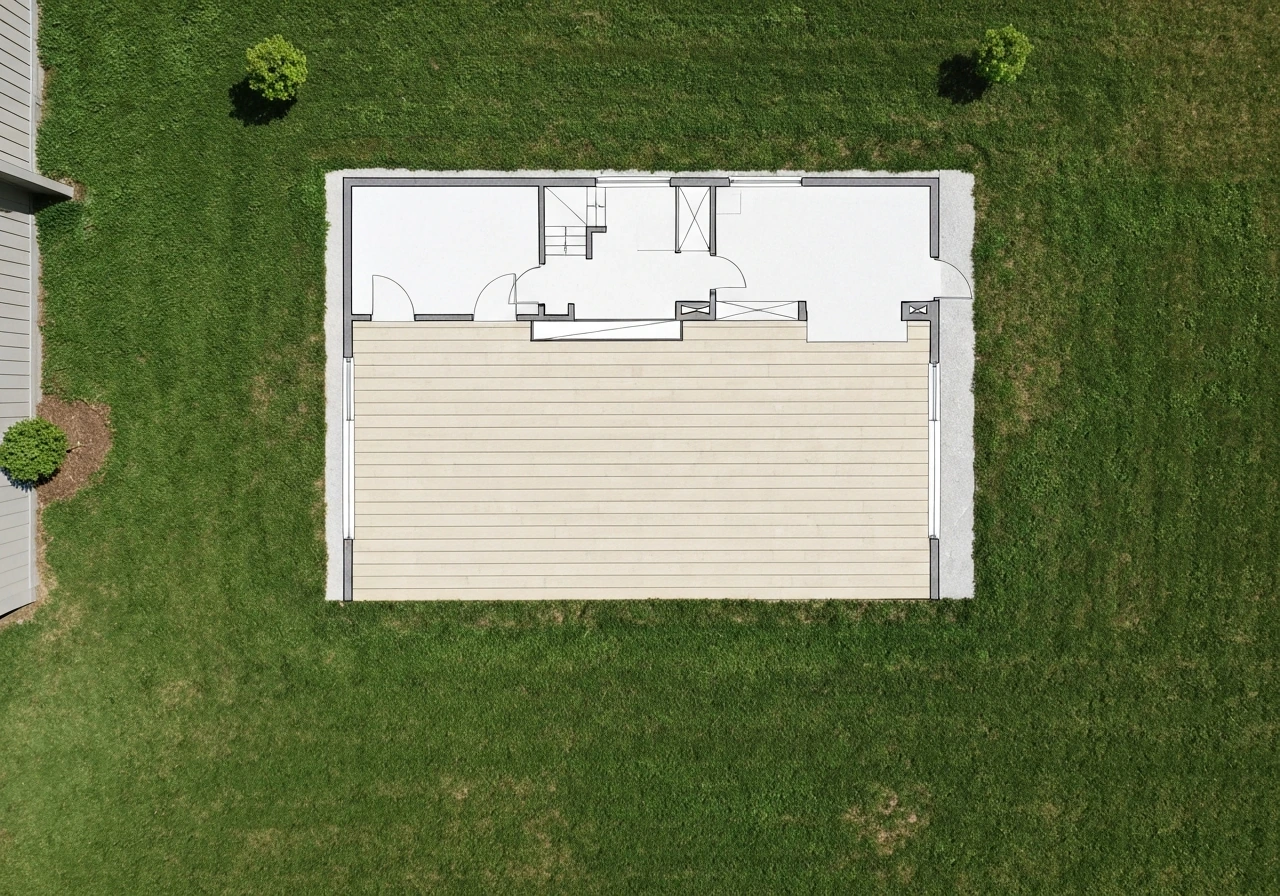
A front patio is most commonly called a front patio, but depending on its features, you might also hear it called an entry patio, front porch, veranda, courtyard, or stoop. The name that actually fits depends on three things: whether it has a roof, whether it's raised off the ground, and how enclosed it is. Get those three details right and you can identify the space accurately every time.
What Is a Front Patio Called? Porch, Verandah, Stoops Explained

Ada Hollis
10 Jun 2026
The most common names for a front patio
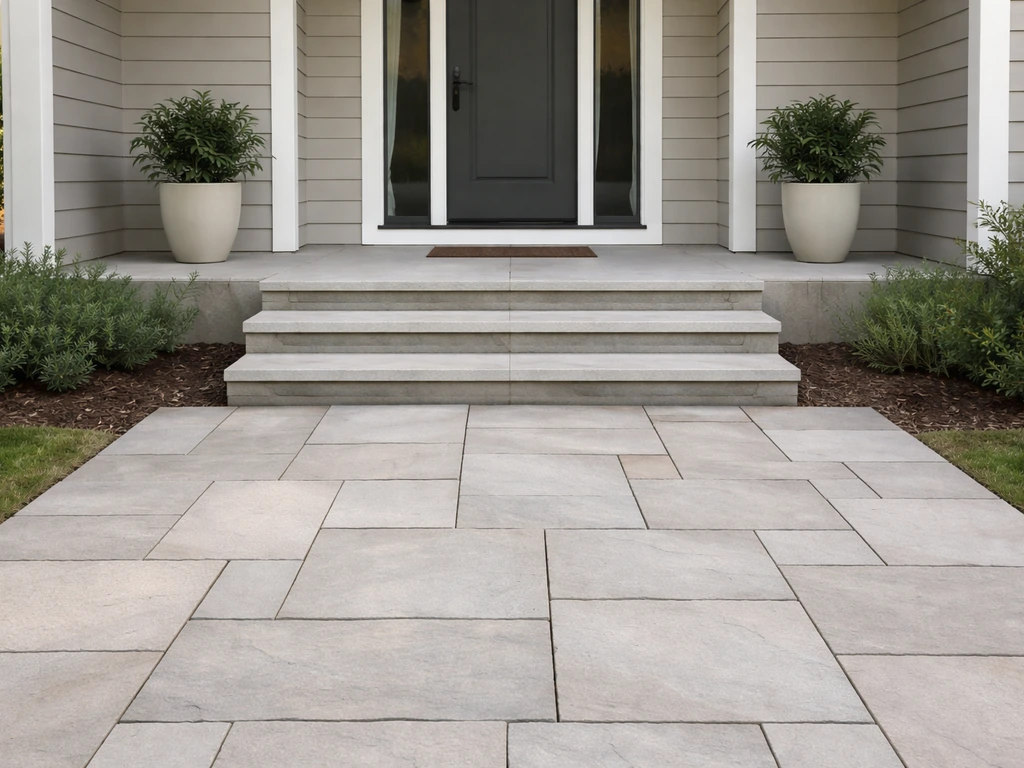
When people say 'front patio,' they usually mean a paved outdoor area at the front of the house that sits at ground level and isn't covered by a roof. It's open to the sky, typically surfaced with concrete, pavers, brick, or tile, and sits directly on or just above grade. That's the baseline definition from Merriam-Webster too: a patio is a recreation area adjoining a dwelling that is typically paved.
In real estate listings, contractors' quotes, and floor plans, this same space goes by several names depending on who's writing the description and where the home is located. Here are the most common ones you'll run into:
- Front patio: the most neutral, widely understood term; implies ground-level, paved, no roof
- Entry patio: used when the paved area sits directly at the front entrance rather than off to one side
- Forecourt: an older architectural term for a paved area in front of a building, still used in formal or heritage property listings
- Front terrace: sometimes used interchangeably with front patio, though 'terrace' can also imply a slight elevation or a more formal finish
- Outdoor living area (front): a vague listing phrase that often means a front patio without committing to a specific structure type
If the space has a roof, steps, or walls, one of those details will push it into a different category entirely, which is where things get confusing in listings and floor plans. The sections below break each alternative down so you can tell them apart.
Front patio vs. front porch: the key difference
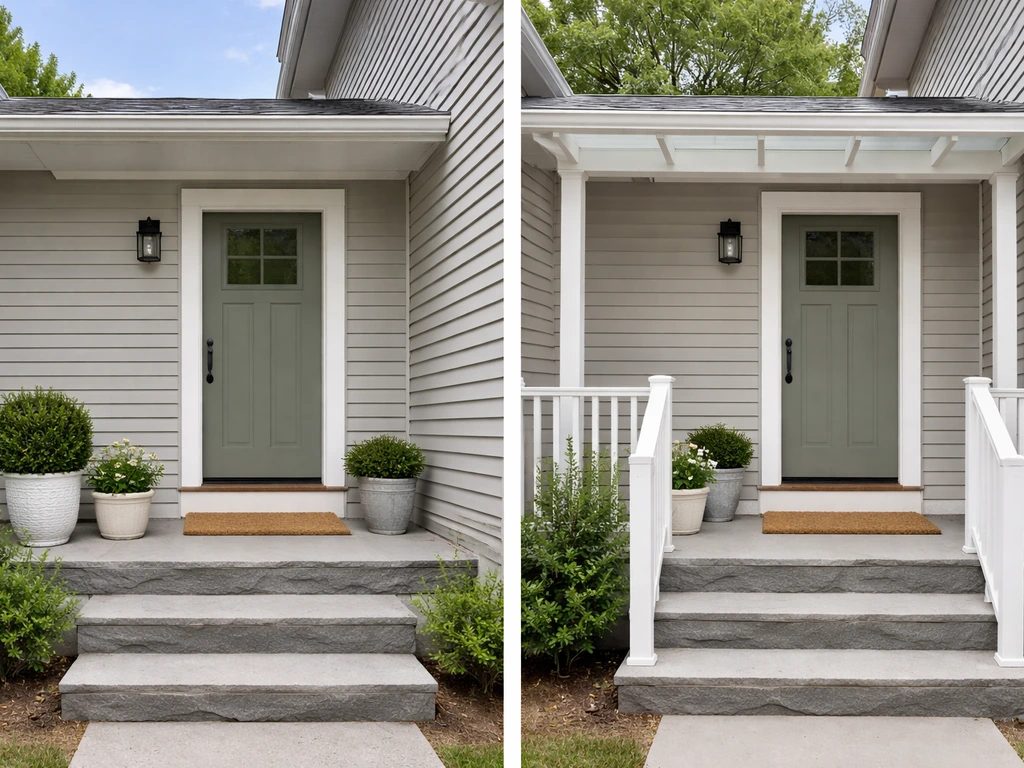
This is the comparison that trips people up the most. A front porch has a roof. A front patio doesn't. That single feature is the dividing line, and it matters more than surface material, size, or whether there are steps involved.
Merriam-Webster defines a porch as a covered area adjoining an entrance to a building, usually having a separate roof. So if you're looking at a listing photo and the front outdoor space has a roof overhead, even just a simple overhang attached to the roofline, it's a porch, not a patio. If it's open to the sky, it's a patio (or possibly a stoop or courtyard, depending on its shape and enclosure).
Porches are also usually elevated slightly off the ground and accessed by steps. That's not always true of patios, which are typically built at or very near grade level. A patio sitting flush with the lawn at the front of the house with no overhead structure is a front patio. That same space with a roof added becomes a front porch. Contractors and permit offices treat these as different structures, which can affect what permits you need if you're building or modifying one.
Veranda, verandah, and regional naming variations
A veranda (or verandah, the spelling preferred in Australian and New Zealand English) is essentially a roofed, open-air porch that wraps around or extends along the outside of a building. Britannica defines it as an open-walled, roofed porch attached to a domestic structure, usually surrounded by a railing. If a front porch is wide, runs the full width of the house, and is covered by a continuation of the main roof, many people would call that a veranda rather than just a porch.
In the American South and in parts of Australia, the veranda is the dominant term for what people in the Northeast or Midwest would simply call a front porch. In British English, you'll sometimes see 'front terrace' used where Americans would say front patio. In Spanish-speaking contexts, 'patio' itself has a different historical meaning, referring to an interior courtyard, but in modern American real estate language it has shifted to mean any paved outdoor area adjacent to a home.
The practical takeaway: if you're reading a listing and see 'veranda,' expect a roofed front or wraparound structure with railings. If you see 'terrace,' look for a paved space that may be slightly elevated. If you see 'patio,' expect ground-level paving with no roof unless the listing explicitly adds 'covered patio.'
Entry patio, courtyard, and stoop: how to tell them apart
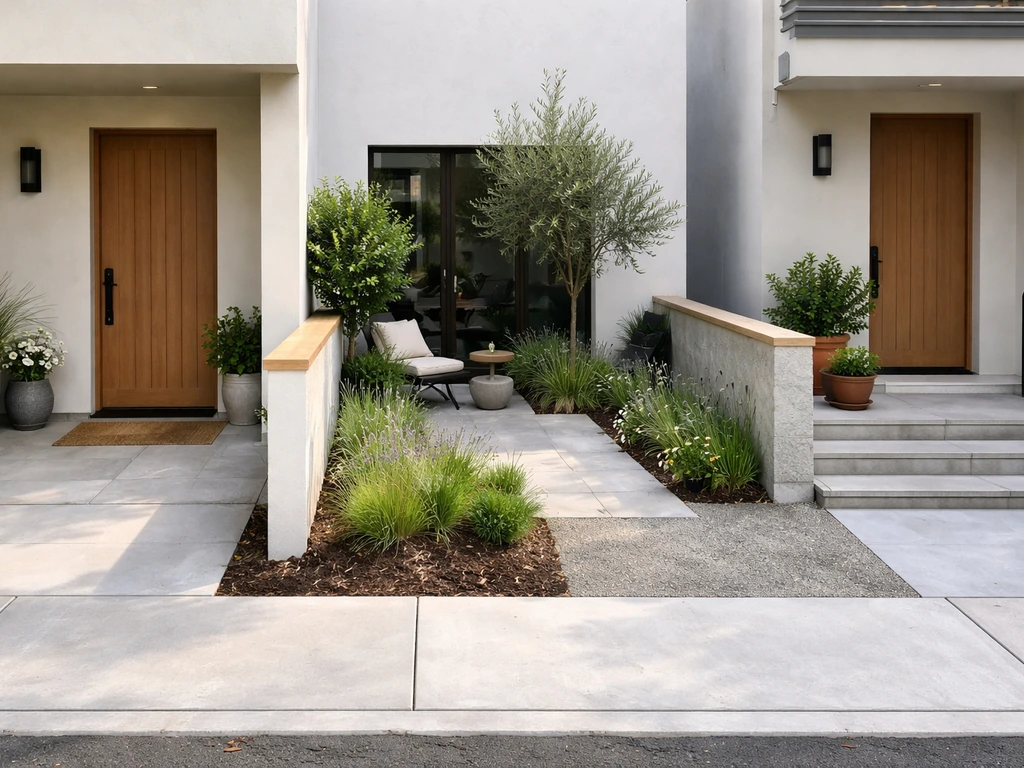
These three terms describe front outdoor spaces that share some overlap with a front patio but each have a distinct characteristic that sets them apart.
Entry patio
An entry patio is a front patio that sits directly in front of the main entrance door. The 'entry' part just clarifies its position. It's still ground-level, still paved, still open to the sky. The distinction is purely locational: it's framing the front door rather than sitting off to the side or wrapping around.
Courtyard
A courtyard is an enclosed or semi-enclosed outdoor space. Dictionary.com defines a courtyard as an enclosed yard or court, an outdoor space that is typically used for lounging with direct access in residential settings enclosed or semi-enclosed outdoor space. Merriam-Webster defines it as a court or enclosure adjacent to a building. In residential architecture, courtyards are typically enclosed on three or four sides by the building itself or by walls and fencing. If you see a front outdoor space that has walls or a fence creating a contained area before you reach the front door, that's a courtyard, not a patio. Some modern homes are designed with a walled front courtyard as a privacy buffer between the street and the entry, and these are sometimes mistakenly labeled 'front patio' in listings.
Stoop
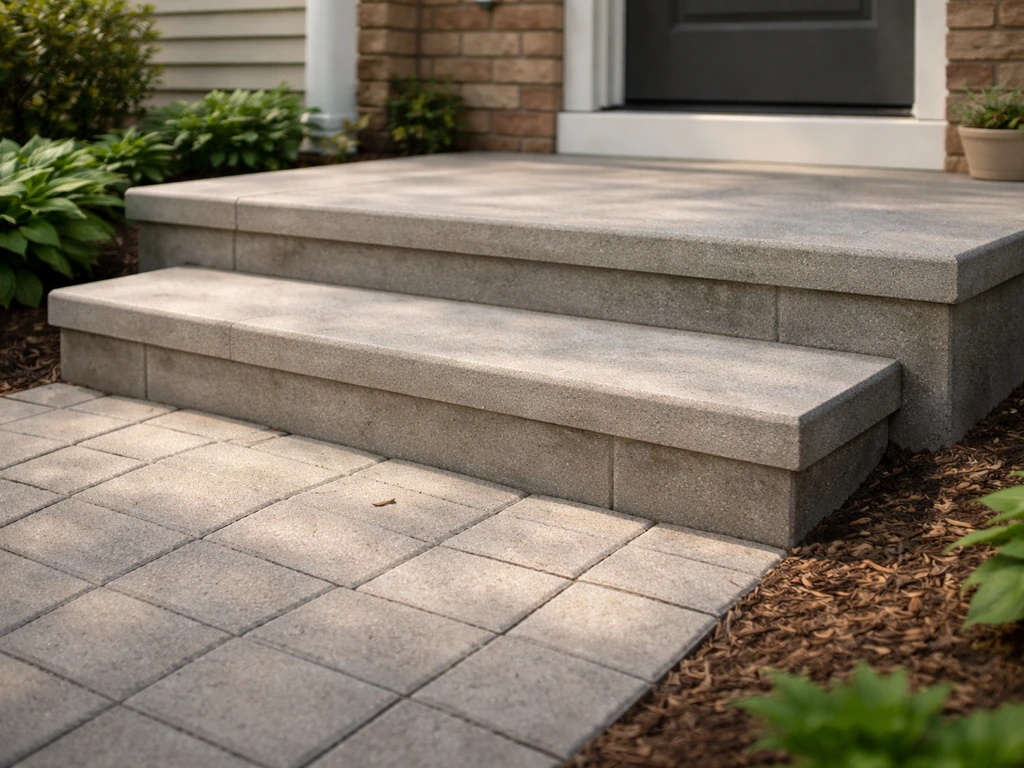
A stoop is a small raised platform at the front entrance of a home, typically with steps leading up to it. The word comes from the Dutch 'stoep' and is especially common in the Northeastern US, particularly in cities like New York. Unlike a porch, a stoop doesn't have a roof or a significant floor area for sitting. Unlike a patio, it's elevated and functionally just a transition point between the sidewalk and the front door. Some municipal codes, like Brook Park, Ohio's zoning ordinance, actually treat a front stoop as a type of front porch for regulatory purposes, which shows how blurry these lines can get officially.
| Space | Has Roof? | At Grade? | Enclosed? | Typical Surface |
|---|---|---|---|---|
| Front patio | No | Yes | No | Concrete, pavers, tile |
| Entry patio | No | Yes | No | Concrete, pavers, tile |
| Front porch | Yes | Usually raised slightly | No (or partially) | Wood, composite, concrete |
| Veranda | Yes | Raised slightly | No (open sides) | Wood, tile, composite |
| Courtyard | No | Yes | Yes (3-4 sides) | Pavers, gravel, tile |
| Stoop | No | Raised, with steps | No | Concrete, brick, stone |
What to look for in listing photos and floor plans
Listing descriptions use these terms loosely, so it's worth learning to read the photos and floor plan symbols yourself rather than relying on the label alone.
In photos, look for these four things in order: Is there a roof or overhead structure? If yes, you're looking at a porch or veranda, not a patio. Is the space at ground level or raised with steps? Ground level points to patio or courtyard; raised with steps points to porch or stoop. What's the surface? Hard paving (concrete slabs, tiles, pavers) is the signature of a patio or courtyard. Wood or composite decking usually means a porch or deck. Finally, are there walls or fencing enclosing the space? If yes, it's most likely a courtyard, even if the listing calls it a patio.
On floor plans, outdoor spaces at the front of the house are usually shown as outlined areas adjacent to the front door, sometimes labeled directly. Sliding door symbols or French door symbols opening onto the space are a clue that the space is intended for access and use, not just a setback area. A space shown without a roof line on the plan but with a paved boundary is a patio. If the floor plan shows a covered area (indicated by a hatched or shaded roof outline continuing over the front space), that's a porch. Some floor plans don't label these spaces at all, which is where knowing the shape, surface, and door connection becomes essential.
One thing that catches people off guard: if a front outdoor space is on an upper floor of a multi-story home, it's almost certainly a balcony, not a patio. Balconies project from the wall of the building above ground level and are enclosed with guardrails. They're accessed through a door and are distinctly elevated. If you see a front outdoor space in listing photos that appears to float above the landscaping with a railing around it, that's a balcony regardless of what the listing calls it.
How to talk about it with agents and contractors
Real estate agents and contractors use these terms with varying precision, and misidentifying the space can cause real problems. If you're asking a contractor for a quote, calling a covered porch a patio could result in incorrect permit applications, since elevated structures and covered structures typically have different permitting requirements. Cities like Bend, Oregon and Naperville, Illinois have explicit permitting distinctions based on whether a structure is a deck, porch, or patio cover, and height thresholds (often 30 inches above grade) trigger additional requirements.
When contacting a real estate agent about a listing, the simplest approach is to skip the label and describe what you see: 'Is the outdoor space at the front ground-level or raised? Does it have a roof or overhead cover? Is it enclosed by walls or fencing?' Those three questions will get you accurate information faster than asking whether it's a patio or a porch, because agents use those terms interchangeably all the time.
For contractors, be specific about the surface, dimensions, elevation, and whether you want a cover added. If you want to build a front patio with a roof added later, tell them upfront, because adding a roof converts it to a porch or covered patio structure and changes the permitting path from the start. If you are wondering can a patio be in the front of the house, the key is whether the space is ground-level and open to the sky rather than roofed build a front patio. If you are trying to visualize where the front patio is located in a house, check whether it sits at the front entrance area and is open to the sky. Getting the classification right from the beginning saves time and avoids having to redo applications.
If you're researching a property and still can't tell from the listing what the front outdoor space actually is, the floor plan is often the most reliable source. A front patio will typically appear on the plan as an outlined, labeled area at grade adjacent to the front entry door, with no roof symbol overhead. If you’re trying to pinpoint where is the patio located, look at the floor plan’s outlined area next to the front entry door and confirm there’s no overhead roof symbol. That same cross-check works whether you're buying, renting, or planning a renovation.
FAQ
How can I tell if what the listing calls a patio is actually a balcony?
In most real estate contexts, a balcony is the default answer when the front outdoor space is on an upper floor. If you see guardrails, a door that exits from a higher level, or the area appears to project above the first-floor roofline, it is typically a balcony, even if the listing uses the word patio.
What does “covered patio” mean, and does it change the classification?
A “covered patio” usually means the patio has been roofed or fitted with an overhead cover after construction (or from the start). Once there is an overhead structure, many jurisdictions treat it like a covered patio or porch rather than an uncovered patio, so confirm wording on the listing and ask about permits if you plan any work.
What if the front outdoor space has steps, but it also looks roofed?
If the listing photo shows steps but also shows a roof overhead, it is generally not a front patio. Steps suggest elevation, and the roof is the decisive feature, so the space is more likely a front porch (or veranda), not a patio.
Can a front patio be enclosed, or does that make it a courtyard?
If a space is paved and open to the sky but it is tightly surrounded by walls or fencing, it can be a courtyard. A quick check is whether the walls create a contained area before the front door, not just a patio surface laid near the house.
How do I distinguish a patio from a small front deck or raised porch platform?
In many places, railings plus an upper-level exit door point to a deck or porch platform rather than a patio. If it’s elevated for sitting, accessed by steps, and has some sort of floor structure, ask for the permit type or building plans, because the terms are often used loosely but the structure category matters.
When requesting a quote, what details should I provide so the contractor doesn’t misclassify it?
To get the right estimate from a contractor, ask for the scope and structure details, not just the name. Useful specifics include approximate dimensions, elevation relative to grade, whether there is an existing roof structure, and whether you want pavers or concrete, plus whether you are enclosing it with walls or fencing.
I want to build a front patio and add a roof later, what should I ask up front?
If you plan to add a roof later, treat the initial project as a “future conversion” because adding overhead cover changes both appearance and typical permitting requirements. Ask the contractor how they would stage the work and whether they recommend engineering or structural review for posts and span loads.
How do I use a floor plan to confirm patio versus porch when the label is unclear?
If the floor plan shows a shaded or hatched overhead area above the front outdoor space, that is usually a roofed structure, which points to porch or veranda rather than a patio. If there is no roof outline, and the area is shown as an exterior paved region at grade, it aligns with patio or courtyard.
What should I expect when a listing calls the front outdoor space a terrace?
“Front terrace” is often used for a slightly elevated, paved outdoor area, sometimes with steps, but the key is whether there is a roof and how open it is. If there is no roof and it’s ground level or only gently raised, it functions like a patio/terrace concept; if roofed, it moves toward porch or veranda.
Could a small front landing be called a patio even though it’s really a stoop?
In older homes and dense urban layouts, agents sometimes label a small raised entry landing as a patio. If the space is directly at the entrance, elevated, and mainly functions as a transition point, it is more consistent with a stoop.
Next Article
What Is Patio in Floor Plan? Meaning and Differences
Know what patio means on a floor plan, how it appears, and how it differs from porch deck balcony terrace.