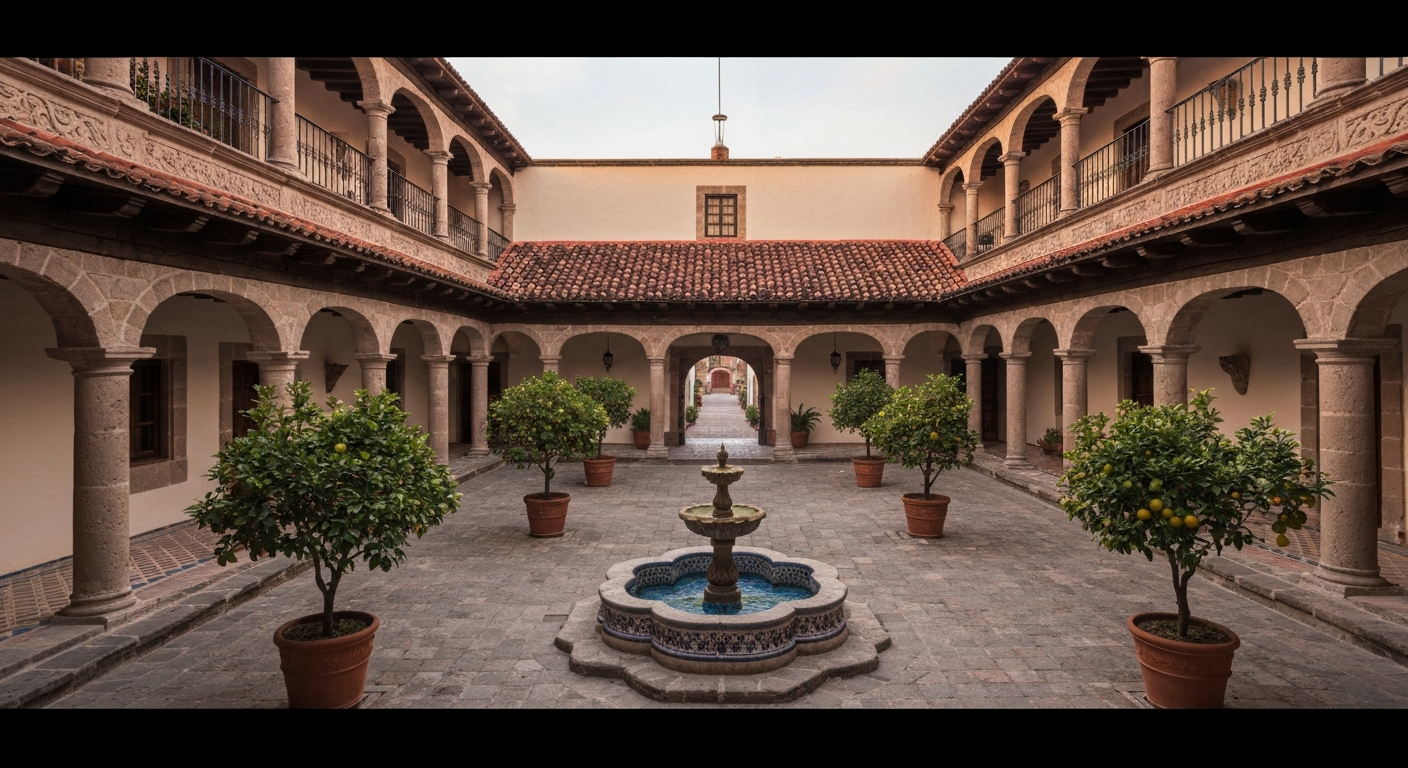
In Mexico, the outdoor space attached to a home is called a patio, pronounced [ˈpatjo] in Spanish. That is the same word English speakers use, but the meaning runs deeper in Mexican architecture: a patio traditionally refers to a central, walled courtyard open to the sky, built at the heart of the home rather than tacked onto the back of it. You will also hear terraza (a raised terrace or rooftop deck), azotea (a flat accessible rooftop), patio de servicio (a utility yard near the kitchen), jardín (a garden), and porche (a covered porch entry). Which word a Mexican speaker reaches for depends on exactly what kind of space they mean.
What Is a Mexican Patio Called? Definitions, Terms & Tips

Ada Hollis
8 Aug 2026
Quick answer: What is a Mexican patio called?
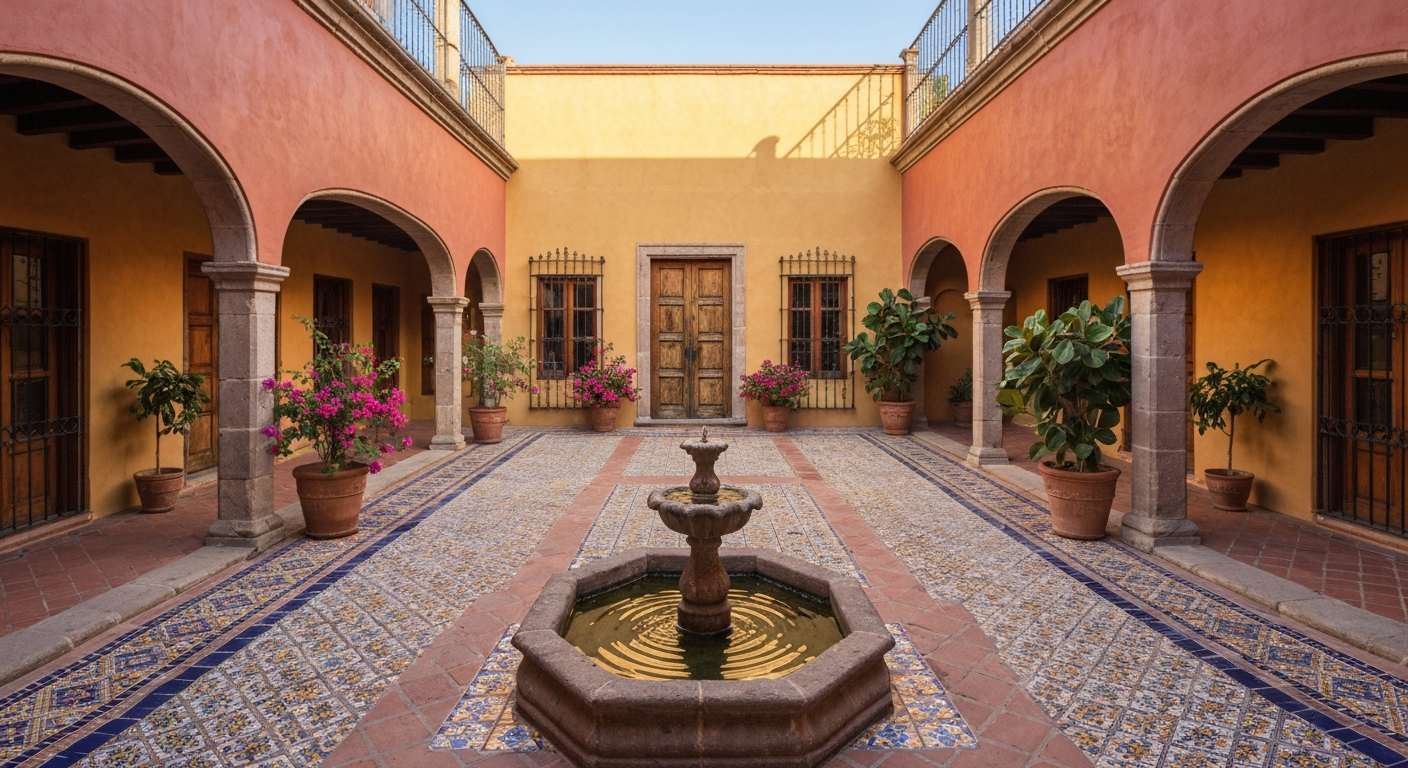
The word is patio, and it is used in both Spanish and English. In Mexican Spanish, patio most precisely describes an inner courtyard enclosed by the walls of a building and left open to the sky above. The Real Academia Española defines it as an uncovered space surrounded by walls or galleries inside a house or other building. In everyday Mexican use, it has broadened to cover any private outdoor area attached to a home, including a backyard, and you will see it written as patio trasero (back patio or backyard) or patio central (central courtyard) in property listings. So if someone asks 'what is that outdoor area at a Mexican house called,' the honest, accurate answer is patio, full stop.
How to say it: Spanish and English pronunciation
Spanish and English handle this word very differently, and knowing both versions helps whether you are reading a listing, talking to a Mexican seller, or just describing a space to someone back home. If you want a quick pronunciation guide, read our short note on how to say patio.
| Language | IPA | Casual respelling | Stress |
|---|---|---|---|
| Mexican Spanish | [ˈpat̪jo] | PAH-tyoh | First syllable, two syllables total |
| British English | /ˈpæt.i.əʊ/ | PAT-ee-oh | First syllable, three syllables |
| American English | /ˈpæt.i.oʊ/ | PAT-ee-oh | First syllable, three syllables |
The Spanish version is essentially two syllables: PAH-tyoh, with the t and i blending into a single glide sound. The English version stretches it to three syllables: PAT-ee-oh. When you are speaking with a Mexican seller, landlord, or agent, the Spanish two-syllable version will always land more naturally. For a deeper look at the Spanish pronunciation and how the word crossed into English, the topic of how to say patio in Spanish covers the phonetics in more detail.
Common Mexican terms and what they actually mean
Mexico has a rich vocabulary for outdoor residential spaces, and the terms are not all interchangeable. Here is what each one refers to in practice.
| Spanish term | Literal translation | What it means in practice |
|---|---|---|
| Patio | Courtyard / patio | Any private outdoor area; historically a walled inner courtyard open to the sky |
| Patio central | Central patio / courtyard | The interior courtyard at the centre of a colonial or traditional home |
| Patio trasero | Back patio / backyard | The outdoor area behind the house; equivalent to a backyard |
| Terraza | Terrace | A raised or level outdoor platform, often with a view; can also describe a rooftop terrace |
| Azotea | Flat rooftop | A flat, accessible rooftop; distinct from a terrace in that it sits on top of the structure (from Arabic al-sutayha) |
| Patio de servicio | Service yard / utility yard | A functional outdoor area near the kitchen used for laundry and household tasks |
| Jardín | Garden | A planted outdoor space; used when there is landscaping, grass, or flower beds |
| Porche | Porch | A covered entry or sheltered space at the front of the house |
The patio de servicio deserves a special note. Mexico City's public housing design manuals (INVI guidelines) treat it as a required functional element that must connect directly to the kitchen and serve laundry and utility needs. It is not a leisure space. When you see 'patio de servicio' in a listing, think utility room that happens to be outdoors, not a place to set up a table and chairs.
How usage shifts across different regions of Mexico
Mexico is a large, climatically diverse country, and the way people describe outdoor spaces tracks with climate, building tradition, and local dialect. In colonial cities like Oaxaca, Mérida, Puebla, and San Miguel de Allende, the word patio almost always conjures the classic walled central courtyard of a colonial casa. These cities have a strong Andalusian architectural inheritance, and the patio there is genuinely central, both physically and culturally. In Mérida especially, where heat is intense for most of the year, the shaded courtyard patio remains a functional staple rather than a decorative one.
In Mexico City and other large urban centres, patio is used more loosely. A small concrete area behind a ground-floor apartment gets called a patio, and the term patio trasero functions almost identically to the English 'backyard.' On upper floors, terraza replaces patio because the space is elevated. In coastal and resort areas like Los Cabos, Puerto Vallarta, and the Riviera Maya, you will hear terraza far more often in real estate contexts, partly because the modern housing stock there is designed with elevated decks and sea views rather than enclosed courtyards.
Northern Mexican states like Nuevo León, Chihuahua, and Sonora have a stronger American architectural influence, and you will sometimes encounter the English word patio used directly in conversations and listings, phonetically adapted to Spanish but understood by everyone. In rural areas and agricultural regions, patio can refer to a broad outdoor area used for practical work, consistent with the Diccionario de Americanismos' agricultural and industrial senses of the word.
When speakers use terraza, jardín, porche, and patio interchangeably
In casual conversation, these terms bleed into each other regularly, and that is worth knowing before you take any listing description too literally. A homeowner describing their flat rooftop outdoor area might call it either their terraza or their azotea, sometimes in the same sentence. Someone with a modest concrete slab in the backyard might say patio, jardín, or just el área de afuera depending on whether there are plants involved. The RAE distinguishes terraza from azotea formally, but the distinction is lost in everyday speech.
Porche is the least ambiguous of the group. It almost always means a covered frontal entry, closer to a veranda or covered porch than to an open yard. Jardín, meanwhile, signals something planted and maintained, so if the outdoor space has grass, trees, or flower beds, a Mexican speaker will typically upgrade from patio to jardín. The overlap between patio and jardín is common in suburban homes where the backyard has both a paved area and a planted section. For anyone researching synonyms and related terms, the topic of what is another word for patio explores these alternatives in more depth.
Patio vs. porch, balcony, veranda, and courtyard: what actually sets them apart
These terms trip up homebuyers and renters in any language. Here is a plain-language comparison based on how each space is built and used.
| Space | Ground level? | Covered? | Enclosed/walled? | Attached to building? | Spanish equivalent |
|---|---|---|---|---|---|
| Patio | Yes (ground) | No (open sky) | Often yes (partially or fully) | Yes | Patio |
| Courtyard | Yes (ground) | No (open sky) | Yes (fully enclosed by walls) | Yes (interior) | Patio central / patio interior |
| Porch | Yes or raised step | Yes (roof overhead) | No (open on sides) | Yes (front/back entry) | Porche / portal |
| Veranda | Ground or raised | Yes (roof overhead) | No (open on sides) | Yes (wraps the building) | Veranda / corredor |
| Balcony | Upper floor | Sometimes | Partial railing only | Yes (projecting from wall) | Balcón |
| Terrace / terraza | Can be any level | No or partial | No | Yes or freestanding | Terraza |
The most practically important distinction for a Mexican property is between a patio and a courtyard. In English, 'courtyard' and 'patio' are often used interchangeably, but in Mexican architecture, the courtyard (patio central) has a specific character: it sits at the interior of the home, surrounded on all four sides by rooms and corridors. A backyard patio sits at the edge or rear of a home instead. A balcón is always elevated and projects from an upper wall; a terraza can be at any level but is an open, viewable platform rather than an enclosed yard. A porche is covered, a patio is not.
The history behind the Mexican patio
The Mexican patio is not an accidental feature. It is the product of three overlapping design traditions arriving together in the 16th century, and the climate made the idea stick.
Roman, Moorish, and Andalusian roots
The enclosed courtyard as a domestic form dates back to Roman atrium houses and was further refined through Islamic architecture, particularly in North Africa and Moorish Spain. The riads of Morocco and the famous patios of Córdoba (recognized by UNESCO as part of the city's heritage) represent the same tradition: an inward-facing house built around a central open space, with rooms arranged around the perimeter. When Spanish colonists brought Andalusian building practices to New Spain in the 1500s, they brought this courtyard tradition with them. The resulting Mexican casa de patio, built around a central open courtyard with a fountain or well, became the template for colonial residential architecture across Mexico.
Climate as a practical driver
Mexico's warm and often humid climates made the enclosed courtyard genuinely useful rather than just aesthetically appealing. A 2022 study published in NPJ Heritage Science evaluated traditional courtyard houses in Colima, a warm, humid Mexican city, and found that the courtyard form functions as an effective passive cooling strategy, moderating interior temperatures without mechanical systems. The enclosed walls shade the ground during the hottest parts of the day while the open sky above allows heat to escape at night. A fountain or planted garden in the courtyard adds evaporative cooling. This is not decorative tradition for its own sake: it is applied climate management. INEGI's national climate maps confirm that the regions where patio-centred housing is most deeply embedded (the Gulf coast, the Pacific coastal lowlands, the Bajío) are also among the hottest and most humid in the country.
Privacy and social structure
The inward-facing design also reflected colonial social norms around privacy and security. Presenting a solid, largely windowless exterior wall to the street while organizing domestic life around an internal courtyard kept family life visible only to those inside. The patio became both a social hub and a private refuge. You can still see this logic in historic neighbourhoods of Oaxaca, Guanajuato, and Puebla, where homes turn a nearly blank facade to the street and open up entirely once you pass through the zaguán (the entry corridor). The topic of why patios were originally built in Mexico goes deeper into this history if you want the full picture.
What Mexican property listings actually say
If you are searching for a home or rental in Mexico, knowing the listing vocabulary saves time and prevents misreads. Mexican property portals like Inmuebles24 routinely use these terms in titles and descriptions, and the words carry specific implications about what you are getting.
- Casa con patio — a house with a private outdoor area; does not specify location or enclosure, could be a backyard or courtyard
- Patio central — a central enclosed courtyard, usually in a colonial or traditional-style home; implies the patio sits inside the footprint of the building
- Patio trasero — backyard; the outdoor space sits behind the house rather than inside it
- Patio de servicio — a utility yard adjacent to the kitchen; functional rather than recreational
- Terraza con vista — a terrace with a view; often an elevated deck, rooftop, or balcony-adjacent space
- Azotea / roof garden — a flat rooftop converted to usable outdoor space; popular in urban apartment buildings in Mexico City
- Jardín privado — a private garden; expect landscaping, grass, or planted areas
- Porche / portal de entrada — a covered front entry porch
In practice, a listing that says 'amplio patio trasero' (spacious backyard patio) and one that says 'patio central con fuente' (central courtyard with fountain) describe very different properties at very different price points. The patio central is almost always associated with colonial-era or heritage-style homes and commands a premium in historic districts. The patio trasero is more common in modern suburban homes and developments built from the 1980s onward.
Questions worth asking when you tour a Mexican property
Reading a listing carefully is one thing; verifying it in person is another. When you visit a property in Mexico, these are the questions that cut through vague listing language:
- ¿El patio es privado o compartido? (Is the patio private or shared?) — In apartment buildings and vecindades, a patio shown in photos may actually be communal.
- ¿El patio de servicio tiene toma de agua? (Does the service yard have a water connection?) — Relevant for laundry setup and utility use.
- ¿La azotea está escriturada? (Is the rooftop included in the title deed?) — In many CDMX properties, rooftop space is legally separate from the main unit.
- ¿La terraza tiene permiso de construcción? (Does the terrace have a building permit?) — Rooftop terraces and additions sometimes lack proper permits.
- ¿El patio recibe luz directa del sol? (Does the patio get direct sunlight?) — Enclosed courtyards can be shaded for most of the day depending on surrounding wall heights.
- ¿Qué dimensiones tiene el patio? (What are the patio's dimensions?) — 'Amplio patio' is subjective; get the square metres.
Mexican building regulations, including Mexico City's Reglamento de Construcciones para el Distrito Federal, treat patios and azoteas as distinct structural and ventilation elements with specific legal definitions. See the Portal Consejería Jurídica y de Servicios Legales, Reglamento de Construcciones para el Distrito Federal / Ciudad de México (CDMX) for the Reglamento's formal definitions and technical rules for patios and azoteas Portal Consejería Jurídica y de Servicios Legales — Reglamento de Construcciones para el Distrito Federal / Ciudad de México (CDMX). When a building permit or title deed says 'patio,' it means something precise under that code. Knowing the difference between how listings use the term loosely and how building codes use it formally can matter when you are reviewing a property's paperwork.
A practical summary of the terms
If you take away one thing from this article, make it this: in Mexico, patio is the default word for a private outdoor space attached to a home, and it covers everything from a small concrete slab behind a city apartment to a grand tile-and-fountain courtyard in a colonial mansion. The more specific terms, terraza, azotea, patio de servicio, jardín, and porche, each carve out a particular type of space based on its location, function, and physical character. When you see these words in a listing or hear them from a seller, you are getting a real signal about what kind of outdoor space you are dealing with, as long as you know what to listen for.
FAQ
What is a Mexican patio called (direct answer)?
In Mexico the simple, everyday term is patio. Depending on form and function you may also see terraza, azotea, patio de servicio, jardín or porche used in listings or speech — but patio is the common word for a private outdoor area or inner courtyard at a house.
How do you pronounce 'patio' in Spanish and English?
Spanish (Mexico): IPA [ˈpat̪jo]; learner respelling: pah-tyoh. English pronunciations vary: US /ˈpæt.i.oʊ/ (PAT-ee-oh) or UK /ˈpæt.i.əʊ/.
What does 'patio' mean in Mexican Spanish?
Patio generally means an outdoor area associated with a house — often an inner courtyard, backyard or open space surrounded by walls or galleries. Usage can vary by region and context (including commercial senses like 'patio de comidas' or station platforms in some Mexican regional senses).
How is 'azotea' different from 'patio' and 'terraza'?
Azotea refers specifically to a flat, accessible roof (rooftop). Terraza emphasizes an open platform or terrace that affords a view and can be at ground level or on a roof. Patio is typically a courtyard or yard at ground level; azotea and terraza are roof/terrace terms.
What is a 'patio de servicio'?
A patio de servicio is a utility yard usually adjacent to the kitchen used for laundry, water tanks, service tasks and equipment. In Mexican housing design and public housing manuals it’s defined as a functional service area rather than a leisure courtyard.
How do patios compare with porches, balconies and courtyards?
Patio: ground-level yard or inner courtyard, often private. Porch (porche or pórtico): covered entrance or small attached covered area at a doorway. Balcony (balcón): elevated platform projecting from an upper floor. Courtyard (patio central): often a formal internal open space surrounded by rooms — architecturally distinct but still called patio in Spanish. Veranda/terrace: covered or open platform for leisure, may overlap with terraza/porche terms.
Next Article
Why Were Patios Originally Built in Mexico: Origins, History and Purpose
Discover why Mexican patios originated, their history, climate purpose, types, and buying tips for listings.