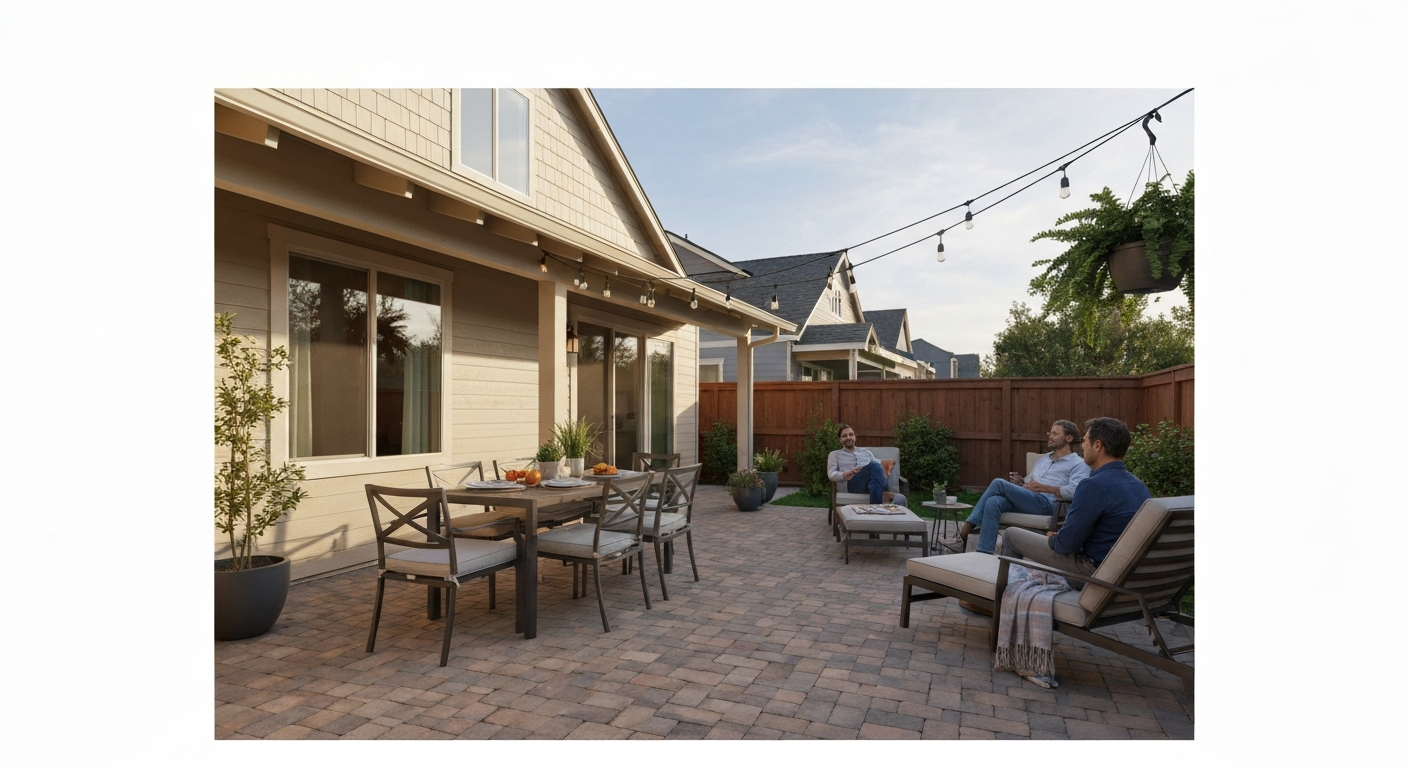
A patio is an open, paved area at ground level, usually behind the house, with no roof overhead. A verandah (also spelled veranda) is a roofed, open-sided structure attached to the outside of a house, most commonly running along the front or side. The single biggest difference is the roof: verandahs always have one, patios usually don't. A gazebo is different again, since it is typically a freestanding, roofed outdoor structure designed for gathering rather than being directly attached like a verandah patios usually don't.
Difference Between Patio and Verandah: Key Features

Ada Hollis
20 May 2026
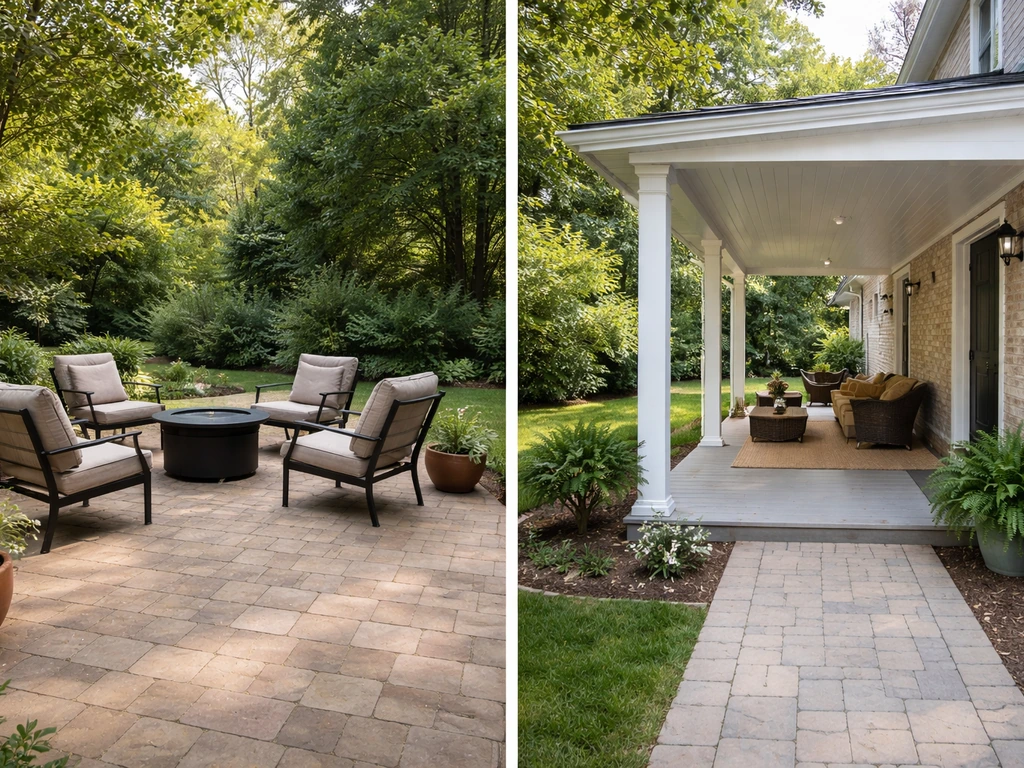
Quick definitions: patio vs verandah
A patio, per Oxford and Merriam-Webster, is a flat, hard surface that adjoins a dwelling and is often paved, typically used for sitting and outdoor dining. It sits at ground level, it's open to the sky, and it doesn't need to be structurally connected to the house in any meaningful way. You could lay one in the middle of a backyard and it would still be a patio.
A verandah, per Encyclopaedia Britannica and Collins Dictionary, is a roofed platform or open-walled porch attached to the exterior of a house, usually surrounded by a railing. It runs along the building itself, its roof is a continuation of (or addition to) the house's roofline, and it functions more like an outdoor hallway or transitional living space than an isolated paved area.
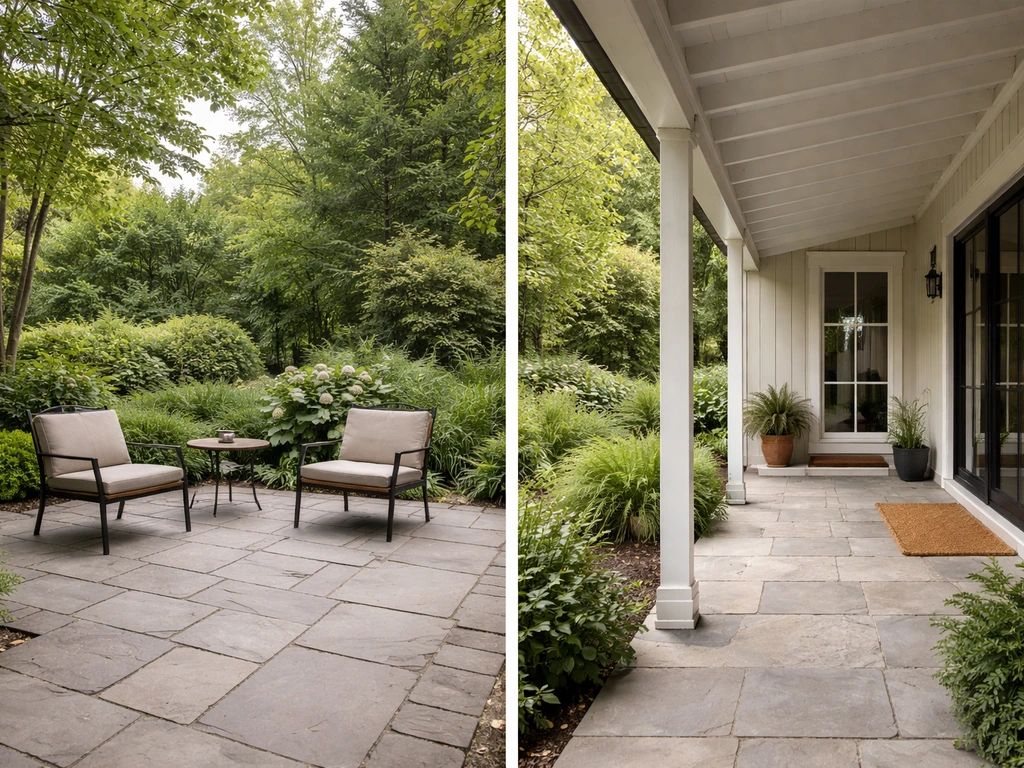
Side-by-side comparison
| Feature | Patio | Verandah |
|---|---|---|
| Location | Usually rear or side yard, set in the garden | Along the front, side, or all around the house facade |
| Attached to house? | Not necessarily — can be freestanding | Yes, always attached to the building exterior |
| Roof/covering | Typically none (open sky); covered patios exist but are the exception | Always roofed — that's a defining feature |
| Floor material | Paving, concrete, stone, pavers, tiles | Timber boards, concrete, or tiles (elevated or flush) |
| Railings/balustrades | Rarely | Very common — often a railing-enclosed perimeter |
| Typical use | Outdoor dining, lounging, barbecue area | Outdoor living room, shaded walkway, social space |
| Structural relationship to house | Independent ground-level surface | Extension of the house structure with its own roof |
The roof makes all the difference (plus how you get inside)
If you're standing outside looking at a property and one outdoor area has a roof connected to the house and another is just open paving in the yard, you've already found your verandah and your patio. That roof test is the fastest way to tell them apart, and it's backed up by every major dictionary definition.
The second clue is access. Because a verandah runs along the building facade, it typically connects directly to the interior through multiple doors or windows. It acts as a buffer zone between the house and the outside world. A patio, on the other hand, usually connects to the house through a single set of sliding doors or a back door, and then it just opens into the yard beyond. A good real estate listing will even use language like 'lower bedrooms open to veranda patio' to signal that the covered attached space serves as circulation between rooms and the exterior.
One edge case worth knowing: a 'covered patio' is a patio that has had a roof structure added after the fact, like a pergola, shade sail, or attached awning. One example of this listing language pattern is a US MLS description that pairs the terms as “covered veranda” (for instance, “Nice private rear yard with 20x12 covered veranda”). Building inspectors and listing platforms often treat covered patios as a separate category from verandahs precisely because the roof wasn't part of the original house structure. So if you see 'covered patio' in a listing, don't automatically assume verandah. Check whether the roofline is a true extension of the house or just a standalone canopy.
Veranda or verandah? The spelling confusion explained
Both spellings refer to the exact same thing. 'Veranda' (no h) is preferred in American English and by UK style guides like The Guardian. 'Verandah' (with h) is the standard spelling in Australian and New Zealand English. Cambridge Dictionary, Merriam-Webster, and Dictionary.com all list both as accepted variants. The word itself is Anglo-Indian in origin, first recorded in English use around 1711, which is why you'll see it pop up in colonial-era architecture across South Asia, Australia, and the American South.
In practice, this means if you're reading a US listing, you'll almost always see 'veranda.' If you're browsing Australian real estate sites, 'verandah' is the norm. Neither is wrong. When a listing says 'front full length verandah,' it means the same thing as 'wrap-around veranda' on a US listing: a roofed, attached, open-sided structure running along the house.
How to spot them in listing photos and floor plans
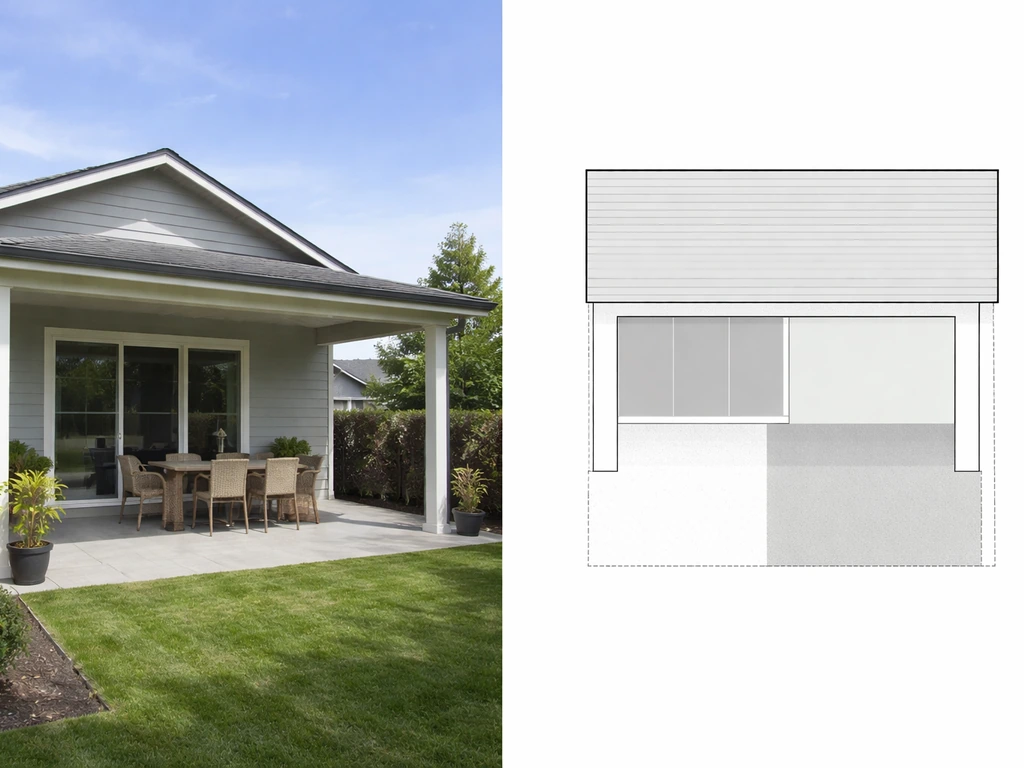
Here's a practical checklist you can run through when looking at property photos or reading a listing description:
- Look for a roof: If the outdoor area has a continuous roof connected to the house's roofline, it's a verandah. If it's open sky, it's a patio (or possibly a deck).
- Check where it sits on the house: A verandah typically runs along the front, side, or wraps around. A patio is usually in the backyard or off a rear door.
- Look for railings or balustrades: Verandahs almost always have them. Patios rarely do.
- Check the floor plan: On a floor plan, a verandah shows up as a labeled zone hugging the building perimeter, often accessed through multiple rooms. A patio appears as a separate rectangle outside the main footprint.
- Read the listing text carefully: Phrases like 'covered veranda,' '20x12 covered veranda,' or 'front full length verandah' all signal a roofed structure. 'Rear patio,' 'paved area,' or 'outdoor entertaining area' usually mean open paving.
- Watch for combined terms: Listings sometimes say 'veranda patio' or list 'covered patio' and 'veranda' separately in the same property. When that happens, they're describing different spaces on the same property.
Don't confuse these with porches, balconies, and courtyards
The porch is probably the term most people mix up with verandah. They're genuinely close: both are covered, both are attached to the house exterior. The practical difference is that a verandah tends to run the full length of a facade (or wrap around multiple sides), while a porch is typically smaller and positioned at a single entry point. Some design guidelines, like those from Wake Forest, NC, define both as 'covered and attached to the house' but distinguish them by scale and placement.
A balcony is elevated, projecting out from an upper floor, and not at ground level. Neither a patio nor a verandah is a balcony, though a verandah can technically appear on an upper level in some historic homes.
A courtyard is an outdoor space enclosed (or largely enclosed) by the walls of a building, sometimes paved like a patio but defined by that sense of enclosure rather than openness. The difference between a courtyard and a patio comes down to walls: if three or more sides are building walls, it tips into courtyard territory. And if you come across the term 'alfresco' in a listing (especially in Australian property descriptions), that's not a structural feature at all. It just means outdoor dining or outdoor living style, and it's usually referring to a covered area that could be a verandah, patio, or purpose-built outdoor room.
The simple rule of thumb, and what to do next
Here's the version worth remembering: a verandah has a roof and runs along the house; a patio is open paving that sits in the yard. If it's covered and attached to the building facade, it's a verandah. If it's a flat paved surface open to the sky, it's a patio.
When you're evaluating a property, use that roof test first. Then check whether the space connects to the house structure or sits independently in the yard. Those two questions will resolve the distinction in almost every listing you encounter. If a listing uses the terms interchangeably or combines them (like 'veranda patio'), look at the photos and check for a roof: the presence or absence of overhead coverage is the single most reliable identifier every time.
FAQ
What if a listing calls it a “veranda patio” or “patio verandah,” how do I tell what it really is?
In many listings, a “veranda patio” label is used loosely. To decide, rely on the roof test and also the attachment point. If the roof looks like a continuous extension of the house roofline and the structure aligns with exterior walls and multiple doors, treat it as a verandah. If it is clearly a standalone paved area with only a partial canopy or later-added shade structure, treat it as a (covered) patio.
Can a verandah be on an upper floor, and does that change the definition?
Yes, a verandah can sometimes appear on an upper level in older or multi-storey homes, but it is still categorized by the roofed, house-attached nature and the wrap or facade placement. If it is ground-level and open to the sky, it shifts toward patio territory. If it is elevated and projecting from upper rooms, it is more likely balcony or terrace.
How can I tell whether a “covered patio” is actually a verandah?
Look for “ceiling” clues and support details. A true verandah typically has posts or a roof structure that reads as part of the house’s exterior system. A covered patio (often pergola, awning, or sail) frequently has lighter, separate supports and can be removable or clearly independent from the main roofline.
Is direct access from the house required for a patio versus a verandah?
A patio does not require a direct interior connection, it just needs to be adjoining usable outdoor space. However, in practice patios are often reached via a single door or sliding doors. So, if you see multiple entry points from several rooms into the covered space, that pattern usually indicates a verandah’s circulation function rather than a standalone patio.
Do real estate platforms treat patios and verandahs differently for property descriptions or measurements?
For measurement and layout, patios are generally counted as yard outdoor living space, which can affect how landscaping and site boundaries are described. Verandahs are more often described as part of the home’s exterior footprint because they wrap along the building and provide covered circulation. When you’re comparing listings, look for wording like “attached to the dwelling” for verandahs.
How do I distinguish a courtyard from a patio when the ground surface looks similar?
Courtyards are defined more by enclosure. A space can be paved like a patio but still be called a courtyard if it is surrounded by building walls on multiple sides. If you see at least three sides bordered by the house or walls, switch your comparison from patio-versus-verandah to patio-versus-courtyard.
If a listing says “alfresco,” does that mean patio or verandah?
“Alfresco” is a style term for outdoor dining or living, not a structural type. It can refer to a covered patio area, a verandah, or even a purpose-built outdoor room. If the listing mentions overhead coverage and facade attachment, it is likely referring to a verandah; if it emphasizes paving open to the sky with optional shade, it may point to a patio setup.
Next Article
Patio Weather Meaning: What Patio, Area & View Mean
Clear patio definition: what a patio is, 'patio weather' meaning, and how it differs from decks or porches.