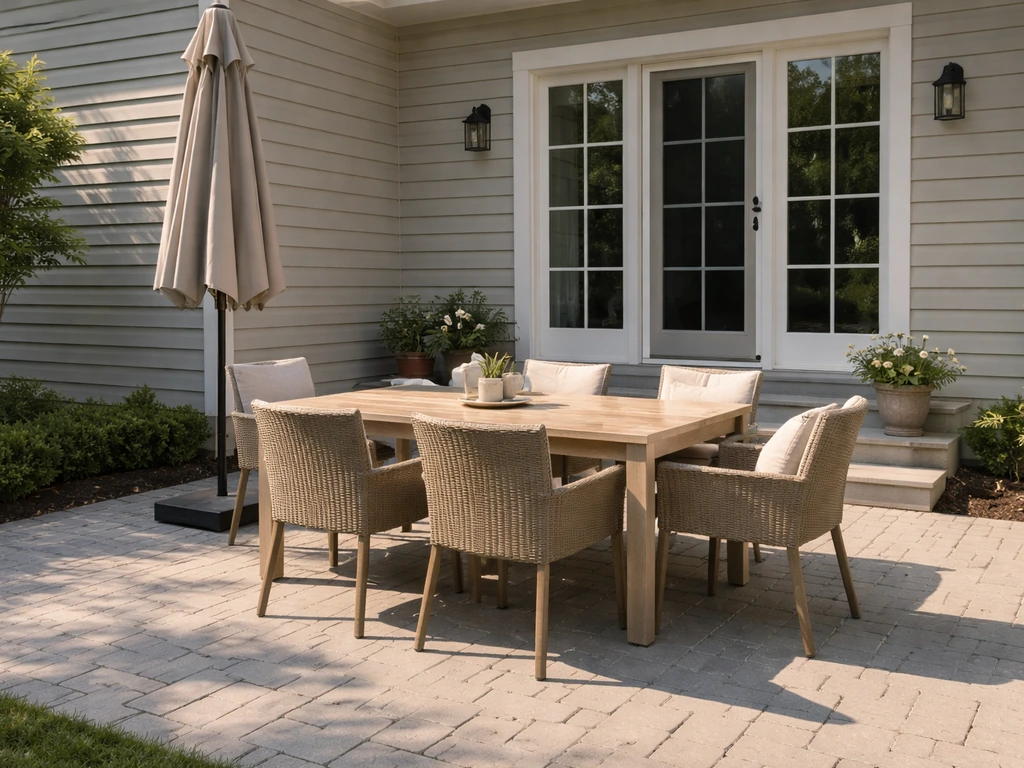
A patio is a ground-level outdoor area attached to a house, typically paved or surfaced, with no permanent roof overhead. It sits directly outside a door (usually the back or side of the home), sits at or very close to grade level, and is designed for everyday outdoor living: dining, relaxing, entertaining, or just getting some air. That's it in plain terms. If you're reading a real estate listing and see 'patio,' picture a flat, hard-surfaced outdoor space you step right out onto from the house, usually without stairs and without a roof above your head.
What Is a Patio in a House? Definition and Types

Ada Hollis
17 May 2026
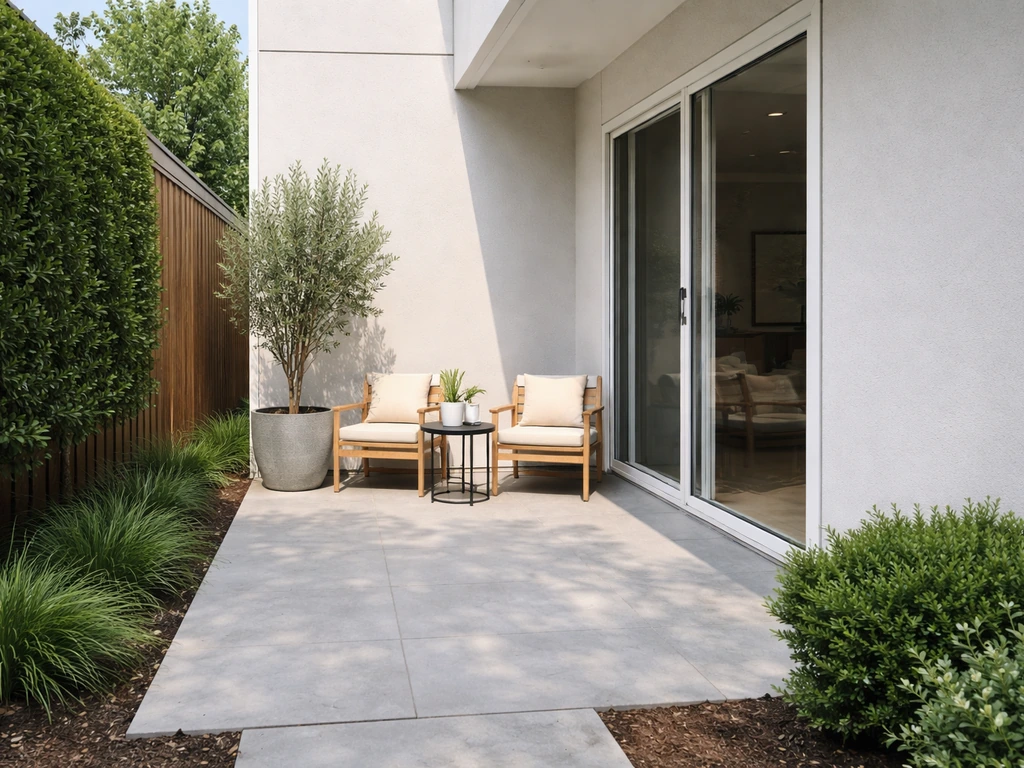
What actually makes a patio a patio
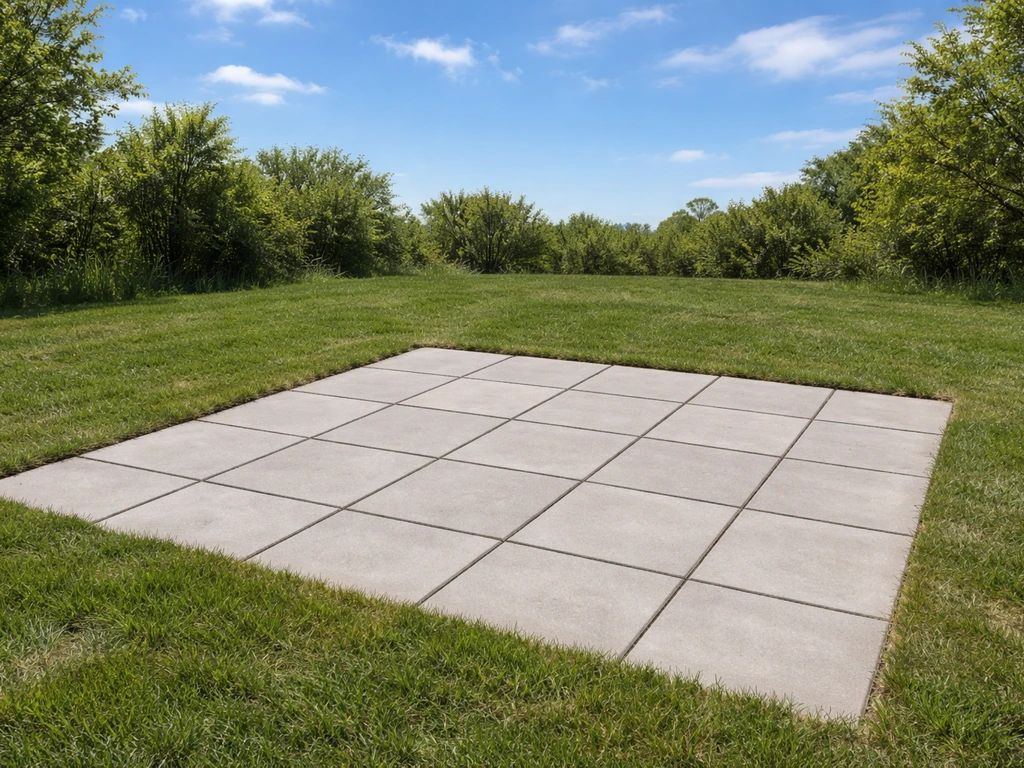
The core definition comes down to three things: it's ground-level (or within a few feet of grade), it's surfaced with something solid, and it isn't covered by a permanent roof structure. blank" rel="noopener noreferrer">Merriam-Webster describes a patio as a recreation area adjoining a dwelling, often paved, and especially suited for outdoor dining. Cambridge Dictionary adds that it has a solid floor but no roof. Cambridge Dictionary defines patio as an area outside a house with a solid floor but no roof, used for relaxing or eating in good weather Cambridge Dictionary adds that it has a solid floor but no roof.. Municipal zoning codes, like the one used in The Colony, Texas, define a patio as a level surfaced area directly adjacent to the principal building, at or within three feet of finished grade, and not covered by a permanent roof.
That 'no permanent roof' part is what trips people up most often. You can absolutely put a pergola, a shade sail, or a retractable awning over a patio, and it's still a patio. But the moment you add a permanent solid roof that's structurally part of the building, most codes and real estate conventions start calling it something else, usually a covered porch or a patio cover. The distinction matters when you're reading listings or pulling permits.
The surface material matters too, at least to distinguish a patio from a lawn. Patios are typically finished with concrete, pavers, stone, brick, tile, gravel, or composite materials. Some wood deck spaces get called patios colloquially, especially when they're at ground level with no elevation, but technically a raised wood platform is more accurately a deck. In everyday speech, people blend these terms constantly, so context always helps.
Where patios sit on a house and how people actually use them
Most patios are positioned at the back or side of a house, accessed directly through a sliding glass door, French doors, or a standard exterior door off the kitchen, dining room, or living room. If you mean the location inside your property, start by checking what room the patio doors connect to and whether it sits at ground level outside a back or side entrance back or side of the home. This placement is intentional: you want a seamless flow between indoor living space and the outdoor area. A patio at the back of a home gives privacy from the street, which is why it became the default in suburban residential architecture.
Front-of-house patios exist too, though they're less common in American-style homes and more typical in Mediterranean, Spanish, or courtyard-style architecture. The question of whether a patio is at the front or back of a house comes up often enough that it's worth knowing: location varies by design style, neighborhood layout, and regional tradition. In denser urban homes or townhouses, patios sometimes appear on the side of the property, sandwiched between buildings.
In terms of daily use, patios are workhorses. People use them for outdoor dining, morning coffee, barbecuing, kids' play areas, container gardening, yoga, or simply as a transition zone between the house and the yard. A well-designed patio essentially extends your usable living space outdoors for most of the year, depending on your climate.
Patio vs. porch vs. balcony vs. verandah vs. courtyard
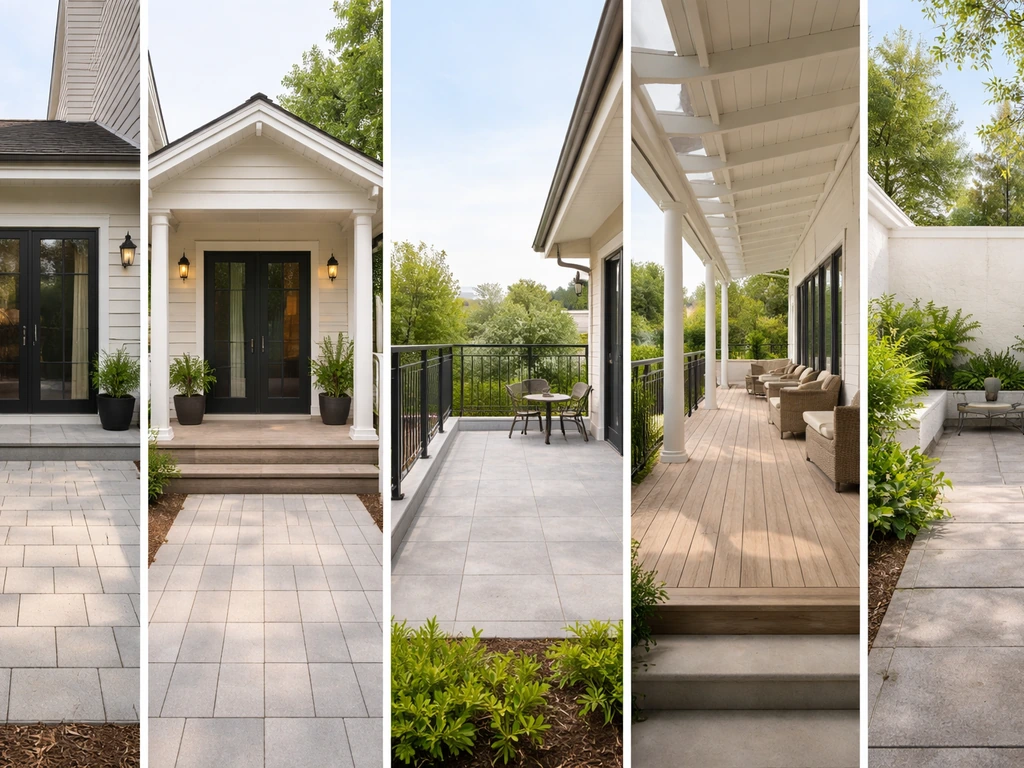
This comparison is the part most people actually need when they're decoding a listing or trying to describe a space they already have. Each of these outdoor areas has distinct characteristics around elevation, roofing, and location on the house.
| Feature | Patio | Porch | Balcony | Verandah | Courtyard |
|---|---|---|---|---|---|
| Elevation | Ground level (within 3 ft of grade) | Ground level or slightly raised | Upper floor, elevated | Ground level, can wrap around | Ground level, enclosed by walls |
| Roof/Cover | No permanent roof | Usually has a roof | Usually has a railing, may have roof above | Has a roof (part of house structure) | Open to sky |
| Location on house | Back or side, attached to exterior door | Front of house, attached to entry | Upper story exterior, off bedroom or living area | Front, side, or wraps around home | Interior of home footprint or between buildings |
| Enclosure | Open on all sides | Often partially enclosed with railings or screens | Open but elevated with railing | Open sides, sheltered above | Fully or partially enclosed by walls or fencing |
| Common materials | Concrete, pavers, stone, brick | Wood, composite, concrete | Concrete slab, tile, wood decking | Wood, composite | Stone, tile, pavers, gravel |
| Typical function | Dining, relaxing, entertaining | Sitting, greeting guests | Views, fresh air, small seating area | Relaxing, shade, wraparound access | Private garden, Mediterranean-style lounging |
The biggest practical distinction: a porch is almost always at the front of the house and has a roof. A patio is almost always at the back or side and has no permanent roof. A balcony is elevated, accessed from an upper floor, and structurally cantilevered or supported off the building wall. A verandah is essentially a roofed, open-sided porch that often wraps around more than one side of the house, common in Victorian, Southern, and Australian architecture. A courtyard is enclosed by walls or the building itself, often at the center of a home or between structures, giving it a more private, enclosed character.
If you're looking at an apartment listing, the patio question gets more specific. Ground-floor apartments sometimes have a small private patio, which is just a ground-level outdoor space outside the unit's door. Ground-floor apartment patios are typically small, hard-surfaced outdoor areas right outside the unit, and they are often the same spaces shown in listings under the patio label. Upper-floor units have balconies, not patios, though some listings misuse the terms. The context of apartment patios is common enough to be worth looking up separately if that's your situation.
Common patio types and the materials they're made from
Covered vs. uncovered
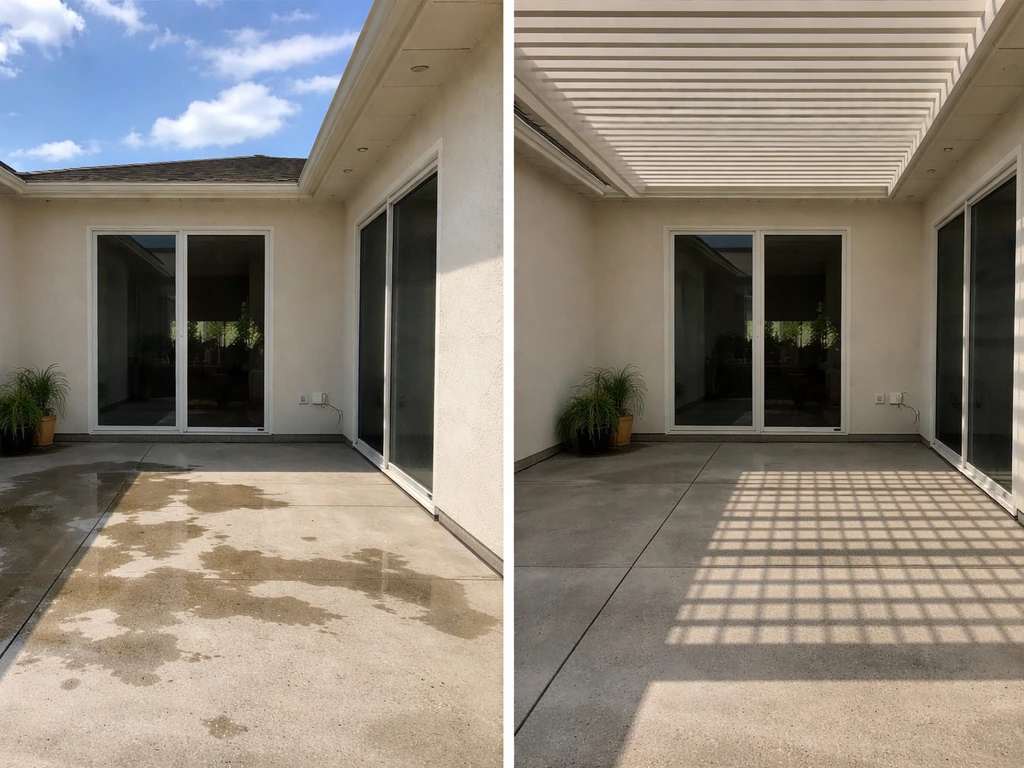
An uncovered patio is the classic version: open to the sky, exposed to sun and rain. A covered patio has some kind of overhead structure, whether a pergola with open slats, a retractable awning, a polycarbonate roof panel, or a full solid patio cover. The covered variety is sometimes called an 'alfresco' area in Australian real estate or a 'patio cover' in contractor language. In listings, 'covered patio' is a meaningful upgrade because it extends usable time outdoors in hot or rainy climates.
Attached vs. detached
Most patios are attached, meaning they're directly connected to the house and accessed from an interior room. A detached patio sits separately in the yard, often centered around a fire pit, pool, or garden feature. Detached patios are less common but show up in larger properties where a secondary outdoor gathering space makes sense.
Materials
- Concrete: the most common and affordable option, poured as a slab, can be stamped or stained for visual interest
- Pavers: individual brick, concrete, or stone units set in sand or mortar, giving a more finished look and easy repair if one cracks
- Natural stone: flagstone, travertine, bluestone, and slate are popular for upscale patios with a natural aesthetic
- Gravel or decomposed granite: a lower-cost permeable option, better for drainage but less comfortable underfoot
- Brick: classic, durable, and warm in appearance, common in older homes and traditional architectural styles
- Tile: popular in warmer climates and Spanish or Mediterranean-style homes, though can be slippery when wet
- Composite or wood decking at grade: technically a deck but often called a patio when it's ground-level and used the same way
Adding or identifying a patio: what to look for and expect
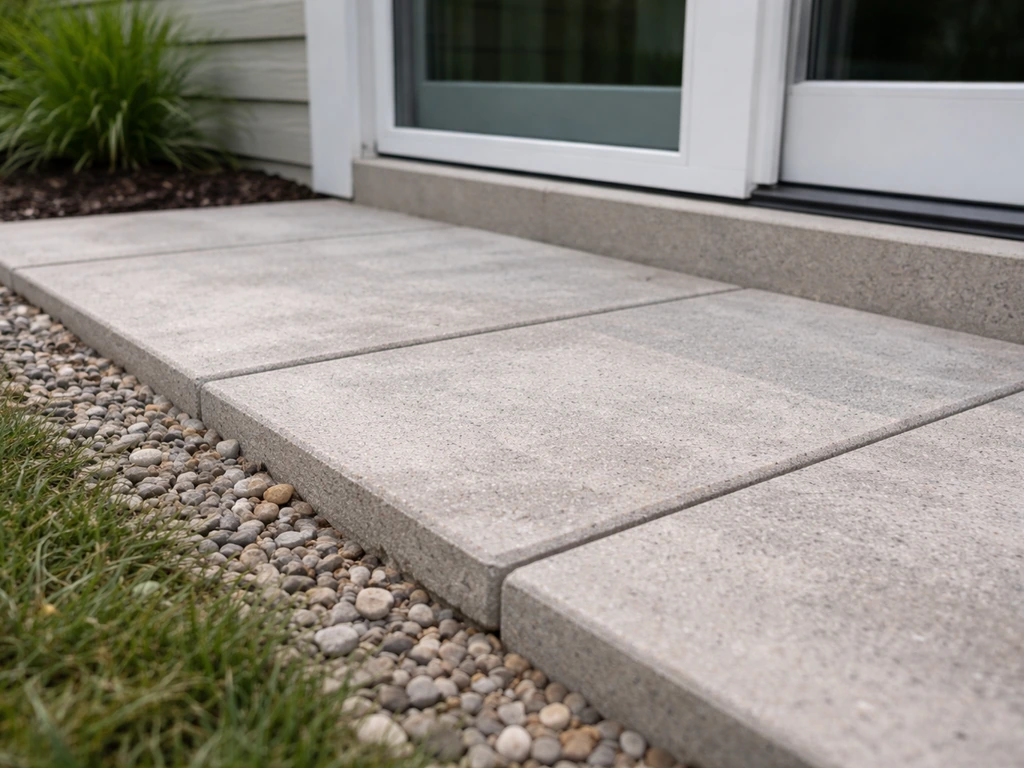
If you're trying to identify whether a house already has a patio, look for a hard-surfaced area directly outside a back or side door, sitting at roughly the same level as the interior floor or just a step down. If there's a concrete slab, a stone or paver surface, or even a well-defined gravel area with edging outside the door, that's your patio. It doesn't need furniture on it or a defined boundary to count.
If you want to add a patio to a home that doesn't have one, the basic process goes like this: choose a location adjacent to an exterior door, determine the size you need (a dining table with chairs typically needs at least 10 by 12 feet, and most people find 12 by 16 feet or larger more comfortable), pick your material, and decide whether you want a DIY project or a contractor. A simple concrete slab patio is one of the more straightforward outdoor projects, while a natural stone or paver installation takes more skill and time to get level and stable.
- Check local permit requirements: many municipalities require a permit for permanent patio surfaces above a certain size
- Mark out the area and confirm it sits within your property setbacks (zoning rules often require patios to be a minimum distance from property lines)
- Decide on the slope: patios need a slight grade (about 1/8 inch per foot) away from the house for water drainage
- Choose your material based on budget, maintenance preference, and climate
- Decide whether to add a pergola, awning, or patio cover now or later
- If hiring a contractor, get quotes referencing 'patio installation' or 'patio slab' and confirm they're talking about ground-level construction, not a raised deck
In contractor and real estate language, you'll also hear terms like 'hardscape,' which refers to all non-plant outdoor surfaces including patios, walkways, and driveways. A patio is a subset of hardscape. Knowing this word helps when you're browsing listings or talking to a landscaper.
How 'patio' is used across cultures, languages, and real estate
The word 'patio' comes directly from Spanish, where it originally referred to an inner courtyard, typically the central open-air space within a traditional Spanish or Latin American home surrounded by walls or covered walkways. In Spanish architecture, the patio is literally the heart of the house. That meaning survives in Spanish today and influences design in Mexico, Spain, and Latin American countries where enclosed courtyard-style patios are still a hallmark of residential architecture.
In English (both American and British), the meaning shifted. The word got applied to any ground-level outdoor hard surface adjoining a house, losing the 'enclosed courtyard' connotation almost entirely. British English uses 'patio' the same way Americans do, though some British homeowners and real estate agents also use 'terrace' for a similar space, particularly in more formal or urban settings. In Australian real estate, the equivalent space is often called an 'alfresco' or 'outdoor entertaining area,' and covered versions are specifically marketed as covered patios or verandahs.
In Hindi and Urdu, there isn't a single equivalent term that maps exactly onto the English concept of a patio. The closest concepts are 'aangan' (an open courtyard, typically internal to the home) or 'chabutra' (a raised outdoor platform). In everyday South Asian usage, English speakers in those regions often borrow the word 'patio' directly when describing Western-style homes. In real estate listings for Indian properties marketed to international buyers, 'patio' and 'terrace' are sometimes used interchangeably.
In American real estate listings specifically, 'patio' is a fairly standard descriptor and usually reliable in meaning: a ground-level outdoor surface attached to the home. Where it gets blurry is when sellers or agents use 'patio' to describe a small wood deck, a gravel area, or even a covered porch. When in doubt, look at the listing photos rather than relying on the word alone. A flat hard surface at ground level accessed from the main living area is a patio, regardless of what the listing calls it.
One regional note worth knowing: in Hawaii and some Pacific Island contexts, similar outdoor living spaces are called 'lanai,' a Hawaiian term for a covered outdoor living area that functions much like a covered patio or screened porch. You'll see 'lanai' used in Florida real estate too, particularly in communities designed with a Florida-room or screened outdoor space. If you encounter 'lanai' in a listing, think: covered outdoor area, usually screened or partially enclosed, similar to what mainland listings call a covered patio or porch.
Wherever you are and whatever terminology surrounds you, the clearest way to identify a patio is to ask three questions: Is it outside and directly accessible from the home? Is it at ground level or very close to it? Is it surfaced with something solid? If the answer is yes to all three, you're looking at a patio, whatever it happens to be called locally.
FAQ
Is a screened-in patio still considered a patio if it is partly enclosed?
Usually, yes. If the area is a solid, hard-surfaced outdoor space right outside the home and at about grade level, it can still be considered a patio even if it has railings or partial walls for wind or privacy. The key is that it is not covered by a permanent roof that is structurally part of the building.
At what point does a patio stop being a patio because it is elevated?
A patio can be slightly elevated, but in most listing and code-style definitions it is essentially at or very near finished grade, often within a few feet, and it should not be reached primarily by stairs. If you must climb multiple steps from the door to get there, it is more likely being described as a deck or porch rather than a patio.
How do I tell the difference between a covered patio and a porch/patio cover?
If the overhead structure is lightweight and not treated as a permanent roof that is part of the building, it is commonly marketed as a covered patio (for example, a pergola, shade sail, or retractable awning). If it is a fixed, solid roof with structural elements that create a true covered room attached to the house, listings and permits may call it a patio cover or a porch.
If it is outside a bedroom door on the second floor, is that still a patio?
In most real estate contexts, a balcony is elevated and accessed from an upper floor, often cantilevered or supported off the building. A patio is typically accessed from a door at ground level. If the space is outside a second-story door, it is generally a balcony even if it looks like a flat hard-surfaced area.
What is the difference between a patio and a courtyard?
No. A courtyard is defined more by enclosure, such as walls or the building itself creating a contained interior-like outdoor space. A patio can be attached and open to the sky, but it is usually not enclosed by surrounding walls in the same way.
Can a patio be made of gravel or does it have to be paved?
A gravel area can be called a patio in everyday speech if it is a defined hard-surfaced outdoor sitting area directly outside a door. However, for practical usability and long-term maintenance, gravel patios are often harder to keep level and can shift without edging or a stable base.
If there is no furniture on the outdoor slab, is it still a patio?
Look for a direct connection to the home, such as a door transition, and for the surface type. If the outdoor area is mainly open soil or grass, it is not a patio. If it is a hard, finished surface like pavers or concrete, it usually qualifies even if it is mostly unfurnished.
Can a patio be detached from the house?
Patios are commonly attached, but detached patios exist, especially on larger lots where the main gathering area is anchored around something like a fire pit or a garden. If it is detached and not directly outside a house door, it might still be called a patio informally, but it is less likely to be described as an attached patio.
Does adding landscaping or container gardens change whether it is a patio?
Usually, yes for the purpose of using the space, but it may change how it is described. If you add plants, raised planters, or containers, it does not change the fact that the patio is the hard-surfaced base. If you switch from hardscape to mostly vegetated area, the term patio becomes less accurate.
What are common listing mistakes when sellers call something a patio?
In listings, pay attention to whether the door you access is at ground level and whether you see hardscape. If the seller calls it a patio but photos show multiple steps, an elevated platform, or a roofed entry, you may be looking at a deck or porch. When in doubt, rely on the photo evidence of elevation, surface, and roofing.
What should I consider if I want to use a patio in hot or rainy weather?
Many climates treat patios differently because water and temperature matter. An uncovered patio can be uncomfortable in heavy rain or strong sun, while a covered patio or a screened version can extend usability. If your goal is year-round use, prioritize roof coverage, drainage, and airflow rather than patio size alone.
In real estate listings, what is the difference between a patio and a terrace?
If a listing mentions both, often it is to distinguish usage and elevation: “patio” implies a ground-level hard surface, “terrace” is sometimes used for a raised or more formal outdoor area depending on region and agent preference. For decision-making, compare elevation and roof coverage in the photos rather than relying only on the word.
If a listing says “lanai,” does it mean the same thing as a covered patio?
A “lanai” in Hawaii or some Florida marketing typically refers to a covered outdoor living area, often screened or partially enclosed, similar in function to a covered patio or screened porch. If you see screening and overhead coverage, treat it as a covered outdoor room rather than an uncovered patio.
Next Article
What Patio Means: Definition, Types, and How to Spot One
Definition of a patio plus how to identify it on homes, compare it to porches and decks, and assess use and upkeep.