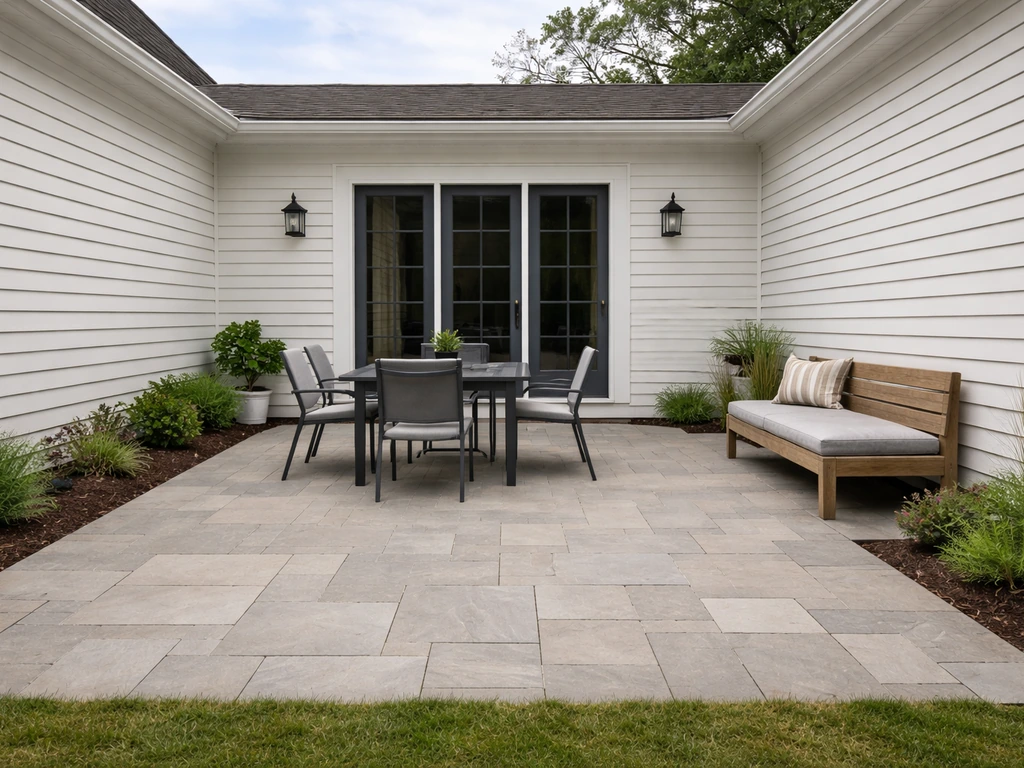
An outdoor patio is a ground-level, hard-surfaced area directly beside or behind a home that's designed for sitting, dining, and relaxing outside. It's usually paved with concrete, stone, brick, or pavers, sits flush with or just above the surrounding ground, and is open to the sky. That's the core of it. When a real estate listing says 'patio,' that's exactly what you should picture: a solid outdoor floor attached to the home, no roof overhead, no elevation above grade.
What Is an Outdoor Patio Called? Patio vs Porch, Courtyard

Ada Hollis
29 Jun 2026
What an outdoor patio actually is
Every major dictionary lands on roughly the same definition. Merriam-Webster calls it 'a recreation area that adjoins a dwelling,' often paved and suited for outdoor dining. Cambridge keeps it even simpler: 'an outside area with a solid floor next to a house where people can sit.' Dictionary.com adds that it's 'usually located beside or behind a house or apartment building.' Put those together and the picture is clear: a patio is a paved outdoor surface attached to a home, intended for leisure, and sitting at ground level.
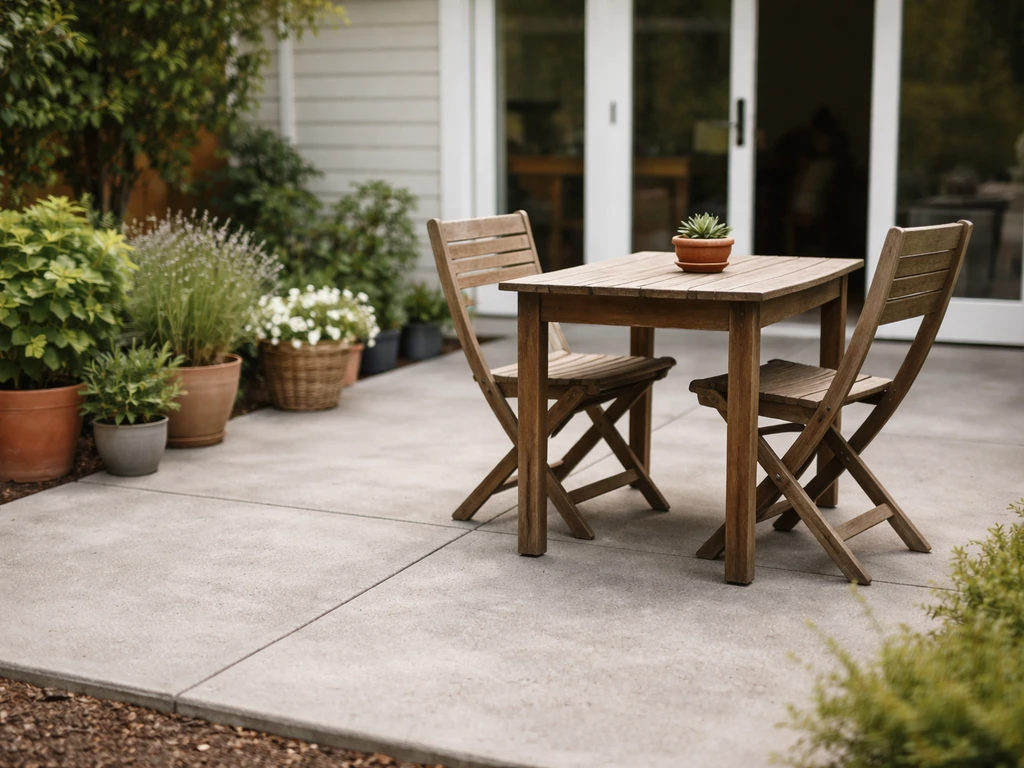
The surface material is a reliable giveaway. Concrete slabs are the most common, but natural stone, brick, flagstone, ceramic tile, and compacted gravel all qualify. What makes it a patio isn't the specific material so much as the fact that there's a solid, defined floor area right next to the house. A patch of lawn beside the back door doesn't count. A paved zone with outdoor furniture does.
One nuance worth knowing: in Australia, 'patio' sometimes refers to a roofed structure that would be called a veranda in the UK or a covered porch in North America. Wikipedia describes “patio” as an outdoor space generally used for dining or recreation that adjoins a structure and is typically paved, and in Australia the term can include roofed structures such as a veranda. If you're reading an Australian or New Zealand property listing, a patio might have a roof over it. Everywhere else, assume it's open-air unless the listing specifically says 'covered patio.'
What it's called in real estate and everyday speech
In MLS listings and everyday conversation across North America, 'patio' is the standard, go-to term for this kind of outdoor space. Real estate agents use it consistently: MLS glossaries define it as 'an outdoor area, usually paved or made with concrete, stone, bricks, or other hard materials.' You'll also see it called a 'terrace' in some listings, particularly for apartments or urban properties. Technically, a terrace is an unroofed, paved area built adjacent to a residence, which is nearly identical to a patio. The words are used interchangeably in most listings, though 'terrace' sometimes carries a slightly more upscale connotation in city contexts.
You might also hear 'back patio,' 'front patio,' or 'side patio' depending on where it sits relative to the house. Some listings just say 'outdoor living area' or 'outdoor entertaining space,' but if it's ground-level and paved, it's a patio by any other name. The word itself comes from Spanish, where 'patio' means an inner courtyard or yard space, and that origin still influences how the term is used in Spanish-speaking countries and communities where it can describe any open outdoor area attached to a home.
Patio vs. porch: the covered vs. uncovered distinction
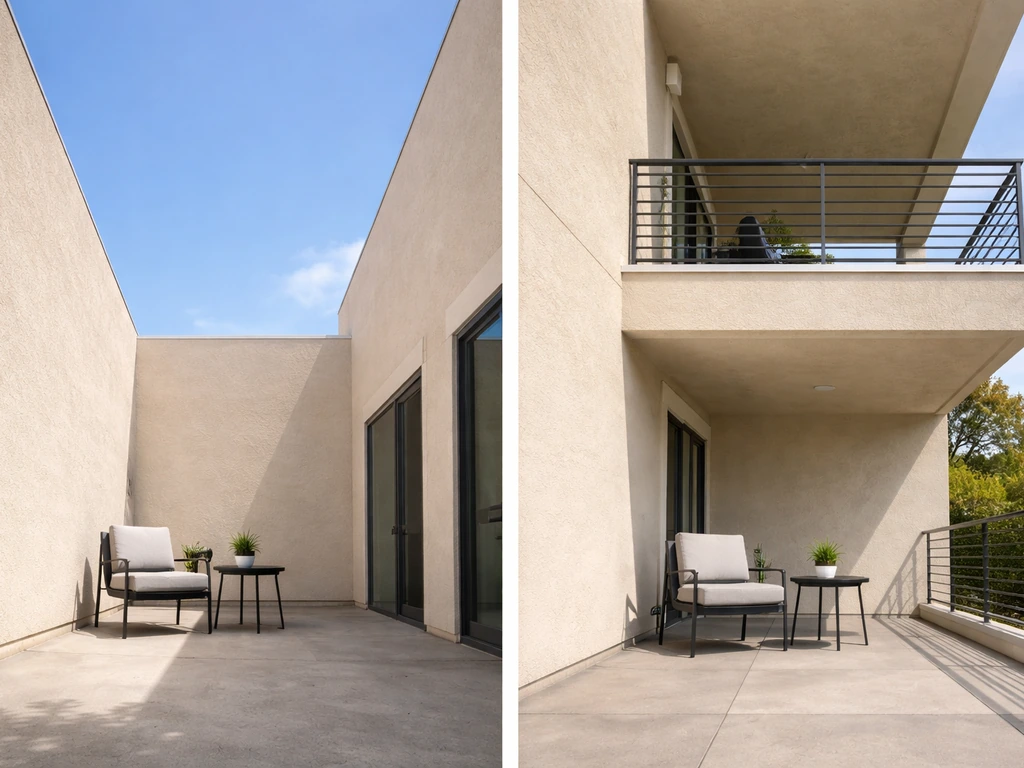
This is the comparison that trips people up most often, and the fix is simple: look up. If there's a roof over your head, it's a porch. If you're open to the sky, it's a patio.
Merriam-Webster defines a porch as 'a covered area adjoining an entrance to a building and usually having a separate roof. Wikipedia describes a porch as a room or gallery located in front of a building's entrance. ' Cambridge reinforces this: a porch is 'a covered area in front of the entrance to a house' or 'a structure built onto the front or back of a house with a floor and a roof but no walls.' The roof is non-negotiable for a porch. It's also architecturally integrated into the home, usually framing the front or back entrance.
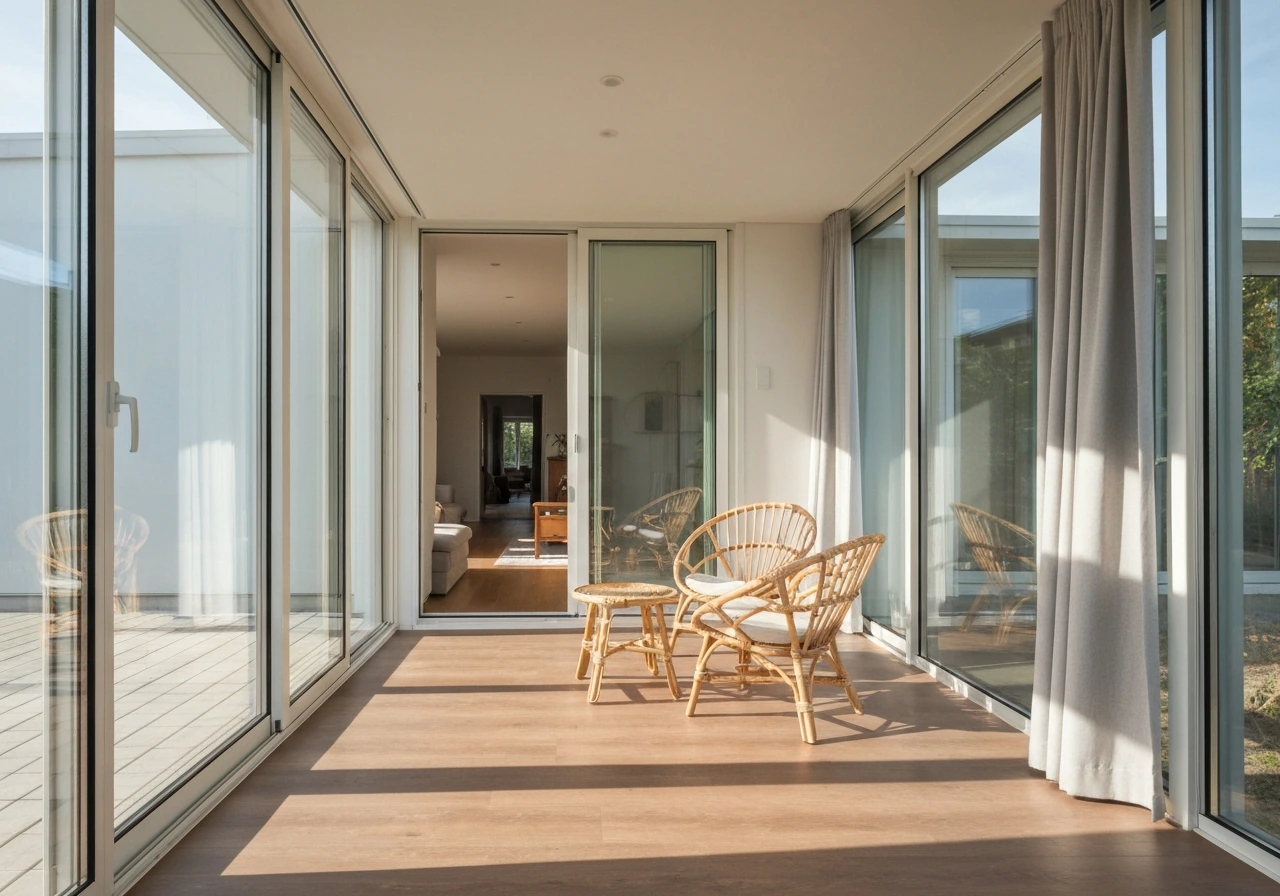
A patio has no such requirement. It can sit anywhere around the property, it doesn't need to frame an entrance, and it has no roof. Where a porch feels like part of the house's architecture, a patio feels more like part of the yard that just happens to have a hard floor. An indoor patio is typically called a sunroom or enclosed courtyard space, depending on the layout. If you're touring a home and standing on a covered platform attached to the front door, that's a porch. If you walk around back and step onto an open concrete or stone surface, that's the patio.
One edge case: 'covered patio' is a real and common term. A pergola or shade structure over a patio slab doesn't automatically make it a porch, especially if the covering is partial or detached from the main roofline. But a fully roofed, enclosed-overhead structure attached to the house starts looking a lot more like a porch (or, depending on the region, a veranda). An enclosed patio meaning is essentially a patio space with walls and often windows or doors, which makes it feel more sheltered than an open-air patio fully roofed, enclosed-overhead structure. The terminology gets fuzzy at the edges, which is part of why these definitions matter when you're reading listings.
Patio vs. balcony: the ground-level vs. elevated split
A balcony is elevated. That's the core difference. Wikipedia defines it as 'a platform that projects from the wall of a building, supported by columns or brackets, and enclosed with a balustrade, usually above the ground floor.' A patio is at ground level. A balcony is up in the air, attached to an upper story of the building, and accessed from inside the home through a door or sliding glass panel.
If you're standing on the first floor of a house and you walk outside onto a paved surface, that's a patio. If you're on the second or third floor and you step out through a bedroom or living room door onto a small projected platform with a railing around it, that's a balcony. Balconies are common in apartment buildings and multi-story homes. Ground-floor units and single-story houses almost always have patios, not balconies.
The confusion shows up in listings when agents describe a ground-floor outdoor slab as a 'balcony' or vice versa. A quick rule: if it's on the ground, it's not a balcony, no matter what the listing says. Balconies project outward from an upper wall. Patios sit on the earth.
Patio vs. verandah (or veranda): the roofed wraparound
A veranda (also spelled verandah, particularly in Australian and British usage) is a roofed, open-air gallery or porch that wraps around the outside of a building, usually at ground level. Wikipedia describes it as 'a roofed, open-air hallway or porch attached to the outside of a building.' Oxford Learner's Dictionaries adds that it's 'a platform with an open front and a roof, built onto the side of a house on the ground floor.' Collins expands on this: a 'large, open porch, usually roofed and partly enclosed, as by a railing, often extending across the front and sides of a house.'
So where a patio is open to the sky and typically located to the rear or side, a veranda wraps around the building and is always roofed. The classic image of a Southern colonial home with a shaded covered walkway running across the front and around the sides is a veranda. You can sit outside on a veranda and stay dry in the rain. You cannot do that on a patio unless you've added a cover.
In North American real estate, the word 'porch' is generally used where British and Australian listings would say 'veranda' or 'verandah.' If you're shopping for a home in the UK, Australia, or New Zealand and a listing mentions a verandah, picture a roofed outdoor corridor attached to the building, not an open paved slab. The spelling variant 'verandah' is more common in Australian and South Asian English, while 'veranda' is standard in American and British English, but they refer to the same structure.
Patio vs. courtyard (and a few other terms worth knowing)
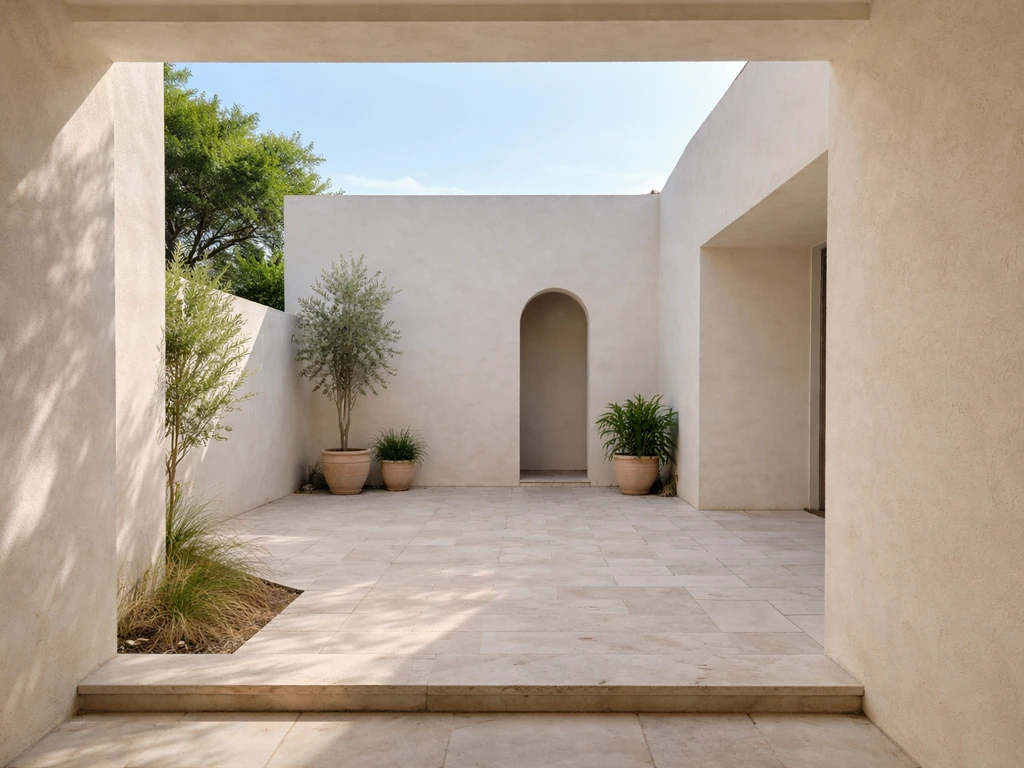
A courtyard is surrounded. That's the defining feature. Wikipedia describes it as 'a circumscribed area often surrounded by a building or complex, open to the sky.' Collins doubles down: 'an open area of ground surrounded by buildings or walls, especially enclosed on all four sides.' A patio is attached to the side of a home and opens outward into the yard. A courtyard is enclosed, typically on most or all sides, by walls or building walls, creating an interior outdoor pocket.
Think of a traditional Spanish or Mediterranean home with an open-air garden space in the center of the building, surrounded by interior-facing walls and rooms. That's a courtyard. Courtyards are also common in apartment complexes, hotels, and townhouse developments where a shared outdoor space sits between wings of the building. A patio, by contrast, is private to one unit and opens to the exterior of the property.
A useful visual rule that holds up well in practice: if it's raised off the ground on posts, it's more like a deck. If it has a roof overhead, it's closer to a porch or veranda. If it's entirely surrounded by walls or buildings, it's a courtyard. If it's a ground-level hard surface open to the sky and attached to one side of the home, it's a patio. Decks deserve a quick mention here too: a deck is a flat outdoor surface connected to the building and often elevated, typically built from wood or composite decking material rather than masonry. Ground-level decks and patios can look similar, but the surface material (wood planks vs. paved stone or concrete) usually tells them apart.
| Space | Roofed? | Ground-level? | Enclosed by walls? | Typical surface | Where it sits |
|---|---|---|---|---|---|
| Patio | No (usually) | Yes | No | Concrete, stone, brick, pavers | Side or rear of home |
| Porch | Yes | Yes | Partially | Wood, concrete | Front or back entry |
| Balcony | No (usually) | No (upper floor) | No (open railing) | Concrete, wood, tile | Projects from upper wall |
| Veranda/Verandah | Yes | Yes | Partially (railing) | Wood, concrete, tile | Wraps around building exterior |
| Courtyard | No | Yes | Yes (surrounded) | Varied: stone, grass, paved | Interior or enclosed by building wings |
| Deck | No (usually) | Sometimes elevated | No | Wood or composite boards | Attached to rear or side of home |
How to identify a patio when you're touring a property
When you're walking through a home, use a quick three-point check to confirm whether an outdoor space is actually a patio, and not something else being described loosely.
- Is it at ground level? A patio sits on or very close to the ground. If you had to go up stairs or step out from an upper-floor room, it's not a patio.
- Is it open to the sky? Look straight up. If there's no permanent roof structure above you, it's consistent with a patio. A full roof makes it a porch or veranda.
- Does it have a hard, defined surface? Concrete, stone, brick, tile, or pavers are all standard patio materials. If you're standing on grass or bare dirt, it's not a patio, no matter what the listing says.
- Is it attached to or adjacent to the home? A patio connects to the property directly, usually accessible through a back or side door. It should feel like an extension of the indoor living space, just outside.
- Is it open on at least two or three sides? If you're surrounded by high walls on every side, you're in a courtyard. A patio opens outward into the yard or landscape.
In practice, this check takes about ten seconds once you know what to look for. The most common mislabeling you'll encounter in listings is calling a covered back porch a 'patio,' or describing a small balcony on a ground-floor apartment unit as a 'patio.' Both of those descriptions are sloppy but not uncommon. Using this checklist protects you from showing up expecting a spacious open-air patio and finding a narrow covered stoop instead.
It's also worth asking the listing agent for square footage if the patio size matters to you for furniture layout or entertaining. 'Patio' tells you the type of space, not the size. A 40-square-foot concrete slab and a 400-square-foot flagstone terrace are both technically patios. The size difference is enormous for daily use, so always get the dimensions if they're not in the listing.
When the lines blur: enclosed and indoor patios
Once you start adding walls or a roof to a patio, the terminology shifts. A patio that gets enclosed with screens, glass, or solid walls becomes something different, and the naming conventions for those spaces are genuinely varied. Depending on the region and the extent of the enclosure, you'll hear terms like sunroom, Florida room, screened porch, lanai, or simply 'enclosed patio. In many listings, an enclosed patio is simply referred to as an enclosed patio or an enclosed outdoor living space. ' These are related but distinct concepts worth exploring separately if you're considering a property with one of those features or planning a renovation.
The core patio, though, stays simple: ground level, hard surface, open to the sky, attached to the home. If you are looking at an enclosed patio, it helps to understand what makes it different from a fully roofed porch or a balcony enclosed and indoor patios. Everything else is a variation or a different space entirely. If you can keep that baseline definition clear, reading real estate listings and identifying outdoor spaces on property tours becomes much more straightforward.
FAQ
If an outdoor space is paved but not attached to the house, is it still an outdoor patio?
Usually no. A patio is typically an outdoor recreation area that adjoins a dwelling. If the hard-surfaced area is in the yard but separated from the home (for example, a standalone walkway pad), listings may call it a terrace, courtyard feature, or paving area instead.
Does a patio have to be fully open to the sky, or can it have partial shade?
It can have partial shade without becoming a porch, for example, a pergola, umbrella, or partial cover over part of the slab. The key decision is whether it has a roof overhead as a structural, consistently overhead cover attached to the home (which pushes it toward porch or veranda language).
Can a ground-level patio be accessed from any room, or does it need to be the back door?
It can connect to any exterior opening, not only the back door. Many patios are accessed from a living room, kitchen, or primary bedroom via sliding doors or steps, but the defining trait remains the ground-level, hard-surfaced area open to the sky.
What’s the difference between a patio and a terrace when house listings use both terms?
They are often used interchangeably in real estate, especially for unroofed hard-surface areas adjacent to a residence. In some contexts, “terrace” is used for a more landscaped or upgraded paved area, but practically you still judge by the same baseline rules: ground level, defined hard surface, open to the sky, attached or adjoining the home.
If my patio has railings, does that automatically make it a balcony or deck?
Not automatically. Railings can appear on patios for safety, especially if the patio is slightly raised or borders a drop-off. If the platform is still at ground level and not an upper-story projection, it’s more likely a patio with safety features than a balcony.
How high is “ground level” for a patio, and when does it become a raised deck?
If it’s essentially at or near grade (flush or just slightly above surrounding ground), it’s typically treated as a patio. If it’s built on structural posts or noticeably elevated like a platform, many listings describe it as a deck instead, even if there’s stairs and a railing.
Are gravel or paver patios the same thing as a paved patio?
A patio is more about having a defined, hard-surfaced footprint than the exact material. Compact gravel, pavers, and similar surfaces can qualify, while an area that’s mostly lawn or turf does not.
Does a patio count if it’s indoors but open-air, like a covered but not fully enclosed space?
If it is open to the sky, even if partially covered, it is usually still treated as an outdoor patio. If it becomes enclosed with walls or glass and transitions into an indoor-like space, listings typically rename it (for example, enclosed patio, sunroom, Florida room), so the presence of walls and glazing matters.
What should I ask for if I care about privacy on a patio?
Ask about sightlines and bordering features, for example, the distance to neighboring windows and fencing height. Also check whether the patio is “covered” or “screened,” since screens or partial walls can create meaningful privacy without changing the basic patio classification.
In property listings, is “front patio” different from “back patio” in terms of definition?
The definition is the same. The only difference is location and typical use (front patio often serves entry seating, back patio often serves dining and entertaining). Classification hinges on the ground-level, hard-surfaced, open-to-the-sky features, not whether it’s at the front or back.
If a listing says “patio” but shows a porch-like roof over it, what’s the best way to confirm?
Use a quick roof check. Look for whether the cover is a full overhead roof attached to the home and whether the area is meant to be a covered entry space. If it’s fully roofed with architecture integrated around an entrance, it is likely being marketed loosely, and you should treat it as a porch/veranda-type space rather than an open patio.
Next Article
What Is an Indoor Patio Called? Names and Differences
Learn what an indoor patio is called, common names like sunroom or solarium, and how it differs from outdoor patios