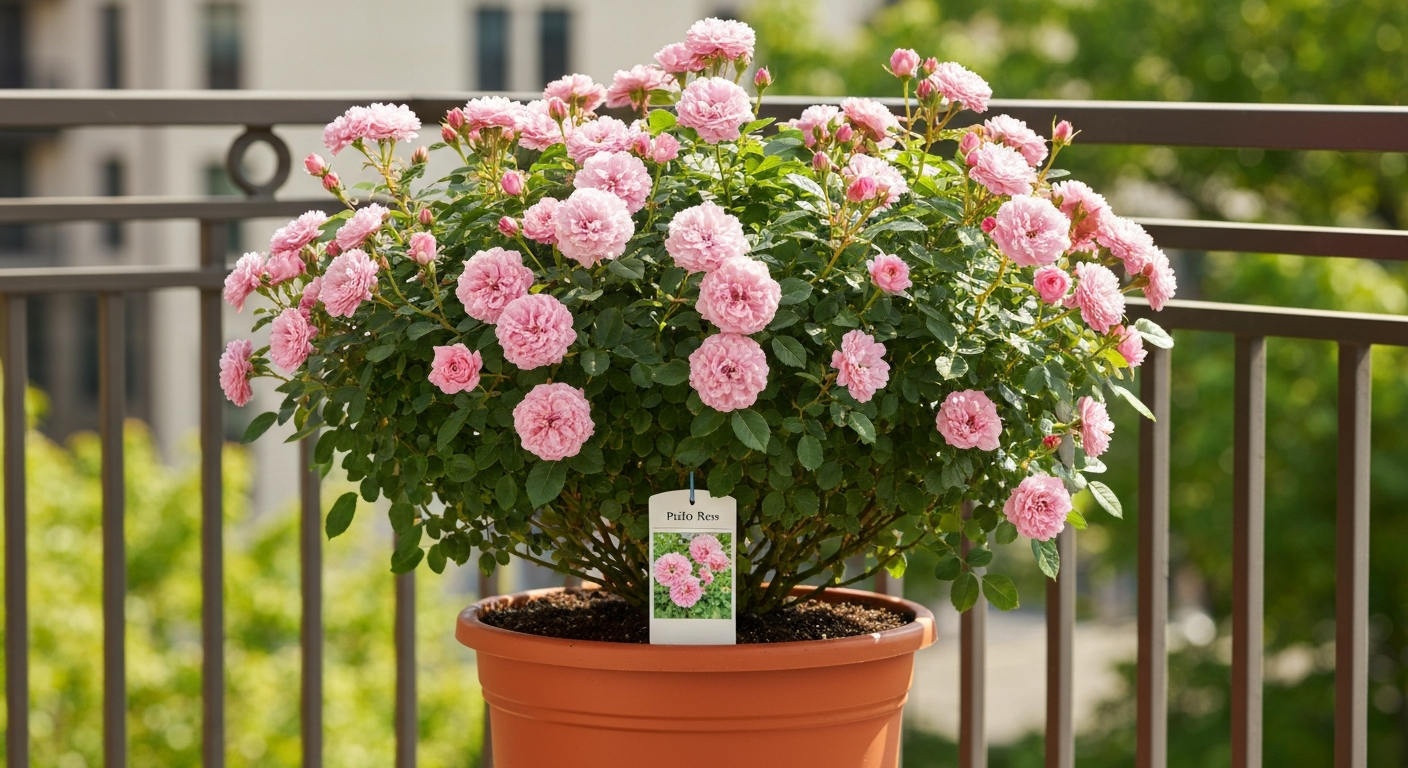
A patio rose is a compact, freely flowering rose variety bred specifically for small spaces: think containers on a balcony, a potted display beside a front door, or a narrow garden bed edging an outdoor terrace. The word 'patio' here has nothing to do with the outdoor living surface, it's a horticultural marketing category, widely used in the UK and Europe, for roses that are larger than miniatures but noticeably smaller and tidier than standard floribundas or shrub roses. Most patio roses top out around 18 to 24 inches tall, flower repeatedly through summer, and thrive in pots with a little extra feeding and watering attention.
What Is Patio Rose: Compact Roses for Balconies & Patios

Ada Hollis
11 Aug 2026
Why 'patio rose' confuses people (and what it actually means)
If you searched 'what is patio rose' expecting to find something about patio design or outdoor flooring, you're not alone. If you meant an outdoor surface rather than the rose category, see our brief guide on 'what is patio on a pallet' for information about DIY pallet patios and decking options. If you meant the software rather than the plant, see our short guide on what is patio app. For related queries about outdoor surfaces, see what is a patio mat for guidance on choosing and using mats on patios. The word 'patio' carries two completely separate meanings in everyday use. In architecture and real estate, a patio is a ground-level outdoor living surface, usually paved with stone, concrete, or tile, attached to or near a home. That's the usage this site focuses on when explaining outdoor spaces. If you're looking for details on patio construction, see our guide on what is a raised patio for definitions and construction considerations. But in horticulture, 'patio rose' is simply a label that rose breeders, nurseries, and garden retailers apply to a specific size class of rose, one that fits comfortably on, well, a patio. For information on other plants marketed by growing location, see what is a patio hydrangea. The confusion is understandable because the plant is literally named after the space it was designed to decorate.
The term gained traction in the UK and Europe from the 1980s onward as breeders responded to growing demand from apartment dwellers and small-garden owners. In North America, the American Rose Society uses the formal class name 'miniflora,' which it officially adopted in 1999, to cover much of the same ground. Many of the roses sold as 'patio' in British garden centres correspond closely to what an American nursery might label miniflora. The two terms aren't perfectly interchangeable, there are slight differences in how breeders apply each label, but for the practical purpose of choosing a rose for a small outdoor space, they describe the same kind of plant.
How patio roses compare to other rose types
Rose categories can feel overwhelming in a garden centre, so a direct comparison helps. The key distinguishing factor for patio roses is size combined with repeat-flowering habit. Here's where they sit relative to the types you'll most commonly encounter:
| Rose Type | Typical Height | Bloom Habit | Container Suitability | Notes |
|---|---|---|---|---|
| Miniature | 6–18 in (15–45 cm) | Repeat-flowering | Excellent | Smallest class; individual blooms very small |
| Patio / Miniflora | 18–24 in (45–60 cm) | Freely repeat-flowering | Excellent | Main focus of this article; intermediate size |
| Floribunda | 2.5–4 ft (75–120 cm) | Repeat-flowering in clusters | Possible in large pots | Bigger plants; need at least a 10-gallon pot |
| Hybrid Tea | 3–5 ft (90–150 cm) | Repeat-flowering, large single blooms | Difficult | Too large and demanding for most containers |
| Shrub Rose | 3–6 ft (90–180 cm) | Once-flowering or repeat | Generally unsuitable | Best in open ground; needs room to spread |
| Climber / Rambler | 6–20 ft (1.8–6 m) | Once or repeat | Unsuitable | Requires a wall, fence, or sturdy trellis |
The Royal Horticultural Society specifically recommends patio and miniature roses when growing roses in containers, warning that many other rose types simply won't thrive long-term in pots. Floribundas can work with a large enough container and diligent care, but patio roses are genuinely bred for the constraints of container life, shallower root runs, faster-drying compost, and limited soil volume.
What patio roses actually look like: size, habit and hardiness
Most patio roses reach a mature height of roughly 18 to 24 inches with a similar or slightly narrower spread, though individual cultivars vary. To give you a concrete example, the RHS records Rosa 'White Patio' with an eventual height and spread of about 0.5 metres (just under 20 inches), which is representative of the class. Rosa White Patio | Patio Rose, RHS Plants lists its eventual height and spread as 0.5 m (about 20 in) blank" rel="noopener noreferrer">Rosa White Patio | Patio Rose — RHS Plants. The growth habit is typically dense and bushy, these plants put a lot of energy into producing flowering stems rather than tall vegetative growth, which is exactly what you want when space is limited.
Bloom size sits between a miniature and a standard floribunda: flowers are small but not tiny, often produced in sprays or small clusters, and most modern patio roses are bred for continuous or repeat flowering from late spring through to the first frosts. Disease resistance has also improved significantly in newer cultivars. Breeders have put serious effort into creating patio roses that are tolerant of black spot and powdery mildew, which matters a great deal when a plant is growing in a pot where stressed roots can make it more susceptible to disease. Cold hardiness varies by cultivar, but as a general rule patio roses in containers need more winter protection than the same plant growing in the ground, because exposed pot walls allow roots to freeze in a way that in-ground planting prevents.
Popular varieties and what the nursery tag is really telling you
When you see 'Patio Rose' on a nursery label, it's a commercial descriptor rather than a botanical classification. The tag is essentially promising you a compact plant suited to terraces, balconies, and containers, but the specific characteristics still depend on the cultivar. Retailers like Breck's list varieties such as 'Be My Baby,' 'Coffee Bean,' and 'Easy Charmer' under their patio rose range, each with published data on mature height, colour, and disease tolerance. Reading those cultivar notes before you buy is worthwhile because within the patio rose category there's still meaningful variation.
The American Rose Society's miniflora class is formally used in rose trials and international judging programs, which gives you a useful quality signal: cultivars entered in official miniflora competition have been evaluated against published standards for bloom quality, plant health, and vigour. When shopping in North American nurseries, look for 'miniflora' or 'Min Fl' on the tag as the equivalent to 'patio rose' in European labelling.
- Soft pinks and whites: classic choices that work with most container colours and patio furniture
- Warm reds and corals: high-impact colour for smaller displays, popular on balconies
- Bi-colour and striped cultivars: widely available in the patio class and excellent for visual interest in a small planting
- Fragrant patio roses: fragrance breeding in compact roses has improved; check the label specifically for scent notes, as many patio roses have little fragrance
- Disease-resistant lines: look for cultivars with explicit disease-resistance ratings — especially black spot tolerance — for lower-maintenance container growing
Choosing the right patio rose for your space
Before you buy, think honestly about four things: how much direct sun your space gets, how much physical room you have, what maintenance level suits your schedule, and whether fragrance matters to you. Roses are sun-hungry plants. Patio roses perform best with at least six hours of direct sunlight per day. If your balcony or patio gets fewer than four hours, even the most compact, disease-resistant cultivar will produce fewer flowers and become more prone to fungal problems. South- and west-facing exposures are ideal; north-facing spots are generally too shaded for reliable flowering.
For very tight spaces like a narrow balcony, stick to cultivars that list a mature spread under 18 inches. On a generous patio or in a small garden bed, you can accommodate slightly larger patio roses and even mix two or three varieties in a wide container for a fuller look. If fragrance is important to you, read the cultivar description carefully before purchasing, many compact roses are bred primarily for visual impact and disease resistance, with fragrance as a secondary consideration, so the scent can be quite faint. For low-maintenance growing, prioritise cultivars explicitly described as disease-resistant, because container-grown roses under stress are more vulnerable to black spot and mildew, and spraying a balcony rose repeatedly is unpleasant.
Containers and potting mixes: getting the foundations right
Container choice matters more than most first-time rose growers expect. The general guidance from extension sources is clear: use the largest container you can practically accommodate. For a single patio rose, a 5-gallon (approximately 19-litre) pot is a realistic minimum for multi-season culture. Smaller nursery pots dry out too fast, restrict root development, and stress the plant into sporadic flowering. Wide, squat containers work better than tall, narrow ones because rose roots spread laterally. Terracotta and unglazed ceramic pots breathe well and look great on a patio but dry out faster than glazed or plastic equivalents, which means more frequent watering in summer.
One point worth flagging for balcony gardeners: large planted containers are heavy. A 5-gallon pot filled with moist compost and a rose plant can weigh 40 pounds or more. Residential balconies are typically designed to a live-load rating in the range of 40 to 60 pounds per square foot under standard building codes, but older buildings or small apartment balconies can vary. If you're placing multiple large containers on a balcony, it's worth checking with your building manager or reviewing structural specifications before loading up the space. This is a practical safety point, not a reason to avoid balcony gardening, just concentrate weight close to supporting walls rather than in the centre.
For potting mix, avoid using plain garden soil in containers. Extension and organic growing guides recommend a soilless medium built around roughly 40 to 60 percent peat or coir for moisture retention, combined with coarse bark or compost for structure, and perlite or vermiculite for drainage and aeration. This kind of mix holds enough moisture to reduce watering frequency while draining well enough to prevent root rot. Roses prefer slightly acidic growing conditions: target a pH of 6. University of Maryland Extension recommends a target soil pH of about 6.0–6.5 for optimal nutrient availability when growing roses, including in container mixes. 0 to 6.5 in your container mix. If you're using a commercial potting compost, check the stated pH and amend with sulphur (to lower pH) or ground limestone (to raise it) if needed.
Planting your patio rose, step by step
Planting in a container
- Choose a container at least 5 gallons (19 litres) in volume with drainage holes — one large hole is less ideal than several smaller ones distributed across the base.
- Add a layer of crocks, gravel, or broken pot pieces over the drainage holes to prevent the potting mix from blocking them.
- Fill the container roughly one-third full with your prepared potting mix (coir/peat base with bark and perlite, pH 6.0–6.5).
- Remove the rose from its nursery pot. UC Cooperative Extension advises selecting plants already growing in at least a three-gallon container, as these have more established root systems.
- Place the root ball in the centre of the container and check the planting depth: the bud union (the swollen graft point at the base of the canes) should sit at or just above soil level in warm climates, or about an inch below the surface in colder regions where frost protection is needed.
- Fill around the root ball with potting mix, firming gently as you go to eliminate air pockets. Leave a 1 to 2-inch gap between the soil surface and the rim of the container to allow for watering.
- Water thoroughly until water runs freely from the drainage holes.
- Position in a spot with at least six hours of direct sun. Do not feed for the first four to six weeks — let the plant establish before adding fertiliser.
Planting in a patio bed or in-ground border
- Choose a spot with six or more hours of direct sun and good air circulation — dense planting against walls with poor airflow increases fungal disease risk.
- Prepare the bed by digging to about 18 inches deep and incorporating compost to improve drainage and organic matter.
- Test or estimate soil pH and adjust to 6.0–6.5 if needed before planting.
- Dig a planting hole roughly twice the width of the root ball and deep enough to place the bud union at the correct level (at or just below soil surface, depending on your climate).
- Backfill with the original soil mixed with compost, firming around the roots.
- Create a shallow watering basin around the plant by mounding soil in a ring about 12 inches out from the canes.
- Water in well, flooding the basin slowly to settle the soil and eliminate air pockets.
- Apply a 2 to 3-inch mulch layer around (but not touching) the canes to retain moisture and moderate soil temperature.
Sun, watering and feeding through the season
Sun is non-negotiable. Patio roses need full sun, a minimum of six hours daily, to flower reliably and resist disease. If your space only gets partial sun, expect sparser flowering and greater susceptibility to mildew. There's no fertiliser programme that compensates for insufficient light.
Watering container roses correctly is the single skill that makes the biggest difference in their health. Check the top 1 to 2 inches of potting mix daily in warm weather: when it feels dry to the touch, water deeply until water drains from the base of the pot. Shallow, frequent splashes encourage surface roots and stress the plant. In high summer, a 5-gallon container in full sun may need watering every day or every other day. In-ground patio roses need roughly 1 to 2 inches of water per week, applied by flooding the basin or using drip irrigation rather than overhead sprinklers, which wet the foliage and encourage fungal disease. Self-watering containers and drip lines are genuinely useful tools for patio and balcony growers who can't check their plants daily, they maintain more consistent moisture than hand-watering alone.
Feeding is where container roses need more attention than in-ground plants. Nutrients leach out of potting mix every time you water, so container roses deplete their soil nutrition faster. Wait four to six weeks after planting before starting to feed, then apply a balanced liquid rose fertiliser monthly through the growing season, following the product directions. UC Cooperative Extension recommends using several lighter applications timed just before each growth and flowering flush rather than a couple of heavy doses. An N-P-K ratio around 3-1-3 (for example, a 12-4-12 formula) suits roses during active growth. Stop feeding about six to eight weeks before your expected first frost to avoid pushing vulnerable new growth into cold weather.
Pruning to keep patio roses compact and productive
Pruning patio roses follows the same basic principles as pruning other modern bush roses. In late winter or early spring, when you can see buds beginning to swell on the canes, prune back to an outward-facing bud, removing dead or damaged wood entirely and thinning any crowded or crossing canes. For most patio roses you don't need to retain as many canes as you would for a large floribunda: three to five strong, healthy canes are a practical target. Through the season, deadhead spent blooms by cutting back to the nearest set of healthy leaves. This encourages the plant to push out the next flowering flush rather than spending energy on setting seed. NC State Extension guidance on pruning modern bush roses applies directly here: the goals are to remove dead wood, open the centre of the plant for airflow, and direct energy into productive new growth.
Winter care for container patio roses
Container roses are more vulnerable to hard frosts than in-ground plants because their roots sit above grade with no insulating soil mass around them. In climates with freezing winters, move pots into an unheated but frost-free garage or shed before sustained temperatures drop below about 25°F (-4°C). If moving isn't practical, cluster pots together against a sheltered wall, wrap the containers in horticultural fleece or bubble wrap, and mulch the top of the pot heavily. In-ground patio bed roses can be mounded with compost or mulch over the crown after the first frost to insulate the bud union.
FAQ
What is a "patio rose"?
A "patio rose" is a marketing and horticultural term for compact, freely flowering rose plants bred or selected to perform well in small spaces and in containers on terraces, patios, balconies or small yards. They are typically larger than miniature roses but much smaller than full-size shrub or climber roses. In some regions the term overlaps with the formal class 'miniflora.' The word "patio" can also mean the outdoor hard-surface area; here it refers to the plant type, not the architectural feature.
How do patio roses differ from other rose types (miniature, floribunda, shrub, climber)?
Patio roses are bred for compact habit and repeat flowering. Compared with miniatures they are often slightly larger with fuller blooms and foliage. Compared with floribundas and shrub roses they stay much smaller and are better suited to containers. They are not climbers and usually don’t produce the large canes or ground coverage of shrubs. In formal classification, miniflora (used in some trials) sits between miniature and floribunda and overlaps with what nurseries call patio roses.
What characteristic features should I expect from patio roses?
Expect a compact mature size (often under about 0.5–1 m / 20–40 in height), abundant repeat blooms through the season, relatively small-to-medium flowers, and a bushy, container-friendly habit. Many cultivars are selected for disease tolerance, consistent flowering and attractive foliage—use nursery or trial notes for specifics.
Which patio-rose varieties are popular and reliable?
Cultivars vary by region and nursery; examples commonly marketed as patio types include 'White Patio' and a range of named "Patio" series plants. Look for trial results (American Rose Society/International Trials) or reputable nursery listings that show height, spread and disease-resistance notes. Choose varieties labeled "patio" or "miniflora" and read cultivar data for local performance.
Can patio roses be grown in containers and which pots are best?
Yes—patio roses are ideal for containers. Use the largest practical pot you can accommodate; many guides recommend moving into 3–5 gallon (≈12–19 L) or larger containers for multi-season culture. Pots should have drainage holes; heavier containers (ceramic, concrete) resist tipping but weigh more—check balcony load limits before placing many heavy pots.
What soil or potting mix should I use for container patio roses?
Use a well-draining, fertile soilless mix: a blend of peat or coir (40–60%), coarse bark or compost for structure, and perlite/vermiculite for aeration. Aim for a slightly acidic pH near 6.0–6.5. Avoid plain garden soil in pots because it compacts and drains poorly.
Next Article
What Is Patio App: Patio Meaning, Types & Buying Tips
Discover whether 'Patio' is an app or outdoor feature, plus clear patio types, care, comparisons, and buying tips.