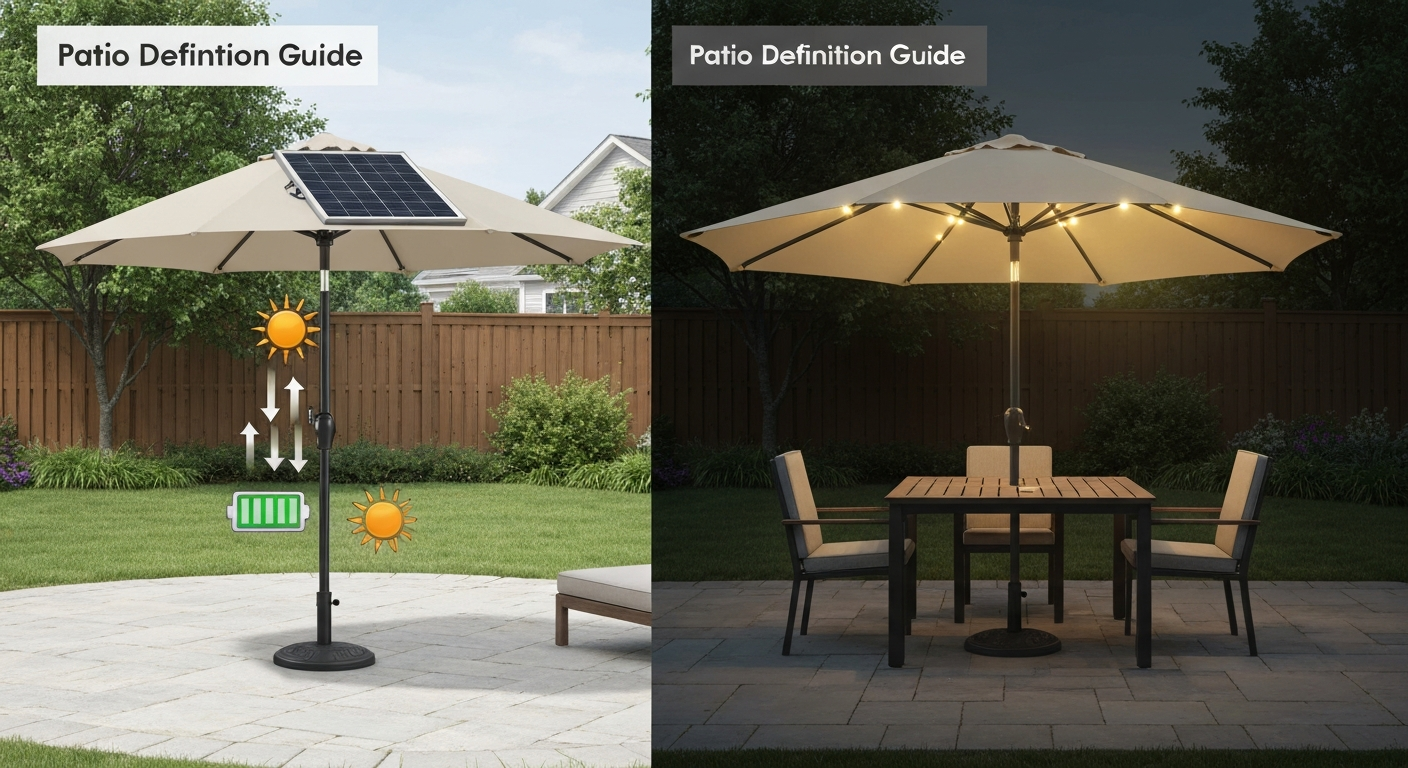
A solar patio umbrella is a standard outdoor umbrella that has small photovoltaic (solar) panels built into or mounted on the canopy, connected to a rechargeable battery and a small charge controller. That battery powers built-in accessories, most commonly LED lights, and sometimes a fan, USB charging ports, or a speaker, without any external wiring or outlet. The only difference from a regular patio umbrella is that solar system tucked into the frame: during the day it charges, and at night it runs. Everything else, the pole, canopy fabric, tilt mechanism, and base, works exactly like any other patio umbrella you already know. If you need a quick refresher on what is a patio umbrella, read our short primer on patio umbrella basics.
What Is a Solar Patio Umbrella: Definition, Uses & Buying Guide

Ada Hollis
14 Jul 2026
How the Solar System Inside Actually Works
Understanding the solar system helps you set realistic expectations before you buy. The system has five main parts working together, and none of them are complicated once you see what each one does.
- Solar panel: A small photovoltaic panel, either a rigid puck mounted at the finial (top) or flexible strips embedded along the canopy ribs. Most consumer models rate between 0.8W and 3W, which is tiny compared to a rooftop panel but enough to trickle-charge a small battery over the course of a sunny day.
- Rechargeable battery: Most current mid-range umbrellas use a lithium-ion (Li-ion) pack, typically 1,800–2,400 mAh or roughly 7–13 Wh. Older or very inexpensive models may use NiMH cells. The battery stores the day's solar harvest and releases it after dark.
- Charge controller / power management board: A small circuit board that regulates charging, prevents overcharge, and manages output to the accessories. You won't see it, but it protects both the battery and the LEDs.
- LED lights: Strips or puck lights built into the canopy ribs or hub. This is the primary load on the battery. At full brightness, most models run 4–6 hours per charge; on a lower brightness setting you can often stretch that to 6–8 hours.
- User controls and accessories: Most umbrellas have a simple on/off switch and a brightness selector, sometimes a remote. Models with USB-A or USB-C ports let you charge a phone, though doing so draws significantly more power than LEDs alone and will shorten light runtime. Some models add a small DC fan at the hub.
Manufacturers consistently recommend an initial charge of at least 6–8 hours of unobstructed direct sunlight before first use and after any deep discharge. One Stop Gardens Solar Umbrella, User Manual (charging guidance: allow at least 8 hours full sun) advises allowing at least 8 hours of full‑sun charging before first use and after any deep discharge, and keeping the panel free of debris to ensure effective charging One Stop Gardens Solar Umbrella — User Manual (charging guidance: allow at least 8 hours full sun). The panel needs to face the sky without shade from trees, roof overhangs, or the canopy folding over it. Once that habit is in place, the system is largely self-managing day to day.
Types and Features Worth Knowing Before You Shop
Solar umbrellas come in the same form factors as regular patio umbrellas, so the shape decision is really a patio layout decision, not a solar one. Here is how the main types break down.
Center-pole (market) umbrellas
The pole runs through the center of the canopy and typically through a hole in your patio table. These are the most common, most affordable, and easiest to find with solar features. Canopies typically range from 7.5 ft to 11 ft in diameter. The solar panel is usually a small rigid module at the very top of the finial, where it gets the most unobstructed sky exposure.
Cantilever (offset) umbrellas
The pole sits to the side and an arm extends the canopy over your seating area. This is great for sectional sofas, lounge chairs, or anywhere you don't want a pole in the middle. Canopies are larger, often 10–13 ft, which means more rib space for solar strip panels and sometimes a bigger battery. The trade-off is a much heavier base requirement: large cantilever umbrellas need a filled base weighing hundreds of pounds to stay stable in wind.
Half umbrellas
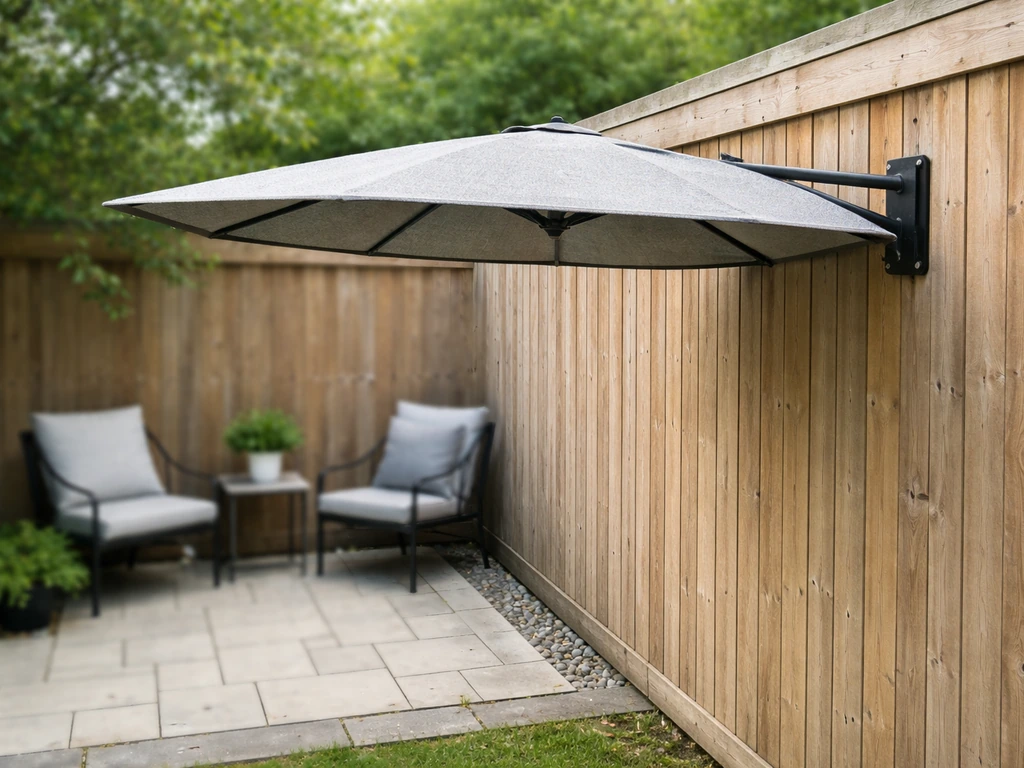
A half-umbrella (also called a wall-mount or space-saver umbrella) has a flat back that mounts to a wall or railing, extending a semi-circular canopy outward. For more details on configurations and mounting options, see what is a half patio umbrella. These work well on narrow balconies or against a house wall where a full circle would either hit the wall or extend too far. Some models include solar LED strips along the ribs, though panel placement is trickier on a half canopy.
Feature add-ons to look for
- LED lighting modes: Look for at least two brightness levels and ideally a warm-white option for ambiance versus a brighter white for task lighting.
- USB charging ports: Convenient for a phone or small device, but check the battery capacity before relying on this heavily with a small 1,800 mAh pack.
- Solar fan: A small DC fan at the hub is genuinely useful on a hot patio. It draws more current than LEDs, so a model with a fan should have a larger battery or a separate solar panel.
- Vented canopy: A double-vent at the top reduces wind lift pressure. Worth paying for in exposed locations.
- Tilt mechanism: Push-button or crank tilt lets you follow the sun for shade during the day. Make sure the tilt doesn't permanently block the solar panel from the sky.
- Remote control: Useful on large cantilever umbrellas where the control is high up on the pole.
Where a Solar Umbrella Makes Sense (and Where It Doesn't)
The solar system only works if the panel sees direct sun for a meaningful portion of the day. That single requirement shapes where a solar umbrella is and isn't a good fit.
Open patios and uncovered decks are the ideal setting. If your patio gets four or more hours of direct sun daily, the battery will charge reliably through a normal season. Poolside areas, rooftop terraces, and backyard dining areas on open ground all fall into this category. These are the spaces where the solar feature earns its price premium over a standard umbrella.
Covered porches and deeply shaded balconies are the wrong fit. If the umbrella spends most of the day under a patio cover, pergola, or building overhang, the panel simply won't collect enough energy to recharge. You would essentially be paying for a solar feature you can never use. In those cases, a standard lighted umbrella powered by a small external USB battery pack or wired LED strip is a more practical choice.
Balconies need two extra checks: first, does the balcony face a sun-exposed direction and get unobstructed sky view for several hours? Second, how will you anchor the base? Many balconies have weight limits, and a heavy sand-filled base for a large cantilever may not be appropriate. A railing-mount clamp system (like the commercially available Rail-EZ style brackets) is often the right answer for balcony use, matched with a smaller center-pole umbrella rather than a large cantilever.
Porches with a partial roof can work if the umbrella is positioned at the open edge of the porch where the panel tilts toward open sky. It is worth testing placement before committing. On a porch that is fully enclosed on three sides, shade is near-total and the solar option is wasted.
Solar Umbrella vs. Other Shade Options: A Direct Comparison
A solar umbrella is just one of several ways to shade an outdoor living space. Knowing how it compares to patio covers, pergolas, awnings, and plain patio umbrellas helps you decide whether it is the right level of commitment and cost for your situation. For another relevant comparison, see patio cover definition.
| Shade Option | Permanence | Typical Cost Range | Permit Usually Required? | Weather Protection | Solar Lighting Option | Portability |
|---|---|---|---|---|---|---|
| Solar patio umbrella | Temporary / portable | $80–$600+ (consumer) | No | Sun shade only; no rain/wind cover | Built-in | High — can move or store |
| Regular patio umbrella | Temporary / portable | $40–$400+ | No | Sun shade only | Not standard | High |
| Patio cover (solid roof) | Permanent or semi-permanent | $3,000–$20,000+ | Often yes | Full overhead protection | Requires wired lighting | None |
| Pergola | Permanent or semi-permanent | $2,000–$15,000+ | Often yes | Partial (open lattice); add-ons needed for rain | Requires wired or battery lighting | None |
| Patio awning (retractable) | Semi-permanent | $500–$5,000+ | Sometimes | Sun and light rain | Optional add-on | None — wall-mounted |
The clearest takeaway from that comparison: a solar umbrella sits at the low end of cost and commitment, it requires no permits, and it moves with you. But it only provides shade directly under the canopy and offers no protection from rain or strong wind. If you need to shade a large deck reliably through all weather, a patio cover or awning is the better long-term solution. If you just want comfortable evening ambiance on a dining patio without running extension cords, a solar umbrella is genuinely hard to beat for the price.
It is worth knowing that a regular patio umbrella and a solar umbrella are functionally identical during the day. The solar model costs more upfront specifically for the LED night-lighting convenience. If you rarely use your patio after dark, that premium may not be worth it.
Practical Buying and Sizing Checklist
Before you commit to a model, work through each of these points. Skipping any one of them is the most common reason buyers end up disappointed.
- Canopy size and coverage: Measure your table or seating area, then add about 2 ft on each side. A 48-inch round table needs at least a 9 ft canopy. A 6-person rectangular dining set typically needs 11 ft. Bigger is almost always better for shade.
- Canopy fabric and UV rating: Look for solution-dyed acrylic (branded as Sunbrella or equivalent) for best fade resistance and UV blocking. Polyester is cheaper but fades faster. A UPF 50+ rating blocks over 98% of UV rays.
- Solar panel wattage: 0.8–1.5W panels are adequate for LED lighting only. If you want a fan or USB charging, look for at least 2–3W or a model with a separate panel section dedicated to accessories.
- Battery capacity: 1,800 mAh is the minimum for reliable multi-hour LED use. 2,400 mAh or above gives you the headroom to also charge a device. Check Wh (watt-hours) if listed, as it accounts for voltage and is a more honest capacity indicator.
- Expected LED runtime: Manufacturers typically claim 4–8 hours. Take the top end of that claim with some skepticism — real-world run time depends on battery age, temperature, and brightness setting.
- Frame material and wind rating: Aluminum frames are lighter and rust-proof. Steel frames are heavier but feel more stable. Look for a published wind speed rating if you are in an exposed location; many consumer models are rated for moderate wind only (around 25–35 mph).
- Base weight: Match the base to the canopy size. A 9 ft center-pole umbrella typically needs at least 50 lb of base weight; a large cantilever umbrella needs 150–300 lb or more when filled. Check the manufacturer's minimum base weight spec, not just the empty base weight.
- Replacement parts availability: Solar batteries degrade over time and will eventually need replacement. Before buying, check whether the manufacturer sells replacement battery packs and LED modules. If they don't, the whole umbrella becomes disposable when the battery fails.
Installation, Anchoring, and Portability
Installation of a solar umbrella is no different from a standard umbrella, you are not wiring anything to your home, so there are no electrical permits or contractor calls required. The anchoring method you choose matters most for safety and stability.
- Table-mount (center-pole through table hole): The simplest setup. The table itself adds stability. Make sure the pole diameter matches your table's hole, typically 1.5 inches, and that the table is heavy enough not to tip.
- Freestanding fillable base: A hollow base you fill with sand or water. Sand is heavier and doesn't freeze; water is easier to pour out for storage. Always fill to the manufacturer's recommended weight. Under-filled bases tip over in wind and are a real safety hazard.
- Bolted surface mount: For permanent or semi-permanent cantilever setups, a steel sleeve can be bolted into a concrete patio or deck substrate. This is the most stable option but removes portability. Check your lease or HOA rules before drilling into a slab.
- Railing clamp mount: Purpose-made clamps (deck rail brackets) grip a balcony or deck rail and accept a pole sleeve. This eliminates the need for a heavy base on a balcony, which is important for buildings with floor load limits. Match the clamp to your rail profile and the umbrella's pole diameter.
- In-ground sleeve: A steel sleeve concreted into the ground allows you to drop in and pull out a center-pole umbrella. Common in permanent garden patio setups. Requires a one-time installation effort but offers excellent stability.
Portability is one of the best arguments for choosing a solar umbrella over a fixed shade structure. You can close it and move it to a different part of the patio, bring it inside during a storm, or take it with you if you move to a new home. That flexibility is worth preserving: choose a base you can transport, and if you are renting, avoid any installation that requires drilling or permanent anchoring without your landlord's approval.
Maintenance, Troubleshooting, and How Long Things Last
A solar umbrella is low maintenance, but the solar components do have a finite life and need basic attention to perform well over time.
Keeping the solar panel clean
Dust, pollen, bird droppings, and leaf debris reduce the panel's ability to charge the battery. Wipe the panel surface with a damp cloth a few times per season, or more often if you are in a dusty or high-pollen environment. Do not use abrasive cleaners or scrubbers on the panel face. A clean panel on a clear day charges noticeably faster than a dirty one.
Battery lifespan and replacement
This is the part most buyers don't think about at purchase. Li-ion batteries in consumer solar umbrellas typically deliver around 300–500 full charge cycles before capacity drops noticeably. Product manuals and retailer listings for small solar-powered umbrella lights show common battery chemistries across models, older/low‑end units with NiCd/NiMH, many current models with lithium‑ion packs, and larger or display units using 12V sealed lead‑acid or larger lithium packs (see Multi‑functional Solar Fan Light, User Manual (examples of Li‑ion and USB charging and charge control in small solar light products)) Multi‑functional Solar Fan Light — User Manual (examples of Li‑ion and USB charging and charge control in small solar light products). If you use the umbrella every evening through a 5-month season, that is roughly 150 cycles per year, meaning you can expect 2–3 seasons of good performance before the battery starts holding significantly less charge. The fix is a replacement battery pack, not a new umbrella. Before buying, verify the manufacturer sells one.
Common issues and quick fixes
- Lights won't turn on after a full day of sun: Check that the on/off switch isn't in the off position (some models have a physical switch that must be enabled before the charging cycle begins). If the switch is on and lights still fail, the battery may be deeply discharged — leave it in direct sun for a full 8 hours without turning it on.
- Lights dim quickly or run for only an hour or two: Battery capacity has degraded. Replace the battery pack if a replacement is available, or accept that the system is near end of life.
- Panel doesn't seem to be charging: Confirm the panel surface is clean and unshaded. Also check any inline connector between the panel and the controller — these can loosen over a season of opening and closing the umbrella.
- Fan runs slowly or not at all: Check the battery charge level first. Fans draw more current than LEDs and will cut out sooner when the battery is low. If the battery is full and the fan still doesn't run, the fan motor may have failed.
- USB charging port delivers weak or no output: Same as the fan — low battery is the first thing to check. Most small-battery umbrella models can't sustain meaningful USB output alongside full LED brightness simultaneously.
Seasonal storage
If you live somewhere with cold winters, store the umbrella indoors or in a shed when the season ends. Li-ion batteries degrade faster when stored fully discharged or in freezing temperatures. Store them at roughly 50–80% charge in a dry, room-temperature environment. Cover or bag the canopy to prevent mildew. Inspect the wiring connectors each spring for corrosion before putting the umbrella back into service.
Solar panel longevity
The photovoltaic cells themselves degrade slowly: crystalline silicon panels typically lose around 0.5% of rated output per year under normal conditions. That degradation is almost irrelevant over a typical umbrella's lifetime. What matters more for umbrella-scale panels is physical damage: cracking, delamination from UV exposure, or water ingress around the panel seal. A rigid finial-mounted panel tends to last longer than flexible canopy-embedded strip panels, which are more exposed to mechanical stress each time the umbrella opens and closes.
Permits, Property, and Renter Considerations
Because a solar umbrella is a freestanding, portable accessory with no electrical connection to your home, it does not require a building permit in any jurisdiction I am aware of. It is treated like patio furniture, not like a fixed structure. This is one of its clearest advantages over permanent shade structures: a patio cover, pergola, or even a large retractable awning may require permits and inspections in many municipalities, which adds cost and lead time. A solar umbrella avoids all of that entirely.
For renters, this is particularly relevant. You can set up and remove a solar umbrella without altering the property at all (assuming you use a freestanding base rather than drilling). That makes it a genuinely renter-friendly way to add evening lighting and shade to a patio or balcony. Check your lease for any restrictions on freestanding structures on balconies, but in most rental situations a solar umbrella falls well within the category of removable personal property.
For real estate shoppers evaluating a property, a solar umbrella has no effect on property value one way or the other. It is personal property that moves with the seller. What matters for the property itself is the underlying patio: its size, surface material, and whether it has a permanent shade structure. If you are trying to understand what the patio itself offers before adding any umbrella or cover, those are separate questions worth exploring.
Is a Solar Patio Umbrella Right for Your Space?
A solar patio umbrella is the right choice when you want daytime shade and evening LED ambiance without running power to your patio, you have an open outdoor space that gets consistent direct sun for charging, and you want a portable, permit-free, renter-friendly solution that you can set up in an afternoon. It is the wrong choice when your outdoor space is heavily shaded (the solar system simply won't work), when you need weatherproof overhead coverage rather than just shade, or when you need to cover a very large area that a single umbrella canopy can't reach.
If the space you are working with is a covered porch, a pergola-shaded deck, or a balcony with limited sun, the comparison table above points you toward alternatives like patio awnings, fixed patio covers, or simply a standard umbrella paired with a separate portable battery light. Understanding what kind of outdoor space you actually have, and what your local conditions are, is always the first step before buying any shade accessory.
FAQ
What is a solar patio umbrella in plain terms?
A solar patio umbrella is a regular outdoor patio or market umbrella that includes small photovoltaic (solar) panels, a rechargeable battery and simple electronics so it can power built‑in accessories (most often LED lights, sometimes a fan, USB ports or speakers). Unlike a standard umbrella, it provides low‑power services without running electrical wiring to the patio.
How does the solar system in the umbrella work? What are the core parts?
Core parts: a small solar panel (mounted on the canopy top or finial), a rechargeable battery pack (often lithium‑ion or NiMH in cheaper models), a charge controller/power management board, the accessory loads (LEDs, small fan, USB ports, speakers), wiring and user controls (on/off, sometimes a remote or dimmer). In sun the panel converts sunlight to electricity to charge the battery; the battery then powers the accessories after dark or on demand.
How much power can I expect from the umbrella’s solar panel and battery?
Typical integrated panels are low‑power—commonly 0.8–3W on consumer models, with some specialty or heavy‑duty umbrellas quoting higher totals. Batteries are usually small (e.g., ~1,800–2,400 mAh or single‑digit Wh). That is enough for LED lighting for several hours (manufacturers commonly claim ~4–8 hours at typical settings) but limits heavier draws like prolonged phone charging or running a fan.
What types and design styles of solar patio umbrellas are available?
Common types include center‑pole (table) umbrellas, cantilever/offset umbrellas, half‑umbrella/bistro models and small balcony umbrellas. Common solar features are integrated LED lights, solar fans, USB charging ports, remotes/dimmers, tilt/crank mechanisms and a range of canopy fabrics (polyester, solution‑dyed acrylic). Higher‑end models may use rigid monocrystalline panels and larger batteries.
Where and when is a solar umbrella appropriate on a property?
They work best where the umbrella’s panel gets direct sun to recharge: open patios, decks, yards, pool decks, rooftop terraces or balconies with good sun exposure. They are less useful on deep covered porches, heavily shaded yards or under awnings because the panel won’t get enough sunlight to recharge reliably. Choose size and mounting style that matches available space and coverage needs.
How do solar umbrellas compare with other shade options (pergola, awning, patio cover, regular umbrella)?
Permanence: solar umbrellas are portable and temporary; pergolas, awnings and patio covers are permanent. Cost: umbrellas are the lowest‑cost up front; pergolas/awnings often cost substantially more and may need permits. Permits & installation: permanent structures sometimes need permits and professional installation; umbrellas do not. Protection: permanent structures offer better all‑weather protection (rain, sustained wind); umbrellas give shade and modest light but limited weather protection. If you want lighting without wiring, solar umbrellas are an easy option; for year‑round coverage or resale value, consider permanent options.
Next Article
What Is a Half Patio Umbrella? Definition, Sizing, Fit
Learn what a half patio umbrella is, how it covers part of a patio, and how to size, mount, and choose one.