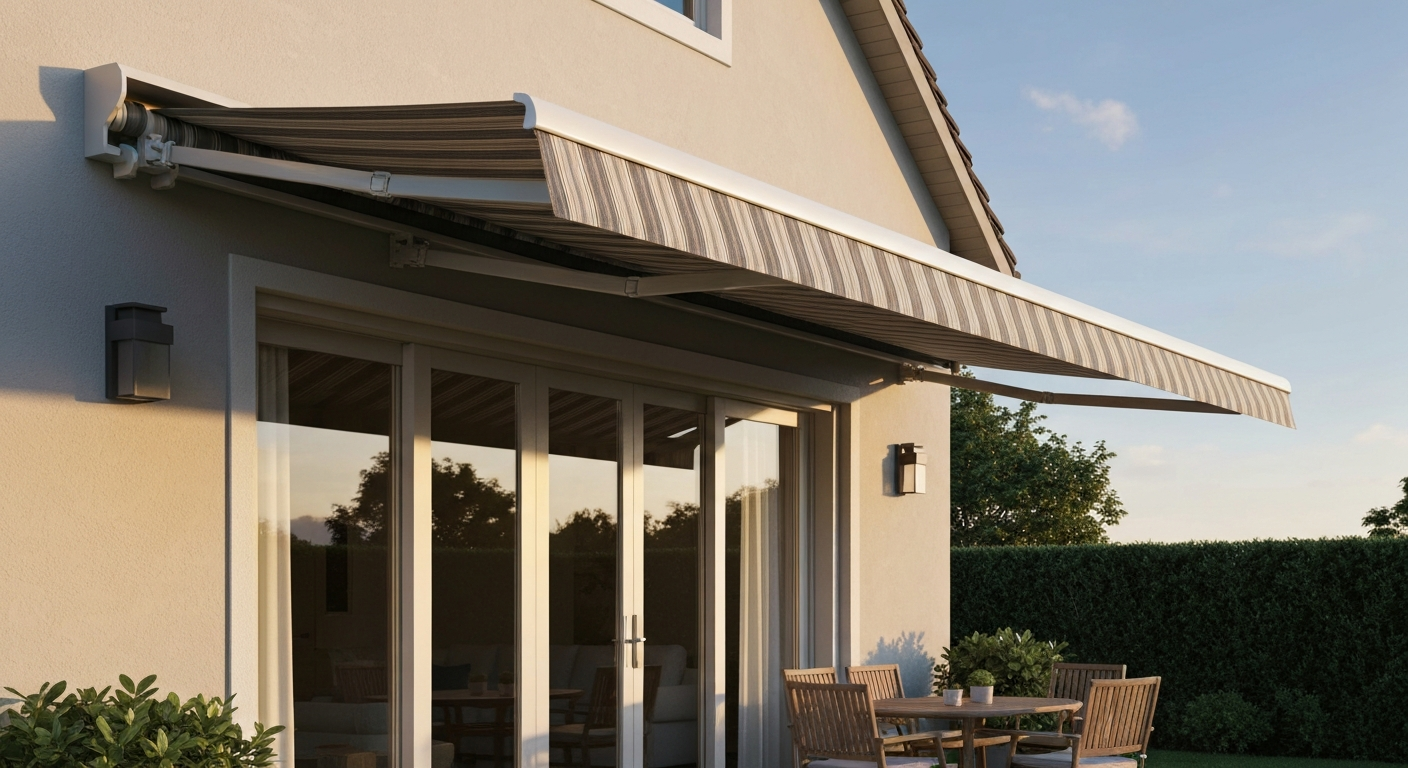
A patio awning is a lightweight framed covering, usually fabric, aluminum, or polycarbonate, attached to the exterior wall of a house (or standing independently nearby) to provide shade and weather protection over a patio, door, or window. Think of it as a retractable or fixed roof extension that stops short of being a full room addition. The most common version you'll encounter is the retractable fabric awning, which rolls back against the wall when you don't need it and extends outward when the sun is brutal or rain threatens.
Patio Awning Definition: Types, Uses, Costs & Buying Tips

Ada Hollis
22 Jul 2026
A plain-language definition worth bookmarking
The International Building Code defines an awning as "an architectural projection that provides weather protection, identity or decoration and is partially or wholly supported by the building." In plain homeowner terms: it hangs off your house wall (or sits on its own frame), it has some kind of covering stretched over a skeleton, and its main job is shade and light rain protection. A retractable awning is the same idea, except the frame collapses back against the wall so you can store it away when it's not needed or when a storm rolls in.
The word "awning" comes from 17th-century nautical English (sailors used canvas coverings called "awnings" on deck) and has been applied to building projections ever since. In Spanish the equivalent is "toldo" or "marquesina"; in Hindi and Urdu, "shamiana" or "chhatri" can describe similar shade structures, though those terms also cover event canopies. If you're searching in a different language or browsing international real-estate listings, that context helps you recognize the same feature by a different name.
What one actually looks like: image guide
Because awnings come in very different forms, a few quick visual references help clarify the definition before diving into types. Useful images to look for include: (1) a fixed aluminum-frame awning with striped acrylic fabric over a sliding glass door, showing the typical pitched projection shape; (2) a retractable cassette awning in its fully extended and fully retracted positions, so you can see the roll-back mechanism; (3) a freestanding awning or shade sail on four posts in a backyard, detached from the house wall; and (4) a motorized awning with a wall-mounted control panel and wind-sensor arm, illustrating the automation hardware. These four visuals cover the full range of what a patio awning can be.
The four main types of patio awnings
Fixed awnings
A fixed awning has a rigid, permanent frame bolted to the wall and doesn't retract. The covering can be fabric stretched over the frame or solid material like aluminum sheeting or corrugated polycarbonate. Fixed awnings are straightforward, low-maintenance (no moving parts), and usually cheaper to install for equivalent coverage. The trade-off is that you can't retract them to admit more light or to protect the fabric during a storm.
Retractable (manual) awnings
This is the most popular residential type. A crank handle (or pull strap) extends or rolls up the fabric over a spring-loaded roller. The fabric folds or rolls back into a housing against the wall. Manual retractable awnings are cheaper than motorized versions, require no electrical work, and can be retracted quickly before a wind event. Most major brands offer them with the same Sunbrella-grade acrylic fabrics used on motorized models.
Motorized awnings
A motorized awning swaps the hand crank for an electric motor, typically a tubular motor from a manufacturer like Somfy, rated to IP44 (protected against splashing water). You control it with a wall switch, remote, or smartphone app. The motor can run on 120/230V hardwired power or, where running conduit through the wall isn't practical, on Somfy's WireFree Solar Pack: a small solar panel and rechargeable battery pack that powers the motor without any wiring. Higher-end motorized setups include wind sensors that automatically retract the awning when gusts hit a threshold, and sun sensors that extend it when UV intensity rises, genuinely useful if you travel or simply forget to check the weather. Controls & safety accessories: motorized awnings commonly integrate with wind sensors, sun/photocell sensors, timers and home‑automation remotes; independent wind sensors automate retraction to protect the awning (manufacturers sell wind sensor accessories or include them in higher‑end packs) See SunSetter — Owner Support & FAQs (wind sensors and accessories) for manufacturer guidance that motorized awnings commonly pair with wind sensors that automatically retract the awning to protect the awning..
Freestanding awnings
A freestanding awning sits on its own posts rather than attaching to the house. This makes it useful for covering a detached patio area, a spot far from the house wall, or a rental property where drilling into the building isn't allowed. Freestanding units are structurally similar to a canopy tent but with a more permanent frame. Because they don't borrow structural support from the wall, the frame posts need to be anchored securely to the ground, especially in windy regions.
How a patio awning compares to other outdoor structures
This is where a lot of the confusion happens, terms like patio cover, pergola, verandah, porch, balcony, and courtyard all overlap in common conversation. Here's how each one differs from a patio awning in practical terms. See the patio cover definition for a clear explanation of how a full roofed patio cover differs from an awning.
| Structure | Attached to building? | Has a solid/full roof? | Retractable? | Structural permanence | Primary purpose |
|---|---|---|---|---|---|
| Patio awning | Usually yes (or freestanding) | No (fabric or light panel) | Often yes | Low to medium | Shade and light rain cover |
| Patio cover | Yes | Yes (solid roof) | No | High | Full weather shelter |
| Pergola | Sometimes (or freestanding) | No (open lattice) | No | Medium to high | Partial shade, architectural feature |
| Verandah | Yes (integral to house) | Yes (permanent roof) | No | High (built-in) | Covered outdoor living |
| Porch | Yes (integral to house) | Yes (permanent roof) | No | High (built-in) | Covered entry or living area |
| Balcony | Yes (structural extension) | Rarely | No | High (structural) | Elevated outdoor access |
| Courtyard | No (ground feature) | No (open sky) | N/A | High (landscape) | Enclosed outdoor space |
The clearest distinction: a patio awning is an accessory added to a house after the fact, while a porch or verandah is built into the house's original architecture. A patio cover (solid roof on posts) is more like a permanent room addition and usually requires a building permit and heavier footings. A pergola is an open-lattice structure primarily valued for aesthetics and partial shade, it doesn't stop rain and doesn't retract. For a clear definition of a pergola patio and how it compares to awnings, see what is a pergola patio. If those topics matter to you, the deeper breakdowns on patio covers, pergolas, and their definitions are covered elsewhere on this site.
Patio awnings vs. patio umbrellas
Umbrellas and awnings both provide shade, but they're fundamentally different products. For a clear explanation of umbrella types, sizes, and when to choose one, see patio umbrella meaning. A patio umbrella is portable and self-supporting, it sits in a base or hangs from a cantilever arm and can be moved around the patio or stored in a closet. An awning is fixed to a wall or frame and covers a set zone. For small tables and chairs where you want flexibility to move things around, an umbrella is more practical. For covering a large sliding-door opening or a deep patio where you want shade all afternoon without adjusting anything, an awning does the job better.
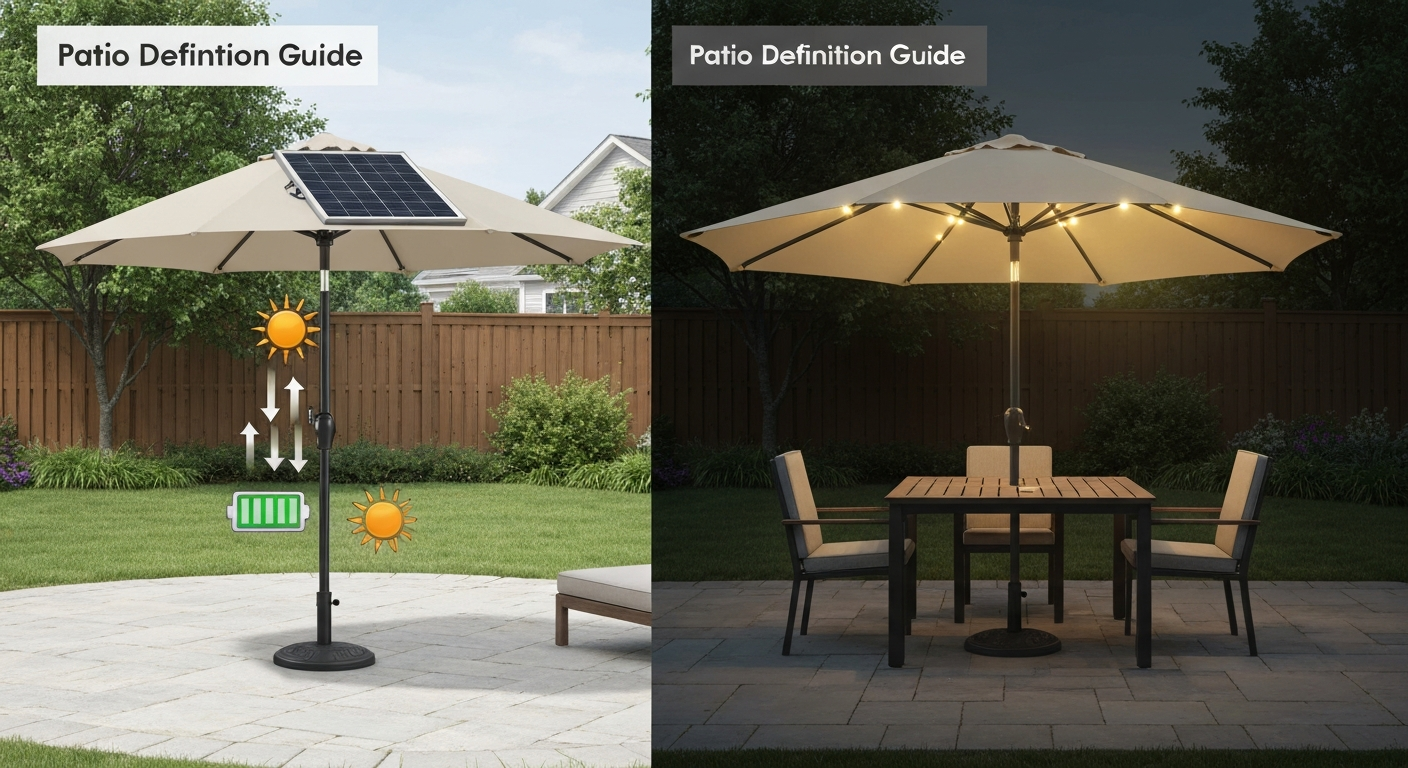
A half patio umbrella (also called a wall umbrella) closes this gap a little, it's a flat-backed umbrella designed to hang against a wall so it doesn't need 360-degree clearance. It covers a smaller zone than a full-size awning, costs much less, and requires zero installation. A solar patio umbrella adds a small photovoltaic panel in the canopy to power integrated LED lights or charge USB devices, which is useful for evening use. See the blank" rel="noopener noreferrer">Treasure Garden catalog (patio umbrellas & accessories) for examples of cantilever and market umbrellas with integrated solar panels or LED lighting and rechargeable battery options. Neither type gives you the coverage area, weather durability, or architectural integration that a proper awning provides, but they're far easier to set up for renters or anyone who needs a no-commitment solution.
| Feature | Patio awning | Standard patio umbrella | Half patio umbrella | Solar patio umbrella |
|---|---|---|---|---|
| Coverage area | Large (8–20 ft wide typical) | Medium (6–11 ft diameter typical) | Small-medium (wall-mounted) | Medium (6–11 ft diameter typical) |
| Portable | No | Yes | Partially (wall-hung) | Yes |
| Installation required | Yes (wall or ground) | No (base only) | Minimal (wall bracket) | No (base only) |
| Built-in lighting | Rare (add-on) | Rare | Rare | Yes (LED via solar) |
| Works in wind | Better (can retract) | Poor in high wind | Poor in high wind | Poor in high wind |
| Renter-friendly | Depends (freestanding yes) | Yes | Yes | Yes |
Materials, features, and weather performance
Fabric options
The dominant premium fabric in residential awnings is solution-dyed acrylic, most commonly sold under the Sunbrella brand (made by Glen Raven). "Solution-dyed" means the color is baked into the fiber during manufacturing rather than applied as a surface coating, the result is significantly better fade resistance than polyester alternatives. PVC-coated polyester is a cheaper option with excellent water resistance but less breathability and faster fading. Sunbrella's shade and awning fabrics carry a 10-year limited warranty; most other premium awning fabrics warranty at 5 years, and budget polyester fabrics typically 1 to 3 years.
Frame materials
Aluminum is the standard for residential retractable and motorized awnings: it's lightweight, rust-resistant, and strong enough to handle normal loads. Powder-coated aluminum resists corrosion well in most climates. Steel frames appear on commercial or heavy-duty residential products and are stronger but heavier and more prone to rust if the coating is scratched. Solid awnings (non-fabric) can use aluminum sheeting, corrugated polycarbonate, or tempered glass, each chosen for how much light transmission the homeowner wants.
UV and water resistance
Premium solution-dyed acrylic fabric blocks most UV radiation (UPF ratings of 30 to 50+ are common) but is water-resistant rather than fully waterproof, it repels light rain but sustained heavy rain will eventually penetrate and should drain off, not pool. PVC-coated polyester is genuinely waterproof but heavier and prone to cracking in cold weather. If your patio needs full rain protection, a solid aluminum or polycarbonate panel awning or a full patio cover is a better call.
Warranty and service-life expectations
A well-maintained premium fabric awning realistically lasts 10 to 15 years. Frames and mechanisms on major brand retractable awnings carry 5 to 10-year warranties. Motors from suppliers like Somfy typically carry 5-year warranties. Those numbers assume proper care: retracting the awning in high wind, cleaning the fabric 2 to 3 times a year, and not allowing debris to accumulate on the cover.
Why homeowners actually install patio awnings
- Shade control: a 10-foot projection from the wall can reduce direct sun on the patio and adjacent windows significantly, making outdoor furniture usable even in mid-afternoon summer heat.
- Cooling savings: shading south- and west-facing windows with an awning reduces solar heat gain inside the house. Studies by the American Society of Interior Designers have estimated window awnings can reduce solar heat gain through windows by 65 to 77 percent depending on orientation — a measurable reduction in air-conditioning load.
- Extended outdoor season: even light rain doesn't end patio time under a water-resistant awning, so you effectively get more usable days outdoors each year.
- Privacy from above: upper-floor neighbors or raised vantage points are partially screened by the awning canopy, adding a low-cost privacy layer.
- Curb appeal and property presentation: a well-chosen awning color and style integrates with the exterior architecture and is visible in listing photos, which matters for resale.
Limitations and trade-offs to understand before buying
Awnings have real limitations, and it's worth being honest about them before you commit to a purchase. Wind is the biggest practical enemy. Manufacturers' manuals and warranty terms almost universally require you to retract fabric awnings before high winds, most residential fabric awnings have a maximum usable wind speed in the range of 20 to 27 mph, above which they should be retracted. Leaving one extended in a storm will often void the warranty if hardware is bent or fabric tears. A motorized wind sensor mitigates this, but it's an additional cost.
Snow load is a related issue in cold climates. Fabric awnings are not designed to hold snow accumulation, and even a light wet snow can stress the frame if the awning isn't retracted or removed for winter. Fixed solid awnings (aluminum or polycarbonate) are more capable but still need proper engineering for snow loads in northern climates.
Coverage is limited by the wall you're attaching to and the projection the hardware supports. Most residential retractable awnings project 8 to 14 feet from the wall; wider or deeper coverage starts to require either a larger (expensive) cassette or a freestanding structure. And while awnings do provide shade, they don't enclose the space, you still get wind, insects, and rain blow-in at the sides. For full enclosure, you're looking at screened patios, sunrooms, or patio covers with side screens.
For renters: wall-attached awnings require drilling into the building's exterior structure, which most landlords won't permit without explicit approval. A freestanding awning or a large patio umbrella is the more practical solution in that situation.
Installation, permits, and property implications
Installing a wall-attached awning means bolting a mounting bracket into the wall framing, which needs to hit structural studs or a solid ledger board, not just the exterior cladding. This is manageable as a DIY project for experienced homeowners, but most manufacturers recommend professional installation to preserve the warranty and ensure the attachment point is structurally sound. Freestanding awnings avoid this entirely but need post footings anchored to the ground.
Permits are required in many jurisdictions for any permanent awning attached to a building. New York City, for example, requires a permit for installation or replacement of awnings and has published specific DOB guidance on this. The IBC and most local codes treat attached awnings as architectural projections with clearance and load requirements. Check your local building department before installation, the permit process is often simple (a paperwork-and-fee procedure, not a full plan review) but skipping it can create problems at resale or during a homeowners' insurance claim.
On resale: a well-maintained, professionally installed awning generally reads as a positive feature in a listing, it signals a usable outdoor space with comfort features already in place. A damaged or cheap-looking awning can do the opposite. If you're in an HOA, check the CC&Rs before choosing a fabric color or style, many HOAs regulate exterior awning appearance.
Installation and permit checklist
- Check local building department requirements for awning permits (attached structures almost always need one).
- Verify HOA rules on awning colors, materials, and projection limits if applicable.
- Locate wall studs or existing ledger board before choosing a mounting bracket style.
- Measure projection depth (how far shade extends from house) and width (span along wall) before ordering.
- Confirm electrical access point for motorized models or plan for a WireFree/solar motor pack.
- Review manufacturer's warranty terms for installation requirements — professional installation is often required to validate the warranty.
- Plan for seasonal retraction or removal in snow climates.
What it typically costs and how to size one correctly
Installed retractable awnings run roughly $15 to $30 per square foot as a general rule of thumb, so a 10-foot-wide by 10-foot-projection awning (100 square feet) would typically cost $1,500 to $3,000 installed, with motorized and premium-fabric versions at the higher end. Fixed aluminum or solid-panel awnings tend to cost more per square foot given the heavier hardware. Freestanding canopy-style awnings can be cheaper on the DIY end but more expensive when you factor in anchoring and heavy-duty frames.
For sizing: measure two numbers first. Projection is how far you want shade to extend from the house wall, think about where your furniture sits and the sun angle at your worst time of day (usually mid-afternoon on west-facing patios). Width is the span along the house wall you want covered. A good rule is to add 2 feet of width beyond the area you want shaded to account for side angles. Compare quotes on a price-per-square-foot basis to make different frame/fabric packages fairly comparable.
Maintenance to keep an awning looking and working right
- Clean fabric 2 to 3 times a year with mild soap and lukewarm water; avoid bleach on acrylic fabrics unless the manufacturer specifically approves it.
- Brush off debris (leaves, bird droppings) promptly — stains are much harder to remove once dried.
- Retract or remove fabric awnings before forecast winds above roughly 20 mph or any significant storm.
- In snow climates, retract or remove fabric awnings before first snowfall and store the fabric indoors if possible.
- Inspect frame joints, bolts, and wall anchors annually — tighten any loose hardware before the season starts.
- Lubricate the roller mechanism on retractable awnings once per season with a dry silicone spray (not WD-40, which attracts dirt).
- Test wind sensors and motor function at the start of each season on motorized units.
Quick glossary of terms you'll see when shopping
| Term | What it means in plain language |
|---|---|
| Projection | How far the awning extends outward from the wall (depth of shade coverage) |
| Cassette | The enclosed housing that the rolled-up fabric retracts into on a retractable awning |
| Valance | The decorative front flap that hangs down at the leading edge of the awning |
| Solution-dyed acrylic | Fabric where color is embedded in the fiber, not surface-printed — better fade resistance |
| IP44 | Ingress Protection rating meaning the motor is splash-proof (protected from water spraying from any direction) |
| WireFree / Solar Pack | A battery or solar-powered motor system that requires no hardwired electrical connection |
| Wind sensor | A device that detects wind speed and automatically triggers retraction of a motorized awning |
| Pitch / slope | The angle of the awning frame — a steeper pitch sheds water more effectively |
Regional and terminology notes
In Australia and New Zealand, you'll see the term "shade sail" used for freestanding tensioned fabric covers over patios, these overlap with freestanding awnings in function but are a distinct product category. In the UK, "awning" most commonly refers to retractable fabric projections over shopfronts and domestic patios; "canopy" is also used loosely for the same thing. In Spain and Latin America, "toldo" is the standard word for a fabric awning, and "marquesina" often refers to a fixed overhead canopy at an entrance. If you're comparing properties across regions or researching products from international brands, keeping these equivalents in mind helps you find the right comparisons.
FAQ
What is a patio awning (simple working definition)?
A patio awning is a lightweight cover—usually fabric on a metal frame or a slim solid panel—attached to or placed near a house to provide shade and basic protection from sun and light rain for a patio, deck, door or window. Retractable awnings roll or fold back against the house when not in use; fixed and freestanding awnings stay in place.
What are the common types of patio awnings?
Common types: fixed (permanent framed fabric or solid panel attached to the building), retractable/manual (rolls or folds away by hand or crank), motorized (electric or battery/solar‑powered motor that opens/closes on remote or sensor), and freestanding (independent frames installed near but not fastened to the house). Many motorized models can add wind/sun sensors and timers.
How is an awning different from a patio cover, pergola, verandah, porch, balcony, courtyard and a patio umbrella?
Awning vs other structures (plain points): - Patio cover / solid roof: heavier, permanent roof structure offering full shelter and year‑round protection; awnings are lighter and often provide only shade and light rain protection. - Pergola: open‑lattice or slatted roof for partial shade and decoration; pergolas usually are rigid and architectural, not fabric rolls. - Verandah/porch/balcony: parts of a building (enclosed or roofed outdoor rooms or projections); awnings are add‑on covers. - Courtyard: an outdoor area enclosed by walls; awnings can be added into a courtyard for shade. - Patio umbrella: portable, single‑pole shade for dining/seat areas; offers flexible placement but less permanent wind resistance and less shade continuity than an attached awning. Note on half and solar umbrellas: half umbrellas or cantilever umbrellas cover offset areas; solar umbrellas use small panels to power lights or fans—useful, but still different from a mounted awning that shades a whole patio wall and door.
What materials are commonly used for awnings (fabric, frames, solid options)?
Typical materials: - Fabrics: solution‑dyed acrylic (e.g., Sunbrella) and PVC‑coated polyester are popular—both resist fading and shed water to varying degrees. - Frames: aluminum (lightweight, corrosion‑resistant) and steel (stronger but heavier, may be powder‑coated). - Solid options: aluminum panels, polycarbonate or metal roofing for a permanent, waterproof covering. Quality fabrics and frames usually come with multi‑year warranties.
How do awnings perform in sun, UV, rain and wind?
Weather performance summary: - Sun/UV: good awning fabrics block significant UV and reduce heat; solution‑dyed acrylics perform best long‑term. - Rain: fabric awnings shed light to moderate rain; pooling can occur on shallow fabric spans and may damage the fabric or frame. Solid panel awnings handle heavy rain. - Wind: most fabric retractable awnings are rated for specific wind speeds and must be retracted in high winds; leaving them out in strong gusts often voids warranties. Motorized units often work with wind sensors to automate retraction.
What are the main benefits of a patio awning?
Benefits: - Fast, cost‑effective way to add shade and reduce direct sunlight into rooms. - Can lower cooling costs for adjacent rooms. - Adds usable outdoor living space and protects outdoor furniture. - Retractable options let you control sun exposure and store the awning when not needed. - Motorized models offer convenience and integration with home controls.
Next Article
What Is a Solar Patio Umbrella: Definition, Uses & Buying Guide
What is a solar patio umbrella: how it works, types, buying checklist, installation, pros/cons for patios.