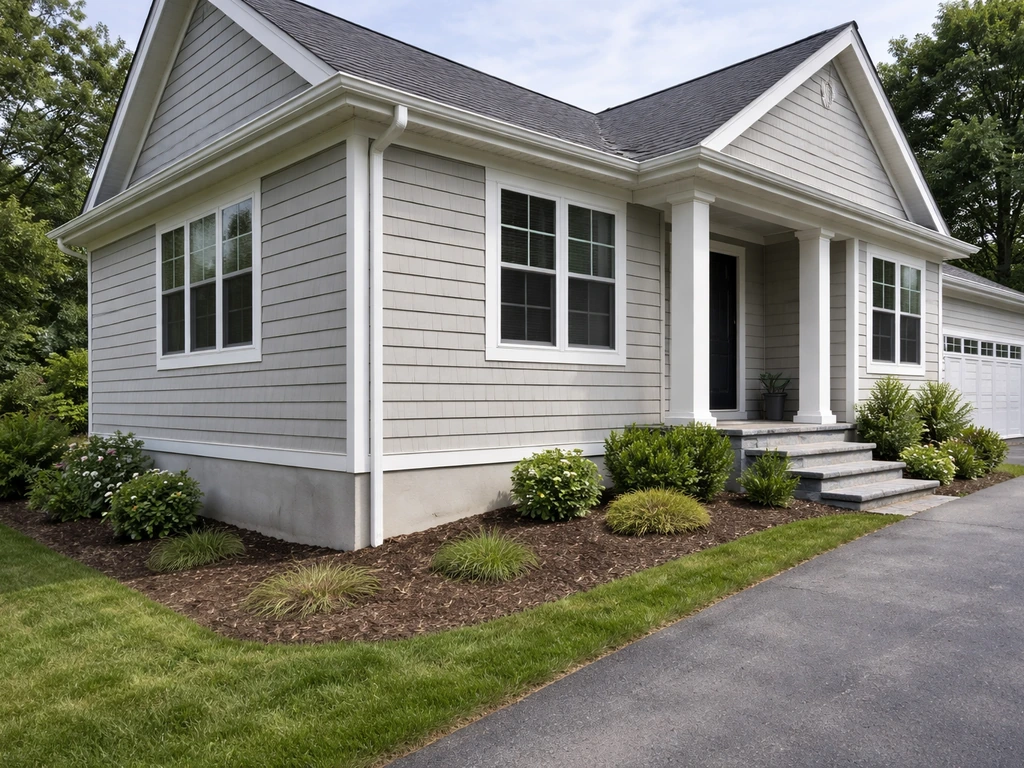
A patio home and a condo are two very different ownership structures, even though both often come with HOA fees and shared walls. The biggest distinction: a patio home is typically sold as a single-family residence where you own the land (or at least a defined lot), while a condo means you own the airspace inside your unit and share an undivided interest in everything else. That difference shapes what you can change, what you pay for, and how much control you actually have over your daily living environment.
Patio Home vs Condo: Key Differences, Costs, and Checklist

Ada Hollis
23 May 2026
What a patio home actually is
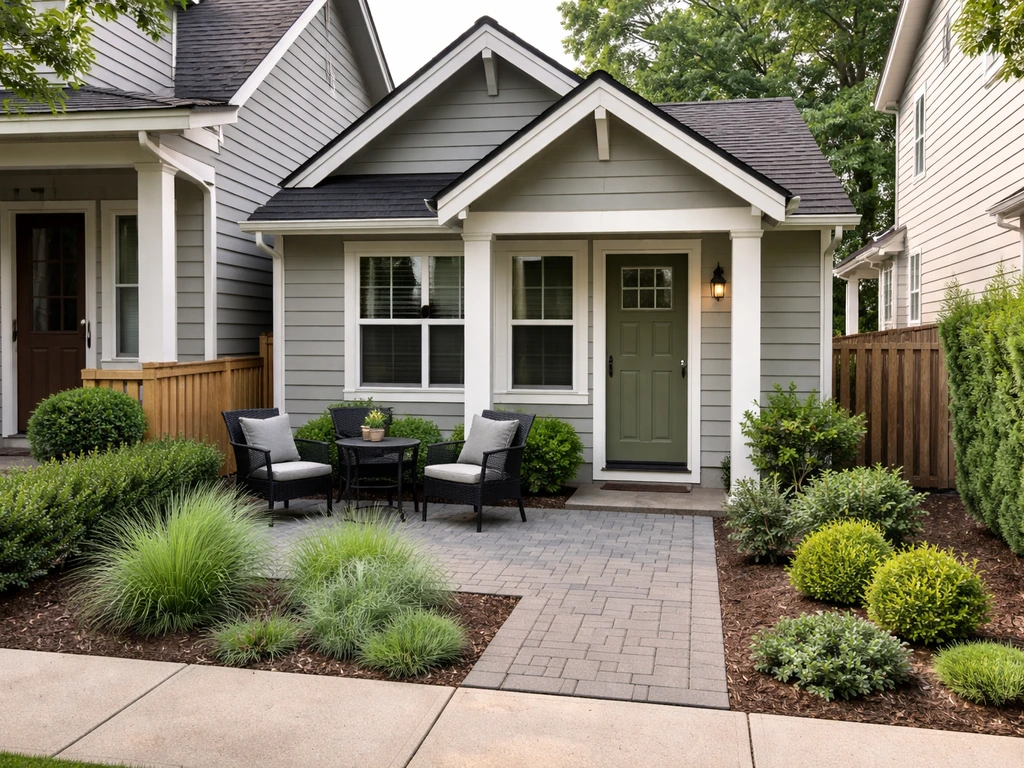
The term 'patio home' gets used loosely in real estate listings, but it generally refers to a single-family-style residence built on a smaller lot, usually with a private outdoor patio space as a central feature of the design. If you are wondering patio homes meaning in real estate listings, it generally refers to a single-family-style residence built on a smaller lot, often with a private outdoor patio as a central feature. The defining characteristic is often a zero-lot-line layout, meaning the structure is built right up to one side property line with no setback. That frees up space on the other side or rear for a private, enclosed outdoor area. A city code definition from Alvin, Texas spells it out clearly: a patio home is a single-family structure of one or two stories where one (but not both) side exterior walls sits directly on the side boundary line of the lot.
In practice, patio homes are marketed as a lower-maintenance alternative to a traditional detached house. You get a private entrance, your own front door, often a small yard or enclosed patio, and the feeling of a standalone home. Some are fully detached; others share a wall with a neighbor, which makes them look a lot like a townhouse from the outside. The key selling point is always that private outdoor living space built into the home's footprint, often designed to be visible from main living areas but screened from public view.
Patio homes almost always sit inside a planned development, and many have an HOA that handles exterior maintenance, common landscaping, or shared driveways. That association structure is where a lot of buyers get confused, assuming a patio home with an HOA must be a condo. It is not, and that distinction matters a great deal when you look at what you legally own.
What a condo actually is
A condominium is a specific legal ownership structure, not just a style of building. When you buy a condo, you own title to your individual unit, which is basically the interior airspace between the walls. You also hold an undivided interest in the common elements: the roof, exterior walls, hallways, lobbies, elevators, parking structures, shared courtyards, and any other spaces that all owners use together. Federal law defines a condominium project as real estate containing residential units plus common areas in which all unit owners hold that shared interest.
Every condo is governed by a homeowners association (or condominium association), and membership is mandatory when you buy. The association collects monthly fees, maintains common areas, holds a master insurance policy covering the building exterior and shared spaces, and enforces a set of governing documents: the Declaration or CC&Rs, bylaws, and rules and regulations. You, as a unit owner, are responsible for your interior and typically need your own HO-6 insurance policy to cover personal property and any interior elements the master policy excludes.
Condos show up in many building forms: high-rise towers, mid-rise buildings, two-story walk-ups, and even detached structures in planned communities where each freestanding unit is legally structured as a condominium. The legal structure is what defines a condo, not the building style.
The day-to-day differences that actually matter
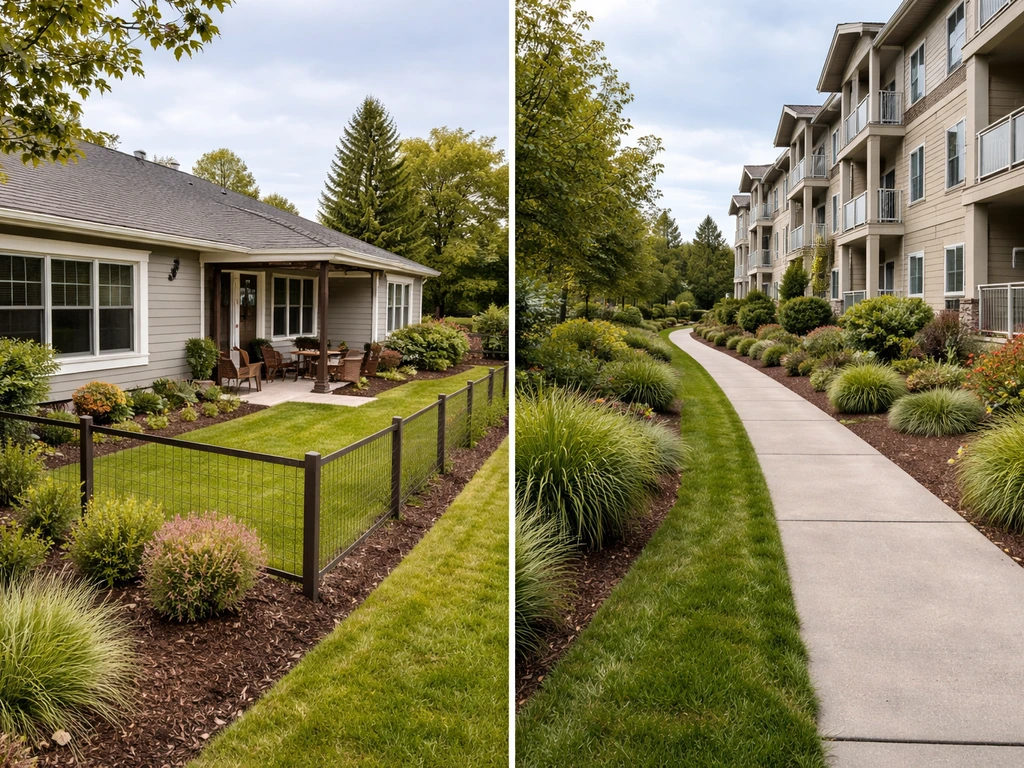
The ownership structure is the foundation of every other difference. In a patio home, you own a lot with defined boundaries. Do patio homes have basements? It depends on the specific property and local building practices, but many patio homes are designed as single-family structures that may or may not include a basement. You can often make changes to your yard, exterior, and structure (subject to HOA rules) because it is your property. In a condo, the association owns the exterior and common elements. You cannot simply replace your front door or repaint your unit's exterior wall because those elements are not legally yours.
| Feature | Patio Home | Condo |
|---|---|---|
| What you own | Fee-simple lot and structure (or defined lot in PUD) | Unit airspace; undivided interest in common elements |
| Land ownership | Yes, typically your own lot | No separate land ownership; common element |
| Private outdoor space | Usually yes: enclosed patio, small yard | May have a balcony or terrace; often limited or none |
| Exterior control | More control, subject to HOA rules | Association controls the exterior; you need approval for most changes |
| HOA structure | Common but not universal; fee varies widely | Always present; mandatory membership |
| Master insurance | May or may not be included in HOA | HOA holds master policy covering building/common areas |
| Your insurance need | Standard homeowners policy (HO-3) | HO-6 condo policy for interior/personal property |
| Shared walls | Sometimes (zero-lot-line or attached style) | Common; often shares walls, ceilings, and floors |
| Maintenance responsibility | Owner handles more (roof, exterior) | Association handles building exterior and common elements |
The practical upshot: patio home owners have more autonomy but more personal responsibility. Condo owners hand off a lot of exterior maintenance headaches to the association, but they also give up direct control over those elements and depend heavily on the association's financial health and management quality.
Common layouts and what they look like in real life
Attached patio homes (shared wall, separate lots)
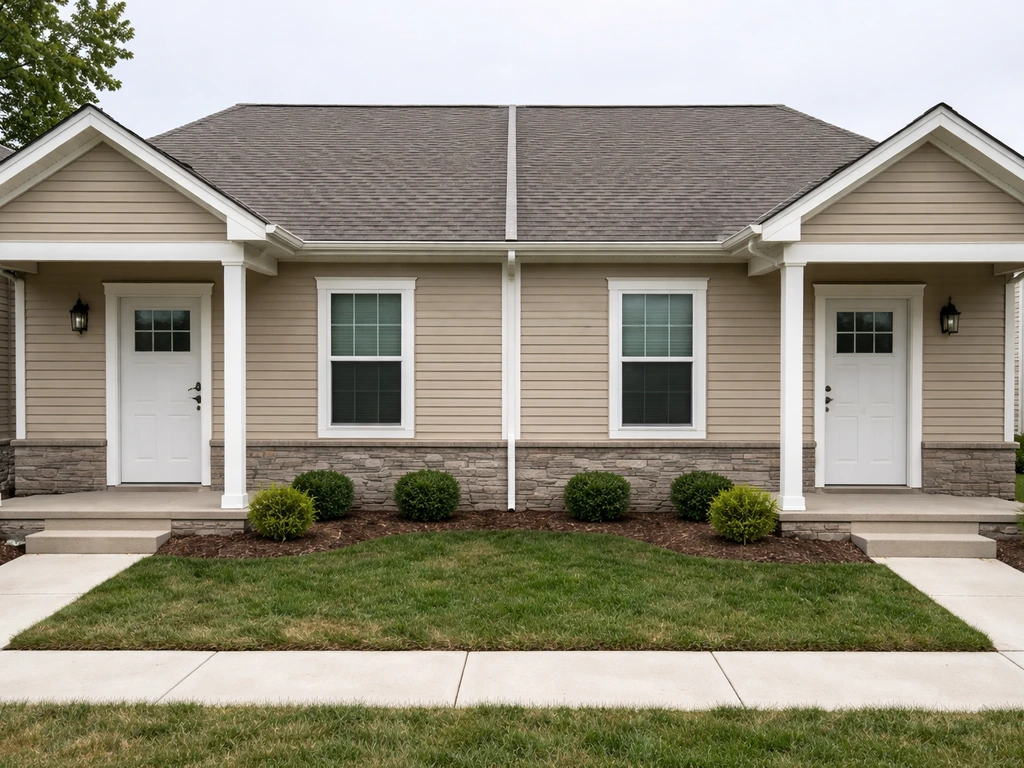
Many patio homes are attached in the sense that one exterior wall sits directly on the lot line and abuts a neighbor's wall. American Family Insurance notes that some patio homes are attached in the sense that they share a wall between units, and that the definition can vary by location and development type Many patio homes are attached. Each unit has its own legal parcel. The private patio is typically on the opposite side or rear, enclosed by a fence or wall for privacy. Driveways may be shared or separate. This layout is common in cluster-style developments and often gets confused with townhouses, but the zero-lot-line configuration and the emphasis on the enclosed outdoor space distinguish it. You are still buying a single-family property with its own deed and lot.
Detached patio homes
Some patio homes are fully detached, sitting on their own small lot with a few feet of separation between structures. These feel most like a traditional house but scaled down. The private patio is usually more prominent here, sometimes wrapping around the home. HOA fees in these communities often cover shared landscaping at entrances or common areas but leave the individual homeowner responsible for their own structure.
Condo units in low-rise or townhouse-style buildings
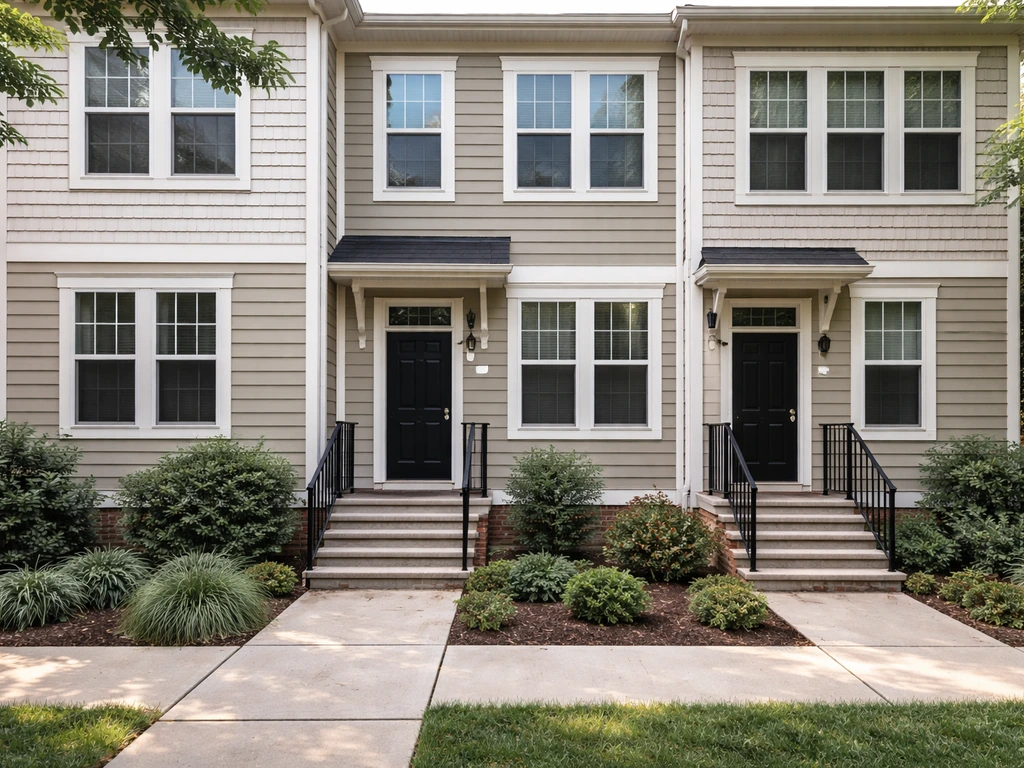
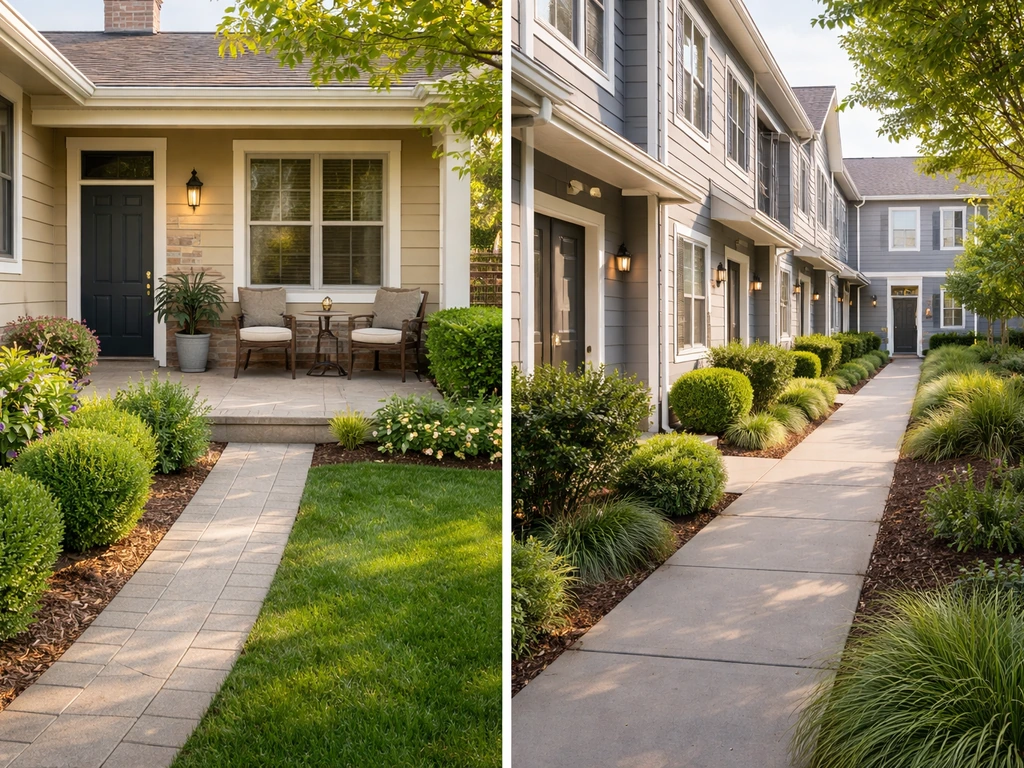
Not all condos are in towers. A two-story garden-style building or a row of attached units can be legally structured as condominiums. In these cases, the building looks similar to a patio home development from the street, but the ownership structure is completely different. Buyers searching for patio homes sometimes accidentally view condo properties, and vice versa. Always ask your agent for the legal classification, not just the marketing description.
Costs and financial tradeoffs
Purchase prices for patio homes and condos vary too much by market to make a clean generalization, but the ongoing cost structure differs in ways that can surprise buyers.
HOA fees
Condo HOA fees tend to be higher than patio home HOA fees because they cover a broader scope: building exterior maintenance, roof reserves, common area utilities, master insurance, and often amenities like pools or fitness centers. Patio home HOA fees can be modest (sometimes under $100 per month in smaller communities) if they only cover shared landscaping and a neighborhood entrance. But in larger planned developments with more amenities, patio home fees can rival condo fees. Always get the actual fee amount and a breakdown of what it covers before you compare.
Insurance costs
Patio home owners carry a full homeowners policy (HO-3 or similar) covering the structure, liability, and personal property. This is typically more expensive than a condo owner's HO-6 policy, which only covers the interior and personal property. However, condo owners need to carefully review what the master policy covers. A community association tip sheet on Madrone HOA explains that the master policy typically covers structures and common elements, while unit owners often need separate HO-6 coverage for interior elements the master policy excludes master policy covers structures and common elements, while unit owners need separate HO-6 coverage. If it is a 'bare walls' policy, you may need additional coverage for flooring, fixtures, and interior improvements. If it is an 'all-in' policy, your exposure is smaller. The association's governing documents will define the boundaries.
Property taxes
Patio home owners pay property taxes on their lot and structure. Condo owners pay taxes on the assessed value of their unit. In many markets, condo unit values are assessed lower than single-family properties, which can mean lower taxes, but this varies significantly by location and assessed value.
Special assessments and reserves
This is where condos carry a unique financial risk. If the association's reserve fund is underfunded and a major repair is needed (roof replacement, foundation work, parking structure repairs), the association can levy a special assessment on all unit owners. These can run into thousands or even tens of thousands of dollars per unit with little warning. A reserve study is the tool associations use to project these costs and ensure adequate funding. Before buying a condo, ask for the most recent reserve study and check the funding level. Patio home associations can also levy special assessments, but the scope is usually narrower because the association owns less of the physical structure.
Rules and restrictions: what you can and cannot do
Both patio home and condo communities are governed by CC&Rs (Covenants, Conditions, and Restrictions), bylaws, and rules and regulations. The specifics vary by community, but certain restrictions show up repeatedly in both types.
Exterior changes and landscaping
Most HOAs require written approval from an Architectural Control Committee (ACC) before you change anything visible from outside your unit: paint colors, fences, doors, patio covers, deck materials, and even holiday decorations in some communities. Condo associations are often stricter here because the exterior belongs to the association, not you. In patio home communities, you technically own the exterior but are still bound by the covenants. Violations can result in fines, and the association can require you to undo unapproved changes at your own expense.
Pets
Pet restrictions are common in both types. Many associations limit the number of pets, restrict breeds or weight limits for dogs, or require pets to be leashed in common areas. Condo associations tend to be stricter about this than patio home communities, but you will find the full range in both. Do not assume a patio home with a private yard means no pet restrictions.
Rentals
This is a big one if you plan to rent the property or consider it as an investment. Many HOAs, particularly condo associations, require board approval before you can lease your unit. Some use a waiting list system, and occupancy without board authorization can be considered invalid under the governing documents. Condo communities often cap the percentage of units that can be rented at any given time, and some prohibit short-term rentals entirely. Patio home communities vary, but rental restrictions are common there too. Confirm the rental policy in writing before you buy if this matters to you.
Parking
Patio homes usually come with a garage or defined parking on your lot, with HOA rules about commercial vehicles, overnight street parking, and boat or RV storage. Condos often assign parking spots that are common elements (meaning the association can theoretically reassign them, though most do not without cause). Guest parking, motorcycle storage, and garage use policies are all worth checking.
How to decide: a checklist before you buy or rent
Once you have narrowed down your options, the decision comes down to what you value most: autonomy and outdoor space (patio home) versus lower maintenance and potentially lower upfront costs (condo), balanced against your risk tolerance for HOA financial health. If you are looking for a patio on top of house, make sure the association rules cover the structure and any exterior features you may want to maintain or modify. Here is how to make sure you know what you are actually getting.
Questions to ask your agent before the showing
- Is this property legally classified as a single-family residence, a PUD (planned unit development), or a condominium? Ask for the legal classification, not just what the listing calls it.
- Does the owner hold fee-simple title to a defined lot, or just to the unit airspace?
- Is there an HOA? If yes, what is the monthly fee and what does it specifically cover?
- Who is responsible for the roof, exterior walls, and foundation maintenance and repair?
- Has there been a special assessment in the last five years? Is one currently planned or being discussed?
Documents to request and review

- The full resale package or HOA disclosure packet: CC&Rs, bylaws, rules and regulations, current budget, and financial statements
- The most recent reserve study (for any community with a shared association) and the current reserve fund balance
- The master insurance policy declarations page (for condos, understand whether it is 'bare walls,' 'single entity,' or 'all-in' coverage)
- Any pending or recently approved special assessments
- The rental policy: whether rentals require board approval, what caps apply, and whether short-term rentals are allowed
- The current violation or fine schedule so you know what the enforcement process looks like
Questions to ask the HOA or management company directly
- What is the current reserve fund balance, and what percentage funded is the community according to the most recent reserve study?
- Are there any pending litigation matters involving the association?
- What is the process and timeline for getting architectural approval if I want to make changes to my unit or outdoor space?
- What are the pet restrictions and how strictly are they enforced?
- If I want to rent the unit, what is the approval process and how long does it typically take?
Your personal priorities checklist
- Do you want private outdoor space (a yard or enclosed patio) as part of your daily life? A patio home usually delivers this more reliably than a condo.
- Do you want to minimize exterior maintenance responsibility? A condo association handles the building, though you give up control as a tradeoff.
- Are you buying as an investment and plan to rent? Investigate rental restrictions in both types; condos often have stricter limits.
- How much financial risk can you absorb? A condo's special assessment risk depends entirely on how well-funded and well-managed the association is.
- Do you want to customize your space, including outdoor areas? Patio homes generally give you more flexibility, but you still need to check the CC&Rs.
- Is long-term resale value a priority? Both types sell well in the right markets, but condo values are more tied to the association's financial health and building condition.
The bottom line: do not let the marketing language decide for you. 'Patio home' is a lifestyle label that can describe several different legal structures. Always confirm the ownership type, lot boundaries, and HOA scope with actual documents before you commit. A well-run patio home community and a well-run condo association can both be excellent places to live. If you want to evaluate whether a patio home fits your lifestyle, reviewing the pros and cons of patio homes alongside how condos work can help you compare control, maintenance, and risk. The difference is in what you control, what you share, and what you owe when something big needs fixing.
FAQ
If my patio home has an HOA, how can I tell whether it is actually a condo?
No. A patio home can have an HOA for neighborhood landscaping or shared entrances, and still be a single-family lot with your own defined boundaries. The fastest way to confirm is to look at the property deed type and the HOA documents, if the property is deeded as a lot you are typically responsible for the structure itself under your own title, even if the HOA manages some common areas.
What documents should I request to confirm the legal classification of “patio home” versus “condo”?
Ask for the recorded legal description and the plat or lot boundary exhibit (often included in the closing packet or title docs). If your purchase is structured as a condo, your deed will reference the condominium unit and the common elements percentage interest, you will not be buying a standalone parcel in the same way.
How do I determine whether my condo needs extra insurance beyond an HO-6 policy?
Look beyond the unit name and check who insures what. If the condo policy is “bare walls,” you generally need HO-6 coverage for interior walls, floors, fixtures, and upgrades that the master policy excludes. If it is “all-in,” your personal exposure is usually smaller, but you still need HO-6 for personal property and liability.
What questions should I ask about condo special assessments before closing?
Special assessments can be triggered by reserve shortfalls, damage not covered by insurance, or lawsuits. Before you buy, request the most recent reserve study summary, the current reserve funding percentage, and whether there are announced upcoming major projects. Also ask whether any assessments are already approved but unpaid.
If I want to paint, fence, or replace something outside, what is the common approval mistake to avoid?
In many HOA communities, you can be charged for permit-related work or required to restore items to the approved condition, even if you used a contractor. For exterior changes, confirm whether you need ACC approval plus city permits, and keep written approval in case you later have to show compliance.
How can parking work differently in a condo versus a patio home, and what should I verify?
Parking rules often have two layers: what you are assigned (sometimes common elements in condos) and what the HOA enforces (vehicle types, overnight rules, guest access). Get the written parking policy, verify whether a space is deeded or assigned by the association, and ask what happens if assignments change during renovations or nonpayment.
Can I rent out a patio home or condo, and what restrictions should I specifically check?
Yes, both can have rental limits, but condo rules are often more restrictive because the association controls the common elements and the risk profile. If you plan to rent, confirm whether board approval is required, whether there is a cap on the percentage of rentals, and whether short-term rentals are prohibited or need separate authorization.
If I own the exterior of a patio home, do I still need approval for fence or patio cover changes?
Patio homes can still require ACC approval for exterior-visible items, including patio covers, fences, and sometimes even certain door or shutter changes. The practical difference is that you own the exterior structure in many patio home setups, but covenants can still restrict what you can do and can require undoing changes at your expense.
How do I avoid confusing a condo building that looks like a patio home?
Yes. A garden-style building or row of attached units can look similar from the street, but be legally structured as condos (unit plus common elements). Conversely, a patio home development can feel townhouse-like yet still be deeded as single-family lots. Your decision should be based on legal docs, not exterior appearance.
What are the best due-diligence steps to evaluate the financial health of the HOA for either option?
Ask about who holds and controls the HOA budget and insurance. If the HOA underfunds reserves or has frequent litigation, costs and delays can hit owners through fees or special assessments. Request HOA financial statements, meeting minutes, and any open violations, then ask your agent to summarize any patterns like recurring reserve issues or repeated contractors replacing the same items.
Next Article
Do Patio Homes Have Basements? How to Check Fast
Learn if patio homes have basements, how to verify fast in listings, questions, and onsite checks, plus exceptions and a