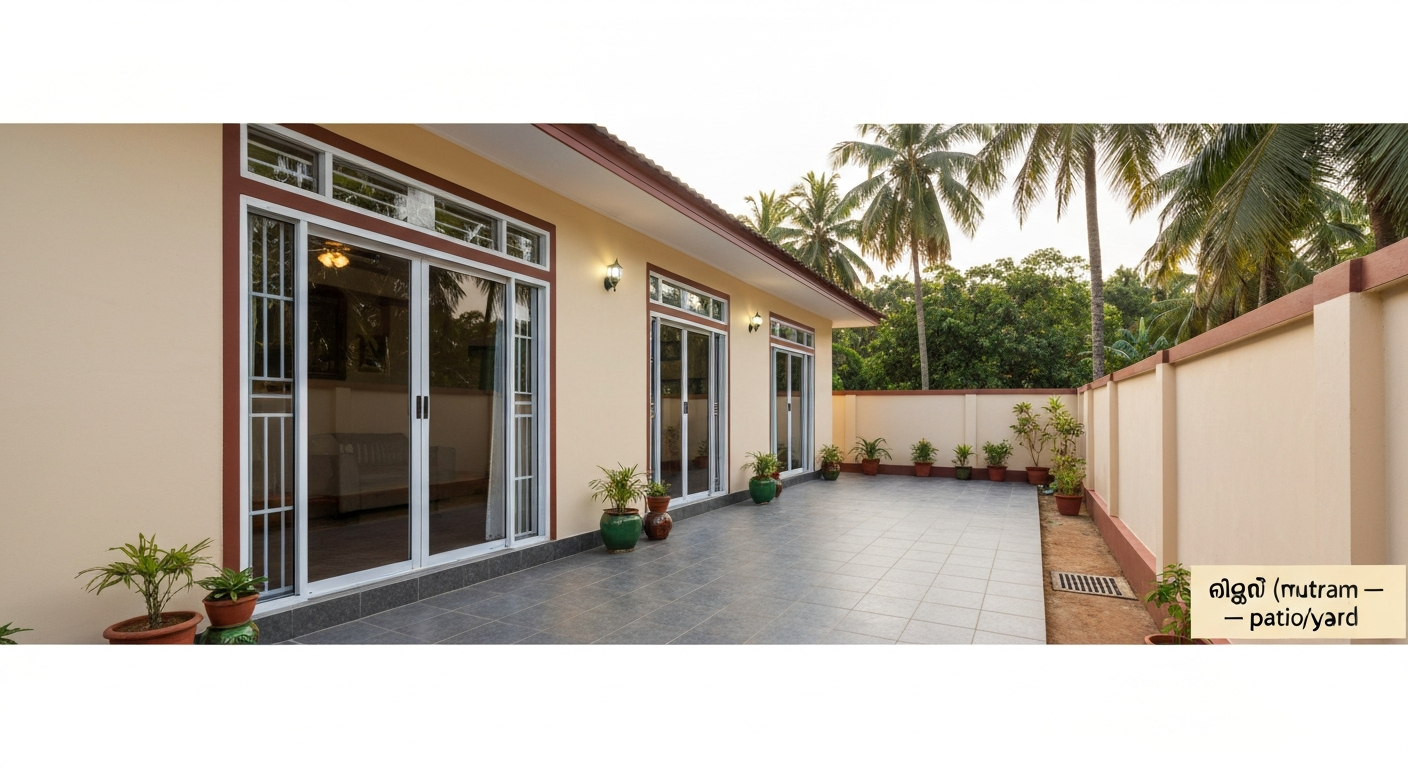
In Bengali, 'patio' is most commonly rendered as প্যাটিও (romanized: pyāṭio), used as a direct loanword. There is no single-word native Bengali equivalent that captures all the same meaning, but the closest descriptive terms are পাকা উঠোন (pākā uṭhon, meaning a paved open courtyard area) or বহিরাঙ্গন বিশ্রামস্থল (bahirāṅgan biśrāmasthala, an outdoor resting place). In everyday Bengali conversation and in e-commerce product listings in Bangladesh, প্যাটিও is the word you will encounter and the one that translators should use first.
Patio Meaning in Bengali: Definition, Terms & Usage Guide

Ada Hollis
5 Aug 2026
What this article covers and who it is for
This article is written for two groups: Bengali speakers who have come across the English word 'patio' in a property listing, a home-improvement article, or a product description and want to know exactly what it means in their language; and English-speaking homeowners, real-estate agents, or translators who need an accurate Bengali rendering they can use with confidence. I will define a patio in plain residential-architecture language, give you the Bengali terms with transliteration and usage notes, walk through the pronunciation, show example sentences in both languages, and clearly separate a patio from other outdoor spaces like the বারান্দা (veranda/porch), ব্যালকনি (balcony), উঠোন (courtyard), and টেরেস (terrace). I will also cover common patio types and materials, real-estate listing implications, and brief notes on how other South and Southeast Asian languages handle the same word.
What a patio actually is
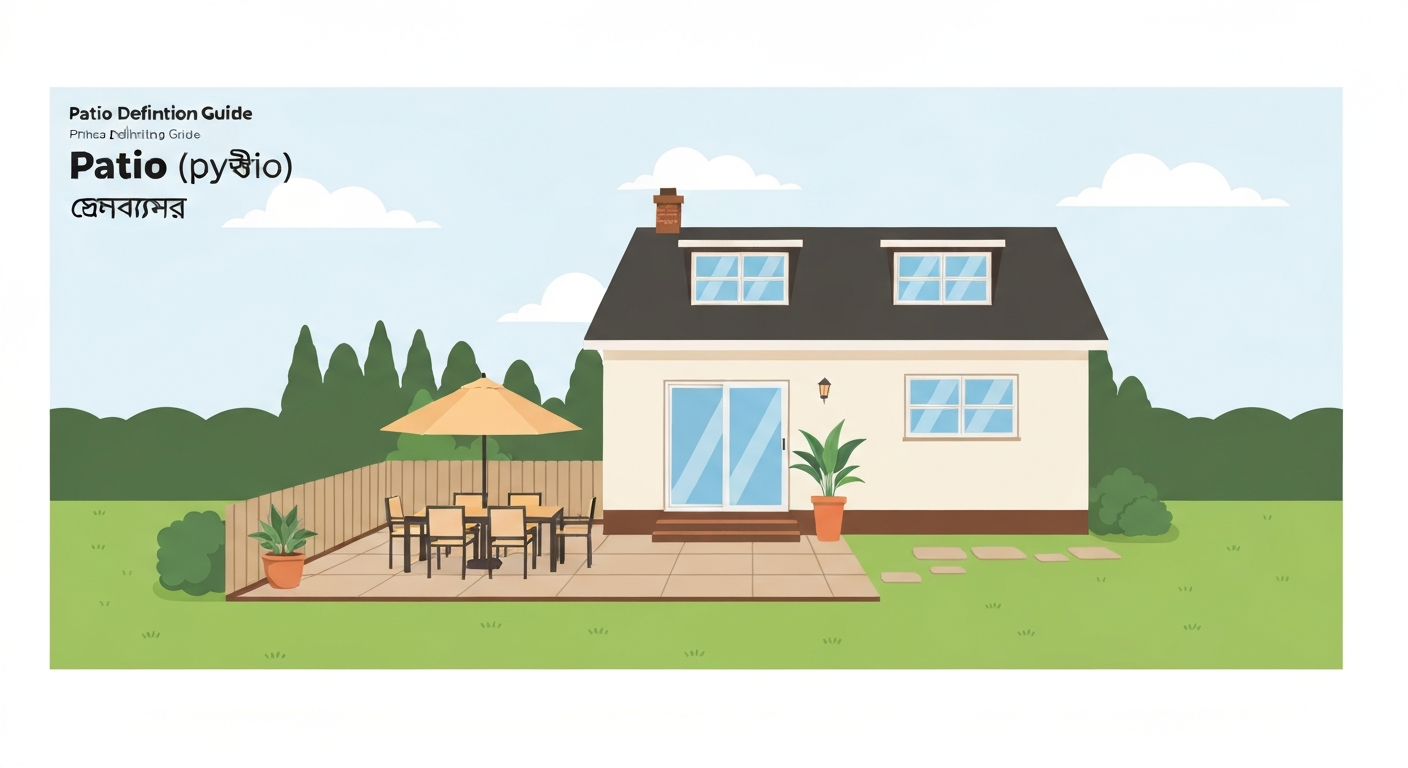
A patio is a flat, hard-surfaced outdoor area that is directly adjacent to a house and sits at ground level. It is typically paved with concrete, stone, brick, or tile, and it is used for sitting, dining, or relaxing outdoors. The Oxford Learner's Dictionary defines it as 'a flat hard area outside, and usually behind, a house where people can sit,' and Cambridge adds that it is 'a stone or hard floor area outside a house.' These definitions are intentionally simple because the concept really is simple: it is a prepared outdoor floor attached to your home.
The word itself comes from Spanish. Merriam-Webster records its first use in English around 1764, tracing it to Spanish usage where 'patio' originally referred to an inner courtyard open to the sky. In modern English-language real estate and home design, however, the dominant meaning is the paved recreational area adjoining a dwelling, not an enclosed courtyard. This distinction matters when you translate the word for Bengali-speaking audiences, because Bengali has separate words for each concept.
The Bengali renderings: loanword, equivalents, and how exact they are
The most direct and widely used Bengali rendering is প্যাটিও (pyāṭio). This is a loanword borrowed directly from English, and it appears in Bengali product descriptions, classified property listings in Bangladesh, and bilingual dictionaries. On e-commerce platforms like Daraz Bangladesh, you will find outdoor furniture listed under প্যাটিও ফার্নিচার (pyāṭio phārnicara), which shows the loanword has genuine commercial traction in everyday Bengali.
Beyond the loanword, here are the nearest native Bengali expressions and where each one falls short as a direct substitute:
- পাকা উঠোন (pākā uṭhon): literally 'paved courtyard.' This is functionally the closest phrase, but উঠোন carries a cultural sense of an open, family-gathering yard in a traditional Bengali homestead, not necessarily the deliberate recreational slab attached to the rear of a modern house.
- বহিরাঙ্গন (bahirāṅgan): means 'outdoor area' or 'exterior space.' It is a general term, not specific to a paved ground-level surface adjoining a house. Useful in a descriptive sentence but not a standalone translation.
- আঙিনা (āṅginā): refers to the open ground around a house, similar to a yard or compound. It overlaps with উঠোন and does not carry the paved, furniture-ready connotation of a patio.
- টেরেস (ṭereś): used in Bengali for 'terrace,' which can mean either a rooftop flat area or an elevated paved space. It is not interchangeable with patio because it implies elevation.
My recommendation for translators: use প্যাটিও as the primary word. If you need a descriptive phrase for a general audience who may not know the loanword, write প্যাটিও (পাকা বহিরাঙ্গন বিশ্রামস্থান), which translates roughly as 'patio (paved outdoor resting area).' This covers the meaning without losing the modern residential-architecture sense.
How to pronounce 'patio' and use it in a sentence
Pronunciation
In standard British English, 'patio' is pronounced /ˈpætiəʊ/, with the stress on the first syllable. In American English it is /ˈpæt̬iˌoʊ/. For Bengali speakers, the closest phonetic approximation is প্যা-টি-ও (pyā-ṭi-o), three syllables, with emphasis on the first: PYAA-tee-oh. The Bengali spelling প্যাটিও reflects this pronunciation accurately.
Example sentences
Below are short, everyday sentences using 'patio' and their Bengali equivalents. These are useful both for translators writing property descriptions and for Bengali speakers learning the word.
| English sentence | Bengali sentence | Transliteration |
|---|---|---|
| Let's have lunch out on the patio. | চলো প্যাটিওতে বসে দুপুরের খাবার খাই। | Calo pyāṭiote bose dupurer khābar khāi. |
| The house has a large patio at the back. | বাড়ির পেছনে একটি বড় প্যাটিও আছে। | Bāṛir pecchane ekaṭi baṛo pyāṭio āche. |
| We put garden chairs on the patio. | আমরা প্যাটিওতে বাগানের চেয়ার রাখলাম। | Āmarā pyāṭiote bāgānera ceyār rākhlām. |
| The patio is paved with flat stone. | প্যাটিওটি সমতল পাথর দিয়ে বাঁধানো। | Pyāṭioṭi samatala pāthar diye bāṃdhāno. |
How a patio differs from related outdoor spaces
This is where most confusion comes in, and getting it right matters whether you are reading a property listing or translating one. Bengali already has well-established words for several outdoor spaces, and none of them are exact synonyms for 'patio.' Here is how each one differs.
Porch (বারান্দা)
A বারান্দা (bārāndā) is what English speakers call a veranda or porch: a covered, roofed outdoor structure attached to the front, side, or rear of a house. The key word is 'covered.' A patio is almost always open to the sky (some patios have a pergola or shade structure, but the default is unroofed). A বারান্দা is structurally part of the building because it needs a roof. A patio is simply a prepared ground surface, so it has no mandatory roof.
Balcony (ব্যালকনি)
A ব্যালকনি (byālakanī) is elevated. It projects from an upper floor, is enclosed by a railing, and you access it through a door from inside the building. A patio is always at ground level. This is probably the simplest and most definitive distinction: if it is up in the air, it is a balcony. If it is on the ground, it is a patio.
Courtyard (উঠোন / আঙিনা)
An উঠোন or আঙিনা is an open area of ground around or within a building, often surrounded by walls or structures on multiple sides. In traditional Bengali rural and urban homesteads, the উঠোন is a central community and family space, sometimes unpaved and sometimes paved. A patio, by contrast, is a deliberate recreational surface attached to the exterior of a house for the use of the residents, and it is not enclosed by walls on multiple sides. The Bangla Abhidhan distinguishes this: উঠোন is more of a general yard or compound space, while a patio implies a purpose-built paved surface for sitting and dining.
Terrace (টেরেস)
টেরেস (ṭereś) in Bengali usage typically refers to a rooftop flat area, which is a very common feature of urban Bangladeshi and Indian Bengali housing. In English, a terrace can also mean a ground-level or raised paved outdoor area, so there is some overlap with patio. But the Bengali usage of টেরেস strongly implies the roof or a raised platform, so using টেরেস as a translation for 'patio' would mislead most Bengali readers into imagining a rooftop space.
Side-by-side comparison: patio, porch, veranda, balcony, courtyard, terrace
| Space | Bengali term | Ground level? | Has a roof? | Attached to building? | Enclosed by walls? | Primary use |
|---|---|---|---|---|---|---|
| Patio | প্যাটিও | Yes | No (usually) | Yes, adjoining | No | Outdoor dining, relaxing |
| Porch | বারান্দা (sামনের) | Yes | Yes | Yes, front/side | Partially | Sheltered entrance, sitting |
| Veranda | বারান্দা | Yes | Yes | Yes, wraps exterior | Partially | Shaded outdoor living |
| Balcony | ব্যালকনি | No (upper floor) | No (usually) | Yes, projects from wall | Railing only | Views, air, small seating |
| Courtyard | উঠোন / আঙিনা | Yes | No | Surrounded by structure | Often yes | Family gathering, utility |
| Terrace | টেরেস | Roof or raised | No | Part of building | No | Rooftop recreation, views |
Everyday bilingual examples showing the differences
Sometimes the clearest way to understand these distinctions is to see them used naturally in sentences alongside each other.
- English: 'We had coffee on the patio, then moved inside when it started to rain.' Bengali: আমরা প্যাটিওতে কফি খাচ্ছিলাম, তারপর বৃষ্টি শুরু হলে ভেতরে চলে গেলাম। (Āmarā pyāṭiote kaphi khāccilām, tārapara bṛṣṭi śuru hale vetare cale gelām.) — Note: a বারান্দা would have kept them dry because it is roofed.
- English: 'Her flat has a small balcony but no patio.' Bengali: তার ফ্ল্যাটে একটি ছোট ব্যালকনি আছে, কিন্তু কোনো প্যাটিও নেই। (Tāra phlyāṭe ekaṭi choṭa byālakanī āche, kintu kono pyāṭio nei.) — The balcony is upstairs; the patio is ground level.
- English: 'The children play in the courtyard while the adults sit on the patio.' Bengali: শিশুরা উঠোনে খেলছে আর বড়রা প্যাটিওতে বসে আছে। (Śiśurā uṭhone khelache āra baṛarā pyāṭiote bose āche.) — উঠোন is the wider yard; প্যাটিও is the paved sitting area.
- English: 'The terrace on the roof gives a great view of the city.' Bengali: ছাদের টেরেস থেকে শহরের সুন্দর দৃশ্য দেখা যায়। (Chādere ṭereś theke śaharere sundara dṛśya dekhā yāya.) — টেরেস is rooftop; প্যাটিও is at the ground.
Common patio types and materials
In practice, the word 'patio' covers a wide range of surfaces and styles. Understanding the material types matters both for homeowners choosing or budgeting a patio and for translators describing one accurately in a property listing.
Poured or stamped concrete
Poured concrete is the most common patio surface in North America. Stamped concrete is poured concrete imprinted with patterns that mimic stone or brick. It is cost-effective and low-maintenance, but if it cracks, the entire slab usually needs to be repaired rather than replaced section by section. For Bengali-speaking readers, this type would be described as ঢালাই কংক্রিটের প্যাটিও (ḍhālāi kaṃkrīṭera pyāṭio).
Concrete or clay brick pavers
Pavers are individual units laid on a compacted sand-and-gravel base. They are more repair-friendly than poured concrete: if one unit cracks or shifts, you lift it out and replace it. This Old House and industry specialists at ConcreteNetwork both note that interlocking pavers handle ground movement better in freeze-thaw climates. In Bangladesh and West Bengal, brick (ইট/iṭ) is a familiar material, so describing a brick-paver patio as ইটের প্যাটিও (iṭera pyāṭio) translates cleanly.
Natural stone (flagstone, bluestone)
Flagstone and bluestone patios use irregular or cut slabs of natural stone. They are durable and visually striking but more expensive than concrete or pavers. Maintenance involves periodic re-setting of stones and filling joints. In Bengali, this would be প্রাকৃতিক পাথরের প্যাটিও (prākṛtika pātharer pyāṭio).
Porcelain or outdoor tile
Outdoor porcelain tile gives a clean, modern look and is resistant to stains and moisture. It requires a stable base and careful installation to prevent cracking from ground movement. In cold climates, freeze-thaw cycles can dislodge tiles if the base is not properly prepared.
Gravel and decomposed granite
Gravel patios are the most affordable option. They drain well naturally, require minimal installation, and can be refreshed easily by adding more material. The drawback is that gravel is not a stable surface for furniture legs and can spread into adjacent lawn or garden beds. Decomposed granite compacts more firmly and is a step up from loose gravel.
Covered vs open patios
A standard patio is open to the sky. A 'covered patio' has a pergola, awning, or solid roof structure over it, which moves it closer to a veranda in character (though the floor-level and attachment principles remain the same). In real-estate listings, the distinction between an open patio and a covered patio matters because a covered patio adds weather protection and effectively extends the indoor living area outdoors.
| Material / type | Cost (relative) | Durability | Repair ease | Best for |
|---|---|---|---|---|
| Stamped/poured concrete | Low to medium | High if sealed | Difficult (full slab) | Budget-conscious homeowners wanting low maintenance |
| Concrete/clay pavers | Medium | High | Easy (unit replacement) | Most residential patios; freeze-thaw climates |
| Natural stone (flagstone) | High | Very high | Moderate | Premium homes; rustic or natural aesthetics |
| Porcelain/outdoor tile | Medium to high | High | Moderate | Modern, clean-look patios in mild climates |
| Gravel / decomposed granite | Very low | Low to medium | Very easy | Budget DIY; informal gardens |
| Covered patio (any material + roof) | Medium to high | Varies by material | Varies | Year-round outdoor living; wet or sunny climates |
What 'patio' means in a property listing
If you are reading a property listing in English and see 'patio' listed as an amenity, it is a specific, searchable feature. In the U.S., major MLS (Multiple Listing Service) data feeds include a dedicated Patio field, which means real-estate databases treat it as a distinct amenity separate from a deck, balcony, or porch. Zillow and similar platforms surface patio as a filterable attribute, so buyers actively search for it. In practical terms, a home with a patio is marketing an outdoor living area that is usable for dining, entertaining, or relaxing without the investment of building a fully enclosed structure.
For Bengali-speaking buyers or renters reviewing an English listing, প্যাটিও আছে (pyāṭio āche, 'has a patio') is the phrase to look for in translated listings. For agents translating listings into Bengali for Bangladeshi or diaspora markets, using প্যাটিও rather than a descriptive phrase keeps the listing searchable and professional. Using উঠোন or বারান্দা instead would suggest a different kind of space to Bengali readers and could create inaccurate expectations before a property visit.
How other South and Southeast Asian languages handle 'patio'
Bengali is not alone in having to borrow or adapt the word. Across the South and Southeast Asian languages that share a similar residential architectural vocabulary, 'patio' is typically handled one of two ways: as a direct English loanword, or described through a native term that approximates the concept without being identical.
In Gujarati, the concept overlaps with words for veranda and courtyard, similar to the Bengali situation, and the English loanword is also in use for modern residential contexts. Kannada has its own equivalent for open courtyard spaces and similarly adopts the English term for the specifically paved, recreational sense. For a direct comparison and the patio meaning in Kannada, see patio meaning in Kannada. Tamil, Telugu, and Malayalam each have established words for veranda/porch structures (which are roofed) and for open yard areas, but none map precisely onto the modern English 'patio,' so these languages also rely on the loanword or a descriptive phrase when writing about contemporary home design. For a related explanation of how the term is handled in Telugu, see patio meaning in Telugu. For a focused explanation of how the term is used and translated in Tamil, see patio meaning in Tamil. In Tagalog, the word 'patio' carries a particularly interesting parallel because Spanish colonialism gave the Philippines both the word and the architectural concept directly from the same Spanish source that gave English the word in the 1700s, making Tagalog usage of 'patio' feel very natural. For notes on the Malayalam equivalent and common translations, see patio meaning Malayalam. For a focused explanation of the word and its usage in Filipino, see patio meaning in Tagalog.
The common thread across all these languages is that when you need to describe a modern, ground-level paved outdoor sitting and dining area attached to a house, the English loanword is the safest and most precise choice in each of these languages, including Bengali.
A practical note for translators and multilingual readers
If you are a professional translator working on property documentation, home-improvement content, or product descriptions, here is my direct guidance: do not force a native Bengali equivalent when the concept being described is specifically a modern paved patio in the English or Western residential sense. The loanword প্যাটিও is understood, it appears in commercial Bengali content, and it prevents the confusion that comes from using বারান্দা (which implies a roof) or উঠোন (which implies a traditional yard). Use প্যাটিও on first mention and add a brief parenthetical if your audience may be unfamiliar: প্যাটিও (বাড়ির পাশের পাকা বহিরাঙ্গন), meaning 'patio (paved outdoor area next to the house).'
For homeowners, the takeaway is simpler. A patio is a ground-level paved outdoor floor attached to your home, open to the sky, and built for sitting and dining outside. In Bengali: এটি বাড়ির গায়ে লাগোয়া একটি সমতল, পাকা বহিরাঙ্গন যেখানে মানুষ বসে আরাম করে বা খাওয়া-দাওয়া করে। (Eṭi bāṛira gāye lāgoyā ekaṭi samatala, pākā bahirāṅgan jekāne mānuṣa bose ārama kare bā khāoyā-dāoyā kare.) That single sentence covers everything a Bengali speaker needs to understand what the word means.
FAQ
What is a concise definition of 'patio' in plain residential-architecture language?
Definition: A patio is a ground-level, usually paved outdoor area next to or immediately behind a house used for sitting, dining and recreation. Patios are typically unroofed (open to the sky) and intended as an informal extension of living space for family and guests. (Sources: Oxford, Cambridge, Merriam‑Webster.)
What Bengali terms can render 'patio' and how should a translator choose between them?
Bengali renderings and guidance: - প্যাটিও (paetio / pæṭio) — loanword used commonly in advertising, product listings and by speakers familiar with the English term; closest phonetic match and useful when the English concept is meant exactly. - পিচ (pich) — uncommon; avoid unless regionally used as slang. - আঙিনা (aṅgīna) or উঠোন (uṭhon) — traditional Bengali words meaning courtyard; use when the outdoor area is enclosed or central to the house (note: not always identical to 'patio'). - বারান্দা (baranda) — means veranda/porch (usually roofed); not interchangeable with patio when the space is unroofed. - টেরেস (ṭerēs) — terrace; may overlap when a patio is on a flat roof or elevated. Translators' note: if the space is a ground-level paved recreational slab adjacent to the house, use প্যাটিও for clarity; if you must use a pure Bengali word, add a short clarifier (e.g., 'প্যাটিও (মাটি‑স্তরের প্লাস্টিক/পাথরের উঠোন)' or 'উঠোন বা প্যাটিও') to show nuance.
How do you pronounce 'patio' and its Bengali renderings? Provide IPA and transliteration.
Pronunciation: - English IPA: UK /ˈpætiəʊ/ ; US /ˈpætioʊ/ (Cambridge, Oxford). Pronounce roughly "PAT-ee-oh". - Bengali loanword: প্যাটিও — transliteration 'paetio' or 'pæṭio'. Spoken Bengali approximation: "প্যা‑টি‑ও" (PYA‑ti‑o). Usage tip: When speaking to Bengali speakers unfamiliar with the loanword, say প্যাটিও and then a short explanation (e.g., 'প্যাটিও, অর্থাৎ বাড়ির পাশের মাটির পাকা বসার এলাকা').
Give short example sentences in English and Bengali using 'patio'.
Examples: - English: "We had breakfast on the patio." — simple everyday use. - Bengali (loanword): "আমরা প্যাটিওতে সকালের নাস্তা করেছিলাম।" (Āmrā paetio‑te sakālēr nāstā karēchilām.) - Bengali (explanatory): "বাড়ির পিছনে একটি পাকা উঠোন বা প্যাটিও আছে যেখানে আমরা ডিনার করি।" (Bāṛir pichhē ēkaṭi pākā uṭhon bā paetio āchē jēkhānē āmrā ḍinār kori.) Translator tip: when listing features in an advertisement, "প্যাটিও আছে" is clear and common.
How does a patio differ from a porch, veranda/বারান্দা, balcony, courtyard/উঠোন and terrace? Provide a clear comparative breakdown and a small table.
Comparative breakdown: - Patio: ground-level, usually paved, generally unroofed, adjacent to house, for seating/dining. - Porch / বারান্দা (baranda): attached platform at an entrance, usually roofed or partially roofed, transitional space between indoors and outdoors. - Balcony / ব্যালকনি: elevated platform projecting from an upper floor, with railing. - Courtyard / উঠোন (uṭhon) or আঙিনা (aṅgīna): enclosed or semi‑enclosed open area within or surrounded by building walls; may be central. - Terrace / টেরেস (ṭerēs): flat open area that can be ground-level or elevated (roof terrace); often broader than a patio. Small comparison table: Feature | Patio | Porch/বারান্দা | Balcony/ব্যালকনি | Courtyard/উঠোন | Terrace/টেরেস Typical level | Ground | Ground (entrance) | Elevated | Ground or inner | Ground or elevated Roofed? | Usually no | Usually yes | No | Sometimes partially | Sometimes Attached to house? | Yes (side/rear) | Yes | Yes (upper) | Enclosed by house | Attached or on roof Use | Dining/relaxing | Entry/shelter | Outdoor view | Open central space | Outdoor living/entertainment Example Bengali label | প্যাটিও | বারান্দা | ব্যালকনি | উঠোন/আঙিনা | টেরেস (If a single-word Bengali equivalent is imperfect, note the nuance: e.g., উঠোন often implies more enclosure than a typical patio.)
What are common patio types and materials homeowners encounter?
Common patio types and materials: - Poured concrete (including stamped concrete) — economical, can mimic stone. - Concrete pavers — interlocking units, repair-friendly. - Natural stone / flagstone — bluestone, slate; aesthetic and durable. - Clay or brick pavers — traditional look, durable. - Porcelain or outdoor tile — modern finishes, requires good drainage. - Gravel or decomposed granite — informal, permeable. - Wood/composite decking used where a raised or warm‑looking surface is desired (may be described as a 'deck' rather than a patio). Practical note: Material choice affects maintenance, drainage needs and listing language (e.g., 'paved patio', 'stone patio', 'concrete patio'). (Sources: This Old House, Angi, ConcreteNetwork.)
Next Article
Patio Meaning Malayalam: Definition, Pronunciation & Guide
പാട്ടിയോ (patio) എന്താണെന്ന് മലയാളത്തിൽ സരള വിശദീകരണം, ഉച്ചാരണവും ഉപയോഗവും, വാങ്ങുമ്പോൾ കാണേണ്ട കാര്യങ്ങളും