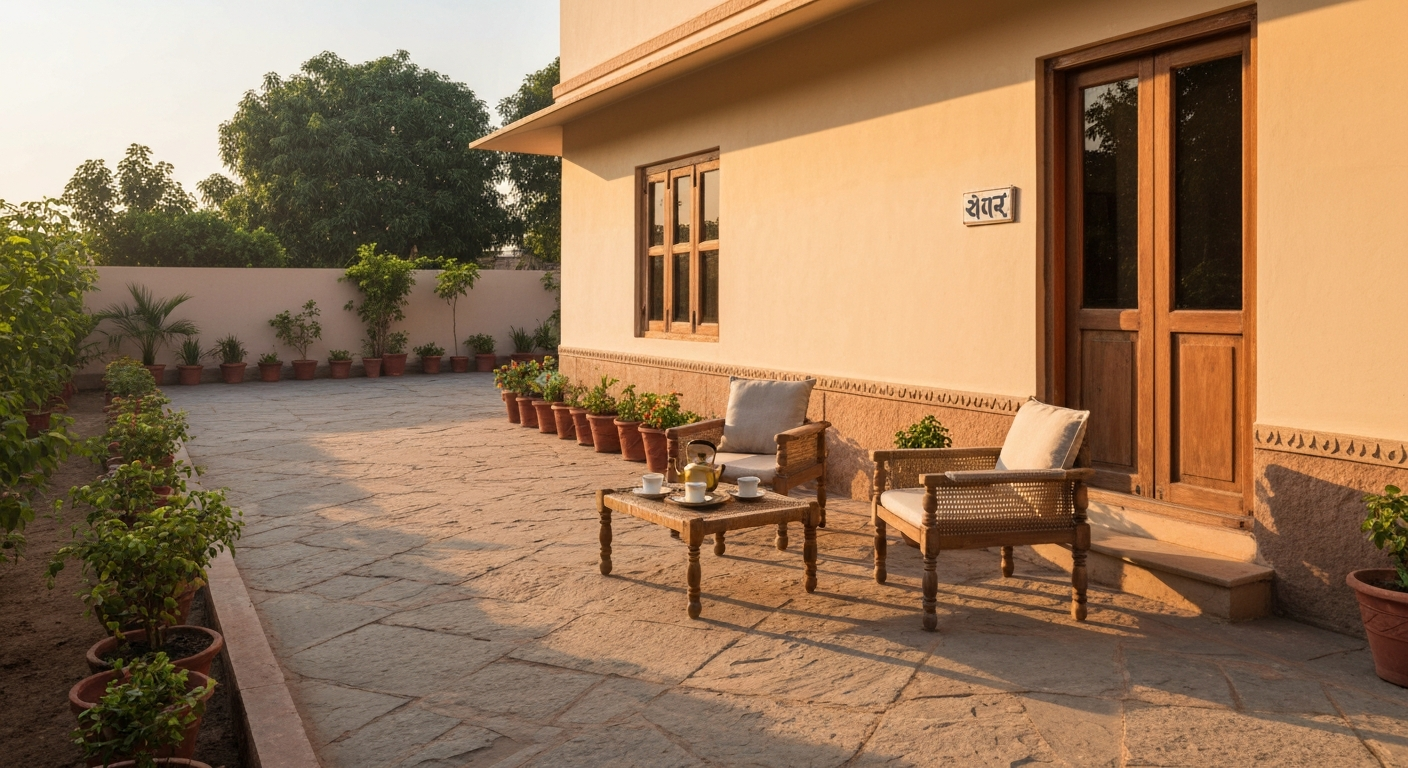
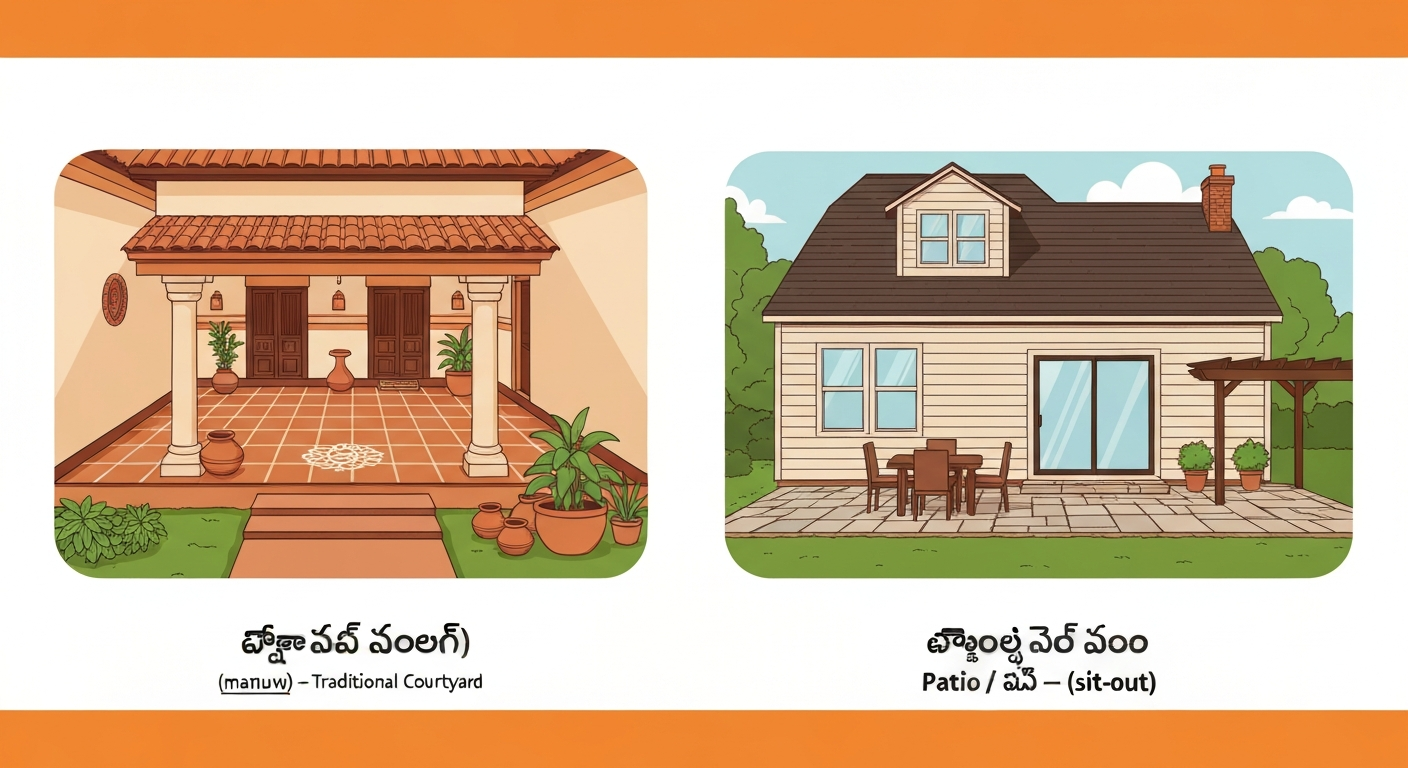
In Telugu, 'patio' is most accurately translated as మండువా (manḍuvā), meaning a courtyard or open ground-level outdoor space adjoining a home. If you come across the word in a property listing or home description and want to understand it in Telugu, the closest everyday equivalent is మండువా, though you will also see అంగనం (aṅganaṁ) used for a similar open courtyard concept. In modern Indian real-estate contexts, the English term 'patio' is often left untranslated or described simply as a 'sit-out' (సిట్-అవుట్) in listings across Andhra Pradesh and Telangana.
Patio Meaning in Telugu: Definition, Translation & Guide

Ada Hollis
23 Jul 2026
What 'patio' actually means in English
A patio is a paved outdoor area attached to a house, sitting at ground level, with no roof (or only a partial one). You use it for sitting, eating, entertaining, or relaxing outside. The floor is hard, typically made from concrete, brick, stone, or pavers, which is what separates it from a garden or lawn. It is not raised off the ground (that would make it a deck), and it is not enclosed by the building on all sides (that would make it a courtyard). Think of it as an outdoor 'room' that extends directly from a back or side door.
Patio in Telugu: script, romanization, and how to say it
The most direct Telugu equivalent for 'patio' is మండువా, romanized as manḍuvā under ISO 15919 transliteration conventions. In everyday spoken Telugu it is pronounced roughly as mun-DOO-vaa, with the stress falling on the second syllable and a slightly retroflex 'ḍ' sound that does not have an exact English equivalent. See Telugu language, phonology overview (reference for IPA conventions) for standard IPA mappings used here blank" rel="noopener noreferrer">Telugu language — phonology overview (reference for IPA conventions). A second term you will encounter is అంగనం (aṅganaṁ, pronounced ung-uh-NUM), which leans more toward the sense of an open courtyard or forecourt. Wiktionary lists అంగనం (aṅganaṁ) as a Telugu translation for 'courtyard' blank" rel="noopener noreferrer">Wiktionary lists అంగనం (aṅganaṁ) as a Telugu translation for 'courtyard'.. For the modern 'sit-out' sense used in property listings, Telugu speakers often say సిట్-అవుట్ (siṭ-avuṭ), borrowed directly from Indian English. When reading a listing or a floor plan in Telugu, any of these three terms can signal what an English document would call a patio. For the equivalent term and examples in Tamil, see patio meaning in Tamil.
| Telugu Script | Romanization (ISO 15919) | Approximate Pronunciation | Closest English Sense |
|---|---|---|---|
| మండువా | manḍuvā | mun-DOO-vaa | Courtyard / patio (traditional) |
| అంగనం | aṅganaṁ | ung-uh-NUM | Open courtyard / forecourt |
| సిట్-అవుట్ | siṭ-avuṭ | sit-AV-utt | Sit-out / small outdoor seating area (modern listing term) |
| మండపం | mandapaṁ | mun-DUH-pum | Pillared porch or pavilion (historical/architectural) |
Example sentences using 'patio' in Telugu and English
Seeing a word used in a sentence is usually the fastest way to lock in its meaning. Here are a few examples that show how 'patio' and its Telugu equivalents appear in natural conversation and property contexts.
- English: 'We have our morning tea on the patio every day.' | Telugu: 'మేము ప్రతి రోజూ మండువాలో మా మార్నింగ్ టీ తాగుతాము.' (Mēmu prati rōjū maṇḍuvālō mā mārniṅg ṭī tāgutāmu.)
- English: 'The apartment has a small sit-out that we use as a patio.' | Telugu: 'ఆ అపార్ట్మెంట్కు చిన్న సిట్-అవుట్ ఉంది, దాన్ని మేము పాటియో వలె ఉపయోగిస్తాము.' (Ā apārṭmeṇṭku cinna siṭ-avuṭ uṁdi, dānni mēmu pāṭiyō vale upayōgistāmu.)
- English: 'The house has a beautiful open courtyard that functions as a patio.' | Telugu: 'ఆ ఇంటికి అందమైన అంగనం ఉంది, అది పాటియోలా పని చేస్తుంది.' (Ā iṁṭiki aṁdamaina aṁganaṁ uṁdi, adi pāṭiyōlā pani cēstuṁdi.)
- English: 'Can we put a table and chairs on the patio?' | Telugu: 'మనం మండువాలో టేబుల్ మరియు కుర్చీలు పెట్టగలమా?' (Manaṁ maṇḍuvālō ṭēbul mariyu kurcīlu peṭṭagalamā?)
Where the word 'patio' comes from
English borrowed 'patio' directly from Spanish, where patio means an inner courtyard, the open central space of a traditional Iberian or Latin American house. The Spanish word itself traces back to Old Occitan and Spanish roots (pati/patu), with connections to Latin origins relating to open or unroofed spaces. The word entered English usage around the mid-18th century, initially carrying the courtyard sense, and gradually shifted in modern English to describe any paved outdoor area attached to a home, even one that is not enclosed. That original courtyard meaning is actually quite close to the Telugu मण्डुवा (manduva) concept, which describes the central open space in a traditional Telugu house style known as the 'manduva illu.'
How to recognize a patio: key features to look for
Whether you are looking at a listing photo or walking through a property, a patio has a consistent set of visual and structural clues. It sits flush with the ground (no steps up, unlike a raised deck), it has a hard paved surface (not grass or gravel alone), it connects directly to the house through a door, and it typically sits at the rear or side of the property. It may have partial shade from a pergola or umbrella but is not fully enclosed. Here is a breakdown of the features you will commonly see labeled in patio diagrams and floor plans.
- Paved surface: concrete slab, brick pavers, natural stone, porcelain tile, or gravel-set flagstone at ground level
- Direct access point: sliding glass door, French doors, or a rear entry door from the kitchen, dining room, or living area
- Defined boundary: edging stones, low planters, a garden border, or a fence line marking where the patio ends
- Partial overhead structure (optional): pergola, shade sail, retractable awning, or a partial roof extension from the house
- Drainage: a slight slope (typically 1 to 2 percent) away from the house foundation to move rainwater clear
- Furnishings zone: space for an outdoor dining set, lounge chairs, a BBQ grill, or a fire pit
- Lighting (in finished patios): string lights, recessed pavers with LED strips, or wall-mounted fixtures near the door
Patio vs porch, balcony, verandah, courtyard, and terrace
These outdoor space terms are used loosely and often interchangeably, but they actually describe quite different structures. The differences matter when you are reading a property listing, comparing floor plans, or trying to understand what you are actually buying or renting. Here is an at-a-glance comparison.
| Space | Level | Roofed? | Attached to House? | Floor Type | Typical Location |
|---|---|---|---|---|---|
| Patio | Ground level | Usually no (partial shade only) | Yes, directly adjoining | Hard: concrete, stone, brick, pavers | Rear or side of house |
| Porch | Ground or slightly raised | Yes, typically covered | Yes, part of house structure | Wood, concrete, tile | Front of house (usually) |
| Balcony | Elevated (upper floor) | No (or partial railing only) | Yes, projects from building wall | Concrete, tile, wood | Any upper-floor facade |
| Verandah | Ground level | Yes, roofed all along | Yes, runs along house perimeter | Wood, tile, concrete | Front and/or sides of house |
| Courtyard | Ground level | No (open to sky) | Enclosed by walls/building on most sides | Stone, gravel, tile, brick | Central or interior of house |
| Terrace | Rooftop or raised platform | Usually no | Yes, part of building structure | Concrete, tile, paving | Rooftop or upper level |
The simplest way to remember this: a patio is ground-level, open to the sky, paved, and tacked on to the back or side of the house. A porch is covered and typically at the front. A balcony is always elevated. A verandah is a covered walkway along the house perimeter. A courtyard is enclosed on multiple sides. A terrace is raised, often on a rooftop. In Indian real-estate listings, you will sometimes see 'terrace' used to mean what most people would call a patio, so always check the floor plan level to confirm.
Common patio types, materials, and how they are used
Patios come in more varieties than most people expect. The type usually reflects the budget, the climate, and how the homeowner plans to use the space. Here is a practical rundown.
Types by layout
- Attached patio: directly connected to the house, the most common residential type, usually accessed via a back door
- Detached patio: a freestanding paved area set apart in the garden, often built around a tree, pool, or fire pit
- Courtyard patio: enclosed on three or more sides by walls, fences, or the house itself, giving privacy and wind protection
- Rooftop patio: built on a flat roof, common in apartments and urban townhouses where ground space is limited
- Pool patio (pool deck): a paved surround running along the edge of a swimming pool, designed for wet-foot traffic
Common materials and what they offer
| Material | Durability | Maintenance | Best For | Approx. Cost Range |
|---|---|---|---|---|
| Concrete slab | Very high | Low (seal every 2-3 years) | Budget builds, large areas | Low |
| Brick pavers | High | Low-medium (re-sand joints) | Traditional look, DIY-friendly | Medium |
| Natural stone (flagstone, slate) | Very high | Medium (seal annually) | Premium, rustic aesthetic | High |
| Porcelain/ceramic tile | High | Low (easy to clean) | Modern, pool surrounds | Medium-high |
| Gravel / decomposed granite | Medium | Low (top up annually) | Informal, drainage-friendly | Low |
| Composite/wood decking | Medium | Medium-high (clean, seal) | Warm look, raised or flush | Medium-high |
How patios are typically used
- Outdoor dining: the most common use, with a table and chairs set up near the kitchen or grill
- Entertaining and socializing: seating areas with sofas, side tables, and an outdoor bar or kitchen
- Relaxation: a lounge chair or hammock setup for reading or sunbathing
- Children's play zone: a safe hard surface adjacent to lawn for bikes, scooters, or outdoor toys
- Container gardening: raised planters and pots arranged along the edges of the paved area
- Hot tub or fire pit area: a load-bearing concrete or stone pad that supports heavy fixtures safely
Spotting patios in property listings, floor plans, and photos
When you are searching for a home in India, the UK, the US, or anywhere else, listing descriptions use a surprising variety of terms for the same feature. In Indian listings (including those on major portals covering Andhra Pradesh and Telangana), a patio equivalent is most often labeled as 'sit-out,' 'sit out,' or 'open terrace.' In US and UK listings you will see 'patio,' 'paved patio,' 'entertaining area,' or 'outdoor living space.' On a floor plan, look for a shaded or hatched area at ground level adjoining the main living or dining room, usually accessible by a sliding or French door. In listing photos, a patio typically appears as a rectangular or freeform paved surface with outdoor furniture, directly behind or beside the house, at the same elevation as the ground floor.
Patios do affect property value in a measurable way. Research from Zillow has shown that outdoor features including paved entertaining areas, outdoor kitchens, and fire features are consistently among the amenities that correlate with faster sales and a premium of roughly 2 percent or more over comparable homes without them. A well-finished patio extends the functional living area of a home without the cost or complication of an addition, which is part of why buyers respond positively to it. For renters, a private patio or sit-out is listed as a premium feature in apartment descriptions and typically commands a higher monthly rent than otherwise identical units without one.
Patio equivalents in other South and Southeast Asian languages
If you are searching for patio translations in other regional languages, here is a quick reference. For the Tagalog translation, see patio meaning in Tagalog. Each of these languages approaches the concept slightly differently, reflecting local architectural traditions. For a Malayalam translation and usage guide, see the article on patio meaning Malayalam. For the patio meaning in Kannada, a common equivalent is ಆವರಣ (āvaraṇa), meaning a courtyard or open outdoor area. For the Gujarati equivalent and usage notes, see patio meaning in Gujarati. For deeper treatment of any individual language, the sibling articles on patio meaning in Tamil, patio meaning in Malayalam, patio meaning in Kannada, patio meaning in Bengali, patio meaning in Gujarati, and patio meaning in Tagalog cover each in full detail.
| Language | Primary Translation | Script | Notes |
|---|---|---|---|
| Bengali | উঠান (uṭhān) / আঙিনা (āṅinā) | Bengali script | Uṭhān = open yard/courtyard adjoining the home |
| Gujarati | ચોક (cok) / ઓટલો (oṭlo) | Gujarati script | Cok = central courtyard; oṭlo = front sitting platform |
| Kannada | ಅಂಗಳ (aṅgaḷa) | Kannada script | Aṅgaḷa = open yard or courtyard, direct equivalent |
| Tamil | திண்ணை (tiṇṇai) / முற்றம் (muṟṟam) | Tamil script | Tiṇṇai = front verandah/raised platform; muṟṟam = open courtyard |
| Malayalam | മുറ്റം (muṟṟaṁ) | Malayalam script | Muṟṟaṁ = open yard/courtyard, the standard Malayalam equivalent |
| Tagalog | Patio (borrowed) / bakuran | Latin script | Patio is used directly; bakuran = yard or enclosed outdoor space |
Patio care, furnishing, and practical tips
Once you have a patio (or you are evaluating one in a property you are considering), keeping it in good shape is straightforward. The biggest maintenance tasks depend on the material, but a few rules apply to almost every patio surface.
- Seal concrete and natural stone every two to three years to prevent water absorption, staining, and freeze-thaw cracking
- Re-sand the joints between pavers annually or when you notice them washing out, to prevent weeds and shifting
- Brush or leaf-blow the surface regularly and wash it down with a hose or pressure washer at the start and end of each outdoor season
- Check drainage after heavy rain: water should not pool near the house foundation; re-grade or add a channel drain if it does
- For furnishings, choose pieces rated for outdoor use (powder-coated steel, teak, eucalyptus, or all-weather wicker); bring cushions indoors or use weatherproof covers during monsoon or heavy rain seasons
- In hot climates common across Andhra Pradesh and Telangana, a shade structure (pergola, shade sail, or retractable awning) makes a patio usable through the summer afternoon hours
- String lights or low-voltage paver lighting extend the evening usefulness of the space significantly with minimal installation cost
The traditional Telugu courtyard and the modern patio
It is worth noting that the patio concept is not foreign to Telugu-speaking households at all. The traditional Telugu vernacular house type, the 'manduva illu' (మండువా ఇల్లు), is literally built around a central open courtyard, the manduva, which served as the social and functional heart of the home. Light, ventilation, cooking, social gatherings, and religious ceremonies all happened in or around this open space. In that sense, the cultural function of a patio (an outdoor area for daily life and gathering) maps very naturally onto something Telugu families have practiced in residential architecture for centuries. The modern patio, tacked onto the back of a contemporary apartment or villa, is a scaled-down, simplified version of that same idea.
FAQ
What concise English definition should the article give for 'patio' to meet reader expectations?
A short, search‑friendly definition: "A patio is a ground‑level, paved outdoor area adjoining a house used for dining, recreation, and relaxation." Cite two authoritative dictionaries (Cambridge, Merriam‑Webster) to support wording and usage notes (adjacent to house, paved/hard surface, used for leisure).
Which exact Telugu words, scripts and romanization should be collected and shown?
Provide primary Telugu translations and alternatives: ఆంగనం (āṅganaṁ / aanganam), మండువా (manḍuvā / manduva) and మండపం (maṇḍapaṁ / mandapam) with Telugu script + ISO 15919 or ALA‑LC romanization. Mark preferred everyday choice (ఆంగనం / aanganam) and note register (manduva = traditional courtyard; mandapam = pillared hall/porch). Use ISO 15919 for consistency and mention LOC/ALA‑LC as an alternative.
What pronunciation guidance and IPA should be included for Telugu terms?
Give IPA transcriptions and simple audio cues. Example: ఆంగనం — romanization āṅganaṁ — IPA approximately /aːŋɡana(ṁ)/; మండువా — manḍuvā — IPA approximately /manɖuvaː/. Base IPA on standard Telugu phonology references; state dialectal variation and cite a phonology source.
What sample sentences (Telugu + English) are required to illustrate use?
Provide 3–4 paired example sentences showing common contexts (home listing, casual, traditional courtyard): 1) Telugu: ఈ ఇంటికి చిన్న ఆంగనం ఉంది. — English: "This house has a small patio/courtyard." 2) Telugu: సాయంత్రం మనం ఆ ఆంగనంలో విందు చేస్తాం. — English: "We have dinner in the patio in the evening." 3) Telugu (traditional): మా వంశంలో మండువా చాలా ముఖ్యమైనది. — English: "The courtyard (manduva) is very important in our family home." Note literal synonyms and preferred translation per context.
What short etymology note should appear about the English word 'patio'?
Include a concise etymology: English 'patio' is borrowed from Spanish patio (originally 'inner courtyard'), traced via Old Occitan/Spanish pati/patu to Latin roots; cite Online Etymology and Merriam‑Webster for authority. Mention how Spanish sense overlaps with South Asian 'courtyard' concepts but modern English tends to mean a paved outdoor leisure area.
What labeled photo/diagram elements must be created or obtained for the article?
Provide one labeled image or simple diagram showing typical patio features: paved floor (tile/stone/concrete), outdoor furniture (table/chairs), planter/greenery, shade (umbrella/pergola), nearby door to house, drainage slope, optional features (firepit/outdoor kitchen). Source or license images from Wikimedia Commons (include exact file and license metadata) or create an original diagram and supply alt text and a brief caption.
Next Article
Patio meaning in Gujarati: Guide for Homeowners & Buyers
પેટિયો (patio / પટિયો): ખુલ્લા બેસવાની જગ્યા, ગુજરાતીમાં અર્થ, લક્ષણો, પ્રકારો અને મિલકત અસર જાણો.