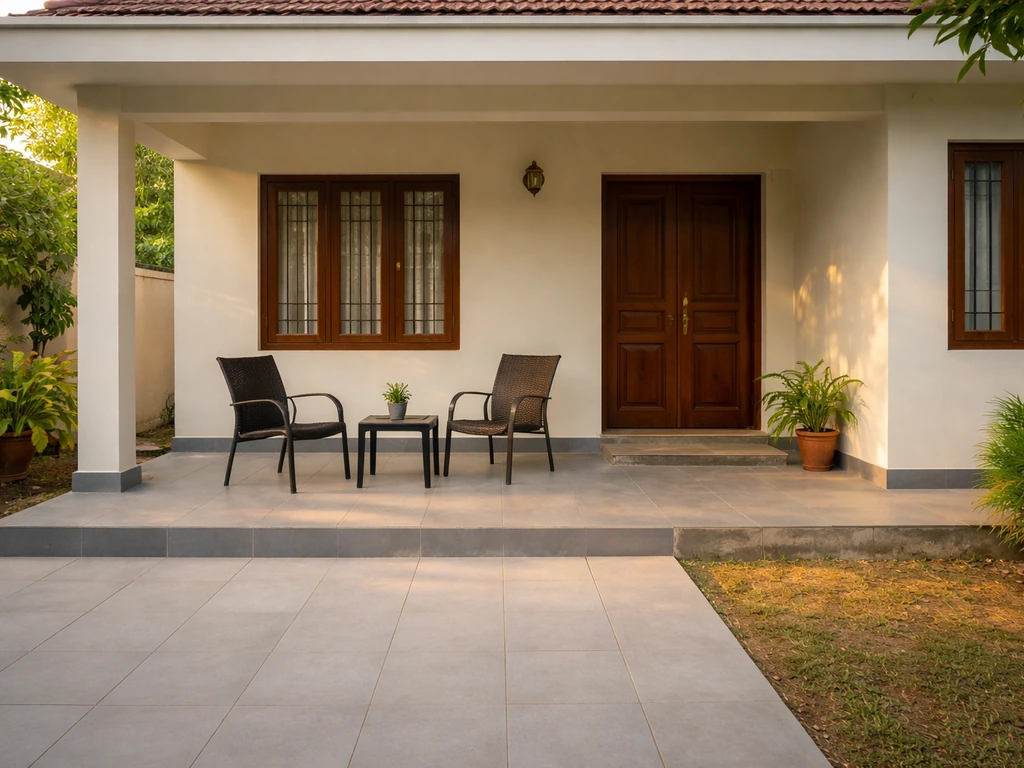
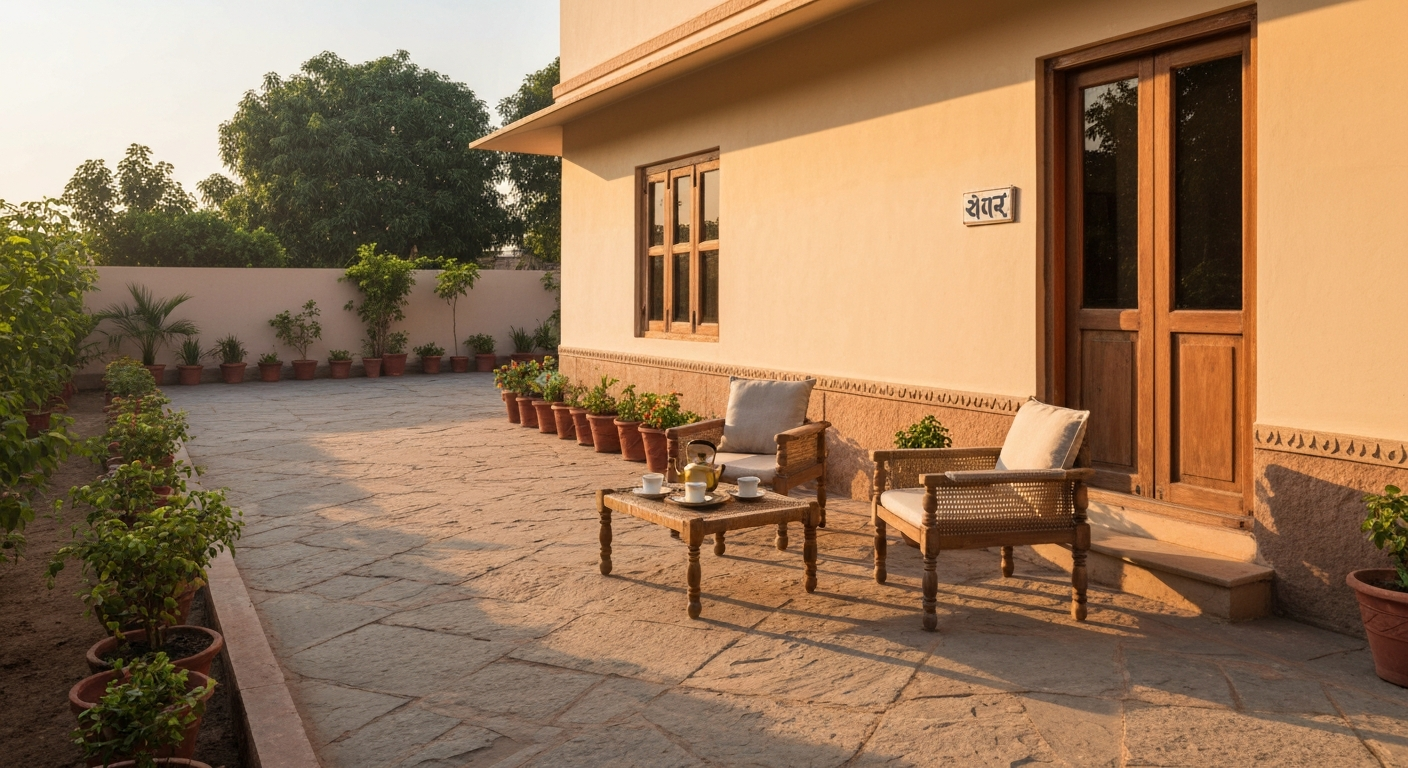
The most natural Gujarati word for patio is આંગણું (also written આંગણ), pronounced roughly 'AHN-guh-noo' (IPA: /ˈəŋ.ɡə.ɳũ/). It refers to the open courtyard or compound area adjoining a home, and it captures almost exactly what English speakers mean by a patio: a paved or open ground-level outdoor space used for relaxing, dining, and daily household activity.
Patio meaning in Gujarati: Guide for Homeowners & Buyers

Ada Hollis
20 Jul 2026
Gujarati definition: script, pronunciation, and example phrases
The word આંગણું is a native Gujarati noun inherited directly from Sanskrit (अङ्गन, aṅgana), which means 'an open space in front of or adjoining a house.' It is not a borrowed English word, which means it sounds natural in both everyday conversation and formal writing. You will see it in Gujarat Samachar features, regional TV content, and in poetry about home and family life. It carries warm, domestic associations rather than a purely architectural sense.
| Script | Romanization | Pronunciation guide | Literal meaning |
|---|---|---|---|
| આંગણું | āṅgaṇũ | AHN-guh-noo (nasalized final vowel) | Courtyard / open yard of a house |
| આંગણ | āṅgaṇ | AHN-gun | Courtyard / compound (shorter form, same meaning) |
Both forms are in active use. આંગણ is the slightly shorter, more literary form; આંગણું is the fully inflected everyday form you will hear in speech. Either is perfectly understood by a Gujarati speaker when you are pointing at an outdoor sitting area.
Example phrases in Gujarati with English translation
- આ ઘરનું આંગણું ખૂબ સુંદર છે. — This house's patio/courtyard is very beautiful.
- આપણે આંગણામાં બેસીને ચા પીએ. — Let's sit in the patio and have tea.
- આ ફ્લૅટમાં ખુલ્લું આંગણ છે. — This flat has an open patio area.
- આંગણ ઉપર ટાઇલ્સ નાખ્યા છે. — Tiles have been laid on the patio.
What a patio actually is: the plain-English definition
A patio is an outdoor area adjoining a house, typically at ground level, paved, and used for dining or recreation. That is the Merriam-Webster core definition, and it holds up well in practice. The three things that define a patio are: it sits at or close to grade (ground level), it is paved or hardscaped rather than planted, and it is directly connected to the home's living area, usually accessible from a back door, living room door, or kitchen.
- Ground level or at-grade: not raised or elevated like a balcony
- Paved or hardscaped: concrete, stone, pavers, tile, or similar material
- Adjacent to the building: directly connected, not a separate structure
- Unroofed or minimally covered: open to the sky, though a pergola or shade sail may be added
- Used for relaxing, dining, or gathering: a functional living-extension space
Patio vs porch vs balcony vs verandah vs courtyard
These five terms get mixed up constantly in property listings, conversations, and real-estate searches. The differences come down to three variables: height (is it at ground level or elevated?), roof (is it covered?), and enclosure (is it open on all sides or surrounded by walls?). Here is a clean breakdown.
| Space | Level | Roofed? | Enclosed? | Best Gujarati equivalent |
|---|---|---|---|---|
| Patio | Ground level | No (usually) | Open on multiple sides | આંગણું (āṅgaṇũ) |
| Porch | Ground level or slightly raised | Yes | Partly open, attached to entrance | ઓટલો (oṭalo) — front stoop/platform |
| Balcony | Above ground (upper floor) | No (usually) | Open front, railing on edge | બાલ્કની (bālkanī) — borrowed term |
| Verandah | Ground level or slightly raised | Yes (roofed) | Open sides, runs along building facade | વરંડો (varaṇḍo) |
| Courtyard | Ground level | No | Enclosed/surrounded by building walls | ચોક / ચોકડી (cok / cokḍī) |
The courtyard (ચોક) is the closest architectural relative of the patio in traditional Gujarati home design. The classic haveli layout, common across north Gujarat, centres on a ચોક: an open internal courtyard enclosed on all four sides. A patio in the Western sense tends to be at the rear or side of a house and is not enclosed, which is the key practical difference.
Common patio types and materials
Types of patios you will find in residential properties
- Attached patio: directly connected to the house, most common in bungalows and villas
- Detached patio: a paved area in the garden set away from the main structure
- Courtyard-style patio: enclosed on two or three sides by walls or fencing
- Rooftop patio: a terrace on a flat roof treated as an outdoor living space (common in Indian urban homes)
- Poolside patio: paved surround for a swimming pool, used for lounging
- Sit-out: the Indian real-estate term most commonly used in listings for a small attached patio or open seating area
Patio materials commonly used in India and Gujarat
- Kota stone (Rajasthan limestone): highly popular for outdoor sit-outs in India due to durability, slip resistance, and affordable cost
- Interlocking concrete pavers: widely available from Indian manufacturers, easy to replace individual pieces
- Precast paver blocks: common in garden paths, driveways, and patio areas
- Outdoor porcelain or vitrified tiles: popular for a polished look in urban villas and apartments
- Exposed aggregate concrete: poured concrete with a textured finish for good grip
- Sandstone and granite: premium options for upscale residential projects
For Gujarat specifically, Kota stone and vitrified outdoor tiles dominate because they handle both the intense pre-monsoon heat (April to May peaks) and the heavy southwest monsoon rainfall from June to September without cracking, staining badly, or becoming dangerously slippery.
Patio in other Indian and regional languages
If you are searching for equivalent meanings in other languages, the same Sanskrit root (aṅgana) turns up across multiple South Asian languages, though each language also has its own culturally distinct terms. For the Tamil equivalent and usage, see patio meaning in tamil. For the Malayalam equivalent and usage notes, see patio meaning malayalam. For readers exploring similar guides in other languages, here is a quick reference. For a Telugu equivalent and usage notes, see patio meaning in Telugu. For the Kannada equivalent and usage examples, see patio meaning in Kannada. For the Bengali equivalent, see patio meaning in Bengali.
| Language | Primary equivalent | Script | Cultural note |
|---|---|---|---|
| Bengali | আঙিনা / আঙ্গন (aangina / aangan) | Bengali script | Direct Sanskrit cognate of Gujarati āṅgaṇ; used for the domestic yard or courtyard in rural and urban Bengali homes alike |
| Kannada | ಅಂಗಣ (aṅgaṇa) | Kannada script | Same Sanskrit root; used for courtyard or open ground; also ಜಗಲಿ (jagali) for a front verandah platform |
| Tamil | தின்னை (thinnai) | Tamil script | Classic Tamil term for a shaded front sit-out or verandah platform; தாழ்வாரம் (thāzhvāram) is used for corridor/verandah spaces |
| Telugu | వాకిలి / అరుగు (vākili / arugu) | Telugu script | వాకిలి refers to the entrance area/forecourt; అరుగు is the raised platform sit-out common in traditional Telugu homes |
| Malayalam | മുറ്റം (muṭṭam) | Malayalam script | Muṭṭam specifically means the open courtyard or yard in front of or within a Kerala home, a central feature of traditional nalukettu house design |
| Tagalog | Bakuran / Patio | Latin script | Bakuran = yard/enclosed outdoor space; the English word patio is also used directly in Filipino real-estate listings and everyday speech |
The pattern across these languages is consistent: every South Asian language has a native word for an open outdoor space adjoining a home, and all of them map closely onto what English speakers call a patio or courtyard. The Tagalog context is slightly different because Filipino residential architecture and property listings borrow English terminology more freely, so 'patio' itself appears often in listings alongside the native bakuran. For the Tagalog term and translation, see patio meaning in Tagalog (bakuran).
How patios show up in property listings and what buyers should check
In Indian real-estate listings, including those on portals like NoBroker, you will rarely see the English word 'patio' used. For example, a NoBroker listing for Belmont Skyverse lists features such as 'sit-out area' and 'sitout' rather than using the word 'patio' blank" rel="noopener noreferrer">NoBroker — sample listing language showing ‘sit‑out area’ / sitout usage. Developers and agents use 'sit-out area', 'sitout', 'verandah', 'exclusive terrace', or simply 'open balcony' instead. If a Gujarati listing says 'ખુલ્લો ઓટલો' (open front platform) or 'આંગણ' in the description, that is the local equivalent of a patio feature.
The ownership angle matters here. Under RERA-style conveyance practices common in India, an attached outdoor space like a sit-out or exclusive terrace is often described as an 'exclusive use area' or 'restricted common area' in the agreement of sale. Haryana RERA project documents refer to 'sit‑out' and 'exclusive use' areas in project/conveyance text blank" rel="noopener noreferrer">Haryana RERA project documents refer to 'sit‑out' and 'exclusive use' areas in project/conveyance text.. This means the promoter grants you the right to use it exclusively, but the land beneath it may legally remain a common area until the final conveyance deed is registered. Always check whether the carpet area measurement in your agreement includes or excludes the sit-out, and verify whether it appears as an exclusive-use allotment or as a separate saleable area.
Key listing terms to look for
- Sit-out / sitout area: most common Indian English label for a small attached patio
- Exclusive open terrace: a rooftop or at-grade paved area assigned to one unit
- Verandah/veranda: a covered version; check whether it is roofed or open
- Private garden/lawn: indicates a ground-floor patio-style area with soft landscaping
- Carpet area vs built-up area: confirm whether the sit-out square footage is included in the carpet area you are paying for
Checklist for evaluating a patio at a viewing or from a listing
- Check the level: is the patio truly at grade, or does it step down from the main floor? Steps affect accessibility and drainage.
- Look at the paving material: stone, tile, and pavers each have different maintenance needs; check for cracks, uneven slabs, or signs of water pooling.
- Assess drainage: confirm that the surface slopes away from the building (approximately 1/4 inch per foot is the recommended minimum gradient) so monsoon water does not collect against the wall.
- Measure usable space: a patio under 10 sq ft is decorative at best; 50 sq ft or more is genuinely functional for seating.
- Note the sun orientation: a west-facing patio in Gujarat will be unusably hot from April to June in the afternoons.
- Check what is included in your title: ask whether the patio/sit-out is exclusive-use or common area under the sale agreement.
- Inspect the boundary: does the patio have a clear boundary wall, railing, or demarcation from a neighbour's or common area?
- Test the access door: the connecting door from living room or kitchen to patio should seal properly to prevent insects and monsoon water entry.
Basic maintenance for patios in Gujarat's climate
Gujarat's climate runs in two demanding phases for outdoor surfaces: a hot, dry summer peaking in April and May where temperatures regularly exceed 40°C, followed by a concentrated southwest monsoon from June to September that brings heavy rainfall and sustained humidity. Both phases stress patio surfaces in different ways, so maintenance needs to follow this seasonal rhythm.
Routine and seasonal tasks
- Pre-monsoon (April to May): inspect grout lines and sealant for cracks; re-apply a penetrating sealer to stone or paver surfaces only when they are fully dry and clean; clear channel drains and gullies of debris before the rains arrive
- During monsoon (June to September): check that surface water drains freely after heavy rain; remove standing water quickly to prevent staining on Kota stone or tiles; keep drains clear of leaves
- Post-monsoon (October to November): power-wash or scrub to remove algae, moss, and monsoon stains; allow the surface to dry fully before re-sealing
- Year-round: sweep regularly to prevent grit from scratching tile glazing; avoid acidic cleaners on Kota stone as they strip the surface finish
- Furniture care: use rust-resistant or powder-coated outdoor furniture; store cushions during monsoon to prevent mould
The single most important maintenance task for any patio in a monsoon-affected region is drainage. A slope of at least 1/4 inch per foot away from the building wall is what hardscape professionals recommend, and getting that gradient right during installation saves a significant amount of remediation work later.
Suggested image captions for patio photos
- An attached Kota-stone patio (આંગણ) adjoining a ground-floor villa in Ahmedabad
- Sit-out area with interlocking pavers and a shade pergola, typical of new Gujarat residential projects
- Traditional Gujarati ચોક (courtyard) in a heritage haveli, Vadodara — the ancestral equivalent of a modern patio
- Rooftop patio with vitrified outdoor tiles: an increasingly common feature in Gujarat apartment buildings
- A verandah (વરંડો) at the front of a bungalow — roofed and attached, distinct from an open patio
- Ground-level sit-out area showing positive drainage slope away from the building wall
Sample sentences to recognise, describe, and ask about a patio
These sentences are useful whether you are reading a Gujarati property description, talking to a real-estate agent, or checking the details of a listing. They cover the most common questions a buyer or renter actually needs to ask.
| Gujarati | English translation |
|---|---|
| આ ઘરમાં આંગણ છે? | Does this house have a patio/courtyard? |
| આ આંગણ એક્સ્ક્લૂઝિવ ઉપયોગ માટે છે કે સામાન્ય? | Is this patio for exclusive use or is it a common area? |
| આ સિટ-આઉટ એરિયા કારપેટ એરિયામાં ગણવામાં આવ્યો છે? | Is this sit-out area counted in the carpet area? |
| આ ટાઇલ્સ ભીની થઈ ગયા પછી સ્લિપ-રેઝિસ્ટન્ટ છે? | Are these tiles slip-resistant when wet? |
| The property has an exclusive sit-out area of approximately 60 sq ft. | મિલકતમાં આશરે ૬૦ ચોરસ ફૂટ એક્સ્ક્લૂઝિવ સિટ-આઉટ છે. |
| We'd like to use the patio for morning tea and evening dining. | અમે આ આંગણ સવારે ચા અને સાંજ ભોજન માટે ઉપયોગ કરવા ઇચ્છીએ છીએ. |
| Does the sale agreement specify the patio as exclusive-use land? | શું વેચાણ સ્ટ્ટ્ ( sale agreement) આ આંગણ/સિટ-આઉટ એક્સ્ક્લૂઝિવ-ઉપયોગ જમીન તરીકે નિર્દિષ્ટ કરે છે? |
Whether you are searching listings in Gujarati, discussing a property with a builder, or simply trying to understand what a feature in a sale agreement means, knowing that આંગણ is the natural local word for patio gives you a real advantage. It connects the Western architectural concept to a domestic term that every Gujarati speaker already understands, and it anchors the conversation in language that feels native rather than imported.
FAQ
What is the Gujarati word for “patio” and how do I pronounce it?
Common, natural Gujarati equivalents are આંગણ (āṅgaṇ) or આંગણું (āṅgaṇũ). Pronunciation (simple): āṅgaṇ / āṅgaṇũ ≈ “AHN-guh-n” / “AHN-guh-noo” (final vowel nasalized). IPA reference: /ˈəŋ.ɡə.ɳũ/.
How can I explain “patio” in plain Gujarati for homeowners or renters? (with short example phrases)
Plain Gujarati definition: આંગણું — ઘરનાં બાજુમાં જમીનમથક પરનું બાંધકામ કે પેવ્ડ બહારનું જગ્યા, જેણે બેસવા, ભોજન કરવા કે ઔટડોર આરામ માટે વપરાય છે. Short example phrases: - હમણાં અમારા ઘરની આગેવોલું આંગણું છે. (હમણાં āmārā ghar nī bājū āṅgaṇũ chē.) - રાતે ચા માટે આંગણામાં બેઠક રાખીએ. (rāte chā māṭe āṅgaṇāmāṁ bēṭhaka rākhīē.)
What is a clear, concise English definition of “patio” and its key features?
Plain English definition: A patio is an outdoor area at ground level adjoining a house, usually paved and used for dining, sitting, or recreation. Key features: - Ground‑level or at‑grade area adjacent to the building - Usually paved or hardscaped (stone, pavers, tiles) - Open to the sky (may have pergola/partial cover) - Used for dining, seating, entertaining, or relaxation - Typically drains away from the house
How does a patio differ from related outdoor spaces (porch, balcony, verandah, courtyard)? Provide a simple comparison.
Quick comparison (one‑line each): - Patio: ground‑level paved outdoor area next to the house, often used for dining/relaxing. - Porch: usually roofed and attached to the entry of a house (can be partly enclosed). - Verandah (veranda/varanda): a long, roofed platform along the outside of a house, commonly with posts/railings. - Balcony: raised platform projecting from an upper floor, not ground level. - Courtyard: an open area enclosed or surrounded on most sides by the building. Suggested short “table” view (text): "Feature — Patio | Porch | Balcony | Verandah | Courtyard; Level — Ground | Ground | Upper | Ground | Ground/inner; Roof? — Often open | Roofed | Open | Roofed | Usually open; Enclosure — Open | Often partly enclosed | Open | Open/covered | Surrounded by building."
What are common patio types and typical materials used in Gujarat/India?
Common patio types: - Paved sit‑out (flat paved area adjacent to living room) - Decked patio (wood or composite decking) - Stone courtyard/patio (natural stone slabs) - Terraced patio (raised/stepped patios for slope) Typical materials used in Gujarat/India: - Kota stone (durable local limestone) - Interlocking concrete pavers - Precast paver blocks - Outdoor porcelain or vitrified tiles - Concrete slab with finish - Timber or composite decking (for raised patios) Practical note: choose slip‑resistant finishes and materials that withstand hot sun and monsoon rain.
What short equivalent translations and cultural notes should I include for Bengali, Kannada, Tamil, Telugu, Malayalam and Tagalog readers?
Short equivalents (one‑word/short phrase) with a cultural note: - Bengali: আঙিনা / আঙ্গন (aangina/aangan) — courtyard/yard used for household activities. - Kannada: ಅಂಗಣ (aṅgaṇa) — courtyard or front open area. - Tamil: தின்னை (thinnai) or அங்கணம் (aṅgaṇam) — thinnai also means a shaded sit‑out/verandah traditionally used for sitting. - Telugu: ఆంగనం (āṅganam) — courtyard/yard; common family gathering space. - Malayalam: ആങ്ങണം (āṅgaṇam) /vtk variant ആंगलണം — courtyard; used in traditional homes. - Tagalog (Philippines): bakuran — yard/compound; veranda/porch often called beranda. Cultural note: South Asian languages typically use native words for a house courtyard/sit‑out (often multifunctional), so local listings more commonly mention sit‑out/verandah/āṅgaṇ rather than the English loan “patio.” Use these equivalents when searching local listings.
Next Article
Patio Meaning in Tamil: What It Is and How to Spot It
பட்டியோ என்றால் என்ன? வீட்டுடன் இணைந்த வெளி அமரும் அல்லது சாப்பிடும் பகுதியை தமிழில் தெரிந்து, மற்ற இடங்களிலிருந்து வேறுபடுத்துங்கள்.