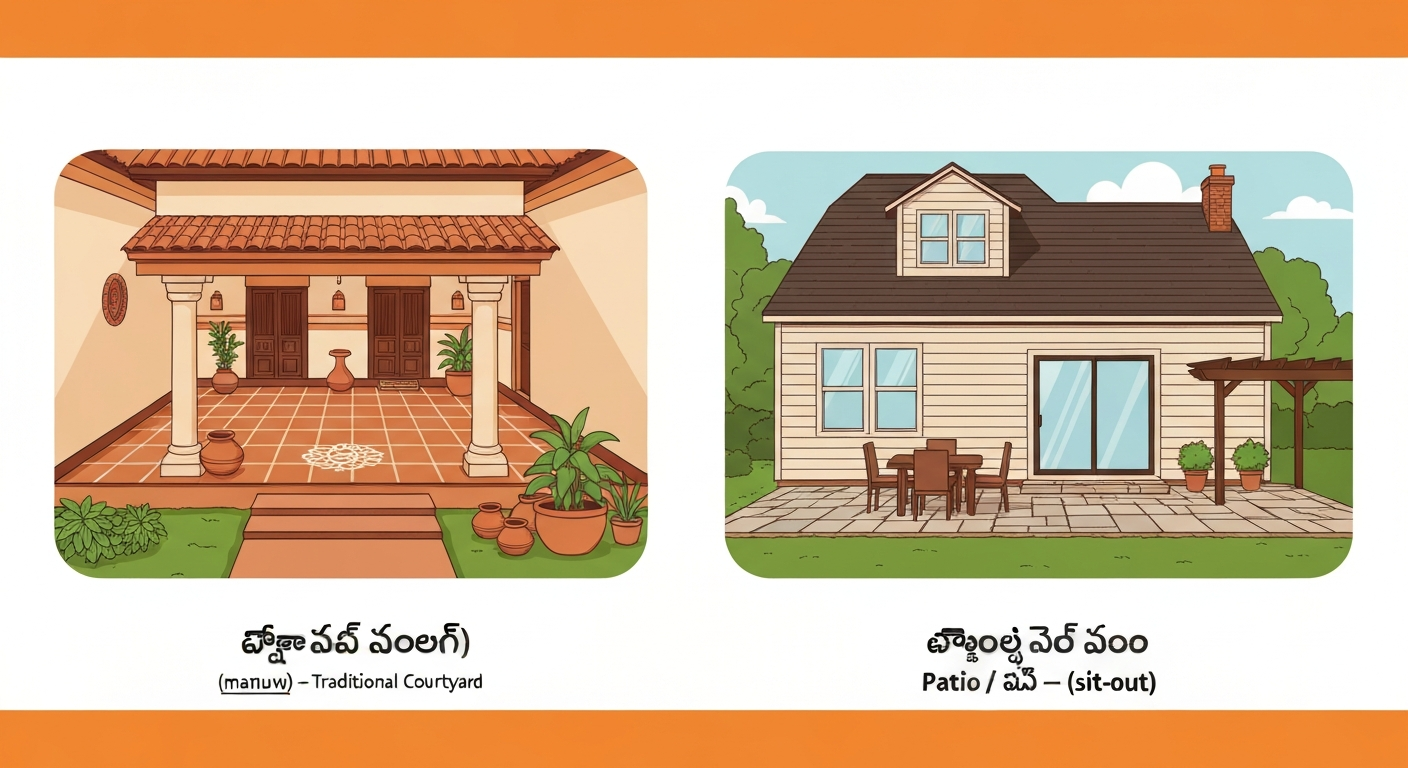
In Malayalam, 'patio' is most closely translated as നടുമുറ്റം (nadumuttam) or മുറ്റം (mutram). Jenson.in, Patio meaning in Malayalam lists 'patio' → നടുമുറ്റം (nadumuttam) / മുറ്റം (mutram) and defines patio as a paved outdoor area adjoining a house blank" rel="noopener noreferrer">Jenson.in — Patio meaning in Malayalam. Nadumuttam specifically means an inner courtyard or open central space within a house, while mutram refers more broadly to a yard or open area adjoining a home. Neither word is a perfect one-to-one match for the modern English 'patio,' but nadumuttam comes closest when the space is partially enclosed, and mutram works well for a simple open paved area at the front or back of the house.
Patio Meaning Malayalam: Definition, Pronunciation & Guide

Ada Hollis
27 Jul 2026
What a patio actually is
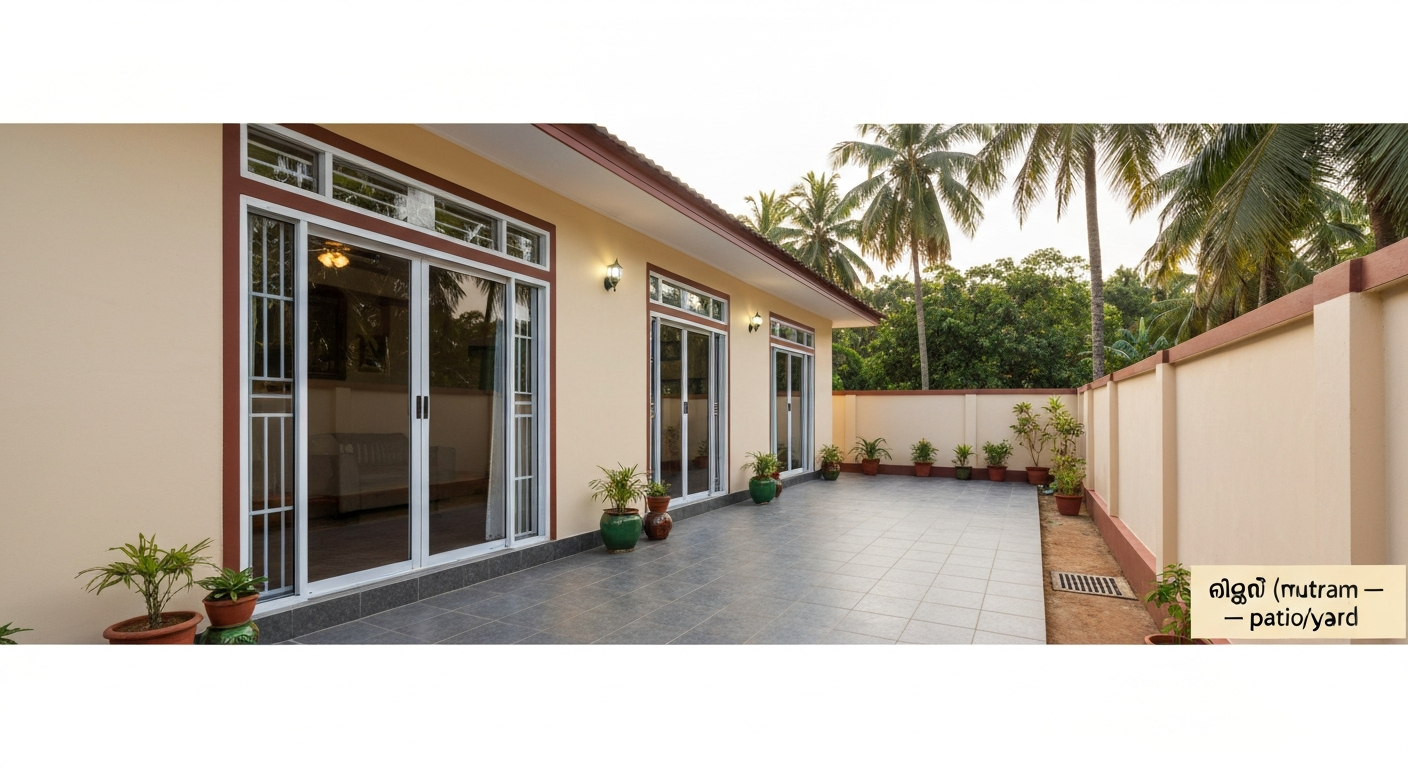
A patio is a ground-level outdoor area directly adjoining a house, paved with tiles, stone, concrete, or pavers, and used for sitting, dining, or relaxing. See Cambridge Dictionary, patio for the standard English definition: a paved outdoor area adjoining a residence, used for dining or recreation Cambridge Dictionary — patio. It has no roof by default (though a pergola or awning can be added), no railings, and sits flush with or just slightly above garden level. That last point matters: if the floor is elevated and has a railing, it is a balcony or terrace, not a patio. In Indian property listings, you will see 'patio' used for the paved area at the back or side of a ground-floor unit, often accessed directly through sliding doors or French doors from a living room or kitchen.
Malayalam equivalents, transliterations, and what they actually mean
There is no single Malayalam word coined exclusively for the Western-style patio, because the concept arrived in Kerala through modern architecture rather than through traditional building forms. Instead, Malayalam speakers borrow from existing vocabulary. Here are the terms you will encounter:
| Malayalam Script | Transliteration | Literal Meaning | How it maps to 'patio' |
|---|---|---|---|
| നടുമുറ്റം | nadumuttam | Inner courtyard / central open space | Best match when the patio is semi-enclosed or central to the structure |
| മുറ്റം | mutram | Yard / open ground area adjoining house | Used for a simple open front or back paved area |
| പേഷ്യോ | peshyo / paatio | Phonetic borrowing of 'patio' | Found in modern listings and lifestyle writing that simply borrow the English word |
| അങ്കണം | ankanam | Courtyard / open enclosure | Less common for patios; used more for formally enclosed courtyards |
In everyday Kerala speech, most people will call a rear paved outdoor space simply the mutram ('the yard') or describe it as the 'patio area' using the English term directly. Written property listings in Malayalam-language media will often switch to the English word 'patio' or write it in Malayalam script as പേഷ്യോ. If you are searching a property portal in Malayalam, try both mutram and nadumuttam alongside the phonetic borrowing.
How to pronounce these Malayalam terms
Malayalam pronunciation can feel tricky at first because the script has distinct letters for sounds that English blends together, but a few rules make it manageable. The double-t in nadumuttam and mutram is a retroflex stop: place the tip of your tongue against the roof of your mouth (further back than a normal English 't') and release it. The 'u' in both words sounds like the 'u' in 'put,' not the 'u' in 'but.'
- nadumuttam: NAH-du-MUTT-am (stress on the first and third syllables; the double-t is a retroflex, held briefly then released)
- mutram: MUTT-ram (one clean retroflex 't' sound; the 'r' is a light tap, not rolled)
- ankanam: AHN-kah-num (the first 'a' is open and long; the 'k' is unaspirated)
- varantha (verandah): vah-RAHN-tha (the 'th' is a dental stop, tongue touching the upper teeth, not the English 'th' as in 'the')
- baalkkani (balcony): BAAL-kah-nee (a near-phonetic borrowing from English; speakers usually keep it close to the English pronunciation)
If you are a non-Malayalam speaker asking a real estate agent or landlord about the patio, using the English word 'patio' or pointing to the space is perfectly fine and universally understood in urban and peri-urban Kerala. For rural areas or older homeowners, saying mutram will get the message across immediately.
How 'patio' appears in listings and everyday speech
On national property portals like MagicBricks, the English word 'patio' appears directly in photo captions ('open patio area,' 'side setback patio') even for properties in Kerala. Some developer project brochures list it under finish specifications: for example, 'Rear Deck (Patio), anti-skid vitrified tiles 600x600mm.' This means buyers searching in English will find patio-labelled photos on Indian portals; they do not need to know the Malayalam word to find the listing.
In everyday Malayalam conversation, you might hear sentences like these:
- "വീടിന്റെ പിന്നിൽ ഒരു നടുമുറ്റം ഉണ്ട്" (Veedinte pinnil oru nadumuttam undu) — 'There is a courtyard/patio at the back of the house'
- "മുറ്റത്ത് ടൈൽ ഇടണം" (Murattath tile idanam) — 'The yard/patio needs to be tiled'
- "പേഷ്യോ ഏരിയ വലുതാണ്" (Peshyo area valuthaanu) — 'The patio area is large' (mixing the borrowed English word with Malayalam grammar)
- "ഈ ഫ്ലാറ്റിൽ ഒരു ചെറിയ മുറ്റം ഉണ്ടോ?" (Ee flattil oru cheriya muttam undo?) — 'Does this flat have a small yard/patio?'
Patio vs porch, verandah, balcony, terrace, and courtyard
This is the comparison most people actually need, because these words get mixed up constantly in both English and Malayalam property descriptions. The key differences come down to three things: height (ground level vs. raised), enclosure (open sides vs. walls/railings), and roofing (covered vs. open sky). Here is the full breakdown:
| Space | Malayalam term(s) | Level | Roofed? | Key feature |
|---|---|---|---|---|
| Patio | നടുമുറ്റം / മുറ്റം (nadumuttam / mutram) | Ground level | Usually no (can add pergola/awning) | Paved; directly adjoins house; no railing |
| Porch | പോർച്ച് / തിണ്ണ (porchu / thinna) | Ground level | Yes — roofed structure | Covered entry area at the front of a house |
| Verandah | വരാന്ത (varantha) | Ground level | Yes — roofed gallery | Roofed open-sided gallery running along the house exterior |
| Balcony | ബാൽക്കണി (baalkkani) | Elevated / upper floor | Usually no | Projects from building wall; always has railing |
| Terrace | ടെറസ് / മട്ടുപ്പാവ് (terrace / mattuppaav) | Rooftop or raised | No | Flat open roof or raised platform, often on top of the building |
| Courtyard | നടുമുറ്റം / അങ്കണം (nadumuttam / ankanam) | Ground level | No (open to sky) | Enclosed or semi-enclosed by building walls on multiple sides |
Why the verandah matters in Kerala context
In Kerala, the verandah (varantha) is an integral part of traditional house design. It runs along the front or perimeter of the house under the overhang of the roof and is the space where family members sit in the evenings. A patio, by contrast, is a separately paved area that is not shaded by the main roof structure. If a Kerala listing says 'varantha,' expect a covered gallery. If it says 'mutram' or 'patio area,' expect an open paved space, likely at the rear or side.
The nadumuttam distinction
Nadumuttam literally means 'the courtyard in the middle' (nadu = middle, muttam = yard/open space). In a traditional Kerala nalukettu (the four-sided house built around a central courtyard), the nadumuttam is the open sky-lit center. Modern Malayalam speakers and some architects use nadumuttam loosely to describe any attached outdoor paved space, but purists use it only for an inner or semi-enclosed courtyard. If you are evaluating a listing that uses nadumuttam, check the photos carefully to see whether the space is truly enclosed by the house structure on multiple sides or simply an open rear patio.
Spotting a patio in photos and property listings
Listing photos can be misleading, especially when agents crop or angle shots to hide context. Here is what to look for:
- Floor level: the patio surface should be at or very near garden/ground level. If you can see a step down from the house, that is normal. Multiple steps or a drop suggests a terrace or lower garden level.
- No railings: a genuine patio has no perimeter railing. Visible railings mean you are looking at a balcony.
- No roof visible in the photo: if the image shows an overhang or ceiling above the seating area, the space is more likely a verandah or covered porch.
- Paved surface: look for tiles, concrete, stone pavers, or brick. A gravel or grass area is usually called a garden or yard, not a patio.
- Listing keywords to search: 'patio,' 'open patio area,' 'rear deck,' 'side setback patio,' 'patio area sq ft,' 'mutram,' 'nadumuttam.'
- Developer spec sheets: look for 'Rear Deck (Patio)' in the flooring finish schedule — this confirms a patio exists and tells you the tile type specified.
When evaluating photos, take the widest available shot first to understand the sightlines and privacy situation, then look at close-up shots for surface condition: cracks, water staining at the wall-to-floor junction, moss or algae growth, and visible drainage outlets. These details tell you a lot about maintenance history.
Features that affect how usable and appealing a patio really is
Not all patios are equal. These are the features that meaningfully change how much you will actually use the space and how much it adds to the property's value:
- Size: a patio under 6 sq m (roughly 65 sq ft) can fit two chairs and a small table — comfortable for one person, tight for entertaining. 10-15 sq m gives room for a four-person dining set plus a grill or planters.
- Covering: an open patio is unusable during heavy monsoon rain and uncomfortable in peak Kerala summer sun. A pergola, shade sail, or polycarbonate roof covering dramatically extends usability.
- Flooring material: anti-skid tiles are the safest choice in Kerala's wet climate. Smooth ceramic tiles become dangerously slippery when wet. Natural stone looks beautiful but needs sealing annually to prevent moss in humid conditions.
- Drainage: the patio surface must slope slightly away from the house wall (a gradient of at least 1:100, so 1 cm drop per 1 metre of run) and drain into a gully or channel. Poor drainage causes water pooling, wall damp, and mosquito breeding.
- Privacy: check boundary wall height, proximity to neighbouring windows, and whether the patio is visible from a public road. A low boundary combined with a ground-floor patio can make the space uncomfortable to use.
- Orientation: in Kerala, a west-facing patio gets intense afternoon sun from March to October. An east-facing patio catches the morning sun and stays relatively comfortable in the evenings. South-facing patios get good light year-round.
Questions to ask before you buy or rent
Bring this checklist to your viewing or send it to the agent before you visit. It covers the things that are easy to overlook when you are excited about a property but that cause real headaches once you move in.
- Does the patio drain away from the house, and where does the water go? Ask to see the drain outlet or gully.
- Is the patio surface anti-skid or smooth? If smooth, ask when it was last cleaned and whether there is any moss or algae accumulation.
- Who owns the patio area? In apartment complexes, confirm whether it is exclusive use (deeded to the flat) or common area (shared or controlled by the housing society).
- Are there any restrictions on what you can do with the patio — structures, enclosures, shade sails, outdoor kitchens? Check the society bylaws or lease agreement.
- Is there an existing pergola, awning, or covering? If so, what material is it (polycarbonate, fabric, metal), and what condition is it in?
- Has there been any water ingress into the adjoining interior room from the patio? Look for water staining on the interior wall directly behind the patio door.
- What is the patio's approximate square footage, and is it included in the stated property square footage or listed separately?
- Is there a tap or water point on or near the patio for cleaning and watering plants?
- How much sun does the patio get in summer afternoons, and is there existing shade?
Common patio types and quick upgrade ideas
Patios come in several configurations in Indian residential properties, and knowing the type helps you judge the photos faster and plan any improvements.
| Patio type | Description | Common in Kerala/India | Quick upgrade idea |
|---|---|---|---|
| Open rear patio | Paved area at the back of the house, fully open to sky | Very common in villas and row houses | Add a polycarbonate pergola and anti-skid tile overlay |
| Covered verandah-style patio | Paved area with a structural roof overhang attached to the house | Traditional Kerala homes | Install ceiling fans and outdoor lights for evening use |
| Side setback patio | Narrow paved strip along the side of the house within the plot setback | Common where rear space is limited | Add vertical garden panels to improve privacy and aesthetics |
| Inner courtyard (nadumuttam) | Open-sky space enclosed by the house structure on multiple sides | Traditional nalukettu and some modern villas | Add drainage channels and a glass/polycarbonate partial roof for rain protection |
| Apartment ground-floor patio | Exclusive-use paved area assigned to a ground-floor flat | Modern apartment complexes | Define the boundary with planter boxes and add low-voltage garden lighting |
If your patio needs work but your budget is limited, the two highest-impact changes are almost always drainage (if it is currently pooling water) and shade (if it is currently unusable in sun or rain). Everything else, including furniture, lighting, and landscaping, is secondary to getting those two basics right in Kerala's climate.
Maintenance habits that keep a patio in good shape
Kerala's high humidity and monsoon rainfall mean patio surfaces need more consistent care than in drier climates. A few regular habits prevent most of the common problems:
- Brush or jet-wash the surface every three to four weeks during the monsoon to prevent algae and moss from building up and making tiles slippery.
- Clear the drain outlet before the monsoon season begins, typically in May. A blocked gully is the single most common cause of water pooling and wall damp.
- Check the tile grout annually. Cracked or missing grout allows water to penetrate underneath tiles, causing them to lift over time. Re-grout with a waterproof grout product.
- Seal natural stone surfaces (granite, sandstone, slate) before the monsoon each year. Unsealed stone in Kerala's climate will develop moss and staining within one season.
- Inspect the wall-to-floor junction at least once a year. This is where water damage almost always starts. If you see any white salt deposits (efflorescence) or paint bubbling, trace the source before it worsens.
Searching in other Indian and regional languages
If you are researching patios across multiple language contexts or helping a multilingual household with a property search, the same definitional question ('what is a patio?') comes up frequently in other South Asian and Southeast Asian languages. Tamil speakers searching for patio meaning in Tamil will encounter similar courtyard vocabulary rooted in Dravidian architectural tradition, just as Telugu speakers searching for patio meaning in Telugu will find overlapping courtyard concepts adapted from local architectural terms. Kannada, Bengali, and Gujarati all have parallel sets of words for yards and courtyards that property listings map 'patio' onto in different ways. For Kannada-specific equivalents and transliterations, see patio meaning in Kannada. For patio meaning in Gujarati, see the guide on patio meaning in Gujarati. Tagalog-speaking communities searching for patio meaning in Tagalog work with a slightly different framework since Filipino architecture has its own set of terms influenced by Spanish colonial building vocabulary. For the patio meaning in Tagalog, Filipino terms influenced by Spanish (for example, patio or balcón) generally map to courtyard- and veranda-like outdoor spaces. Each of these language contexts has its own specific transliterations and usage patterns that are worth exploring if Malayalam is not the primary language of your property search. If you also need the patio meaning in Telugu, check the corresponding Telugu terms for yard, courtyard, and paved outdoor areas. For Bengali equivalents and common transliterations, see patio meaning in Bengali.
FAQ
Title and meta description for an article about 'patio meaning Malayalam'
Title: Patio Meaning in Malayalam — Definition, Transliteration & Usage Meta description (≤160 chars): Clear definition of 'patio' in Malayalam (നടുമുറ്റം / മുറ്റം) with pronunciation, examples, comparisons and buyer/renter tips.
Plain English definition of 'patio'
A patio is a paved or hard‑surfaced outdoor area at ground level that adjoins a house or apartment, used for sitting, dining or recreation. It is usually open to the sky but can be partly covered.
Malayalam equivalents, transliterations, pronunciation and short usage examples
Common Malayalam equivalents: 1) നടുമുറ്റം — transliteration: nadumuttam — pronunciation guide: nah‑doo‑mut‑tum. Usage: "ഈ വീടിന് മുന്നില് ഒരു നടുമുറ്റം ഉണ്ട്" (Ee veedhin munpil oru nadumuttam undu) — "This house has a patio in front." 2) മുറ്റം — transliteration: mutram — pronunciation guide: moot‑rum. Usage: "തറവാട്ടില് മുറ്റത്തിലേക്ക് അടുത്തു നിൽക്കാം" (Tharavaattil mutrathilekku aduthu nilkaam) — "Step out to the patio in the ancestral home." Note: Modern listings often use the English word 'patio' (പാറ്റിയോ / patio) or describe 'open paved area' (പൊതു അടിഞ്ച്/പവിളി) in Malayalam-English mixed captions.
How 'patio' differs from porch, verandah, balcony, terrace and courtyard (simple comparative summary)
Patio: ground‑level paved area adjoining a house, usually open. Porch: small roofed structure at an entrance, often with steps and a ceiling. Verandah (വരാന്ത / varantha): a long, roofed open gallery attached along a wall, common in Indian homes. Balcony (ബാൽക്കണി / baalkkani): raised projecting platform above ground level with railing. Terrace: a flat open roof or raised paved area (roof terrace or building‑level). Courtyard (അങ്കണം / nadumuttam): enclosed open space surrounded by building walls; a traditional inner courtyard is also called nadumuttam. Quick table: - Level: patio = ground; porch/verandah = ground (roofed); balcony = above ground; terrace = roof/raised; courtyard = enclosed. - Roof: patio usually open; porch/verandah roofed; balcony sometimes roofed; terrace open or partly covered; courtyard may be open to sky.
How patios may be labeled or shown in listings and photos (what to look for)
Look for listing words: 'patio', 'open patio area', 'rear deck', 'side setback patio', 'nadumuttam' or 'മുറ്റം' in Malayalam listings. In photos, identify: ground level surface adjoining the back/side/front of a house, paving/tiles or concrete, outdoor furniture, visible drainage gulley, absence of a raised railing (if ground level). Captions on Indian portals often keep the English word 'patio' even in mixed language ads.
Questions buyers/renters should ask about a patio
Ask: Is the patio ground‑level or raised? Is it paved (tiles/pavers/concrete) or soil/grass? Is there a slope/drainage outlet and visible gully? Is any cover (pergola/awning/verandah) present or possible? How private is the patio (walls/fencing)? Are there restrictions on use (HOA/maintenance)? Have there been water ingress or damp stains on adjoining walls?
Next Article
Patio Meaning in Telugu: Definition, Translation & Guide
Patio meaning in Telugu: clear definition, Telugu translation, pronunciation, examples, types, care & listing tips.