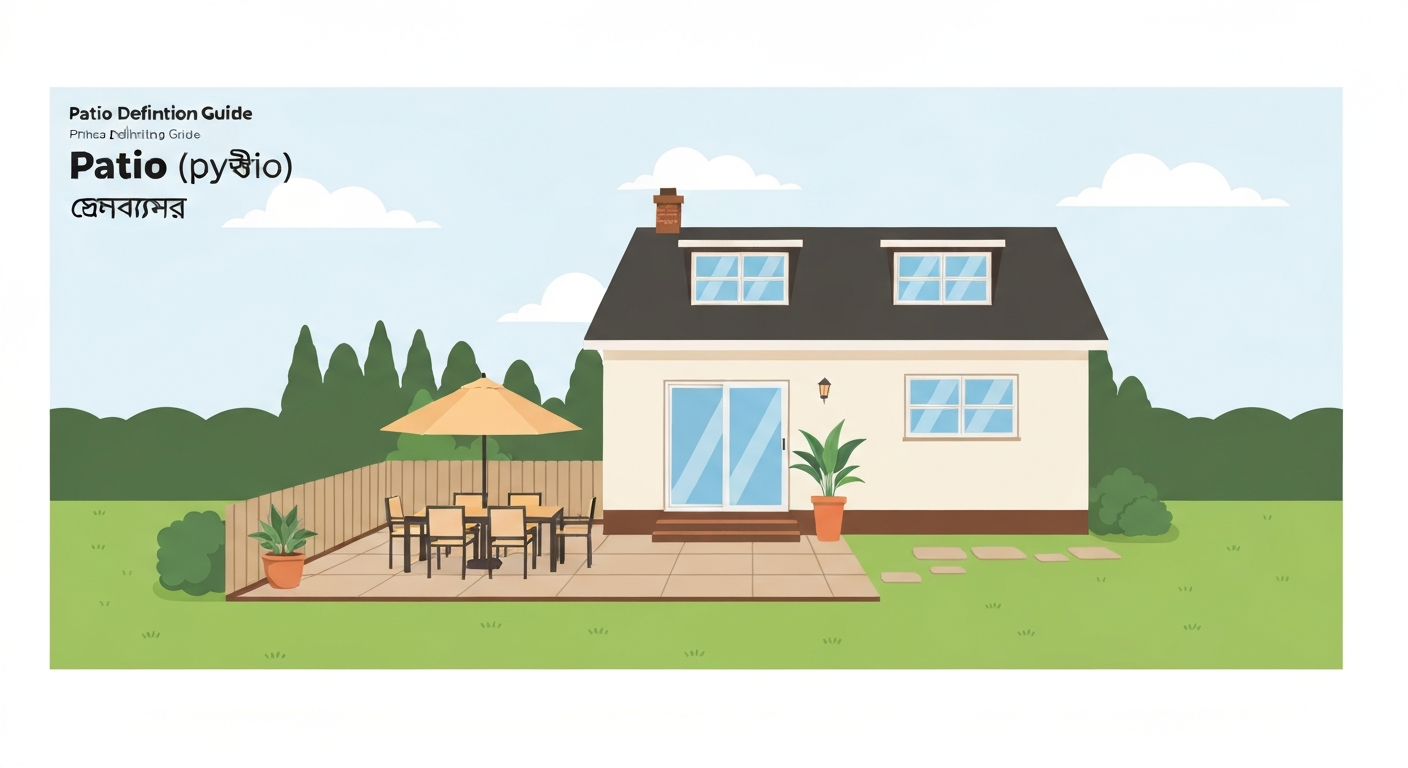
The Kannada word for patio is ಅಂಗಳ (transliterated as aṅgaḷa, pronounced roughly as 'ung-guh-luh'). It refers to an open or paved outdoor area directly adjoining a house, and it carries the broader sense of a yard, courtyard, or forecourt in everyday Kannada usage. If you have seen 'patio' on a property listing and wondered what it means in Kannada, ಅಂಗಳ is the word you are looking for.
Patio Meaning in Kannada: Translation, Pronunciation & Tips

Ada Hollis
8 Aug 2026
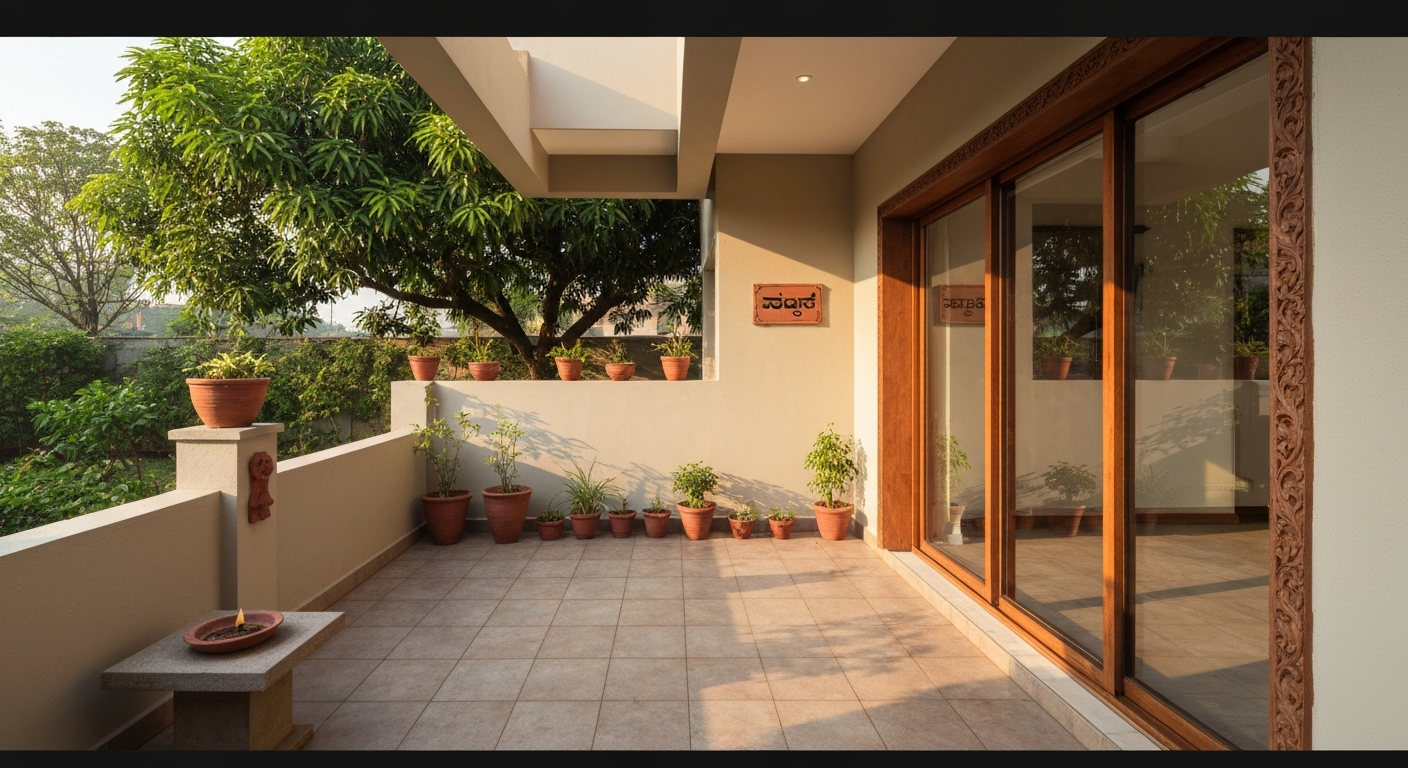
What this article covers
This article is written for homeowners, renters, real-estate shoppers, and language learners who want to understand the Kannada meaning of 'patio' quickly and accurately. Alongside the Kannada translation, you will find the script, transliteration, IPA pronunciation, and example sentences. The article also provides quick translations into six other Indian and regional languages, a comparison of patios with porches, balconies, verandahs, and courtyards, a rundown of common patio types, and practical tips for reading property listings that mention patios. If you need the Malayalam equivalent and usage, see our article on patio meaning Malayalam for translation, pronunciation, and examples.
Kannada translation, script, transliteration, and pronunciation
The single-word Kannada equivalent of 'patio' is ಅಂಗಳ. Shabdkosh, ಅಂಗಳ (supporting usage senses) documents ಅಂಗಳ as the Kannada single‑word equivalent of 'patio' with usage notes and a brief gloss blank" rel="noopener noreferrer">Shabdkosh — ಅಂಗಳ (supporting usage senses). In formal ISO 15919 transliteration it is written as aṅgaḷa. Refer to the blank" rel="noopener noreferrer">ISO 15919 table for Kannada (Transliteration of Kannada (ISO 15919 table PDF)) for the standard romanization forms such as ಅ -> a, ಙ -> ṅ, ಳ -> ḷ. The ṅ represents the velar nasal sound (similar to the 'ng' in 'sing'), and the ḷ is a retroflex lateral, a sound produced with the tongue curled slightly back. For a practical English-speaker approximation, say 'ung-guh-luh' with the stress on the first syllable.
| Feature | Detail |
|---|---|
| Kannada script | ಅಂಗಳ |
| ISO 15919 transliteration | aṅgaḷa |
| Reader-friendly romanization | angala |
| IPA pronunciation | /aŋɡaɭa/ |
| Approximate English sound | 'ung-guh-luh' |
| Core meaning | yard, courtyard, paved outdoor area adjoining a house |
| Related forms | ಅಂಗಣ (aṅgaṇa), ಅಂಗುಳು (aṅguḷu) |
Classical Kannada lexica including the Amarakosha tradition and the Kittel corpus list ಅಂಗಳ with the senses 'yard, court, verandah.' The related form ಅಂಗಣ shares the same Sanskrit-Prakrit root (aṅgaṇa, meaning an open space or courtyard), which is why this family of words appears in many South Asian languages with similar meanings. A slightly fuller descriptive gloss in Kannada is: ಮನೆಗೆ ಅಂಟಿರುವ, ಸಾಮಾನ್ಯವಾಗಿ ಕಲ್ಲು ಅಥವಾ ಟೈಲ್ಗಳಿಂದ ಮಾಡಿದ ಹೊರಾಂಗಣ, meaning 'an outdoor area attached to a house, usually made of stone or tiles.'
Example sentences in Kannada
Seeing a word in context is the fastest way to lock in its meaning. The sentences below show how ಅಂಗಳ is used naturally in everyday Kannada, along with transliteration and an English translation for each.
| Kannada sentence | Transliteration | English translation |
|---|---|---|
| ನಮ್ಮ ಮನೆಯ ಅಂಗಳದಲ್ಲಿ ನಾವು ಸಂಜೆ ಕಾಫಿ ಕುಡಿಯುತ್ತೇವೆ. | Namma maneya aṅgaḷadalli nāvu saṃje kāphi kuḍiyuttēve. | We drink evening coffee in our home's patio/courtyard. |
| ಅಂಗಳದಲ್ಲಿ ಒಂದು ದೊಡ್ಡ ಮಾವಿನ ಮರ ಇದೆ. | Aṅgaḷadalli ondu doḍḍa māvina mara ide. | There is a large mango tree in the patio/yard. |
| ಈ ಮನೆಯ ಅಂಗಳ ಮಾಳ ಮತ್ತು ಟೈಲ್ಗಳಿಂದ ನಿರ್ಮಿಸಲಾಗಿದೆ. | Ī maneya aṅgaḷa māḷa mattu ṭailgaḷinda nirmisalāgide. | This house's patio is built with tiles and paving stones. |
| ಹೊಸ ಮನೆಯಲ್ಲಿ ವಿಶಾಲವಾದ ಅಂಗಳ ಇದ್ದರೆ ಒಳ್ಳೆಯದು. | Hosa maneyalli viśālavāda aṅgaḷa iddare oḷḷeyadu. | It would be nice to have a spacious patio in a new house. |
Quick translations: patio in six other languages
If you are researching patio terminology across South and Southeast Asian languages, the translations below give you a fast reference. See patio meaning in Gujarati for the Gujarati word, script, pronunciation, and usage. For the Bengali equivalent and usage examples, see patio meaning in Bengali. All of these words share a common Sanskrit-Prakrit ancestry (the root aṅgaṇa), which is why they look and sound remarkably similar to each other and to the Kannada ಅಂಗಳ. Tagalog is the exception, drawing on a different linguistic tradition. For the Tagalog equivalent and usage details, see our article on patio meaning in Tagalog.
| Language | Script | Transliteration | Approximate meaning |
|---|---|---|---|
| Bengali | আঙিনা / আঙন | āṅginā / āṅon | yard, courtyard, open area adjoining a house |
| Gujarati | આંગણું / આંગણ | āṅgaṇuṁ / āṅgaṇ | courtyard, yard, open space attached to a house |
| Tagalog | patio / bakuran | patio / bakuran | patio (loanword); yard or enclosed outdoor space |
| Tamil | ஆங்கணம் | āṅkaṇam | courtyard, open area, paved yard |
| Telugu | ఆంగణం | āṅgaṇaṁ | courtyard, outdoor living area adjoining a house |
| Malayalam | അങ്കണം | aṅkaṇaṁ | courtyard, open yard, outdoor space near a house |
Each of these languages has its own article on this site if you need fuller explanations, example sentences, and pronunciation guides specific to that language.
Patio vs. porch, balcony, verandah, and courtyard
These terms often get used interchangeably in conversation and property listings, but they describe genuinely different things. Knowing the distinctions saves confusion when you are reading a spec sheet or describing a space to a contractor.
| Outdoor space | Location | Level | Roof | Typical surface | Kannada equivalent |
|---|---|---|---|---|---|
| Patio | Ground level, adjoining the house | Ground | Usually open (sometimes pergola or shade cover) | Paving stones, tiles, concrete, gravel | ಅಂಗಳ (aṅgaḷa) |
| Porch | Front or back of house, attached to entrance | Ground or slightly raised | Usually roofed | Wood, concrete, tile | ಮುಂಜಾವಣಿ / ವರಾಂಡ |
| Balcony | Upper floors, projecting from the building wall | Elevated (first floor or above) | Open or partially covered | Concrete, tile | ಬಾಲ್ಕನಿ (balkaṇi) |
| Verandah | Attached to the front or side of the house | Ground level, slightly raised | Roofed (part of the main roof) | Tile, concrete, wood | ಜಗುಲಿ (jaguli) |
| Courtyard | Enclosed outdoor space within or between buildings | Ground | Open to sky | Stone, earth, paving | ಅಂಗಳ / ಒಳ ಅಂಗಳ (oḷa aṅgaḷa) |
The key distinction for a patio is that it sits at ground level, is directly accessible from inside the house (usually through a rear or side door), and is typically paved or surfaced rather than bare earth. A verandah is covered by the home's roof extension and is more of a transitional indoor-outdoor zone; a patio is more open and dedicated to outdoor living. Courtyards are enclosed by walls or buildings on multiple sides, while a patio is usually open on at least one edge. In Kannada-speaking regions, ಅಂಗಳ can loosely refer to both a patio and a courtyard, so context and the physical layout of the property matter.
Common patio types and features
Patios come in a wide range of configurations, and the type matters both for how you use the space and what it costs to build or maintain. Here is a practical breakdown of the most common types you will see in listings and architectural plans.
Attached vs. detached
An attached patio shares at least one edge with the house wall and is accessed directly through a door, typically a sliding glass door, French door, or rear access door. A detached patio is freestanding in the garden or yard, separated from the house structure. Attached patios are more convenient for daily use and tend to add more to a property's perceived value; detached patios offer more design freedom and are easier to retrofit in an established garden.
Surface materials
- Paved (concrete slabs, natural stone, or brick): durable and low-maintenance, the most common type globally
- Decked (timber or composite decking): warmer underfoot, popular in temperate climates, requires periodic sealing or oiling
- Tiled (ceramic, porcelain, or natural stone tiles): aesthetically versatile, widely used in South Asian homes
- Gravel or crushed stone: affordable and well-draining, informal in appearance
- Exposed aggregate concrete: a mix of durability and texture, common in newer Indian residential projects
Covered vs. open
An open patio has no overhead cover and is fully exposed to the sky. A covered patio has some form of overhead shelter, ranging from a simple shade sail or pergola to a fully roofed extension. In hot and humid climates like much of Karnataka, a covered patio (sometimes called a 'covered sit-out' in Indian listings) is far more practical for daily use through the summer and monsoon months. A fully enclosed patio with glass panels on the sides blurs the line between indoor and outdoor living and is sometimes called a sunroom or garden room.
How to spot a patio in a property listing
Indian property listings, including those on platforms like 99acres and MagicBricks, do not always use the word 'patio' consistently. Developers use a range of terms to describe what is functionally the same space. Knowing the synonyms helps you understand exactly what a property offers before you visit.
Look for these terms in listing copy and specification sheets, as they typically indicate a patio or patio-equivalent space:
- Patio (the English loanword, used directly in premium and urban listings)
- Sit-out or sitout (very common in South Indian listings, especially in Karnataka, Tamil Nadu, and Kerala)
- Private courtyard (used for ground-floor apartments and independent houses)
- Terrace garden (sometimes indicates a ground-level paved area rather than a rooftop)
- Verandah or varandah (can indicate either a covered patio or a traditional verandah; check the floor plan)
- Utility/service courtyard (a functional rear paved area, common in apartment blocks)
- Deck or decked area (timber-surfaced patio, more common in premium projects)
- ಅಂಗಳ (the Kannada term, occasionally used in local-language listings in Bengaluru and other Karnataka cities)
When you see 'patio' listed as a separate line item in a specification sheet, it usually means a distinct paved outdoor area exclusive to that unit (not shared), accessible from the living room or bedroom, and at ground level. This is particularly valuable for ground-floor apartment buyers who want private outdoor space without a full garden to maintain.
Why the patio distinction matters for buyers, renters, and homeowners
Whether you are buying, renting, or renovating, understanding what kind of outdoor space a property has affects your decision in practical ways. A patio adds usable living area that does not appear in the carpet area calculation, which means the value it adds is not always reflected in the headline square footage. Premium ground-floor apartments in Bengaluru, Mysuru, and other Karnataka cities increasingly advertise private patios as a key selling point, often pricing those units 8 to 15 percent higher than equivalent upper-floor units without outdoor space.
For renters, a patio changes how you use the home daily. It is outdoor space you can furnish, plant pots on, or use for morning yoga, without the upkeep of a full garden. For homeowners, maintenance is a real consideration: a tiled patio needs annual grout sealing and cleaning, a decked patio needs periodic oiling or replacement of boards, and an open paved patio in a rainy climate like coastal Karnataka will need good drainage planning to prevent water pooling.
In real-estate negotiations, being clear about whether an outdoor space is a patio, a verandah, or a balcony also affects how it is legally described in the sale deed. Only some outdoor areas are included in the super built-up area calculation. Always ask your developer or seller to clarify the exact designation in the documents.
Patios in Kannada-speaking regions: what to expect
Traditional Karnataka domestic architecture does not use the word 'patio,' but the concept has always existed under a different name. The ಅಂಗಳ in a traditional Karnataka home is typically a central open courtyard (similar to the Tamil Nadu thinnai or the Haveli's chowk), often with a tulasi katte (a raised plinth for the holy basil plant) at its centre. In older homes, especially in North Karnataka's vernacular style and in Coorgi (Kodagu) architecture, the ಅಂಗಳ is an integral part of the floor plan rather than a design add-on.
In contemporary urban Karnataka, particularly in Bengaluru's apartment developments, the patio concept has been adapted into what developers call a 'private sit-out' or 'garden terrace' for ground-floor units. These are typically 60 to 150 square feet of tiled or paved space behind or beside the unit, sometimes with a low boundary wall or planters. High-end villa projects in areas like Sarjapur Road, Whitefield, and North Bengaluru frequently feature larger patios with landscape design, pergolas, and outdoor seating areas that closely match what you would call a patio in the Western sense.
In the architectural context, patios function as microclimates in hot climates. Shaded and paved outdoor areas help moderate the temperature around a building by reducing direct solar radiation on walls, a principle used by Arup and other firms in designing low-energy buildings across South Asia. This is a practical reason why the traditional Karnataka ಅಂಗಳ (internal courtyard) was not just cultural but environmentally intelligent design.
If you are comparing this with patio terminology in neighbouring states, the Tamil equivalent ஆங்கணம் (āṅkaṇam) and the Telugu ఆంగణం (āṅgaṇaṁ) are near-cognates of the Kannada ಅಂಗಳ, all tracing back to the Sanskrit aṅgaṇa. For more detail, see the article on patio meaning in Tamil. The concept and the word are part of a shared pan-South-Asian architectural tradition, not a Western import. For a Telugu-specific explanation and examples, see the article on patio meaning in Telugu.
Frequently asked questions
Is ಅಂಗಳ the only Kannada word for patio?
ಅಂಗಳ is the closest single-word equivalent and the most widely understood. Related forms include ಅಂಗಣ (aṅgaṇa, slightly more formal or classical) and ಅಂಗುಳು (aṅguḷu, found in older texts). In everyday spoken Kannada in urban settings, many speakers simply use the English word 'patio' or the phrase 'sit-out' directly. In Bengaluru real-estate contexts, 'ಅಂಗಳ' is understood but 'sit-out' or 'patio' are more commonly written in listing documents.
Does ಅಂಗಳ mean the same thing as a courtyard?
It can, and that is where the overlap gets interesting. In traditional Karnataka homes, the ಅಂಗಳ is often a central or front courtyard enclosed on multiple sides by the house structure, which is closer to the architectural definition of a courtyard than a patio. In modern usage, when people say ಅಂಗಳ for a contemporary house, they usually mean an open or semi-open paved area on the ground level near the entrance or rear of the house, which is functionally a patio. The context, and the floor plan, tell you which one it is.
Where does the English word 'patio' come from?
The English word 'patio' comes directly from Spanish, where it means an inner courtyard or open area attached to a house. It entered English largely through the influence of Spanish colonial architecture in the Americas and the Mediterranean-inspired design trends of the 20th century. The Oxford Advanced Learner's Dictionary defines it as 'a paved outdoor area adjoining a house,' which is the standard definition used in most English-language property contexts globally.
Is a patio the same as a terrace in Indian property listings?
No, though the terms are sometimes used loosely. In Indian listings, a terrace usually refers to a flat rooftop area accessible from an upper floor. A patio is a ground-level outdoor space directly adjoining the main living area. Some developers use 'terrace garden' to describe a ground-level paved area with planting, which is functionally a patio. Always check the floor plan or ask the developer to clarify the level and access point.
How is the Kannada word ಅಂಗಳ pronounced by native speakers?
Native Kannada speakers pronounce ಅಂಗಳ as roughly 'ung-guh-luh,' with a short open 'a' sound at the start, a velar nasal before the 'g' (like the 'ng' in 'singing'), and a retroflex 'l' at the end that sounds slightly different from the English 'l' (the tongue tip curls back toward the palate). The IPA representation is /aŋɡaɭa/. If you are not a native Kannada speaker, 'ung-guh-luh' is close enough to be understood clearly.
Can I use the word 'patio' in a Kannada sentence directly?
Yes, and many urban Kannada speakers do exactly this. English loanwords are common in Bengaluru Kannada in particular. Saying 'ನಮ್ಮ ಮನೆಯ patio ತುಂಬಾ ದೊಡ್ಡದಾಗಿದೆ' (namma maneya patio tumba doḍḍadāgide, meaning 'our house's patio is very large') is entirely natural in modern conversational Kannada, just as using 'balcony,' 'kitchen,' or 'bedroom' in Kannada sentences is standard practice.
FAQ
What is the Kannada meaning of the English word "patio" in a reader‑friendly line?
Kannada equivalent: ಅಂಗಳ (aṅgaḷa). Reader‑friendly gloss in Kannada: ಮನೆಯನ್ನು ಅಡ್ಡಗೈಿದ್ದಕ್ಕೆ ಅಥವಾ ಮನೆಯ ಎದುರಿನಲ್ಲಿ/ಅಕ್ಕದಲ್ಲಿ ಇರುವ ಸಾಮಾನ್ಯವಾಗಿ ಪೈವ್ಡ್/ಮೈದಾನದ ಹೊರಾಂಗಣ (ಮಾಟ/ಕಲ್ಲು/ಟೈಲ್ ಇತ್ಯಾದಿ). English gloss: an outdoor area adjoining a house, usually paved.
How do you write, transliterate and pronounce 'patio' in Kannada?
Kannada script: ಅಂಗಳ ISO/academic transliteration: aṅgaḷa Reader‑friendly romanization: angala (or aṅgala to show nasal) Approximate IPA pronunciation: /aŋɡaɭa/ (sounds like "ung‑ga‑la" with a retroflex 'ḷ').
Is ಅಂಗಳ a perfect one‑word match for every sense of 'patio'?
ಅಂಗಳ covers the common senses (yard, courtyard, outdoor area adjoining a house). But 'patio' can also mean a specific paved seating area, a covered sit‑out or a commercial outdoor seating (restaurant patio). In some contexts Kannada speakers may use verandah sit‑out words (ವರಾಂಡಾ/ಸಿಟ್‑ಔಟ್) or the English loan 'patio' for clarity.
What authoritative sources support this Kannada translation and pronunciation?
Useful authoritative sources include: English dictionary senses (Oxford, Cambridge, Merriam‑Webster) for the English meaning; Kannada lexica/online dictionaries (Shabdkosh, Amarakoṣa, Wiktionary entries for ಅಂಗಳ/ಅಂಗುಳು) for the Kannada lemma and pronunciation; ISO 15919 or transliteration tables for romanization standards; and architectural/real‑estate references (RIBA, developer spec sheets) for usage in listings and built form guidance.
How does a patio differ from a porch, balcony, verandah and courtyard? (short comparison)
Patio: outdoor paved area adjoining ground‑floor house, used for seating/dining. Porch: a sheltered extension at an entrance (roofed, often small). Balcony: an elevated platform projecting from an upper floor with a railing. Verandah (veranda): long roofed gallery along the outside of a house (often raised). Courtyard: an open space enclosed by the building on several sides (may be internal). Note overlaps exist: a verandah can be a covered patio; a courtyard can function as a patio.
What are common patio types and features to recognize?
Common types/features: attached (directly beside house) vs detached; paved (tiles/stone/concrete) vs decked (wood/composite); covered (roof or pergola) vs open (fully exposed); furnished (seating, dining) vs planted (potted plants, raised beds); multifunctional (BBQ area, outdoor kitchen, dining). Materials and access (door to garden/house) help identify type.
Next Article
Patio Meaning in Bengali: Definition, Terms & Usage Guide
প্যাটিও অর্থ: বাংলায় কী, উচ্চারণ, সমতুল্য শব্দ ও পার্থক্য, গৃহনির্মাণ ও রিয়েল এস্টেট পরিপ্রেক্ষিতে।